5th of Holmains
John Carruthers, 5th Laird of Holmains and 1st Baron of Holmains, inherited his grandfather's estate in May 1523 under circumstances that could easily disappear in a simplified family tree. His father, also a John Carruthers, had been the recognized heir apparent of the 4th Laird and was still alive in February 1516 (Flodden was in September), but died before he could inherit. The younger John therefore succeeded not his father, but his grandfather. The documentary transition is unusually clear: on 21 May 1523, John was infeft as heir to his grandfather in Holmains and its associated lands, followed the next day by sasine in land at Ruthwell.
His exact birth date remains uncertain. Carruthers & Reid believed that he must have been born in the latter part of the fifteenth century, an inference strengthened by the extraordinary fact that he survived until 1580. If so, John lived through one of the most violent and transformative stretches of Scottish history. He inherited Holmains under James V, survived the collapse of the Scottish army at Solway Moss, lived through the minority and reign of Mary Queen of Scots, watched Scotland formally reject papal authority during the Reformation of 1560, and lived into the reign of the infant James VI. By the time he died, the Scotland of his youth had almost disappeared.
Solway Moss 151
John's importance to the Carruthers story goes beyond his unusually long life. The estate that Roger de Carruthers had begun assembling in 1375 had spent nearly 170 years growing through inheritance, purchase, royal favor and the complicated machinery of feudal landholding. Under John 5th, that accumulation reached a new level. Holmains ceased to be simply the name of a landed house and became a formally constituted barony. Then, only six years later, the extinction of the senior male house at Mouswald changed John's place within the family itself. By the middle of the sixteenth century, the man who had begun life as the grandson of a laird had become Baron of Holmains and head of the senior surviving Carruthers house.
The Grandson Who Inherited Holmains
John inherited a remarkably substantial estate. His grandfather had spent decades adding property, protecting fishing rights, recovering from an enormous 550-merk financial disaster and negotiating the dangerous politics of the West March. By the time the younger John succeeded in 1523, Holmains was capable of supporting a considerable body of armed followers. Carruthers & Reid later calculated that the 5th Laird could place approximately 100 armed men in the field, while neighboring Wamphray and the senior Carruthers house of Mouswald could each muster around eighty. The figures tell us something important about the scale of the estate John had inherited and continued to build: Holmains was becoming one of the substantial landed powers of Annandale.
John did not immediately complete every feudal formality associated with his inheritance. Although infeft in 1523, Carruthers & Reid record that it was not until 1541 that £20 was paid to the Treasurer for the ward, relief and other dues associated with his lands. That delay was not unique in the Holmains story; generations of the family sometimes allowed technical matters of title to remain unfinished for years. What mattered in practical terms was that John had possession, status, tenants, income and the ability to exercise the authority expected of a substantial Border laird. During these years he continued consolidating the estate. Among the properties that entered the Holmains orbit was Rammerscales, acquired in December 1541 from John Ramsay. This was not simply another isolated farm added to a growing list. The acquisition came immediately before the great legal transformation of Holmains itself and fits a recognizable pattern: John was assembling and consolidating lands before seeking the higher status that would follow in 1542.
Blanche Murray of Cockpool
Unlike the unnamed wives of the earlier Holmains lairds, John's first wife finally steps clearly into the family record. She was Blanche Murray, daughter of Sir John Murray of Cockpool, one of the important landed families of Dumfriesshire. The marriage therefore joined two families deeply embedded in the political and military world of the West March. The relationship was more than decorative genealogy. The Murrays of Cockpool appear repeatedly in the same Border networks as the Carruthers, and Blanche's brother Cuthbert Murray of Cockpool would become important again when John later remarried. Carruthers & Reid state that John and Blanche had seven sons and perhaps daughters, making this one of the first Holmains households we can reconstruct in considerable detail. Their eldest son, another John Carruthers, was the intended heir. Their second son George would eventually become 6th of Holmains. Other sons included William, Archibald, Patrick, Robert and Simon. The 1542 Crown charter itself is particularly valuable because it names seven sons, transforming what might otherwise have been a later genealogical tradition into a family structure anchored in contemporary land documentation.
William is particularly important because in 1552 his father granted him lands that established the cadet house of Carruthers of Dormont. That branch would endure independently for centuries and eventually become important in reconstructing the wider Carruthers descent. John's long household therefore did more than produce the next Baron of Holmains; it helped create additional branches of the family across Dumfriesshire.
1542 — Holmains Becomes a Barony
The great legal achievement of John's life came in 1542. By then Holmains had grown substantially beyond Roger's original cluster of properties. John obtained a new Crown Charter in which his lands were resigned and regranted, assembled into the free Barony of Holmains for himself and his heirs male. The charter recited the extensive properties belonging to the estate and, importantly for the genealogy, named seven of John's sons. From this point onward John was no longer simply the 5th Laird of Holmains. He was the 1st Baron of Holmains. The transformation was the culmination of nearly two centuries of family expansion. Roger had begun in 1375 with Holmains, Little Dalton, Fourteenaikerbank and associated property. Successive generations added lands across Annandale and Dryfesdale, while the 4th Laird acquired Daltonheuk, Blaeberrieward and the Isle in the Annan. John inherited that accumulated estate and brought its scattered components together under a new legal identity.
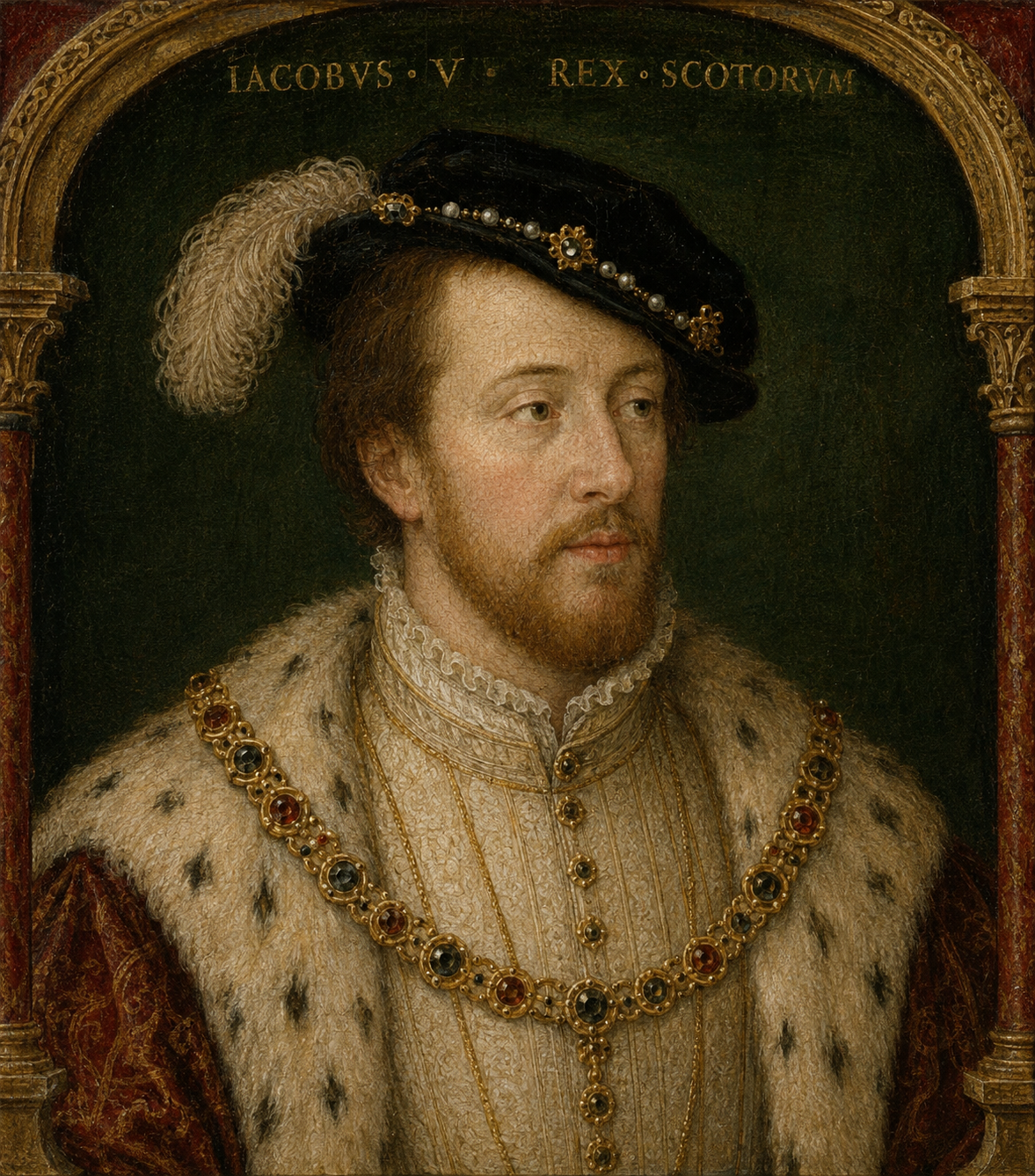
The timing could hardly have been more dramatic. The year in which Holmains became a barony was also the year in which James V led Scotland toward another disastrous confrontation with England. John had achieved the greatest advancement yet experienced by his house just as the political world around him was beginning to collapse.
James V
Solway Moss — 1542
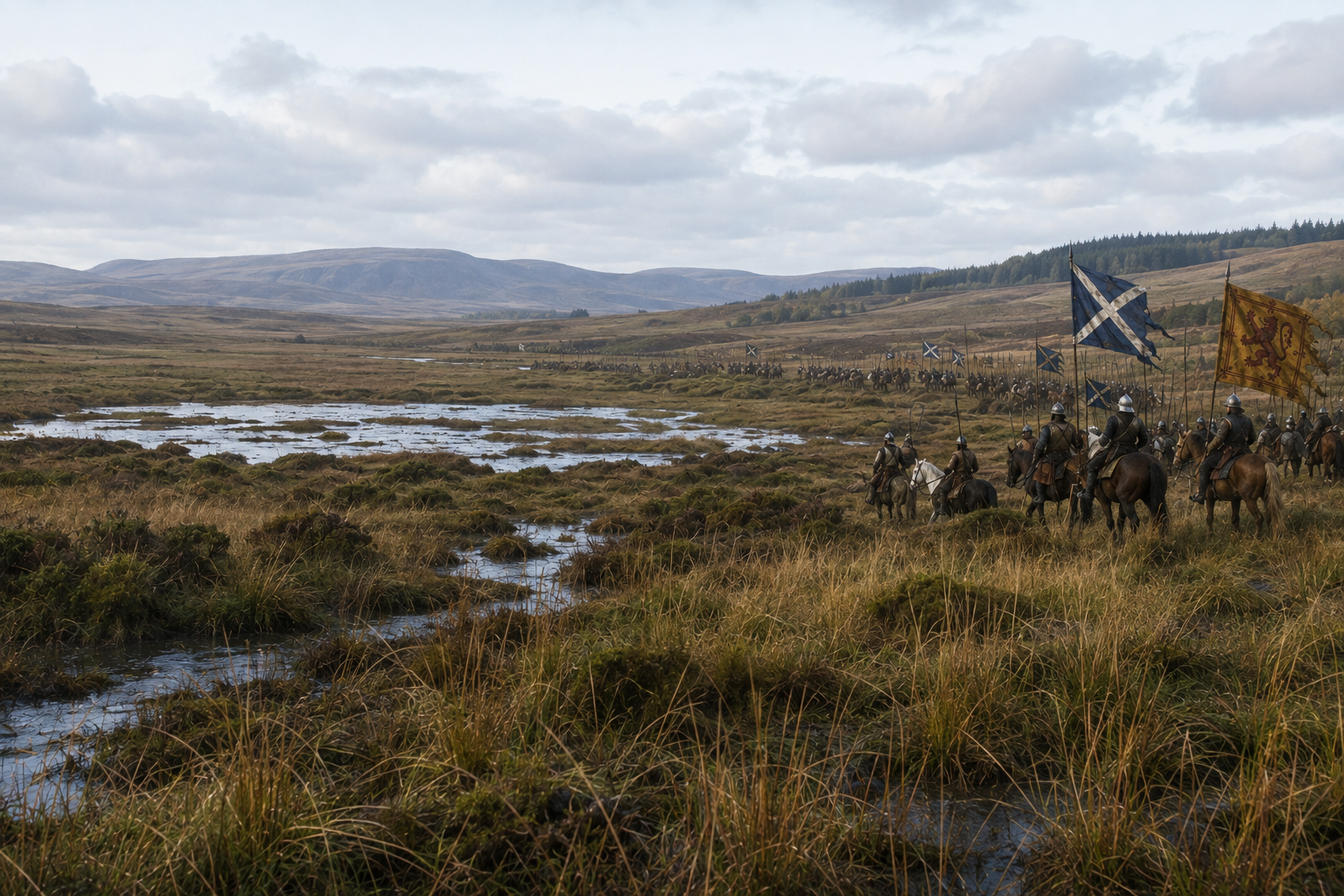
Relations between James V of Scotland and Henry VIII of England deteriorated sharply during the early 1540s. Henry had broken with Rome, while Scotland remained officially Catholic, and political and religious tensions became entangled with the old rivalry between the kingdoms. In November 1542 a Scottish force moved into the western Border country and encountered the English near Solway Moss. The Scottish expedition ended disastrously.
For John Carruthers 5th of Holmains, the catastrophe was personal. His eldest son and heir, John Carruthers, was killed at Solway Moss. The young man who should have inherited the newly created Barony of Holmains disappeared from the succession almost as soon as the barony itself had been established. John's second son, George Carruthers, now became the future of the house. The parallel with John's own childhood is striking. His father had died before inheriting Holmains, forcing the estate to skip a generation and pass from grandfather to grandson in 1523. Now John experienced the same disruption from the opposite side. He had lived long enough to establish a barony for his heirs, only to see his eldest son die before him. Within weeks Scotland suffered another enormous blow. James V died in December 1542, leaving the crown to his infant daughter, Mary Stuart. Scotland suddenly had a baby queen, a fractured political leadership, an aggressive English king to the south and a Border region descending once again into instability.
John Carruthers had just become Baron of Holmains. His eldest son was dead. And the worst years of the Anglo-Scottish conflict were still ahead.
A Border in Chaos
The years following Solway Moss were among the most unstable of John's lifetime. Henry VIII attempted to force a marriage between the infant Mary Queen of Scots and his son Edward, beginning the brutal series of invasions later remembered as the Rough Wooing. Border allegiances became extraordinarily fluid. Families made agreements with England, returned to Scottish allegiance when circumstances changed, negotiated ransoms, exchanged prisoners and tried above all to preserve their lands and kin.
The surviving Holmains material places John directly inside this world. In 1544, an English figure of considerable importance, Sir Thomas Musgrave, Constable of Bewcastle, ended up in Carruthers hands after being captured in the company of Borderers associated with Holmains. Musgrave was brought back to Holmains before the Scottish Warden, Robert Maxwell, intervened and had him transferred to Lochmaben Castle. The affair immediately became a matter of cross-border diplomacy, demonstrating once again that Holmains was no longer operating at the margins of Border politics.
Carruthers & Reid believed that John resisted accommodation with England longer than many of his neighbors. The pressure, however, became overwhelming as English armies penetrated deeper into southern Scotland. By 1547 the struggle reached another terrible climax.
Pinkie Cleugh — 1547
On 10 September 1547, Scottish and English armies met near Musselburgh at the Battle of Pinkie Cleugh, the last major pitched battle fought between the two kingdoms before the Union of the Crowns. The English army under the Duke of Somerset combined cavalry, artillery, infantry firearms and naval gunfire with devastating effect against the Scottish forces. The result was another crushing defeat.
Later Carruthers tradition places John 5th at Pinkie commanding a substantial body of Border light cavalry, commonly described as around 200 horsemen. The Clan Carruthers Society's reconstruction states that the Holmains cavalry suffered heavily and that, after the battle and subsequent English advance, John was left with 162 followers when he submitted to the English. The figure of 162 is independently reflected in historical lists of Annandale leaders and their followers following the English occupation.
The surviving evidence is strongest for what happened immediately afterward. In September 1547 English forces under Lennox and Lord Wharton captured Annan, throwing the surrounding country into panic. Holmains appears among the Annandale lairds who then took an oath of obedience to the English king. For that submission John was subsequently declared a traitor by the Scottish Parliament in 1548.
Calling John simply a traitor, however, would badly misunderstand the Border world in which he lived. Allegiance along the frontier could be brutally pragmatic. A laird had lands, tenants, children and armed followers whose survival might depend upon decisions made while an enemy army was physically occupying the district. The same records that show John's submission also show how quickly political circumstances changed. Within only a few years, he was back in royal favor.
1548 — The Senior House Changes
Then came another event that permanently altered the history of the Carruthers family.
Until 1548, the senior Carruthers house was Mouswald. Its ancestry and status ran alongside Holmains, but Mouswald had long represented the senior chiefly line. In 1548 Sir Simon Carruthers of Mouswald was killed during a Border raid and left no surviving male heir. The male house of Mouswald therefore ended.
The senior surviving Carruthers house was now Holmains.
That made John Carruthers, 5th of Holmains and 1st Baron, the head of the senior line from which the later chiefly succession would descend. The modern Court of the Lord Lyon proceedings concerning the Carruthers chiefship likewise recognize descent through John Carruthers, 5th of Holmains, whose descendants carried the Holmains line forward.
The transformation is remarkable when viewed across the preceding biographies. Roger had received Holmains in 1375. Four generations expanded and protected it. John 5th inherited it in 1523, transformed it into a barony in 1542, and by 1548 found himself at the head of the senior surviving house of his name.
Back in Royal Favor
The accusation of treason did not permanently destroy John. Border politics moved too quickly for that. By 1553, Carruthers & Reid record that Holmains had been completely restored to favor and John was serving as Steward Depute of Annandale for Sir John Maxwell of Terregles. The appointment is one of the clearest indications of the political position he had achieved. A man recently condemned by Parliament was again trusted with substantial regional responsibility.
The office also tells us something about what John's daily authority had become. He was not merely administering his own tenants and properties. As Steward Depute he operated within the machinery of regional justice and government in Annandale, under one of the most powerful Border families. The old distinction between landowner, military leader and local official becomes increasingly difficult to maintain in men such as John. His estate supported his authority; his kinship network reinforced it; his armed followers protected it; and his relationship with powerful regional superiors gave it political weight.
Peace remained elusive. In 1555, the Grahams of Esk burned Holmains lands, while the inhabitants of Annan also suffered. The Border continued behaving as the Border had for generations: raids, retaliation and disputes existed alongside courts, royal commissions and carefully written land charters.
Janet Jardine — John's Second Wife
John eventually married a second time. His second wife was Janet Jardine, whose name survives securely because she appears as one of the executors in his testament. Carruthers & Reid went further and used a Holmains charter to identify her as probably the widow of Cuthbert Murray of Cockpool, John's own brother-in-law. Cuthbert Murray had died in January 1541, leaving Janet a widow before her later marriage to John.
That identification creates one of those wonderfully tangled kinship networks characteristic of landed Border society. John's first wife, Blanche Murray, belonged to Cockpool. His second wife appears to have been the widow of Blanche's brother. The connection therefore kept John firmly inside the same Murray-Jardine-Carruthers social world rather than representing an entirely new alliance.
We should preserve the distinction in the evidence. Blanche Murray is securely identified as John's first wife. Janet Jardine is securely identified as his second wife through the testament, while her identification specifically as Cuthbert Murray's widow is the reconstruction supported by the Holmains material and Carruthers & Reid.
The Scottish Reformation Arrives
John's exceptionally long life also meant that he witnessed a transformation none of the earlier Holmains lairds could have imagined.
The Scotland into which he had been born was Catholic. Parish churches, monasteries, saints' cults, ecclesiastical courts and the authority of Rome formed part of the religious structure of the kingdom. John's own uncle James Carruthers, Rector of Wamphray, belonged to that old ecclesiastical world. Yet during John's lifetime reforming ideas spread through Scotland, intensified by political conflict and eventually erupted into revolution.
In 1560, the Scottish Parliament rejected papal authority and adopted a Reformed confession of faith. The Scottish Reformation did not instantly erase the older religion from every household or district, but institutionally it transformed the kingdom. The Mass was rejected by the new Protestant establishment, church property and patronage became politically contested, and men such as John Knox emerged as major forces in national life.
For John, this was not abstract theology occurring somewhere in Edinburgh. Landed families possessed patronage rights over churches, interacted with clerics and controlled properties whose histories were intertwined with ecclesiastical institutions. Roger's original 1375 Holmains grant had included the patronage of Little Dalton Church. Nearly two centuries later, John 5th was living through a revolution in what the Scottish church itself meant.
The Closeburn Feud — 1563
In 1563, John appears in one of the most violent episodes preserved from his later life. A feud erupted between the Carruthers and the Kirkpatricks of Closeburn. The surviving record does not explain how the dispute began, but the confrontation escalated into an armed fight in which Roger Kirkpatrick of Closeburn was wounded and several of his relatives and retainers were killed. John, together with his sons George and William, Edward Irvine of Bonshaw, David Irvine of Robgill and others, was summoned in connection with the affair.
The episode demonstrates how little the underlying culture of the Border had changed despite the Reformation and increasingly sophisticated royal government. Legal institutions existed. Summonses could be issued. Sureties could be demanded. Yet disputes between powerful families could still erupt into organized violence involving relatives and armed followers.
For the aging John, the incident is particularly striking. He had already survived Solway Moss, the Rough Wooing, Pinkie, accusations of treason and decades of Border instability. Now, probably well into later life, he remained sufficiently involved in the affairs of his family to appear at the center of another violent regional dispute.
Mary Queen of Scots Falls
Only four years later, Scotland underwent another political convulsion.
Mary Queen of Scots was forced to abdicate in 1567, and her infant son became James VI. Once again Scotland had a child king and a regency government, and once again the loyalty of powerful regional families mattered enormously. John was summoned to Edinburgh that year with other leading Border lairds to advise the Regent concerning the establishment of justice and order in the West March.
That summons may be one of the best measures of how far Holmains had risen since Roger's day. John was now an elderly man whose experience stretched back through several reigns, wars and political regimes. The government considered him one of the Border lairds whose advice mattered when attempting to control one of the most difficult regions of Scotland.
Even age did not entirely remove him from violence. In 1570, Carruthers & Reid place him in an affray at Cockpool involving Lord Scrope's raiders. During the same year he signed the Band of Dumfries, pledging allegiance to the young James VI.
The 5th Laird had begun his public life under James V.
He would end it under James VI.
Seven Sons and the Future of Holmains
John's family was large enough that several future Carruthers branches can be traced through his sons. The eldest John, intended to inherit, died at Solway Moss in 1542. The succession therefore shifted to George Carruthers, who would become the 6th Laird and 2nd Baron of Holmains. William established the important cadet line of Dormont, while other sons named in the family record included Archibald, Patrick, Robert and Simon.
The precise reconstruction of every daughter is less secure. Later historical accounts identify daughters marrying into neighboring Johnstone families, including a daughter who married Gilbert Johnstone of Wamphray and Marion Carruthers, who married John Johnstone of Newbie. These connections fit perfectly within the dense marriage network of Annandale, although they should be kept distinct from the seven sons specifically anchored by the 1542 charter.
John's family therefore illustrates the way a successful landed house spread itself across the region. One son inherited. Another established a cadet estate. Daughters married into neighboring landed houses. Other sons occupied positions or acquired lands that extended the family's influence. By the second half of the sixteenth century, the name Carruthers was not concentrated in a single tower or estate; it existed within a web of properties and kinship relationships across Dumfriesshire.
John's Death — 19 August 1580
Unlike so many of the earlier Holmains lairds, John's death is precisely recorded.
John Carruthers, 5th of Holmains and 1st Baron, died on 19 August 1580. His testament was subsequently confirmed on 16 January 1580/81 in the Edinburgh Commissariot. Even more unusually, the testament tells us where he wished to be buried: Little Dalton Kirk.
There is something wonderfully fitting about that burial choice.
Little Dalton had been present at the very beginning of the Holmains story. In 1375, Roger de Carruthers received lands there together with the patronage of its church. More than two centuries later, Roger's descendant—the man who transformed Holmains into a barony and carried the family into the early modern age—asked to be laid to rest at Little Dalton Kirk.
John died at what Carruthers & Reid called a great age. Their conclusion that he must have been born in the latter part of the fifteenth century is reasonable given the chronology of his succession and the remarkable length of his documented career.
His second son George succeeded him as 6th of Holmains and 2nd Baron.
The Man Who Changed the House
John 5th occupies a different place in Carruthers history from every Holmains laird before him. Roger founded the estate. The next three generations enlarged it, defended it and ensured that it passed intact through the family. John inherited all of that work and carried it across a threshold.
During his lifetime Holmains became a barony. The house could muster a substantial armed following. John served within the government of Annandale, survived war with England, lost his eldest son at Solway Moss, endured the catastrophe of Pinkie, navigated submission and restoration, lived through the Scottish Reformation, became embroiled in the Closeburn feud and was still considered important enough in old age to advise the government about keeping peace in the West March.
Most importantly for the family itself, 1548 changed who the Carruthers of Holmains were. When the male house of Mouswald ended, Holmains became the senior surviving house. The line Roger had begun with a land grant in 1375 had outlived the older branch and emerged carrying the family's senior succession.
John had inherited Holmains because his father died before his grandfather.
He then watched his own eldest son die before him.
Yet the house survived both broken generations.
When John finally died on 19 August 1580, the estate passed to George, his second son. Behind him John left a barony, multiple cadet lines, alliances stretching across the great Border families, and a Holmains house transformed from one branch of the Carruthers family into its senior surviving line.
And after a life spanning perhaps eight decades of extraordinary Scottish upheaval, the old Baron chose to return to the place that connected his family directly with its beginning.
Little Dalton.
For Your Reference;
Born: probably late 15th century · Annandale, Dumfriesshire, Scotland
Father:John Carruthers, Heir Apparent of Holmains, who died after February 1516 but before May 1523
Paternal Grandfather:John Carruthers, 4th Laird of Holmains
Mother: Unknown
First Wife:Blanche Murray, daughter of Sir John Murray of Cockpool
Second Wife:Janet Jardine; identified by Carruthers & Reid as probably the widow of Cuthbert Murray of Cockpool
Children by Blanche: Seven sons are associated with the 1542 charter—John, George, William, Archibald, Patrick, Robert and Simon; daughters are also reported in later historical sources
Eldest Son:John Carruthers, killed at the Battle of Solway Moss in 1542
Successor:George Carruthers, 6th of Holmains and 2nd Baron
Occupation / Position: landed Border magnate; 5th Laird of Holmains; 1st Baron of Holmains; Steward Depute of Annandale; head of the senior surviving Carruthers house after 1548
Succeeded Grandfather:21 May 1523
Holmains erected into a barony:1542
Death:19 August 1580
Burial:Little Dalton Kirk, Dumfriesshire
Testament: Edinburgh Commissariot; confirmed 16 January 1580/81.
Succession Record — 21–22 May 1523: John was infeft as heir to his grandfather, the 4th Laird, in Holmains and associated properties, followed by sasine in land at Ruthwell. His father, the previous heir apparent, had died before inheriting.
Feudal Dues — 1541: Although John had been infeft in 1523, the Treasurer received £20 in 1541 for ward, relief and other dues associated with his lands.
Rammerscales — 1541: John acquired Rammerscales shortly before the erection of Holmains into a barony, part of the continuing consolidation of the estate.
Crown Charter — 1542: John's accumulated lands were resigned and regranted as the Barony of Holmains, with the charter naming seven sons and establishing succession in the male line.
Solway Moss — 1542: John's eldest son and heir, John Carruthers, was killed at the Battle of Solway Moss, making his younger brother George the eventual heir to Holmains.
Pinkie and English Submission — 1547: Holmains appears among the Annandale powers forced into submission following the English military advance. Historical lists associate the Laird of Holmains with 162 followers at this stage. John was declared a traitor by the Scottish Parliament the following year.
Senior Carruthers House — 1548: Following the death of Sir Simon Carruthers of Mouswald without a male heir, Holmains became the senior surviving Carruthers house, with John at its head.
Restoration — 1553: John had returned fully to Scottish favor and served as Steward Depute of Annandale for Sir John Maxwell of Terregles.
Dormont — 1552: John granted lands to his son William Carruthers, establishing the cadet House of Carruthers of Dormont.
Closeburn Feud — 1563: John and sons George and William, together with allied Irvings and others, were summoned after a violent confrontation in which Roger Kirkpatrick of Closeburn was wounded and several men were killed.
West March Council — 1567: John was summoned with other leading Border lairds to Edinburgh to advise the Regent on establishing justice and order within the West March.
Cockpool and the Band of Dumfries — 1570: Despite his advanced age, John participated in an affray involving Scrope's raiders at Cockpool and subsequently signed the Band of Dumfries, pledging allegiance to James VI.
Testament and Burial — 1580: John's testament records his death on 19 August 1580, names Janet Jardine among his executors, and directs that he be buried at Little Dalton Kirk. The testament was confirmed on 16 January 1580/81.
Arthur Stanley Carruthers & R. C. Reid, Records of the Carruthers Family (1934), Chapter V, “Holmains,” especially pp. 83–90. Read the original volume at Internet Archive
Calendar of Holmains Writs — principal documentary sequence for John's 1523 succession, estate acquisitions, 1542 barony and later land transactions.
Register of the Privy Council of Scotland, Acts of the Parliaments of Scotland, and Edinburgh Commissariot Testaments, Vol. VIII — evidence for John's political activity, Border affairs, 1548 forfeiture/treason episode and 1580 testament.
15th Great Grandfather of author Krysta Abesamis