A Border Laird's Life
Seventeenth-Century Dryfesdale
The story of the Chalmers family begins in the quiet countryside of Dryfesdale, where generations of Border families built their lives among fertile fields, winding rivers, and ancient roads that had carried travelers across southern Scotland for centuries. Long before modern highways reached Dumfriesshire, the River Dryfe flowed through a landscape of small estates and neighboring farms whose owners knew one another through marriage, business, church, and shared responsibility for the land.
Among those landowners was James Chalmers of Dam, a gentleman whose surviving records are few but whose world can still be remarkably well understood. Although history has preserved only scattered references to James himself, the parish in which he lived remains richly documented, allowing us to reconstruct the environment that shaped his daily life. By understanding seventeenth-century Dryfesdale, we gain a far clearer picture of the responsibilities, opportunities, and challenges that surrounded families like the Chalmers.
An Ancient Parish on Scotland's Western Border
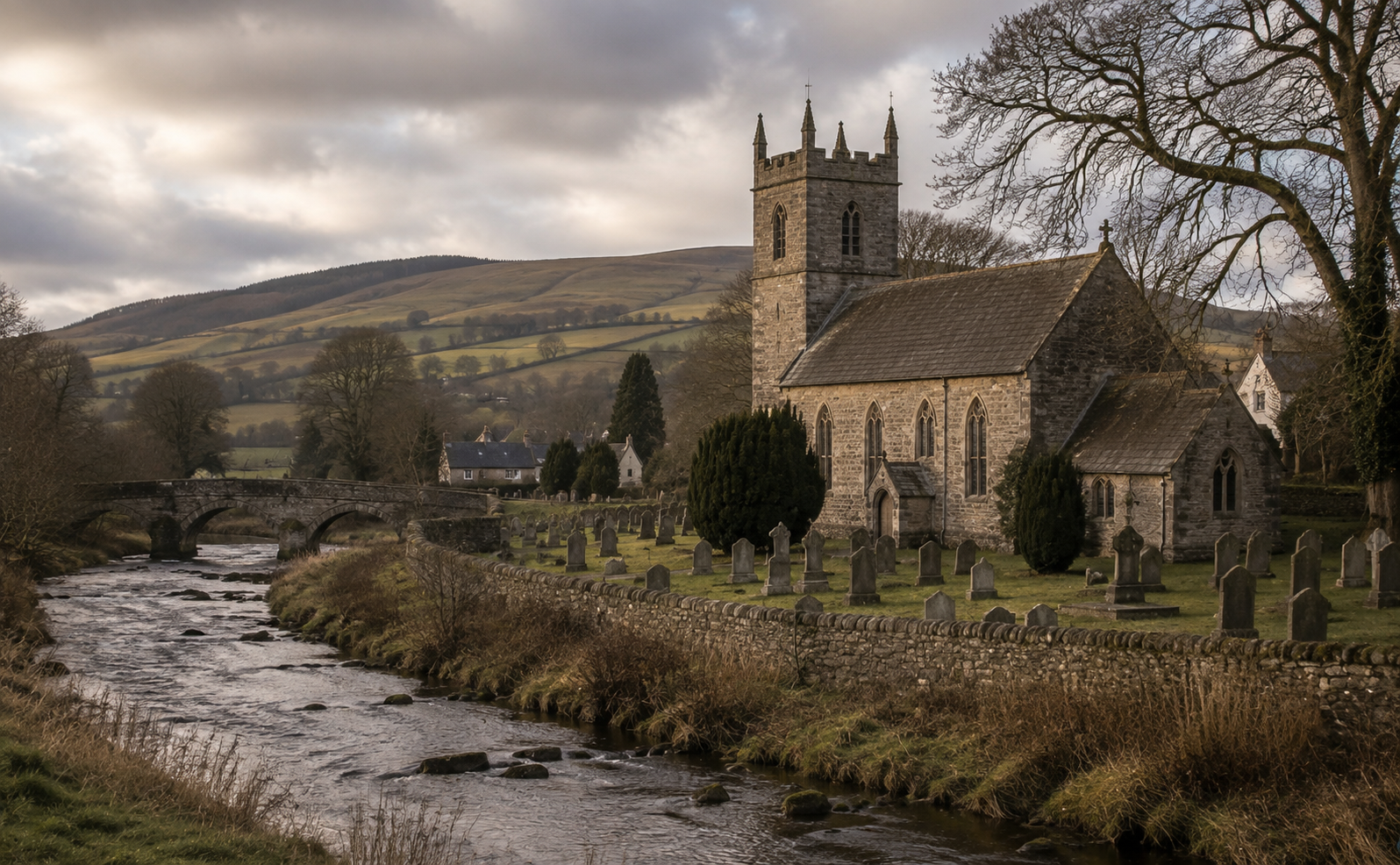
River Dryfe
Dryfesdale was already an ancient community when James Chalmers walked its fields during the late seventeenth century. The parish had been established centuries earlier and was dedicated to St. Cuthbert, one of the most revered saints of northern Britain. Historical records place the church within the Bishopric of Glasgow by the early twelfth century, demonstrating that Christian worship had been centered here for generations before the Chalmers family entered the historical record.
The parish occupied a strategic position within Annandale, bordered by Applegarth to the north, Hutton and Corrie to the east, Lochmaben to the west, and Dalton to the south. Through its center flowed the River Dryfe, a tributary of the River Annan that watered fertile farmland before joining the larger river near Lockerbie. The valley formed one of the principal agricultural districts of southwest Scotland, where productive soils supported sheep, cattle, oats, barley, and hay that sustained both local families and regional markets.
This was no isolated frontier settlement. The great road linking England and Edinburgh passed nearby, bringing merchants, ministers, government officials, soldiers, drovers, and travelers through the district. Lockerbie served as an important market town where livestock, grain, wool, and other goods changed hands, ensuring that even relatively small landowners remained connected to Scotland's wider economy.
The Estate of Dam
Within this productive countryside lay the estate of Dam, the home of James Chalmers and his family. Although modest in comparison with the great estates of Scotland's nobility, Dam represented far more than a farmhouse surrounded by fields. In seventeenth-century Scotland, land defined identity, responsibility, and social standing. To be known as "James Chalmers of Dam" was to be identified with a specific property whose history stretched back through earlier generations.
Modern valuation records preserving older assessments confirm that Dam formed part of the historic landed landscape of Dryfesdale by the seventeenth century. The estate appears alongside neighboring holdings including Broomrig, Lockerbie, and other nearby lands, illustrating that it belonged to a tightly connected community of proprietors whose properties bordered one another across the valley.
Those neighboring estates were more than lines upon a map. Their owners attended the same kirk, witnessed one another's legal transactions, settled disputes over boundaries, borrowed money from one another, and often strengthened relationships through marriage. In rural Scotland, geography shaped society. A man's closest neighbors frequently became his closest associates.
What Did a Border Laird Actually Do?
Popular imagination often portrays seventeenth-century Scottish gentlemen as soldiers or politicians, yet most spent the greater part of their lives managing land. James Chalmers almost certainly rose before sunrise to inspect livestock, supervise servants, and ensure that the work of the estate progressed according to the season. Stone dykes required continual maintenance, drainage ditches had to remain clear, timber demanded careful management, and fields required constant attention if harvests were to succeed.
Spring brought lambing and planting. Summer demanded long days gathering hay and tending crops beneath the often unpredictable Border weather. Autumn filled barns with grain while tenants prepared livestock for the coming winter. During colder months attention shifted toward repairing buildings, maintaining equipment, and ensuring that food stores remained sufficient until another growing season arrived.
Estate management also required legal knowledge. Property boundaries needed defending, rents collected, contracts witnessed, and family interests protected through carefully recorded deeds and agreements. Literacy and numeracy were therefore valuable skills for landowners, whose responsibilities extended far beyond manual agriculture.
A Community Built on Relationships
One of the greatest misconceptions about seventeenth-century rural Scotland is that families lived in isolation. In reality, communities like Dryfesdale functioned through dense networks of cooperation and trust.
The Chalmers family provides an excellent example. James married Janet Johnstone, sister of John Johnstone of Breconside, linking two neighboring landed families whose estates lay only a short distance apart. Their children, Andrew and Margaret Chalmers, would carry those relationships into the next generation, eventually connecting the Chalmers estates with the Carruthers family through Margaret's marriage.
Such alliances were common throughout the Borders. Marriage strengthened neighboring estates, while witnesses at legal transactions often included nearby landowners, relatives, ministers, or trusted merchants. Understanding these relationships is often as important to historians as tracing direct lines of descent, because they reveal the social fabric that held rural communities together.
Living in the Shadow of History
Although the great era of Border Reiving had largely ended before James Chalmers reached adulthood, its influence remained visible throughout Annandale. Tower houses still dotted the countryside, reminders of centuries when families defended their homes against raids, feuds, and warfare along the Anglo-Scottish frontier. The landscape itself bore the marks of earlier generations, from ancient field systems and medieval churches to Roman roads and camps that had occupied the district more than a thousand years before.
For families living at Dam, history surrounded them at every turn. They farmed fields that had fed countless earlier generations while traveling roads whose origins stretched deep into Scotland's past. Every neighboring estate possessed its own history, woven together through centuries of inheritance, marriage, and changing ownership.
Chalmers Family in dryfesdale
Today, much has changed across Dryfesdale, yet the broad character of the valley remains surprisingly familiar. The River Dryfe still follows its ancient course toward the Annan, while historic place names such as Dam, Dryfeholm, Broomrig, and Breconside continue to appear on modern maps. The parish church stands upon ground that has witnessed worship for centuries, and the surrounding hills still frame the landscape that James Chalmers knew more than three hundred years ago.
The surviving records tell us frustratingly little about James himself. We do not know the sound of his voice, the color of his eyes, or the thoughts that occupied his mind as he walked across the fields of Dam. Yet by understanding the world around him, we recover something equally valuable. We see the rhythms of a Border estate, the responsibilities of a seventeenth-century laird, the close-knit relationships between neighboring families, and the remarkable continuity of a landscape that still preserves echoes of the Chalmers family's world.
History is not always preserved through dramatic events or famous names. Sometimes it survives in rivers that continue to flow, farms that still bear their ancient names, and scattered documents that allow us to reconstruct the everyday lives of families who quietly shaped the history of their communities. The Chalmers of Dam were one such family, and through the landscape of Dryfesdale, their story continues to endure.