Annandale Scotland
Families, Feuds, and The Western Borders
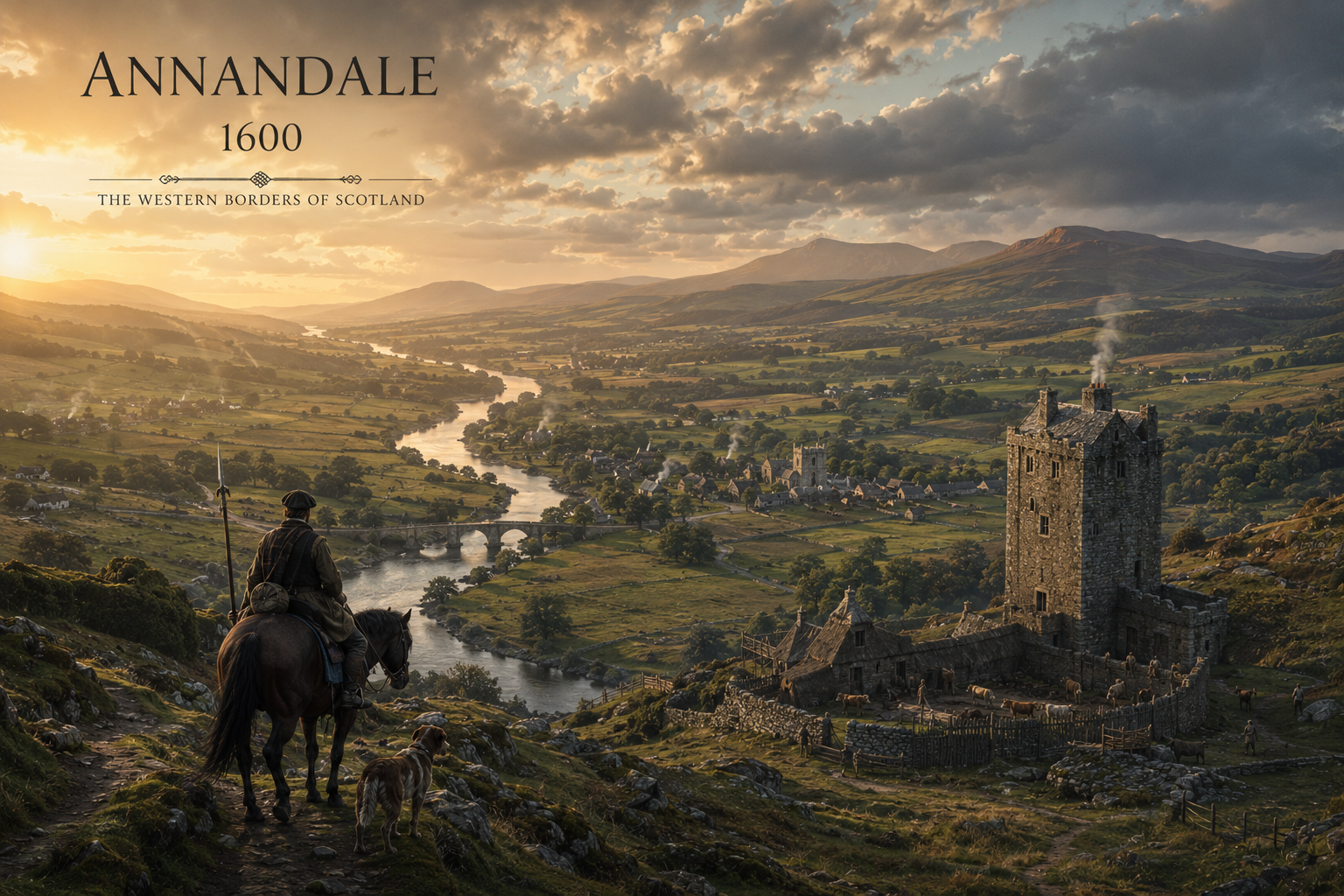
Long before descendants of the Border families crossed into Ulster or America, the valley of Annandale stood at the center of one of the most powerful and unstable frontier regions in Scotland. Stretching along the River Annan through Dumfriesshire toward the Solway Firth, Annandale formed part of the western marches — a landscape shaped by fortified towers, rival dynasties, royal politics, mounted riders, and generations of shifting alliances that influenced the history of southern Scotland for centuries. It was the world they inherited. The region itself occupied a critical position between Scotland and England. Armies passed through its valleys. Royal authority frequently weakened within its uplands and mosslands. Families survived not merely through land ownership, but through kinship alliances, marriage networks, military service, and defensive strength. And among the most powerful families of Annandale stood the Maxwells, Johnstones, and Carruthers. These dynasties shaped much of the western Border world during the late medieval and early modern periods. Their towers, estates, and influence stretched across the surrounding countryside, tying together neighboring lands through both cooperation and violent rivalry. The Maxwells rose into one of the dominant noble houses of southwestern Scotland. Associated closely with Caerlaverock Castle, the Maxwell family held extensive political influence across Dumfriesshire and the western marches. Through royal favor, land holdings, and strategic marriages, they became deeply woven into the governance and instability of the region alike. Nearby stood the Johnstones. Centered around Annandale itself, the Johnstones developed into one of the fiercest riding families of the Borders. Their long-running feud with the Maxwells became one of the defining conflicts of the western marches during the sixteenth century. Raids, retaliations, murders, shifting alliances, and armed confrontations scarred the region for generations. The feud eventually culminated in violence so severe that it entered Border legend.
After the Battle of Dryfe Sands in 1593 — one of the bloodiest clan conflicts in Border history — hundreds of Maxwells were reportedly killed as the Johnstones gained dominance within Annandale. Years later, John Maxwell, 9th Lord Maxwell, was himself killed by Johnstone hands in continuing retaliation tied to the same feud. Yet even amid violence, marriages continued linking these families together. This contradiction defined the Borders. The same dynasties who raided one another also relied upon intermarriage for political survival, land security, inheritance, and regional influence. Over generations, bloodlines intertwined so thoroughly that former enemies became part of the same ancestral networks. And through these connections emerged lines tied to Margaret Chalmers and the broader royal-associated branches documented in a new book ‘The Royal Branch’ by Krysta Abesamis.
Families within Annandale often carried distant noble, royal, or knightly associations through centuries of interconnected marriages. Scottish noble networks were rarely isolated. Local Border houses frequently intersected with larger dynastic lines reaching into court politics, military service, and old aristocratic bloodlines extending across Scotland itself. The Chalmers line formed part of this broader world. Through marriage, kinship, and regional alliance, the ancestry surrounding Margaret Chalmers existed within a landscape shaped not only by ordinary frontier survival, but also by the lingering presence of old noble connections woven throughout southwestern Scotland. Yet Annandale was not composed solely of nobles and lairds. Ordinary life unfolded continuously beneath these larger political struggles. Farmers worked narrow valleys along the Annan. Shepherds grazed livestock across the uplands. Women managed tower households, gardens, wool production, and food stores while maintaining families through uncertain years of conflict and instability. Tower houses dotted the countryside. Holmains, Lochwood, Mouswald, and neighboring fortalices rose across the western marches as defensive homes built for endurance rather than luxury. Smoke drifted from hearth fires. Riders crossed the valleys carrying news between kin. Livestock remained close to stone walls at night while families listened for movement beyond the hills. The geography itself shaped Border identity. Annandale’s river valleys, uplands, mosslands, and frontier roads created ideal terrain for riding culture. Reivers moved swiftly through the countryside during raids and retaliations. Cattle could vanish into hidden hollows such as the Devil’s Beef Tub. Marshes and rough terrain complicated royal control for generations. The Borders developed their own culture because the land demanded it.
Even after the Union of the Crowns in 1603 began pacifying the frontier, the memory of the old Border world remained deeply embedded within Annandale’s families. Many descendants later crossed into Ulster carrying with them the customs, Presbyterian traditions, speech patterns, and survival instincts forged along the western marches. Eventually those migrations extended across the Atlantic. But long before America, there was Annandale. And even now, the old landscape still preserves traces of that world — in ruined towers, weathered kirkyards, surviving surnames, and the winding valleys where the powerful families of the western Borders once rode beneath the shifting skies of Annandale.