Andrew Chalmers of Parliament Close
I found tucked away in the St Andrews University archives an ordinary paper bill from 1693. It lists books and stationer’s wares supplied to Henry Cheap of Rossie by an Edinburgh bookseller named Andrew Chalmers. In a brief window between 1683 and 1694, he seemingly had managed to pull off something rare for a Dumfriesshire lad.
By late 1694, a follow-up entry closed the ledger. Andrew had died, at only twenty-six years old.
He was the only brother of my 9th great-grandmother, Margaret Chalmers.
Unmarried, no children, living & working off the Mile in Edinburgh!
I had to know more…
He was the only son of James Chalmers of Dam and Janet Johnstone. Under normal Border custom, Andrew (born around 1668) would have stayed at Dam in Dryfesdale Parish, taking over the tenant rolls, overseeing the ditching and stone dykes, and managing the harvest of oats and barley. His father’s marriage to Janet Johnstone had linked Dam directly to the neighboring lands of Breconside, held by Janet’s brother John Johnstone. It was standard landowning strategy. Andrew and his sister Margaret grew up together walking the march stones between both properties. Yet James didn’t keep Andrew on the farm.
Instead, he probably paid heavy fees to send his boy seventy miles north to train in Edinburgh’s book trade. It required Latin, rigorous bookkeeping, and years under the thumb of a city guild master. When Andrew arrived in the capital, the town was stacked high along the Royal Mile under the Castle rock. Everything rattled—carters pulling freight up from Leith, lawyers packing into Parliament House, Presbyterian divines walking to St Giles’, and apprentices dodging through the streets with damp sheets fresh off the press. The place reeked of sea coal, wet stone, tallow candles, calfskin leather, and printer’s ink. Seemingly, the coolest place to be in 1683.
The whole trade centered around Parliament Close (modern Parliament Square).
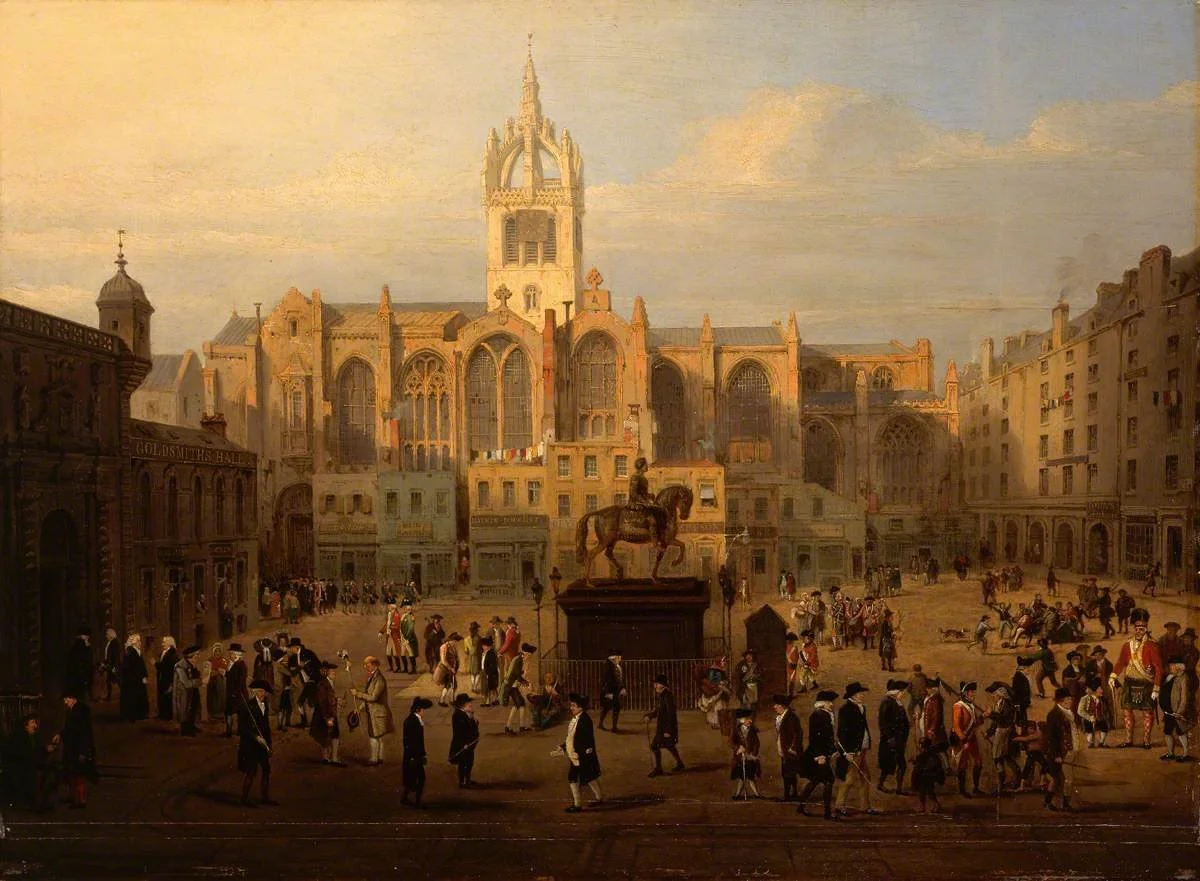
Parliament Close abt 1690 (*credit: Museums & Galleries Edinburgh – City of Edinburgh Council)
On 20 June 1683, Andrew signed indentures with Gideon Shaw, whose shop traded under the sign of the Blue Bible. Shaw was well plugged into Edinburgh’s merchant elite through his marriage into the Cunninghame family. Investigations into Gideon are equally exciting. Gideon was a true activist!
From his shop at the Blue Bible in Parliament Close, Schaw became involved in a long-running fight against the powerful ‘printing monopoly’ claimed by the King’s printer, Andrew Anderson, and later Anderson’s widow, Agnes Campbell. He joined other booksellers in challenging the monopoly in 1671 and later helped establish competing presses, even bringing skilled printers from abroad to Edinburgh. Campbell responded by taking Schaw and his associates before the Privy Council in 1678, but he continued opposing her privileges into the 1680s.
Andrew therefore entered the Blue Bible bookshop at about age fifteen under a master who had spent years fighting over something fundamental to their trade: who had the right to print and sell books in Scotland.
Stationers weren’t simple shopkeepers. They bought paper from Continental mills, financed print runs, hired binders, extended customer credit, and supplied parchment and forms to the courts. Apprentices pulled down the heavy shutters at daybreak, swept the stone floors, unpacked deliveries from city presses, and packed book crates for country estates. How exciting!
Four years in, his friend & mentor Gideon Shaw died (1687).
Rather than losing his time or heading back to Dumfriesshire, Andrew stayed. Most apprentices actually lived on the bookshop premises or ‘upstairs’ and/or even with the owner’s family nearby. The guild must have arranged for his term to continue, because on 22 February 1689 he was formally admitted as an Edinburgh Burgess and Guild Brother.
He didn’t wait around. With the legal right to trade, Andrew probably opened his own shop on Parliament Close because by March 12th 1690, he indentured an apprentice of his own: Thomas Carruthers, whom I have long suspected is a kin-connection from the Holmains branch “over Denbie” back in Dumfriesshire.
Gideon’s will & probate show Gideon’s assets being dealt with by other family members, and there is no indication that Andrew ever took over The Blue Bible bookshop where he was an apprentice for so many years before.
By 1691, Andrew was financing and co-publishing titles with another bookseller, John Vallange, under the imprint: “Printed for Andrew Chalmers and John Vallange, and are to be sold at their shops.”
I found two surviving publications that carry their joint imprint:
William Sherlock:The Case of the Allegiance Due to Sovereign Powers (1691) — a sharp post-Glorious Revolution treatise on royal authority and conscience.
Sir George Mackenzie:The Moral History of Frugality (1691) — written by the founder of the Advocates Library.
These two titles remain the only surviving publications attributed to Andrew in modern bibliographies.
Back in Dumfriesshire, Andrew’s maternal uncle, John Johnstone of Breconside, always took notice. Lacking male heirs, John decided the young Edinburgh bookseller was the right man to hold the estate. On 30 April 1693, John executed a deed conveying the lands of Breconside and Cocketts in Moffat parish over to his nephew Andrew, closing out that branch of the Johnstone family.
Breconside Tower · Coordinates: 55.30570, -3.40674
The transfer made Andrew both an Edinburgh stationer and an Annandale landowner.
Sadly, he held both titles for barely a year.
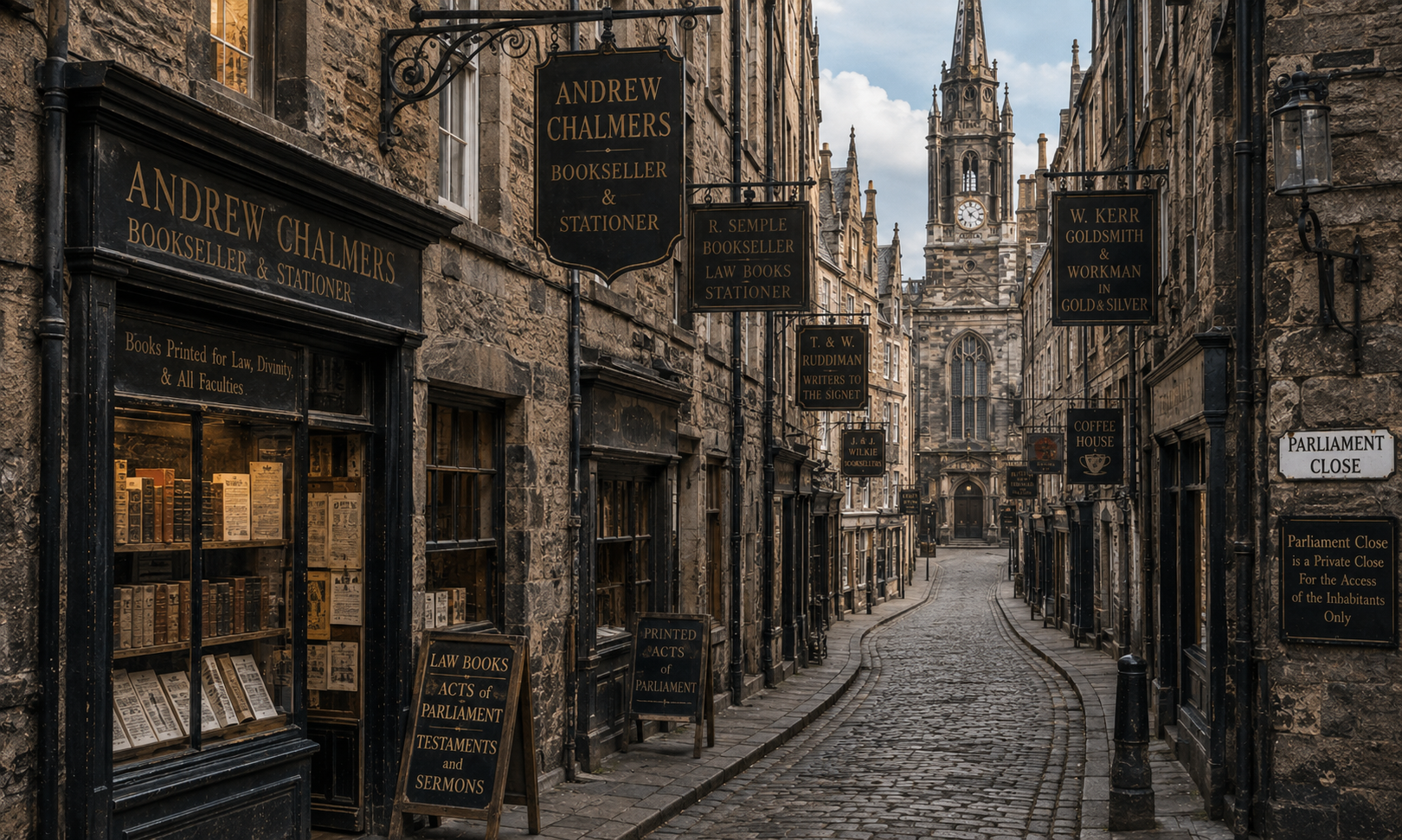
A vision of Parliament Close 1690
Sometime between that April 1693 conveyance and 14 December 1694, Andrew died. His parents must have been crushed. Their only son. His only sister Margaret was suddenly left with a very different future and new responsibilities.
This is where I think Andrew’s apprentice, Thomas, introduced his cousin William Carruthers to Margaret Chalmers, because they were married within a year.
And she was a catch! She just inherited a lot of land.
No letters or parish burial records tell us exactly what took Andrew. I imagine his Edinburgh shop was cleared out and his apprentices moved to new masters. Only months earlier, Andrew had carefully recorded the books supplied to one of his customers, likely expecting many more years of business.
A later Scottish historical account describes a pestilential outbreak beginning in November 1694, which contemporaries called “strange fevers” and severe infectious fluxes. It was associated with the terrible subsistence crisis of the 1690s and reportedly caused extraordinary mortality in places such as West Calder and Livingston, both west of Edinburgh. That is the strongest lead right now, particularly because its documented onset around November sits so close to our December end date for Andrew. Illness seems possible, but no surviving evidence tells us what happened.
I may always be searching for more of him. He was so young! At the top of his game in the hot new literary scene of Edinburgh. He knew Latin. And must have worked so hard at his apprenticeship. He probably knew ‘everybody.’ And I am so infatuated with his short documented existence.
Andrew was twenty-six, unmarried, apparently successful, and then suddenly dead.
Those family lands in Dumfriesshire passed to his sister, Margaret. And when their paternal uncle John Chalmers later died without heirs, Margaret also inherited Dam, Ludovickland, and Pantonacre—folding all her family holdings directly into the Carruthers line when she married William Carruthers.
I found Uncle Andrew almost by accident, lingering at the edges of my 9th great-grandmother Margaret Chalmers-Carruthers’ story. I found this ambitious young Edinburgh bookseller with a shop, an apprentice, and publications.
So glad I wandered off long enough to meet him…
We could have been fast friends.
For Your Reference
• University of St Andrews, Cheape of Rossie Papers, ms36929 Box11/520 — Andrew Chalmers’s 1693 account for books supplied to Henry Cheap of Rossie, later discharged on 14 December 1694 by the assignee of “the deceased Andrew Chalmers, stationer in Edinburgh.” This is our strongest direct manuscript evidence of Andrew’s business and death.
• Roll of Edinburgh Burgesses and Guild-Brethren, 1406–1700, Scottish Record Society — records Andrew’s admission as an Edinburgh burgess on 22 February 1689 through his apprenticeship to Gideon Schaw.
• Register of Deeds (Dalrymple), vol. 77, pt. 2, 30 April 1693; Dumfries Register of Sasines, 2nd Series, vol. IX, fol. 106 — identifies Andrew as the son of James Chalmers of Dam and Janet Johnstone, records him as a stationer in Edinburgh, and documents the Breconside/Cocketts property connection.
https://carruthersclan.wordpress.com/1736/07/11/carruthers-of-breconsyde-clan-carruthers-ccis/
*Note on Historical Images
Some images used in this article are AI-assisted historical reconstructions, created to help visualize people, places, buildings, and events for which no surviving photograph or contemporary image exists. They are included for visual context and storytelling and should not be considered documentary evidence.
9th great-granduncle of author Krysta Abesamis