Chattahoochee River
For thousands of years, it has been a lifeline—feeding civilizations, guiding migrations, powering industry, and shaping the lives of countless families whose stories are woven into the history of the American South. Long before highways crossed its waters or cities rose along its banks, the Chattahoochee served as the great natural highway connecting the Blue Ridge Mountains to the Gulf of Mexico.
The river begins high in the Blue Ridge Mountains near present-day Brasstown Bald in northeast Georgia. From there it flows approximately 430 miles, carving valleys through the Appalachian foothills before joining the Flint River to form the Apalachicola River on its journey to the Gulf of Mexico. Every bend tells a story of exploration, survival, and renewal.
Long before European settlers arrived, Indigenous peoples flourished along its banks for thousands of years. The Muscogee (Creek) people gave the river its name, generally translated as "painted rock" or "marked rock," a reference to the colorful granite outcroppings that lined portions of its course. Villages, ceremonial grounds, fishing sites, and trading paths stretched from the mountains to the coastal plain, making the Chattahoochee one of the South's most important cultural corridors.
When Ulster Scots, German, English, and other frontier families gradually pushed south and west after the American Revolution, they discovered what Native peoples had understood for centuries: rivers were the true highways of early America. The Chattahoochee offered fertile bottomlands, dependable fresh water, abundant game, and transportation routes connecting isolated settlements. Cabins, ferries, gristmills, and eventually thriving towns appeared wherever the river could sustain a growing community.
The Chattahoochee at Lanett MILL: A River Powered a Community
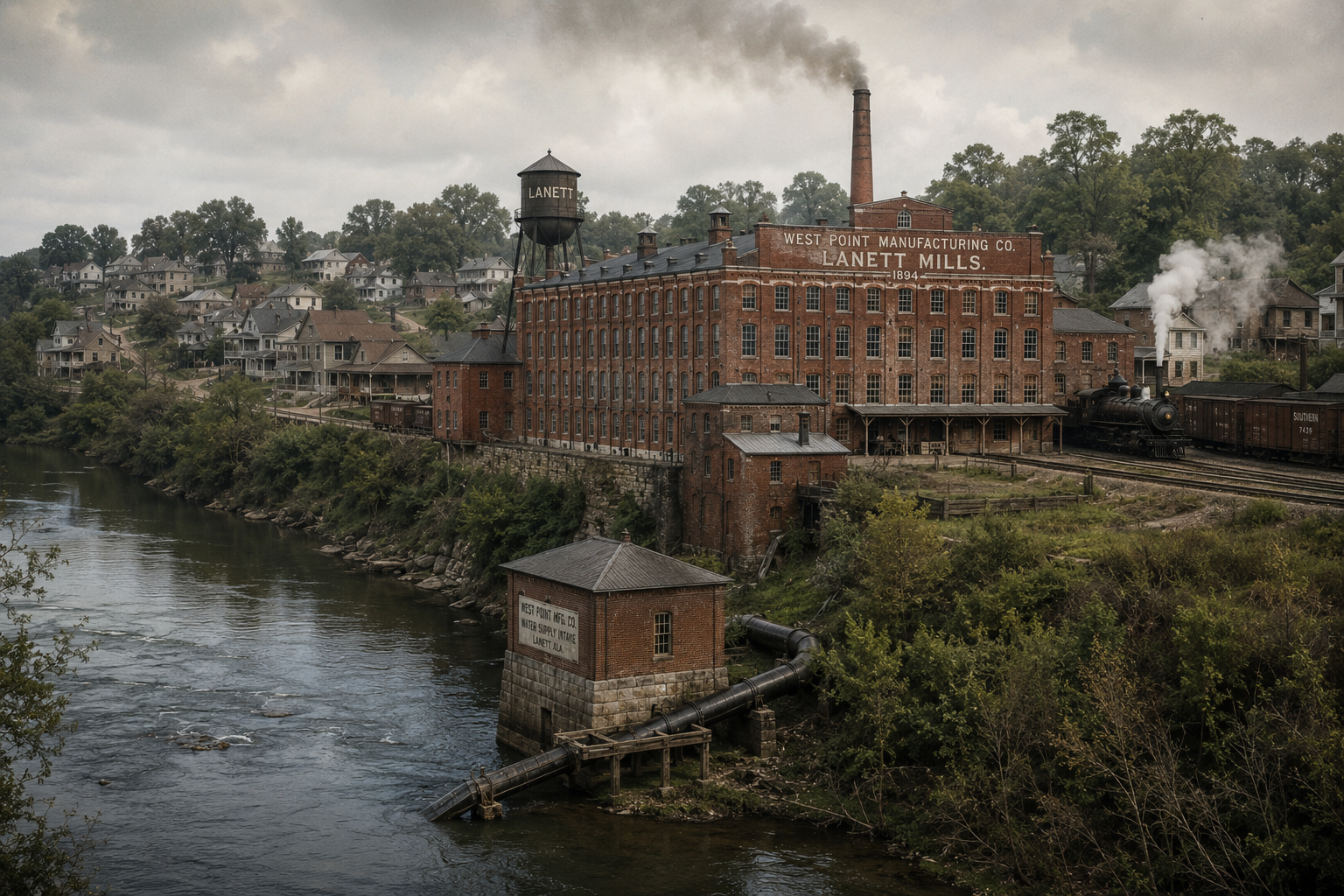
AI Image
By the late nineteenth century, the Chattahoochee River had become far more than a natural landmark. Along the Alabama–Georgia border at Lanett, its flowing waters helped create one of the South's largest textile manufacturing districts. The river formed the state line itself, while its steady current attracted investors eager to harness its tremendous power for industry.
The Lanett Mill, completed in 1894 by the West Point Manufacturing Company, stood only a short distance from the Chattahoochee. During its earliest years, the river supplied the enormous quantities of water required for textile production and, through nearby hydroelectric development, provided the power that drove the spinning frames, looms, and machinery. Without the Chattahoochee, the mills at Langdale, Fairfax, Riverview, Huguley, and Lanett would never have developed into the thriving industrial communities they became.
Around these mills grew carefully planned company villages. Rows of modest mill houses, churches, schools, company stores, and recreation grounds formed self-contained neighborhoods where generations of textile workers lived within walking distance of the factory gates. The daily rhythm of life was set by the mill whistle, while the Chattahoochee flowed quietly only a few hundred yards away.
For the Dean family, this river became part of their own story.
The 1900 Federal Census places William John Dean, his wife Mattie, and their growing family in the Huguley Mill community of Chambers County, Alabama. Their home stood only a short distance from the Chattahoochee River, where the textile industry had transformed a once-rural landscape into one of the South's busiest manufacturing centers. As the Dean children came of age, many would eventually find employment in the same mills whose existence depended upon the river's waters. Each morning they walked from the company village to the spinning rooms and weave sheds while the Chattahoochee continued its timeless journey toward the Gulf. Ella Dean’s father William was listed as a ‘Fisherman’ in the 1900 census, he probably fished the Chattahoochee River.
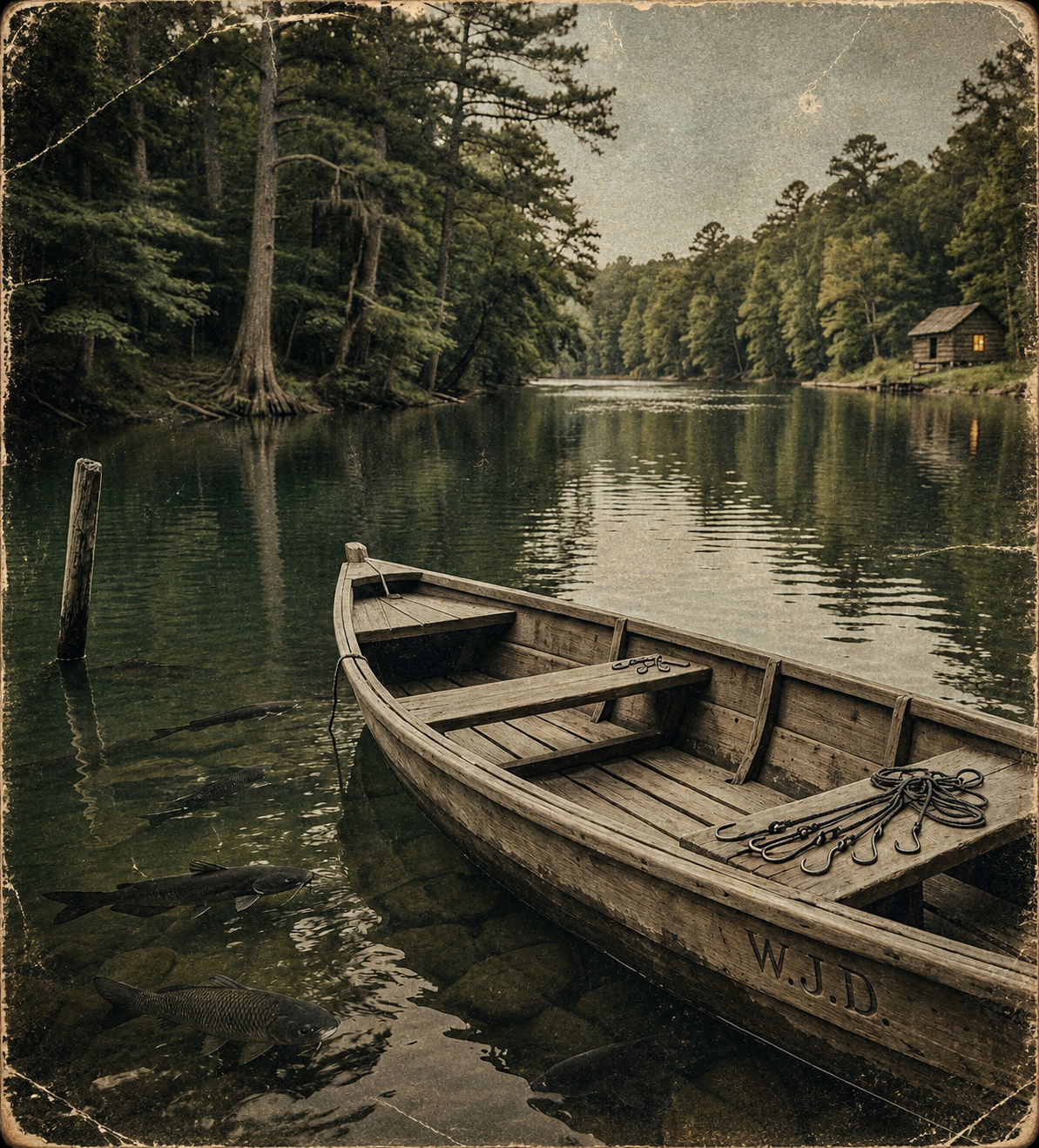
Chattahoochee River 1900
For this generation of the family, the river represented opportunity. It provided steady employment, helped support growing families, and shaped everyday life within the mill villages that became home to thousands of workers throughout Chambers County and neighboring Troup County, Georgia.
The Chattahoochee also witnessed some of the South's defining moments. It formed portions of colonial and state boundaries, served as a strategic military objective during the Creek Wars and the Civil War, and became a center of commerce as steamboats carried cotton, timber, and manufactured goods between inland communities and Gulf ports. Every generation left its mark while depending upon the same waters that had sustained those before them.
Yet despite centuries of change, the Chattahoochee remains remarkably familiar. Mist still rises above its quiet reaches at dawn. Ancient sycamores continue to shade its banks. Herons stalk the shallows where Indigenous fishermen once cast their nets, and mountain springs still feed the headwaters much as they did long before the first European maps were drawn.
For genealogists, rivers often explain what paper records cannot. Families followed waterways because rivers offered food, transportation, fertile land, and opportunity. Understanding the Chattahoochee is therefore more than learning geography—it is understanding why so many Southern families settled where they did, how communities remained connected, and why generations continued returning to the same waters that had shaped their ancestors' lives.
For the families chronicled throughout Kings of the Blue Ridge, the Chattahoochee represents another chapter in a remarkable journey. From the Borderlands of Scotland to Ulster, from Pennsylvania to North Carolina, from Tennessee to the mill villages of Alabama and Georgia, each generation adapted to a changing world while remaining connected by the rivers that guided their lives. Along the banks of the Chattahoochee, the story continued—not with pioneers clearing forests, but with fathers, mothers, and children whose hard work inside the textile mills helped build a new South.
The Chattahoochee is not merely a river running through history. It is a river that made history, carrying with it the hopes, hardships, perseverance, and legacy of the Blue Ridge families whose stories continue to flow across generations.