Breconside Tower
The Scottish Estate That United the Johnstones, Chalmers, and Carruthers Families
Few places in southwest Scotland hold as much significance for my family's history as Breconside Tower. Hidden among the rolling hills of Dryfesdale in Dumfriesshire, this modest Border tower was far more than a country residence. For several generations it stood at the crossroads of three families whose stories would become permanently intertwined: the Johnstones, the Chalmers, and ultimately the Carruthers family.
Today Breconside appears to be a quiet farmhouse tucked away from public view. Yet beneath centuries of alterations survives the same tower that witnessed the lives of my seventeenth-century ancestors.
The Ancient Lands of Breconside
The history of Breconside reaches back long before the Chalmers family entered the picture. The lands formed part of the old Logane estate, traditionally associated with the Carruthers family under the Bruce Lords of Annandale before later passing through Crown and Douglas control. Medieval charters record the lands as early as 1411, when the Earl of Douglas regranted them to Simon de Carruthers. In 1452, King James II confirmed the Logan lands to John Carruthers of Mouswald, making them part of the newly created Barony of Carruthers.
The Logan estate included several farms and holdings:
Breconside
Craigbeck
Logan Woodhead
Logan Woodfoot
Crofthead
Interestingly, despite the importance of the estate, there is no evidence that Breconside itself contained a fortified residence during the fifteenth or early sixteenth century. The tower familiar today had not yet been built.
the Johnstones Built Breconside Tower
Around 1590, everything changed.
A branch of the powerful Johnstone family established themselves at Breconside and erected the tower house that still forms the heart of the building today. Historical evidence indicates that James Johnstone, younger of Breconside, succeeded his father in 1576, while the tower itself appears to have been constructed during the last decade of the sixteenth century. It is absent from the famous 1590 "Platte" of Border strongholds but is documented by 1592, allowing historians to narrow its construction to those intervening years.
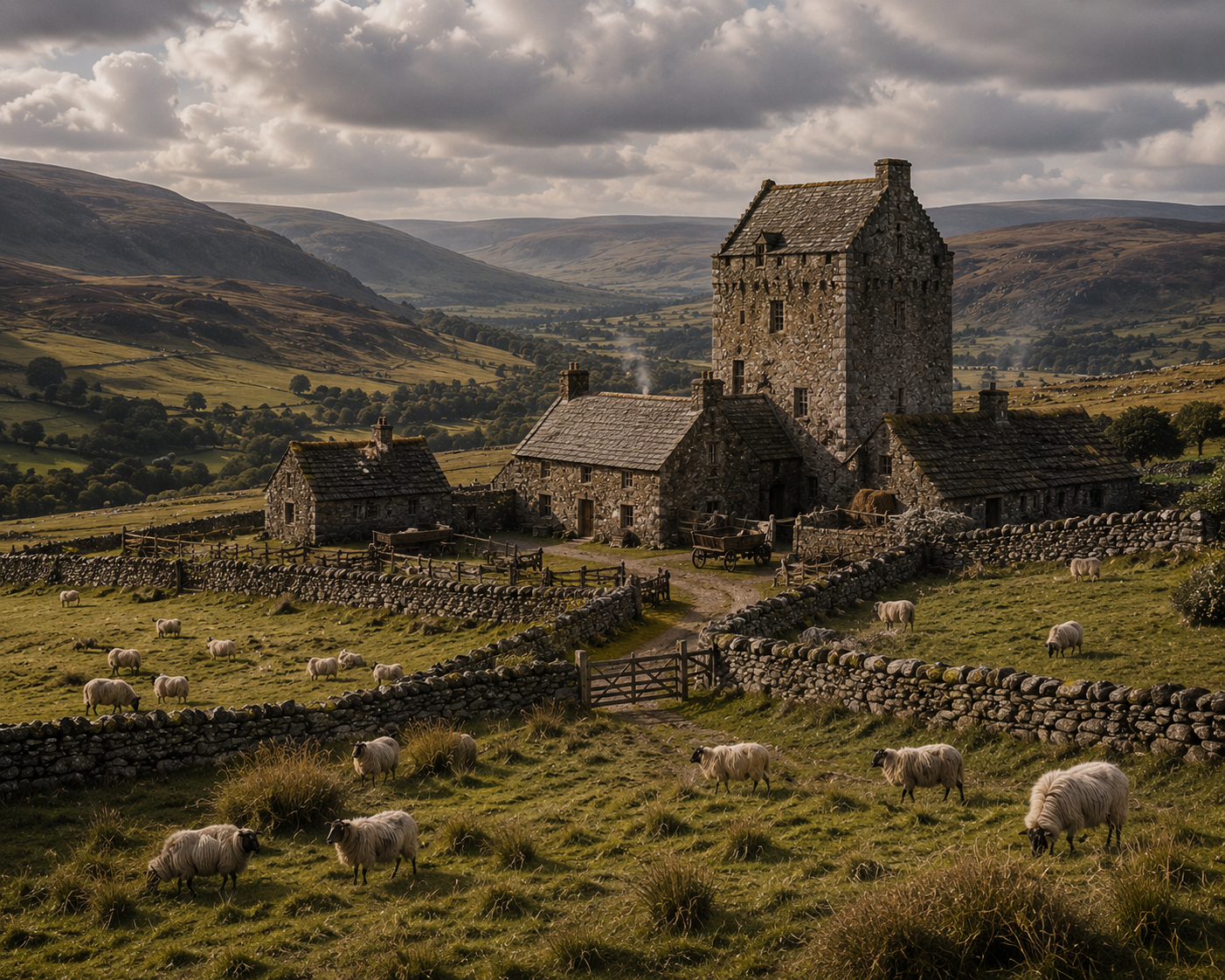
Unlike a great castle, Breconside was a classic Scottish Border tower house. Built of thick local stone walls, it originally stood three storeys high with a garret above. The vaulted basement provided secure storage, while the principal hall occupied the first floor. A winding stair served the upper chambers, and from its elevated position the tower commanded fine views across the surrounding countryside, particularly toward the south where danger most often approached during the turbulent Border years.
Although the great era of Border Reiving was drawing to a close, memories of cross-border violence remained fresh. Tower houses such as Breconside combined domestic comfort with practical security, serving as both family home and refuge when necessary.
James Chalmers of Dam
It is documented that James married Janet Johnstone, sister of John Johnstone of Breconside, linking two neighboring landed families in Dryfesdale. Their children included Andrew Chalmers and Margaret Chalmers, whose lives would forever connect Breconside with the Chalmers and Carruthers families.
In 1693, John Johnstone transferred the lands of Breconside and Cocketts to his nephew Andrew Chalmers of Dam. This was not simply a real estate transaction. It represented the passing of a family estate from the Johnstones into the Chalmers line through the close relationship created by James and Janet's marriage.
Andrew's Unexpected Legacy
Andrew Chalmers never became the long-term laird of Breconside.
Unlike many Border gentlemen, Andrew had built a career far from Dryfesdale. After apprenticing under the Edinburgh bookseller Gideon Schaw, he became a respected bookseller and stationer in Parliament Close, partnering with John Vallange and publishing important legal and political works.
His inheritance of Breconside should have marked the beginning of a new chapter for the family.
Instead, tragedy intervened.
Andrew died before 1695, only a short time after receiving the estate. His promising career in Edinburgh ended unexpectedly, and Breconside passed to his sister.
Margaret Chalmers and William Carruthers
Andrew's sister, Margaret Chalmers, became his heir and was married to William Carruthers.
With that inheritance, Breconside entered the Carruthers family.
The transition was not an easy one. Historical research indicates that the estate already carried significant debts incurred during the Johnstone ownership. William and Margaret were forced to borrow substantial sums to manage the property, and financial difficulties continued well into the next generation. Even after William's death, Margaret borrowed money from David Wightman, minister of neighboring Applegarth, illustrating the continuing financial pressures facing the estate.
These struggles remind us that inheritance did not always bring prosperity. Owning land also meant inheriting mortgages, repairs, obligations, and responsibilities accumulated by previous generations.
The Tower That Still Stands
One of the remarkable aspects of Breconside is that the core of the building survives today.
Historic Environment Scotland identifies the central structure as the original late sixteenth-century tower, although later owners altered it extensively. During the eighteenth century a semi-octagonal stair tower was added, Victorian owners inserted larger windows and domestic wings, and the roofline was lowered from its original height. Even so, the north and east walls preserve much of the original tower built by the Johnstones over four centuries ago.
When I look at photographs of Breconside today, I see the place where:
the Johnstones established their Border home,
James Chalmers' family became connected through marriage,
Andrew Chalmers briefly inherited the estate,
and Margaret Chalmers carried it into the Carruthers family.
Those surviving stone walls witnessed every one of those transitions.
Breconside Tower
Coordinates: 55.30570, -3.40674
Uncle John chose Andrew personally.
This is something I hadn't fully appreciated before.
The Breconside land was not transferred after John's death.
It was transferred by uncle John Chalmers himself on 30 April 1693.
That means John made a conscious decision while alive to settle the estate on Andrew.
What the evidence tells us
By 30 April 1693, when John Johnstone conveyed Breconside to Andrew Chalmers:
The tower house itself was about 100 years old, having been built around 1590–1592. It was already an established Border laird's residence, not a new house. Breconside Tower
It was still the principal residence of the Breconside branch of the Johnstones.
There is no evidence that it was ruined or abandoned.