The Gillespie Footprint
Lancaster, pennsylvania (18th century)
FATHER Gillespie CANDIDATES FOR MARGARET GILLESPIE
The surviving records presently identify several adult Gillespie men living within or directly connected to the southern Lancaster County–northern Cecil County frontier during the decades surrounding the 18th century (1710-1770).
These include:
James Gillespie
William Gillespie
Patrick Gillespie
Robert Gillespie
Although their exact relationships cannot always be demonstrated, the records clearly place these men within the same Presbyterian frontier community stretching across present-day southern Pennsylvania and northern Maryland.
Rather than viewing them as isolated individuals, historians examine them as part of a broader family network.
Name / Birth Death / Occupation / Status Notes
Col. James Gillespie. c. 1700–1765. · Justice of the Peace, Colonel, landowner ; Justice in Lancaster County by 1747/48; prominent Little Britain Township landholder; 364-acre estate sold by sheriff in 1765. Brotherhood to William is probable
William Gillespie. c. 1710-1766. · Farmer, landowner ; Husband of Eleanor; lived in Little Britain Township by the 1740s; later moved to Big Spring (West Pennsboro) in Cumberland County.
Robert Gillespie c. 1710-1760 · Farmer / landowner ; Appears repeatedly in the Little Britain and Lancaster County records alongside William and James. Likely part of the same family group.
Patrick Gillespie. c. 1715-1779 ·Planter / Farmer - Migrated to Prince Edward County, Virginia. His 1779 will names wife Isabel and children William, David, Eleanor, Margaret, and Mary.
John Gillespie? Unknown Unknown Unknown - Mentioned in some compilations but lacking sufficient evidence to place him confidently among the brothers.
Earliest Secure Record
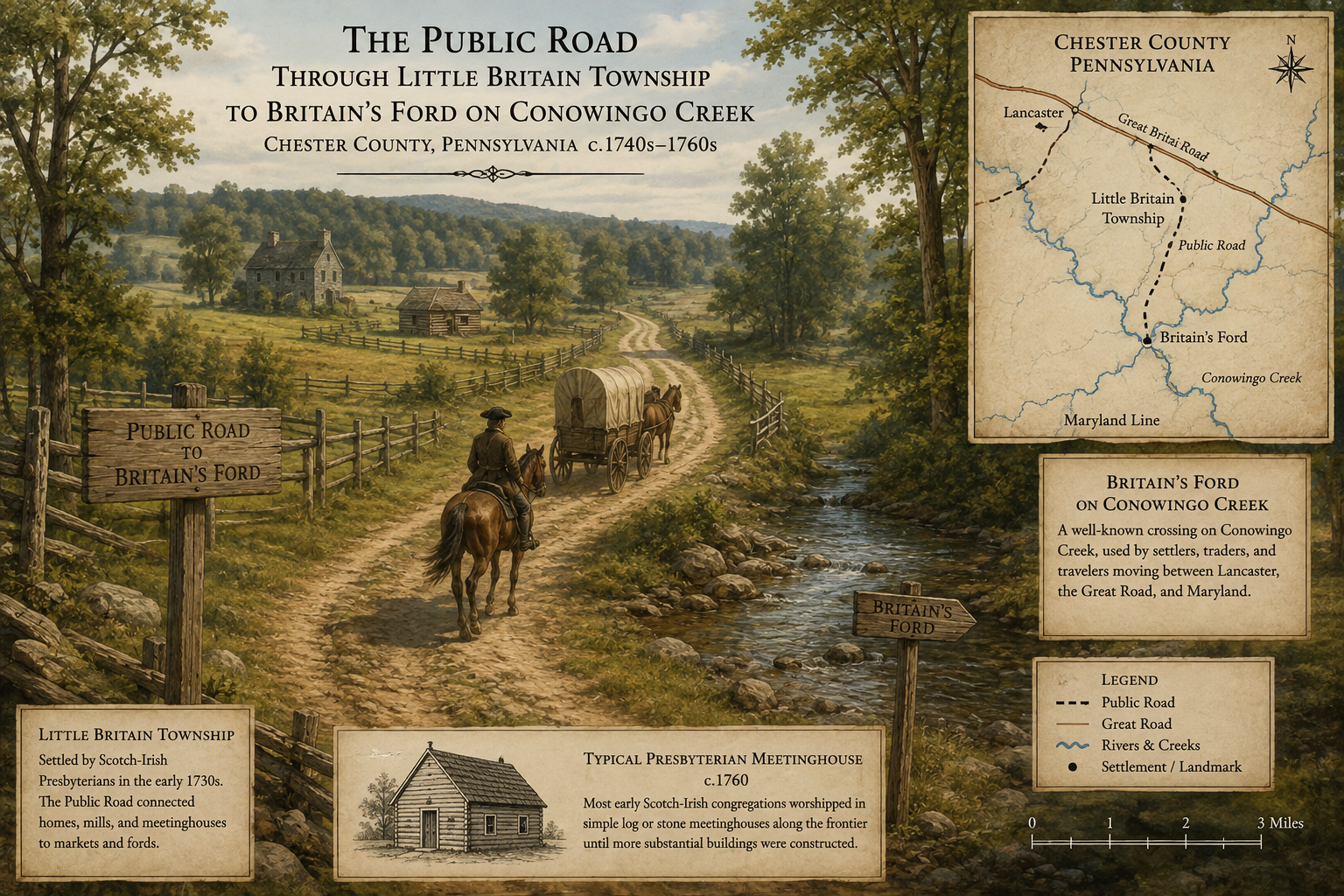
William's earliest securely documented appearance occurs on 5 August 1740, when he signed a petition requesting construction of a public road through Little Britain Township to Britain's Ford on Conowingo Creek.
Among the petitioners were:
James Ewing
James McQuisten
Robert Love
William Crawford
John Smith
Road petitions are particularly valuable because the signers generally lived along the proposed route.
Rather than simply proving William's existence, the petition places him within a specific frontier neighborhood occupied by many of the same Scots-Irish families who appear repeatedly throughout the Carruthers story.
Earlier reports placing William on a similar petition in 1735 remain unverified.
Until the original record is located, 1740 remains the earliest secure documentary reference.
A Documented Brother
One of the strongest surviving Gillespie records dates to 15 June 1750.
Living in Amelia County, Virginia, Patrick Gillespie appointed:
"my brother William Gillespie of Lancaster County, Pennsylvania"
to serve as his attorney in selling Patrick's property in Charlestown, Cecil County, Maryland.
This single document establishes several important facts.
It proves that Patrick and William were brothers.
It confirms William remained associated with Lancaster County in 1750.
And it demonstrates that the Gillespie family maintained connections extending across Pennsylvania, Maryland, and Virginia while remaining part of one extended migration network.
William should therefore be viewed not as an isolated frontier settler, but as a documented member of a larger Gillespie family.
A Possible Eldest Brother
Most important for us, James Gillespie is genuinely on the landscape. The historical description places his nearly 600-acre tract along Conowingo Creek, associated with William Fulton’s 1742 acquisition and an early mill property.
Mount Gillespie
During the late 1750s, William acquired a tract known as Mount Gillespie in Octoraro Hundred, Cecil County, Maryland.
The property adjoined the Ewing tract known as ‘Dividing’ , illustrating once again the close relationship between these neighboring Scots-Irish families.
Although located in Maryland, the property remained part of the same local community.
Little Britain Township and Octoraro Hundred shared the provincial boundary, allowing residents to appear in records of both Pennsylvania and Maryland while continuing to live within the same frontier neighborhood.
Mount Gillespie was not a mountain. It was a named 273-acre Maryland land tract in Octoraro Hundred, Cecil County, patented to William Gillespie in 1760. William and Eleanor later sold it to Stephen Gillespie for £600; the 1783 assessment lists Nathaniel Gillespie holding the same 273 acres.
*That means it must have been separated from James’ Gillespie’s Mill, which was farther north in East Drumore Township, Lancaster County, on Conowingo Creek, about a mile east of Hensel. Three public roads converged on that mill by 1752.
WIFE Eleanor Gillespie
The records also preserve the identity of William's wife.
She appears simply as Eleanor, occasionally written as Eliner, and participated with William in documented land transactions.
Although numerous online genealogies assign her various maiden names, no surviving primary document presently establishes her ancestry.
Until such evidence appears, she should simply be identified as:
Eleanor, wife of William Gillespie.
was Margaret Gillespie their daughter?
It may be found by reconstructing the community in which they lived.
Among the Gillespie men, William Gillespie presently stands as the strongest candidate for Margaret's father.
Not because a single document names him. No such document has yet been found.
Rather, William consistently appears where we would expect Margaret's father to appear.
He belonged to the correct generation. He lived within the same settlement occupied by the Carruthers and Morrison families.
He remained associated with the same network of Presbyterian neighbors throughout his life.
And unlike other documented Gillespie households, his known history leaves room for an undocumented married daughter.
The conclusion remains a working hypothesis. It is not presented as proven fact.
Westward to Cumberland County
William's story did not end in Lancaster County.
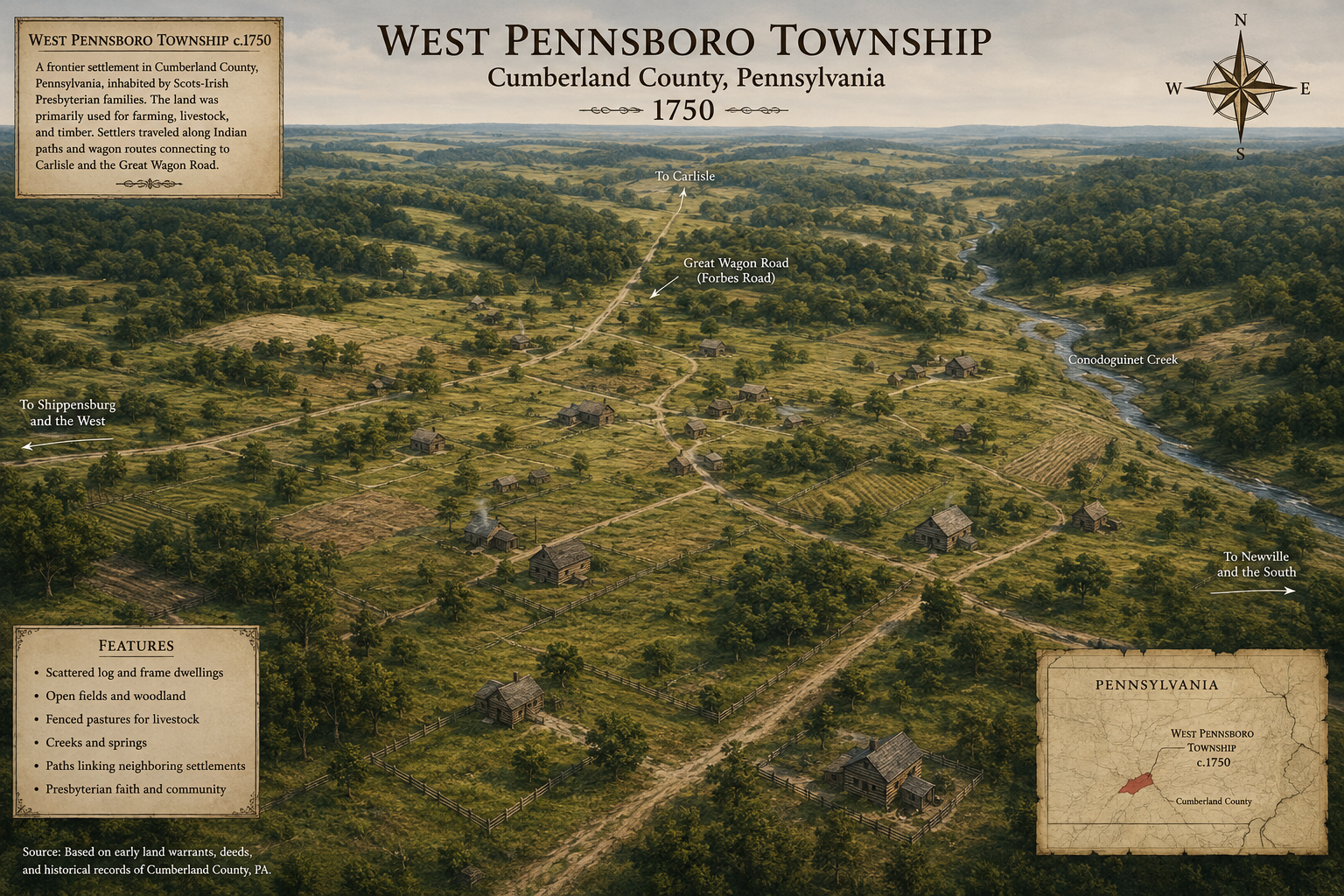
He later acquired land in , from James McQuisten—one of the very men who had signed the 1740 road petition decades earlier.
That continuity reveals something important.
These families were not merely neighbors.
They migrated together.
The clearest evidence comes from church records.
On 28 March 1766, William and Eleanor were dismissed from Nottingham Presbyterian Church and transferred to Big Spring Presbyterian Church near present-day Newville.
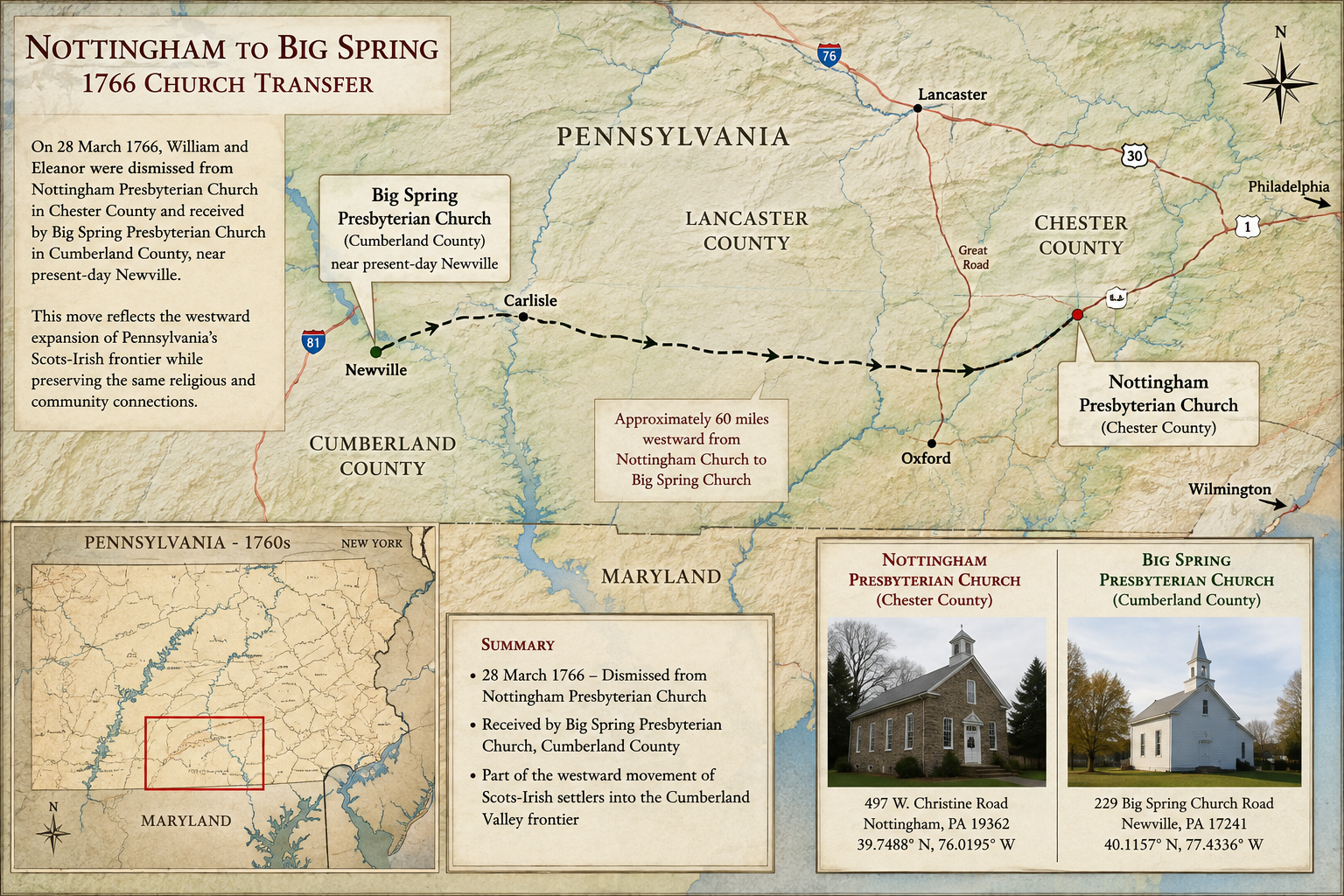
The move reflects the steady westward expansion of Pennsylvania's Scots-Irish frontier while preserving the same religious and community connections established years earlier in Lancaster County.
Could William Be Margaret's Father?
No surviving primary document identifies Margaret Gillespie as William's daughter.
That remains the central obstacle.
Even so, William continues to satisfy nearly every historical requirement.
He belonged to the correct generation.
He lived within the same Presbyterian settlement as the Carruthers and Morrison families.
He remained associated with the Ewing, Porter, and McQuisten migration network.
His documented wife, Eleanor, and reports of a large household leave room for an older daughter whose marriage may simply have gone unrecorded.
Against that stand two undeniable facts.
No surviving document calls Margaret his daughter.
And later references to William's estate identify sons without providing a complete accounting of daughters.
For those reasons, William cannot yet be identified as Margaret's father with certainty.
The Present Evidence
Genealogy often advances one document at a time.
Today, William Gillespie and his wife Eleanor remain the strongest documented candidates for Margaret Gillespie's parents.
Not because one record proves the relationship.
But because the surviving chronology, geography, migration patterns, church records, documented family associations, and neighborhood reconstruction all point consistently toward the same conclusion.
Should a family Bible, will, deed, or church register someday identify Margaret by name, that evidence should immediately replace hypothesis with fact.
Until then, William Gillespie remains the most historically convincing candidate—and the search continues…