Robert Morris
The Merchant Who Financed the American Revolution
History has bestowed lofty titles upon America's Founding Fathers. George Washington became the Father of His Country. Thomas Jefferson penned the Declaration of Independence. Alexander Hamilton built the nation's financial system. Yet behind each of these towering figures stood another man whose wealth, commercial genius, and willingness to risk everything may have done as much as any battlefield victory to secure American independence.
His name was Robert Morris, and during the Revolution many simply called him "The Financier."
Born on January 20, 1734, in Liverpool, England, Robert Morris arrived in the American colonies as a young teenager after his father established himself in the thriving port city of Philadelphia. Few could have imagined that this English-born merchant would eventually become one of the architects of the United States itself.
Philadelphia in the mid-eighteenth century was exploding with opportunity. Merchant vessels crowded the Delaware River carrying sugar from the Caribbean, manufactured goods from Britain, rum from New England, tobacco from Virginia, and flour from Pennsylvania's fertile interior. Morris entered this bustling commercial world as an apprentice and quickly displayed an extraordinary gift for finance. Rather than merely buying and selling cargo, he mastered the intricate networks of credit, insurance, international exchange, and investment that connected the Atlantic world. By his early thirties he had become one of the wealthiest merchants in British North America.
His prosperity arrived during a period when the British Empire itself stood at the height of its power. The conclusion of the French and Indian War in 1763 left Britain victorious but heavily indebted. Parliament attempted to recover those costs by taxing the American colonies through measures such as the Sugar Act, Stamp Act, and Townshend Duties. Morris initially hoped reconciliation remained possible, believing that continued trade with Britain benefited both sides of the Atlantic. Yet as imperial policy grew increasingly rigid, he gradually concluded that economic freedom and political independence had become inseparable.
When armed conflict erupted at Lexington and Concord in 1775, the Continental Congress suddenly faced an impossible challenge. It could authorize armies, appoint generals, and issue declarations, but it possessed almost no reliable income. Soldiers needed uniforms, muskets, cannon, wagons, horses, food, powder, and pay. Without money, the Revolution could collapse before it truly began.
Robert Morris stepped into the breach.
Drawing upon decades of commercial relationships, he leveraged his own reputation and private fortune to secure desperately needed supplies for George Washington's army. Merchants throughout Europe and the Caribbean extended credit not simply because Congress asked, but because they trusted Robert Morris to honor his obligations. On numerous occasions he signed personal notes, pledged his own assets, and borrowed enormous sums to keep the Continental Army operating. During the darkest days of the war, when Congress possessed little more than depreciating paper currency, Morris's private credit often became the government's lifeline.
His importance reached its climax in 1781.
General Washington had identified an extraordinary opportunity to trap Lord Cornwallis's army at Yorktown, Virginia. Success depended upon moving thousands of American and French troops hundreds of miles while coordinating with the French fleet under Admiral de Grasse. Yet Congress lacked the money to pay soldiers or purchase the necessary supplies. Morris personally raised the funds, arranged emergency financing, and secured provisions that allowed the campaign to proceed. The victory at Yorktown effectively ended major combat in the American Revolution. Historians have long argued that without Morris's financial intervention, Washington may never have reached Virginia in time to achieve the decisive victory.
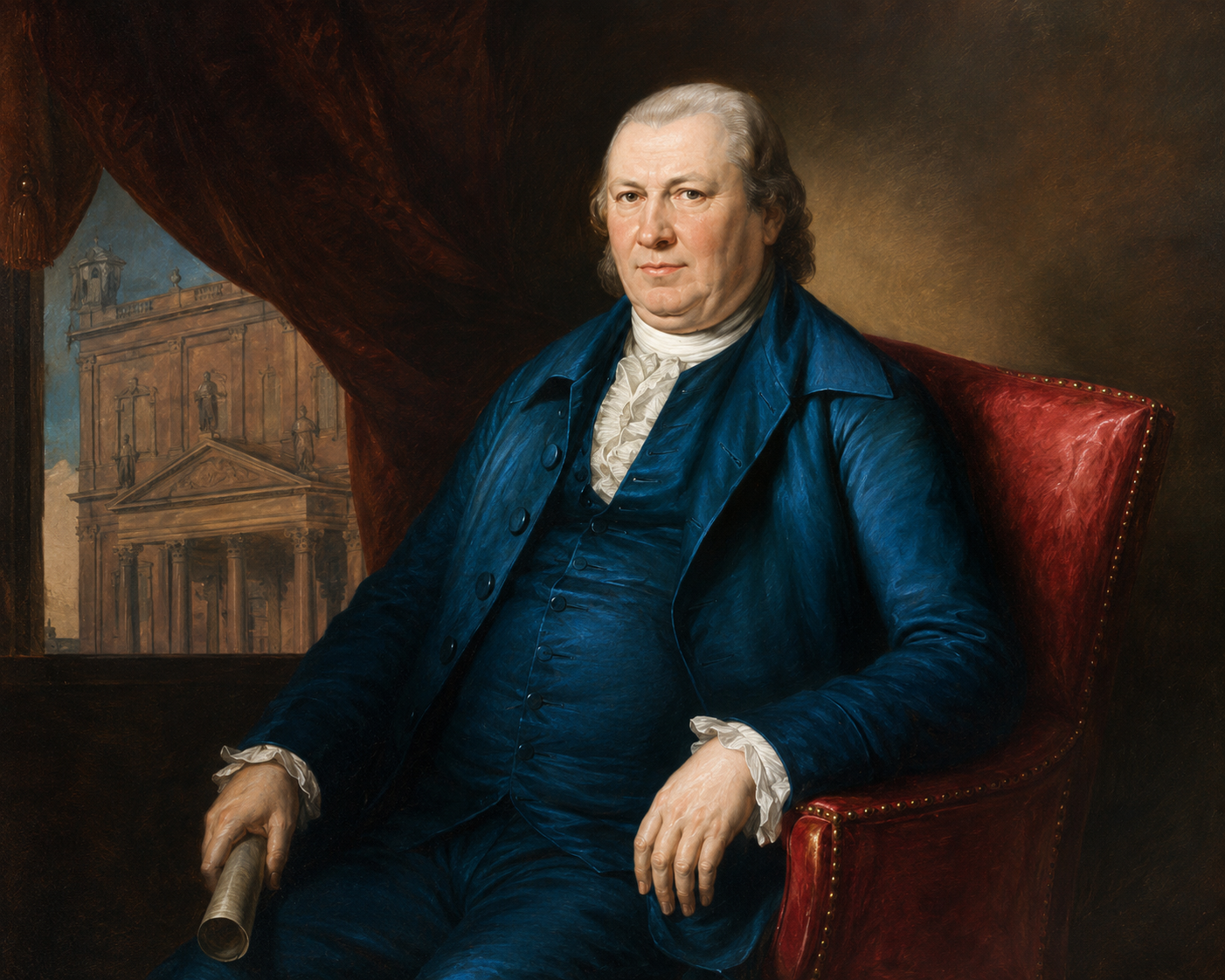
Robert Morris: The Merchant Who Financed the American Revolution
Recognizing his remarkable abilities, Congress appointed Morris Superintendent of Finance in 1781, effectively making him the first national finance minister of the United States. He immediately began imposing order on the nation's chaotic finances. Government accounts were standardized, wasteful expenditures were reduced, and more disciplined accounting practices replaced years of administrative confusion. Perhaps his most enduring achievement was the creation of the Bank of North America, the nation's first successful commercial bank. Chartered in 1781, it provided desperately needed stability to the infant American economy and demonstrated that the new republic could establish credible financial institutions capable of earning international confidence.
Morris's influence extended beyond finance. He signed the Declaration of Independence, the Articles of Confederation, and the United States Constitution, making him one of only two men—alongside Roger Sherman—to sign all four of America's foundational governing documents. While Washington commanded armies and Madison debated constitutional theory, Morris helped ensure that the machinery of government possessed the financial foundation necessary to survive.
Peace, however, brought opportunities as well as dangers.
The vast lands of the new United States promised extraordinary profits to ambitious investors, and Morris plunged eagerly into speculative real estate ventures. Together with partners such as John Nicholson and James Greenleaf, he acquired enormous tracts of land stretching across Pennsylvania, New York, Kentucky, Georgia, and the emerging federal district that would become Washington, D.C. At the height of his career, many contemporaries considered Robert Morris the wealthiest man in America. His residences rivaled those of European aristocrats, his commercial influence reached both sides of the Atlantic, and his signature carried immense financial weight.
Then the market turned.
The Panic of 1796–1797, one of the young nation's first great financial crises, shattered land values and froze credit throughout the country. Investors could no longer meet their obligations, banks curtailed lending, and Morris found himself trapped beneath a mountain of debt created by ambitious speculation. Despite years spent financing the birth of the republic, the government he had helped create offered little relief.
In 1798, Robert Morris entered Philadelphia's Prune Street Debtors' Prison, where he remained for more than three years. It remains one of the most remarkable reversals in American history. The man who had once financed Washington's army and rescued the Continental Congress from bankruptcy now occupied a prison cell because he could no longer satisfy his own creditors.
Public sympathy for Morris's plight contributed to growing calls for reform. In 1800, Congress enacted one of the nation's first federal bankruptcy laws, allowing imprisoned debtors an avenue toward financial relief. Morris was released in 1801, but his immense fortune had vanished forever. He spent his remaining years living quietly in Philadelphia until his death on May 8, 1806.
Robert Morris's story stands as one of the great paradoxes of the American founding. He accumulated immense wealth through intelligence, discipline, and commercial vision, then willingly risked that fortune to finance a revolution whose outcome remained uncertain. He helped establish the credit of the United States, created its first successful national bank, signed its foundational documents, and made possible the military victory that secured independence. Yet the same appetite for bold investment that fueled his rise ultimately destroyed him.
Today, Washington, Jefferson, Hamilton, and Franklin remain household names, while Robert Morris is remembered by comparatively few Americans. Yet every stable financial institution, every government bond, every national banking system, and every successful public credit market owes something to the merchant who believed that a nation's promise was only as strong as its ability to honor its debts.
Without Robert Morris, the United States may have won its ideals on paper. With him, it gained the financial strength to survive long enough to become a nation.