Donegal, Ireland
At the Edge of the Atlantic
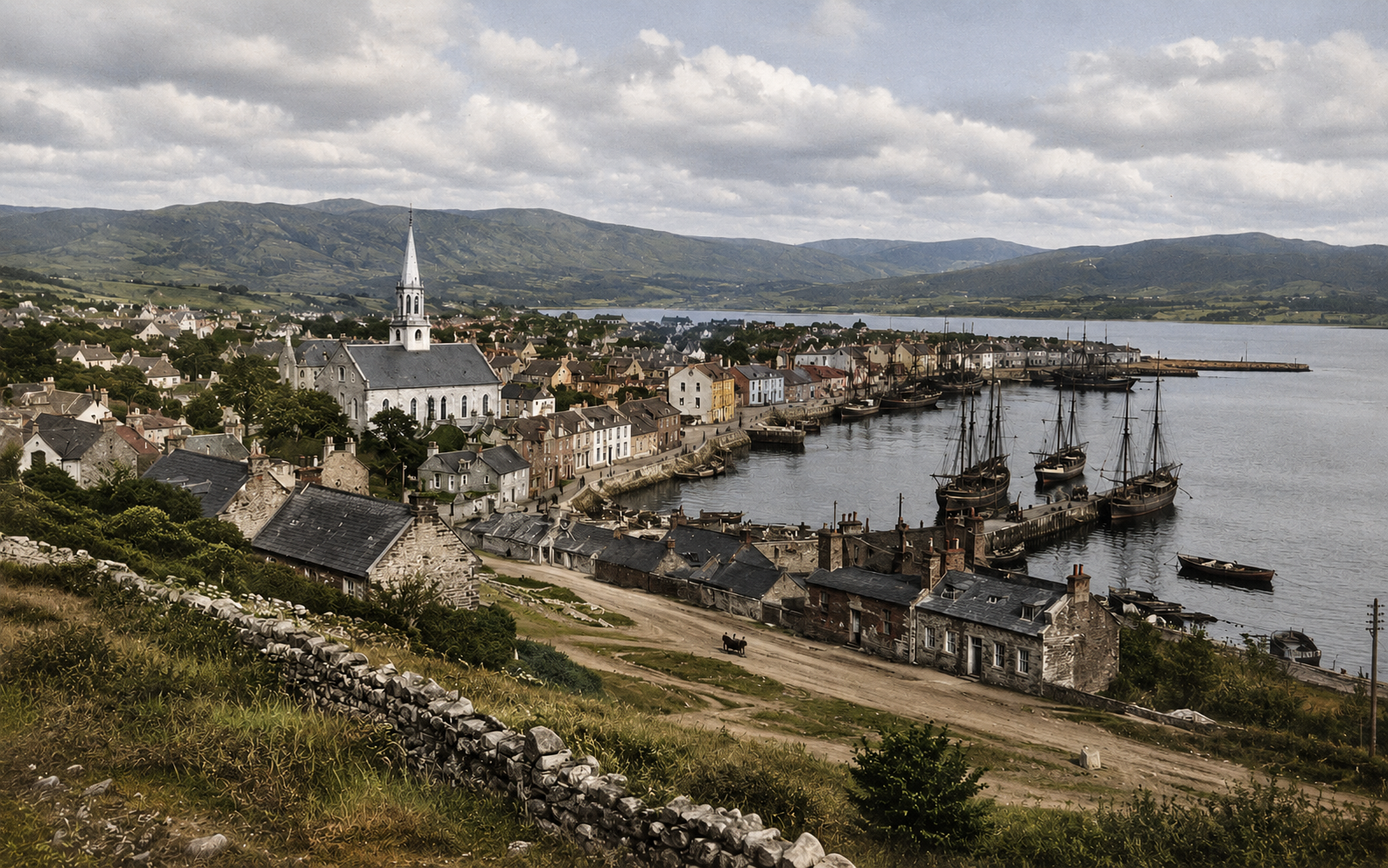
By 1720, County Donegal stood at the far western edge of the British Isles — a rugged country of mountains, fishing villages, windswept coastlines, stone cabins, linen fields, and harbors facing directly toward the Atlantic world. For many families living there, America was no longer an abstraction. It had become a destination spoken about in kitchens, market squares, and churchyards. The old Gaelic order had collapsed generations earlier after the Nine Years’ War and the Flight of the Earls in 1607. In the century that followed, Ulster changed dramatically. Scottish settlers crossed the North Channel into Donegal and neighboring counties under the Plantation system, bringing Presbyterian traditions, Lowland farming practices, and new trade networks into a landscape still deeply Irish in language and culture. By the early eighteenth century, Donegal had become a place layered with identities. Along the coast and market towns, one could hear English, Scots dialects, and Irish Gaelic spoken within the same day. Families often carried memories of movement already — from Scotland into Ulster, from one rented holding to another, from coast to inland valleys in search of work or land. Life was not easy.
Most ordinary families lived in small stone or turf-built cottages roofed with thatch. Smoke from peat fires drifted through rafters blackened over generations. Clothing was homespun. Food depended heavily on oats, barley, potatoes, buttermilk, and whatever could be raised from rocky ground. Livestock represented survival itself. A single cow could determine whether a household endured winter. The land was beautiful, but unforgiving.
DONEGAL, IRELAND 1725
Donegal’s geography shaped daily life. Roads were rough and often impassable in winter. Mountain passes isolated communities. Storms from the Atlantic battered the coast for days at a time. Yet the sea also connected Donegal to a larger world. Harbors such as Lough Swilly and nearby ports along Ulster’s coast tied the county into expanding Atlantic trade. The Atlantic crossing had become increasingly familiar. Ships bound for the American colonies regularly departed from Ulster ports including Londonderry, Belfast, Newry, and smaller coastal anchorages used by merchants and emigrants. While Donegal itself did not possess the same commercial infrastructure as Belfast, many emigrants from the county traveled eastward or southward to board vessels carrying passengers to Pennsylvania, Maryland, Virginia, and the Carolinas. These ships were not immigrant liners in the modern sense, they were cargo vessels adapted for human transport. Passengers slept in cramped quarters below deck among chests, tools, blankets, barrels, and livestock provisions. Voyages could last six to twelve weeks depending on weather and currents. Disease spread easily. Storms were common. Water spoiled. Food rationing became severe during delayed crossings. Yet people continued to go. The reasons varied from family to family. Rising rents, religious discrimination against Presbyterians under Anglican rule, failed harvests, inheritance limitations, and the constant instability of tenant life all pushed many toward emigration. Letters returning from Pennsylvania described fertile land, cheaper acreage, and frontier opportunity unimaginable in parts of Ulster.
By the 1730s, stories of America had become woven into local conversation. One neighbor’s son disappeared across the ocean. Another family sold possessions quietly before departing. Ministers preached farewell sermons. Port towns filled with carts carrying bedding, tools, spinning wheels, seed sacks, and family Bibles toward waiting ships. For some, the journey was temporary in imagination — a way to earn land or fortune before returning. For many others, departure became permanent the moment the coastline disappeared behind Atlantic fog. The New World that awaited them was not peaceful wilderness. Pennsylvania’s frontier remained dangerous and uncertain. Dense forests, isolation, unfamiliar climates, disease, and frontier conflict shaped early settlement life. But to families leaving Donegal, America represented possibility in a world where land ownership and stability often remained beyond reach. The people who left Ulster during this period would later become part of what historians now call the Scots-Irish migration — families who carried Border traditions, Presbyterian religion, farming culture, oral storytelling, and frontier resilience deep into the Appalachian backcountry. Many eventually moved southward through the Great Wagon Road into Virginia, the Carolinas, Tennessee, Alabama, and beyond.