Border Reivers
Life Along the Anglo-Scottish Frontier
For centuries, the lands stretching between southern Scotland and northern England existed as one of the most unstable frontiers in Europe. Long before modern borders became fixed lines on maps, the western marches of Dumfriesshire, Annandale, Liddesdale, and the Solway region formed a violent and shifting world where survival often depended less upon kings or governments than upon family loyalty, horsemanship, and the strength of one’s tower house. This was the world of the Border Reivers.
The word reiver came from the old Border term meaning “raider”. These were not organized national armies, but riding families and kinship networks who moved through the frontier country conducting raids, retaliations, livestock theft, feuds, and armed retaliation across both sides of the Anglo-Scottish border. And among the families deeply rooted in this world were the Carruthers. The western marches were dominated by surnames that became inseparable from Border history itself — Johnstones, Maxwells, Armstrongs, Grahams, Bells, Irvings, Elliots, Scotts, and Carruthers among them. Their towers, farms, and fortified houses stood scattered across valleys, mosslands, forests, and river crossings where violence could erupt with little warning. This was not lawless chaos in the modern sense.
The Borders operated under their own culture of survival. Families formed alliances through bloodlines, fosterage, marriage, and military obligation. Livestock represented wealth. Horses represented mobility. Reputation represented protection. A family unable to defend itself risked losing cattle, crops, land, or even its surviving sons. Raiding became woven into frontier life. Under cover of darkness, mounted riders crossed hills and river valleys to reclaim stolen cattle, retaliate against rival families, or enforce old feuds. These raids could involve dozens — sometimes hundreds — of armed riders moving swiftly through the countryside before disappearing back into the frontier landscape.
The geography itself encouraged it. The western Borders were difficult to govern. Marshlands, dense woods, isolated valleys, and rough uplands created ideal conditions for mounted movement and concealment. Solway Moss, the Esk valley, Annandale, and the hill country surrounding Dumfriesshire became part of an inherited mental map known intimately by the riding families who lived there. Tower houses rose across the region as defensive homes rather than royal castles.
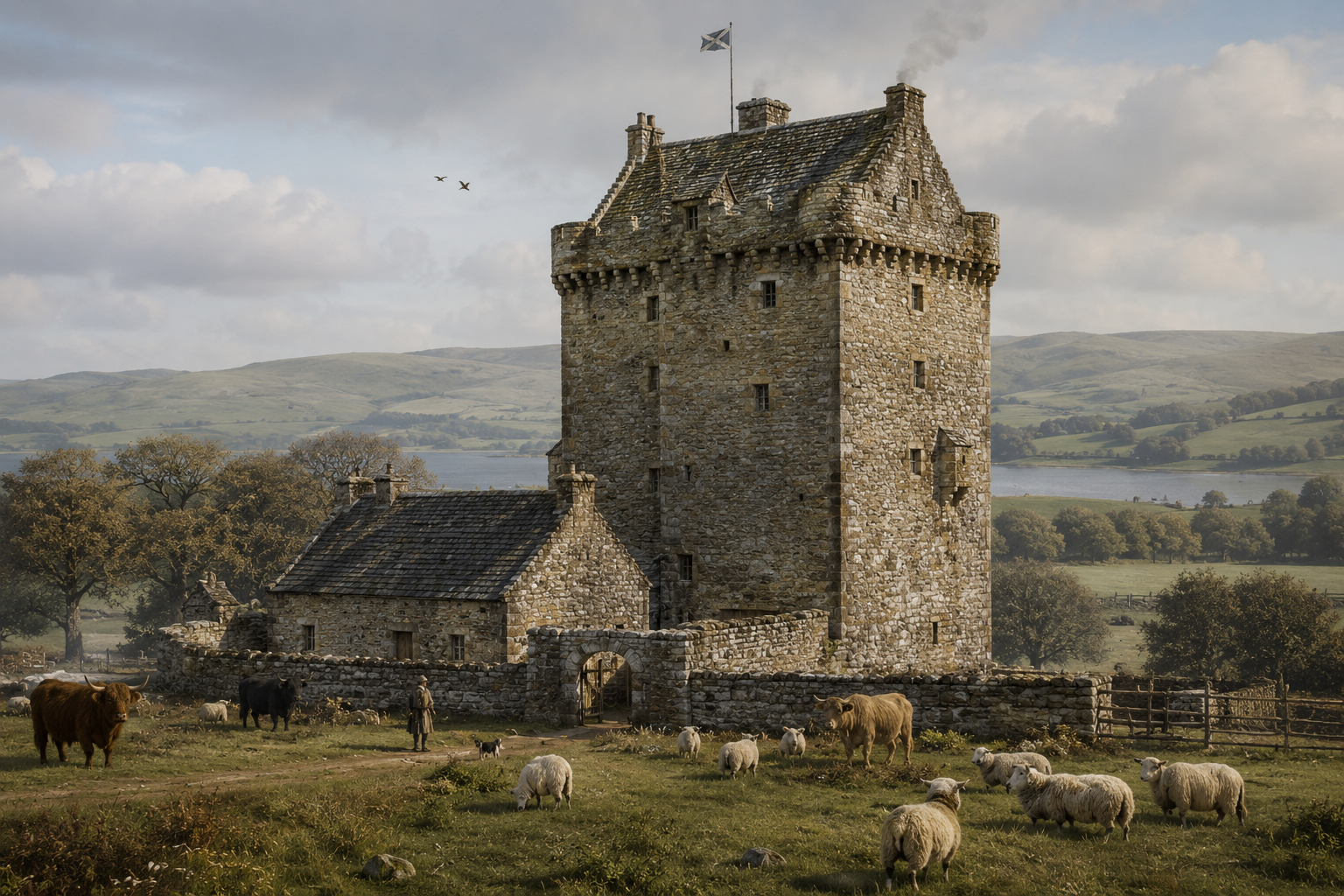
Holmains Tower 1600
Structures like Holmains Tower, nearby Caerlaverock Castle, Lochwood, and dozens of smaller peel towers existed not simply as residences, but as survival architecture. Thick stone walls, narrow staircases, iron gates, elevated entrances, and defensive positions reflected a world where attacks could arrive suddenly. At night, livestock might be brought close to towers for protection. Watches were kept. Riders arrived carrying news from neighboring kin.
Fires burned within halls while storms swept across the Solway lowlands outside. Children grew up inside this atmosphere. They inherited not only land and surnames, but feuds, loyalties, alliances, and inherited memory. A child born into a Border family quickly learned who their allies were, which valleys were dangerous, and what names carried either friendship or threat. Religion and politics further complicated life. The Borders stood directly between two kingdoms often at war. English armies moved north. Scottish armies moved south. Local families were frequently pulled between crown loyalties and survival realities. During periods of national conflict, frontier families could be labeled traitors by one side and defenders by the other within the same generation.
The sixteenth century became especially violent. Feuds between the Maxwells and Johnstones escalated into open warfare across Dumfriesshire. The Armstrongs and Grahams gained reputations feared throughout the marches. Entire settlements could be burned during retaliatory raids. Livestock theft, ransom-taking, and blood revenge became so common that specialized frontier laws — known as March Law — developed to govern disputes unique to Border life. Yet despite the violence, ordinary life continued. Women maintained households, managed stores, raised children, spun wool, prepared food, and often defended homes during absences or attacks.
Farmers worked difficult land. Markets continued. Marriages united neighboring families. Church bells still rang across valleys where armed riders had passed only nights earlier. This contradiction defined the Border world: danger and domestic life existed side by side. By the early seventeenth century, the Union of the Crowns under James VI and I began changing the frontier permanently. The old Anglo-Scottish border lost much of its military function as both kingdoms came under one monarch.
Royal authorities increasingly moved to suppress raiding culture, dismantle feuds, and pacify the region once known as the “Debatable Lands.” Many old riding families adapted. Some moved into military service abroad. Others turned more fully toward farming, trade, tenancy, or migration. Over generations, descendants of these frontier families crossed into Ulster during the Plantation period, carrying Border customs, Presbyterian traditions, riding culture, and deeply rooted kinship networks with them. Eventually many of those same families crossed the Atlantic.
The frontier instincts learned along the western marches — mobility, endurance, distrust of centralized authority, clan loyalty, and survival in difficult landscapes — would later reappear in the Appalachian backcountry of Pennsylvania, Virginia, Tennessee, and the American South. For descendants tracing the Carruthers lines of Dumfriesshire, the Border Reivers are not distant folklore.
The towers, marshes, frontier roads, and feuds of the western marches shaped the generations long before they ever boarded ships for Ulster or America. And though the raids eventually faded, the atmosphere of that old frontier world still lingers across the Borders today — in ruined towers, weathered kirkyards, surviving surnames, and the stone landscapes where the riding families once moved beneath the moonlit skies of the western march.