Egidia Graham & the 9th Earl of Angus
To understand the immense wealth and sovereign shadow that anchored the marriage networks of upper Dumfriesshire, the narrative must ascend into the absolute highest echelons of the Scottish peerage, where a quiet branch of country lairds was suddenly catapulted into the center of a royal murder scandal. This was the world of William Douglas, Ninth Earl of Angus (1532) and his wife Egidia 'Gelis' Graham (1535) at Morphie. For nearly forty years, they lived a life of prosperous, rural obscurity along the rain-swept eastern coast of Kincardineshire, far removed from the treacherous politics of the royal court.
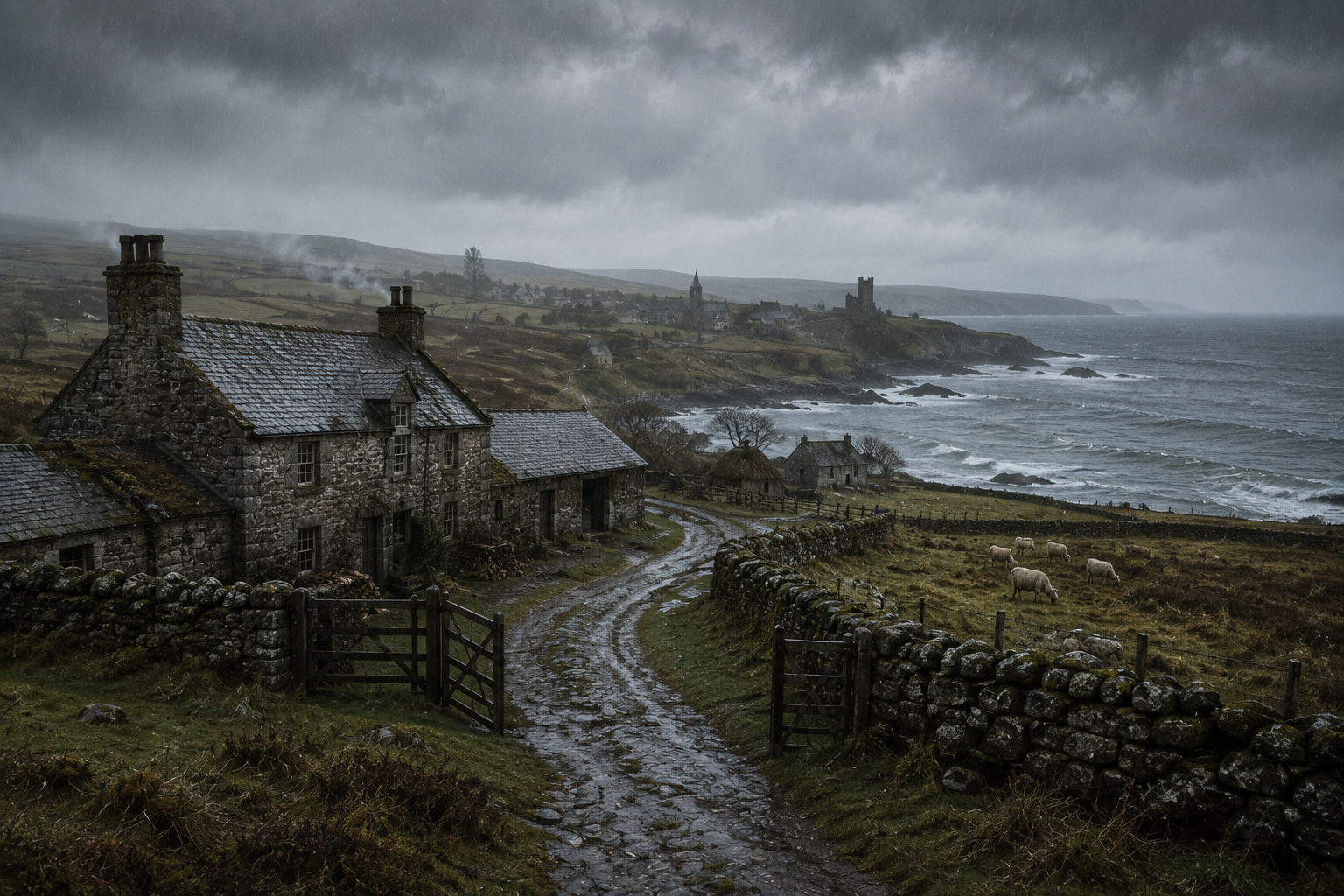
Eastern coast of Kincardineshire 1580
Yet, their quiet estate management at Glenbervie was shattered overnight in 1588 when a dark, supernatural terror gripped the House of Douglas, fundamentally shifting the family line forever.
The dramatic transformation began with the sudden and highly suspicious illness of William’s kinsman, Archibald, the Eighth Earl of Angus. In the summer of 1588 the young, powerful Earl collapsed at Smeaton in Lothian, struck down by a baffling, wasting disease that completely stumped the kingdom's finest physicians. Dr. Craig, the royal doctor, found his medical knowledge useless against the malady, providing a convenient cloak for a massive social panic.
In an era intensely obsessed with sorcery, the verdict was immediate: the Earl had not died of natural causes, but had been aggressively bewitched to death by a coven of treasonous warlocks.
The resulting investigation ignited a fierce, paranoid crusade that reached the absolute highest levels of the crown. King James VI, harboring a deep, lifelong terror of dark magic, took personal delight in overseeing the examinations. The state focused its fury on several high-profile suspects, including Barbara Napier and the notorious Agnes Sampson, a midwife who was eventually dragged to the Castle Hill of Edinburgh and publicly burned at the stake.
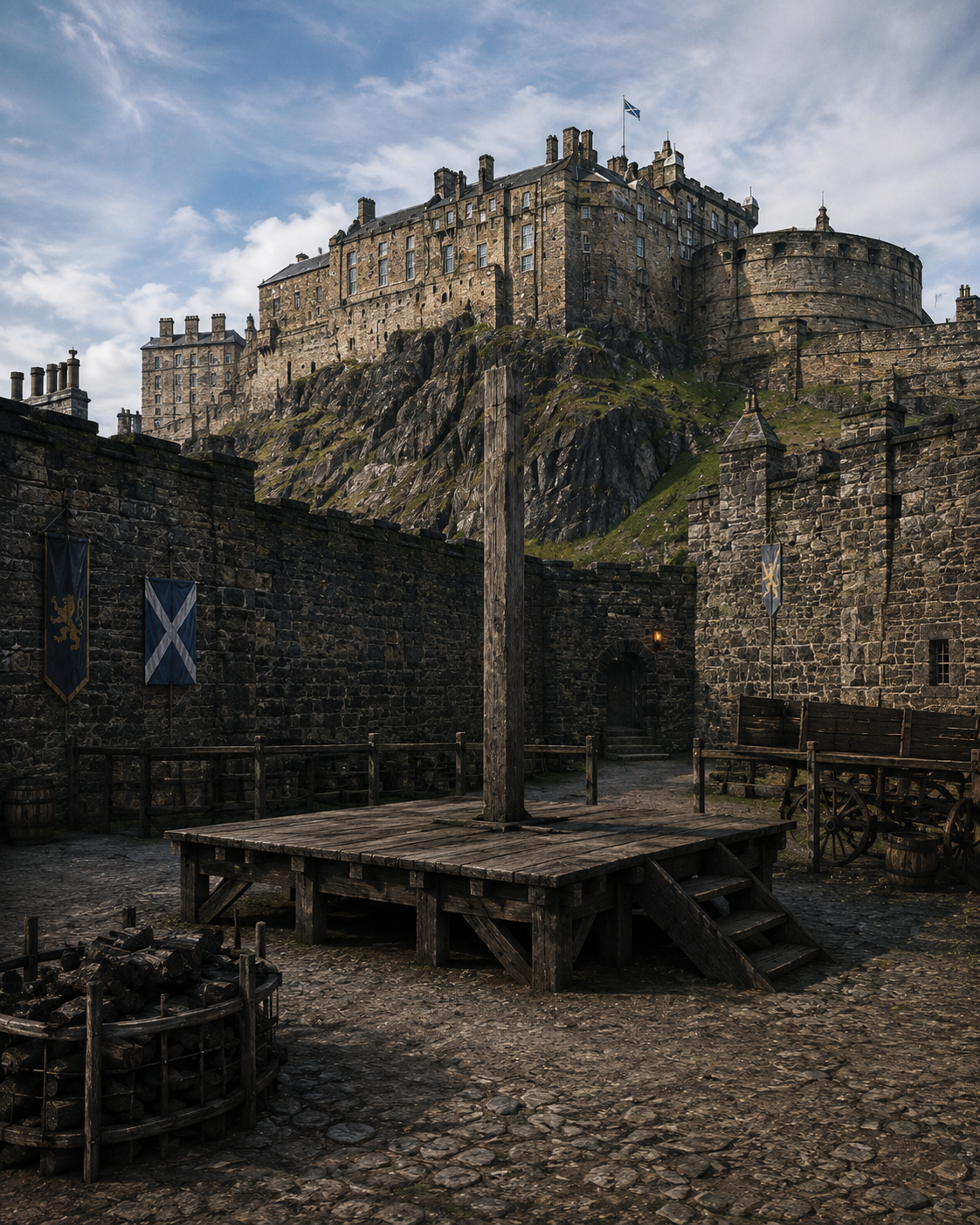
Castle Hill of Edinburgh
In a particularly bizarre twist that fascinated the King, another accused witch named Geillis Duncan (no relation) was forced to play a strange, traditional dance tune before the royal court to demonstrate her allegiance to the devil. As the smoke cleared from the execution pyres, the male line of the senior Earls of Angus lay totally extinct, and by ancient feudal right, the entire earldom—along with its massive estates and sovereign privileges—reverted directly to William Douglas of Glenbervie.
Suddenly elevated as the Ninth Earl of Angus, William and Gelis Graham had to navigate a landscape of immense prestige and immediate financial peril. The aging laird was no longer just a local master of sheep lands; he was a premier peer of Scotland, tasked with ruling extensive territories. To secure the formal crown charters for his new titles, William was forced by King James VI to pay a staggering financial composition of 35,000 merks, a heavy toll that required every ounce of the family’s wealth to survive.
Egidia Graham, an iron-willed matriarch who managed the domestic economy of the family, stepped forward to secure her own legal protections, obtaining formal royal confirmations of her liferent lands and the ancestral baronies of Glenbervie to shield the family estate from royal overreach.
Within this charged, high-stakes environment, the children of William and Gelis were raised to command the strategic alliances of the realm. They welcomed their eldest son, William Douglas, in 1554 who was trained to succeed as the Tenth Earl of Angus, eventually causing his own stir as the only member of the household to openly adhere to the Roman Catholic faith. Their second son, Archibald Douglas, arrived circa 1556 and was placed directly into the service of the reformed Kirk as the Parson of Glenbervie until his untimely passing in 1584.
Their third son, George Douglas, born circa 1558 similarly entered the ministry, serving as a clergyman until his death in 1590 As the family footprint grew along the coast, they celebrated the birth of their daughter, Sarah Douglas, circa 1562 whose future alliances would permanently link the family lines across the shires. Finally, their youngest son, Robert Douglas, arrived circa 1564 eventually obtaining the ancestral estate of Glenbervie in 1591 Robert was later knighted by King James VI and strategically married a daughter of Sir George Auchinleck of Balmanno, weaving the sovereign blood of Angus directly into the legal network of the Lowland gentry.
When William Douglas finally passed away on July 1, 1591 Gelis Graham was left to anchor the family’s legacy alone. She buried her husband at Glenbervie Kirk beneath a magnificent, towering stone sarcophagus, upon which she ordered the entire genealogy of the Lairds of Glenbervie carved in stone, tracing their proud bloodline back to its mythical foundation in the year 730 AD.
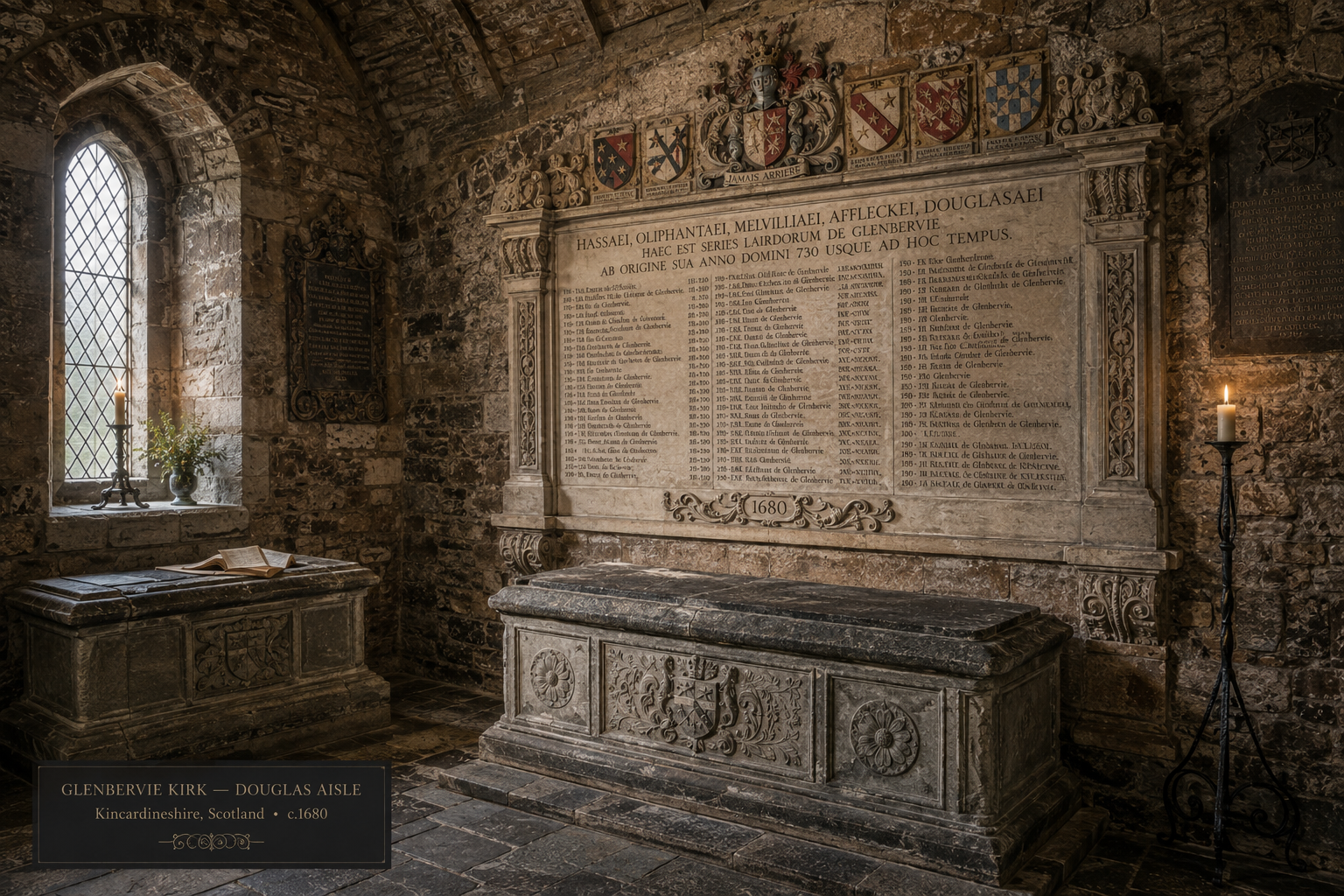
Surviving her husband well into the next century, Gelis used her substantial liferent powers to defend her children’s inheritance through the complex regional court systems, ensuring the family name remained uncompromised.
The unyielding pride and vast territorial ambition that William and Gelis forged in the crucible of the 1588 succession crisis created an elite blueprint that their descendants would carry for generations. Yet, the deep legal acumen that allowed this family to survive the predatory court chambers of King James VI did not begin with the House of Douglas.
The calculating, courtroom brilliance that protected the Angus estates had been systematically engineered a generation prior, along the rugged north-eastern coast of Scotland, where the Grahams of Morphie first learned to weaponize property law as a tool of survival. To find the source of the steel that Egidia brought to the earldom, the narrative must turn its gaze toward the ancient stone strongholds of Kincardineshire, where her own father ruled his lands with an iron hand.