Parliament Close
The Bookshops That Built Edinburgh
Long before Edinburgh became known as the "Athens of the North," one narrow lane beside St. Giles' Cathedral quietly laid the foundations for Scotland's intellectual revolution.
Its name was Parliament Close in 1675 - 1700.
Today, thousands of visitors walk across Parliament Square without realizing that beneath the modern paving stones once stood one of Britain's greatest concentrations of booksellers, printers, lawyers, merchants, and craftsmen. During the seventeenth century, this remarkable street became the commercial heart of Scotland's publishing industry, where ideas were bought and sold alongside Bibles, schoolbooks, legal papers, and maps.
Among its most respected businesses stood the bookshop of Gideon Shaw, identified by a painted sign known as
‘The Blue Bible’ from 1675-1687.
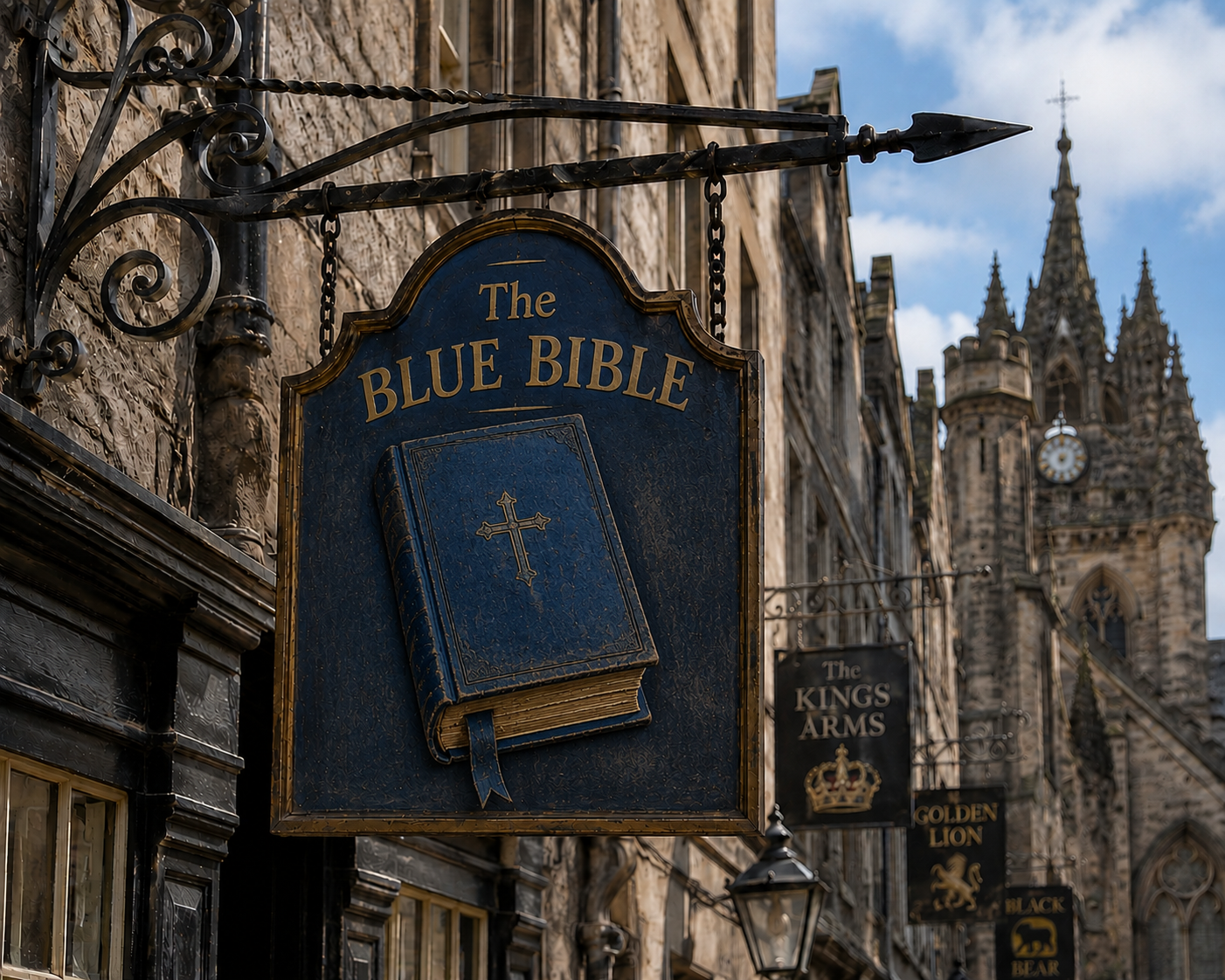
Gideon Shaw’s ‘The Blue Bible’ bookshop on Parliament Close 1675-1687
A Street Reserved for the Finest Trades
Parliament Close was never an ordinary marketplace.
In 1643, the Edinburgh Town Council ordered that the shops surrounding Parliament House should be occupied only by the city's most prestigious trades. Goldsmiths, jewellers, watchmakers, mathematical instrument makers, and booksellers were encouraged to establish themselves there, transforming the district into one of Scotland's most distinguished commercial addresses.
Unlike the noisy food markets elsewhere in the city, Parliament Close catered to professionals, merchants, lawyers, ministers, and educated citizens who came seeking knowledge, luxury goods, and legal services.
Before Street Numbers
Visitors searching for a shop in seventeenth-century Edinburgh would not have looked for a numbered address.
Instead, every business was identified by a painted hanging sign.
The city was filled with memorable names:
The King's Arms
The Golden Lion
The Black Bear
The Angel
Among them stood the Blue Bible bookshop, the bookseller's sign used by Gideon Shaw, stationer and burgess of Edinburgh.
Historical bibliographer H. G. Aldis records him simply as:
"Shaw, Gideon, stationer. 1670–1687. Edinburgh, in the Parliament Close at the sign of the Blue Bible."
That single entry preserves the address of one of Parliament Close's forgotten bookshops.
More Than a Bookshop
A modern bookstore sells books.
A seventeenth-century stationer's shop supplied an entire community.
Customers entered the Blue Bible shop looking for:
Bibles
Psalters
Schoolbooks
Sermons
Blank account books
Writing paper
Ink
Quills
Legal forms
Printed proclamations
Pamphlets
Every shipment arriving from Edinburgh's printers helped spread literacy throughout Scotland.
The World Outside the Door
Stepping outside the Blue Bible shop, a visitor found themselves surrounded by the institutions that governed Scotland.
Only a few steps away stood:
Parliament House
The Court of Session
St. Giles' Cathedral
Advocates' chambers
Merchants' offices
Goldsmiths' workshops
Fellow booksellers
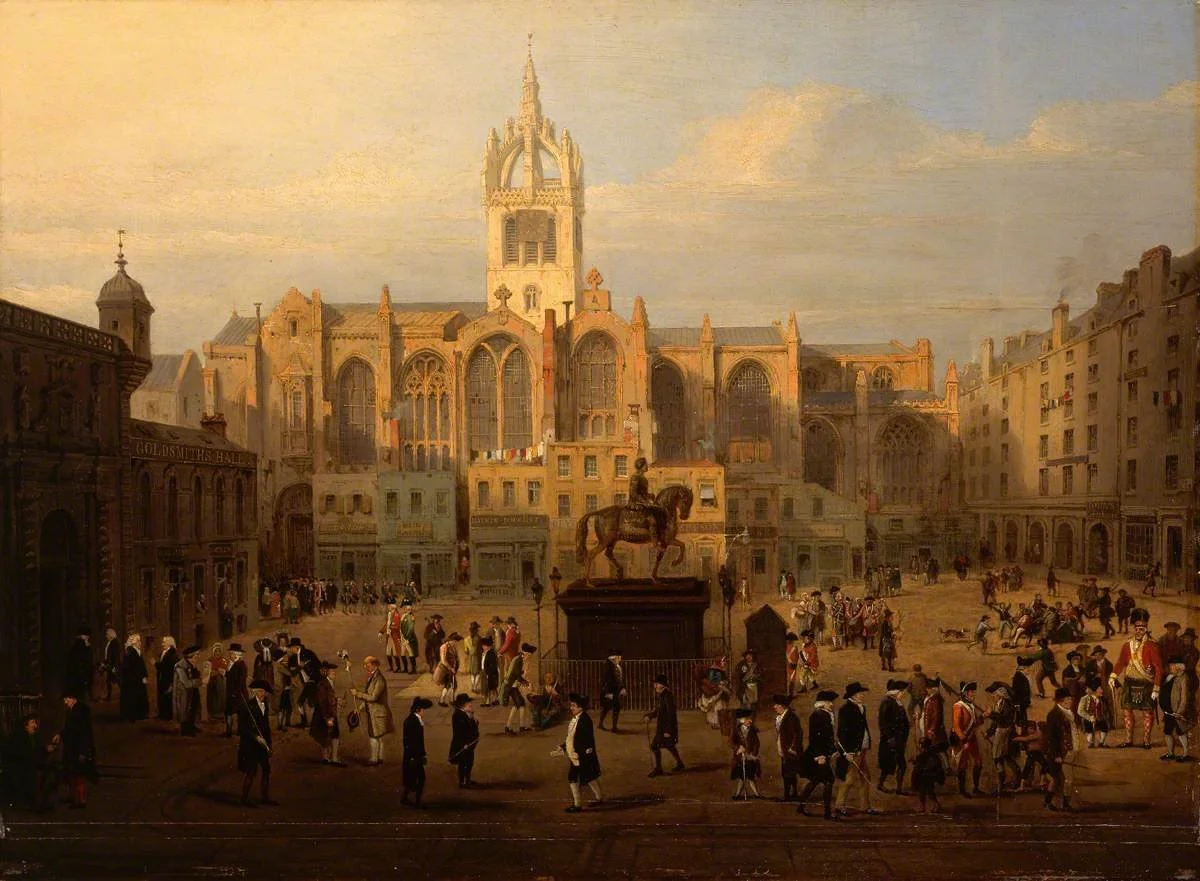
Parliament Square after 1690 (*credit: Museums & Galleries Edinburgh – City of Edinburgh Council)
Lawyers hurried to court carrying bundles of legal papers. Messengers crossed the Close delivering documents. Ministers debated theology. Merchants negotiated business. Printers delivered freshly bound books to waiting customers. Every day, Parliament Close buzzed with conversation.
Gideon Shaw's Remarkable Network
Gideon Shaw occupied a respected position within Edinburgh's commercial community.
He married Elizabeth Cunninghame, daughter of merchant William Cunninghame, connecting his household to one of the city's established merchant families. Parish records repeatedly show members of the Cunninghame family acting as witnesses at the baptisms of the Shaw children, reflecting the close commercial and social ties between these families.
Shaw was also more than a shopkeeper.
He was a burgess, a guild brother, a master who trained apprentices, and one of Edinburgh's recognized stationers. Among the young men who entered his shop as apprentices was Andrew Chalmers, son of James Chalmers of Dam, whose apprenticeship was formally recorded in 1683.
A Street That Changed the World
When Gideon Shaw first opened the Blue Bible, Edinburgh's publishing industry was still relatively small.
Within a generation, Parliament Close would become the center of an extraordinary intellectual transformation.
The same streets that echoed with the footsteps of seventeenth-century stationers would later serve the age of David Hume, Adam Smith, William Creech, Allan Ramsay, and the Scottish Enlightenment.
Ideas that reshaped economics, philosophy, science, and politics would pass through the hands of booksellers working only yards from Gideon Shaw's shop.
Most of Parliament Close has changed beyond recognition.
The medieval tenements are gone.
The painted shop signs have disappeared.
The Blue Bible no longer hangs above its doorway.
Yet for nearly two decades, Gideon Shaw welcomed customers beneath that sign, serving lawyers, ministers, merchants, students, and ordinary readers from one of Scotland's most important streets. Parliament Close was never simply a place to buy books. It was where knowledge met commerce, where apprentices learned their trade, where merchants exchanged ideas, and where the foundations of Scotland's literary and intellectual future were quietly laid—one book at a time.
The equestrian statue of King Charles II in Parliament Square, Edinburgh was erected in 1685.
Both Gideon Shaw & Andrew Chalmers would have known the statue in their time.
For Your Reference;
H. G. Aldis, A List of Books Printed in Scotland Before 1700 (entry for Gideon Shaw and the Blue Bible).
Parliament Square Edinburgh Project (development of Parliament Close and the publishing trade).
Edinburgh Burgess and Guild records.
Edinburgh apprenticeship records for Gideon Shaw and his apprentices.