William Carruthers of Breconside
the Origins of William Carruthers (1671–1720)
One of the greatest frustrations in Scottish genealogy is that history naturally remembers the men who inherited—but often forgets the generations who did not.
Estate charters followed the laird. Retours identified the heir. Testaments settled property. Younger sons, however, frequently disappeared into the background of history, leaving only scattered appearances in legal papers, land transactions, church registers, or family correspondence. Once they established households of their own, many simply vanished from the surviving record.
That documentary silence lies at the heart of one of the most intriguing questions in the Carruthers family:
Who was William Carruthers of Breconside?
No surviving document has yet identified his parents.
No surviving charter places him within the principal Carruthers line.
Yet, just as importantly, no surviving record places him within any other Carruthers family.
When the surviving evidence is assembled—not one document at a time, but as a complete historical picture—a compelling pattern begins to emerge.
This article explores why Kings of the Blue Ridge reconstructs William Carruthers as most likely belonging to the cadet branch of the Carruthers of Holmains, and why that conclusion rests upon considerably more than family tradition alone.
The Marriage That Started the Investigation
The investigation into William's origins actually begins with his wife.
Margaret Chalmers was not the daughter of an obscure tenant farmer or village tradesman.
She belonged to an established Ayrshire family whose documentary record places them among the landed gentry serving the Scottish Crown during the late Stuart period.
Her father, James Chalmers of Dam, was consistently styled "of Dam" in contemporary records—a designation identifying him with an established estate rather than a leased farm. Surviving legal documents and royal records place him within the social and political world surrounding the Stuart monarchy, where he served as a gentleman closely associated with Crown administration.
Margaret's mother, Janet Johnstone, brought equally distinguished ancestry into the marriage. Through her, Margaret descended from the Johnstones of Breconside, a respected landed branch of one of the most influential Border families in southwest Scotland.
This was not an ordinary household.
These were families accustomed to managing estates, negotiating legal contracts, and participating in the social networks of Scotland's landed society.
That background immediately raises an important historical question.
Why does a woman from such a family appear to marry a man whose parentage has disappeared almost entirely from the documentary record?
Marriage
Seventeenth-century Scottish marriages were rarely random.
Among the landed classes, marriages commonly strengthened family alliances, protected property, reinforced political relationships, and preserved social standing across neighboring estates.
Certainly, exceptions existed. Love undoubtedly played its part. Financial reversals, widowhood, political upheaval, or illegitimacy occasionally produced marriages that crossed social boundaries.
But those exceptions generally left traces within the historical record.
No such explanation has yet surfaced for Margaret Chalmers.
Instead, history presents us with William Carruthers—a man whose parentage remains undocumented despite marrying into one of the better-documented families of southwest Scotland.
That absence has led some researchers to conclude that William must simply have been an unrelated Carruthers of modest standing.
Yet history rarely rewards arguments built solely upon silence.
Instead, historians ask a different question:
What explanation best fits the surviving evidence?
Holmains
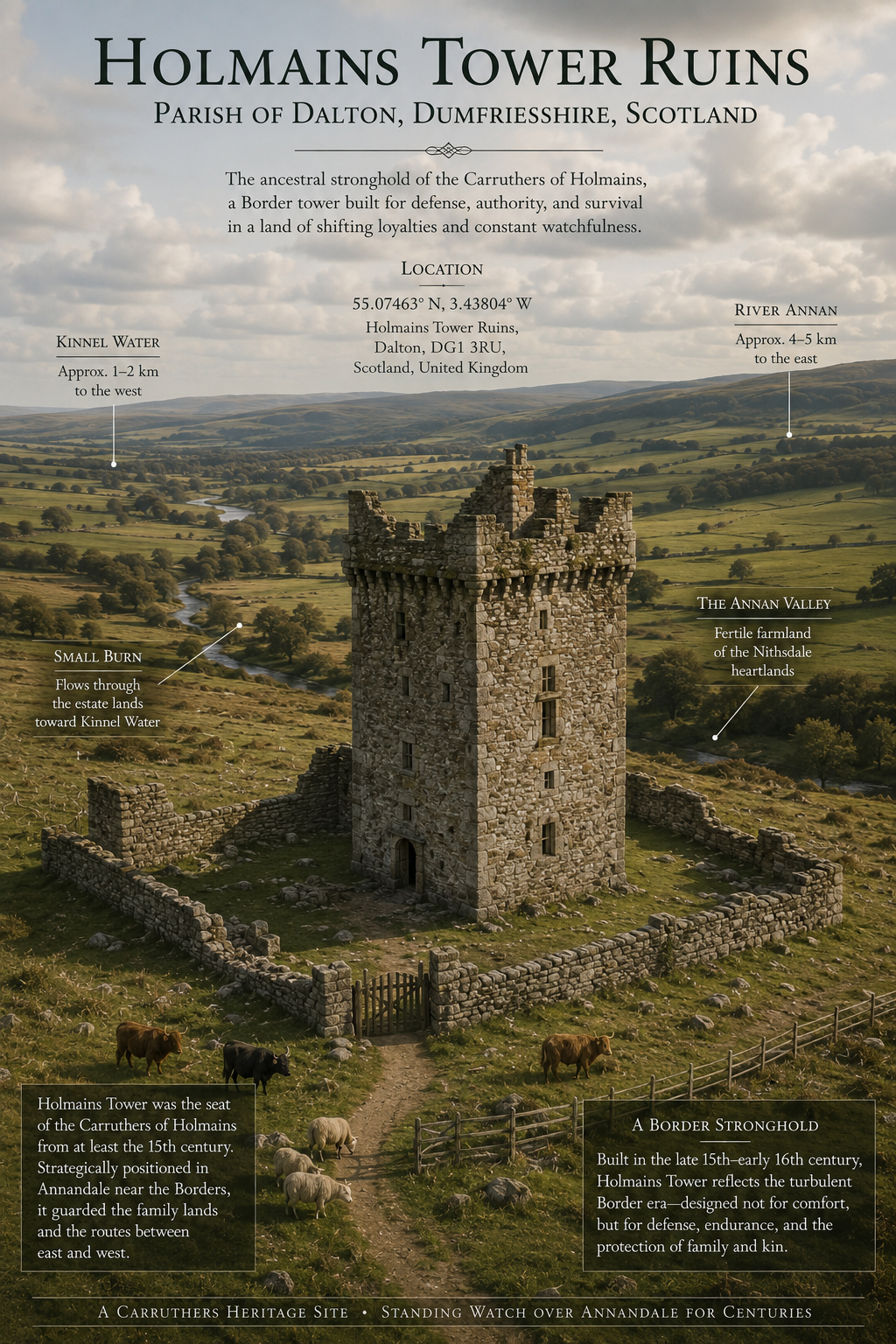
Among all documented Carruthers branches surviving into the late seventeenth century, one family consistently satisfies William's chronology, geography, social standing, and documented associations better than any other.
The Carruthers of Holmains.
By the late seventeenth century, Holmains represented the principal surviving branch of the Carruthers family. The estate produced generations of lairds, military officers, attorneys, and landed gentlemen whose influence extended throughout Annandale and the neighboring Border districts.
Just as importantly, not every member of that family is fully documented.
Scottish inheritance overwhelmingly favored the eldest son.
Estate histories naturally followed the succession of lairds because those men inherited the property, maintained the family title, and generated the legal records historians rely upon today.
The younger sons lived very different lives.
Some entered military service.
Others became lawyers, merchants, ministers, or established households upon smaller holdings nearby. Many appear only briefly before disappearing almost entirely from the surviving record.
This pattern was neither unusual nor unique.
It was simply how seventeenth-century Scottish record keeping worked.
Understanding that reality changes the way we must approach William Carruthers.
Rather than asking why no surviving charter names him as a younger son of Holmains, we should first ask whether we would reasonably expect such a record to survive at all.
For many younger sons of Border families, the answer is often no.
Breconside Connection
One document became particularly significant during this investigation.
In 1699, members of the Carruthers family of Holmains appear in a documented financial transaction connected with Breconside.
At first glance, it appears to be an ordinary legal matter.
Yet Breconside was far more than another neighboring estate.
It belonged to Margaret Chalmers' maternal family through the Johnstones.
That single record demonstrates something important.
The Carruthers of Holmains and the Johnstones of Breconside were not isolated families living in separate worlds.
They were conducting documented legal and financial business with one another during precisely the generation in which William and Margaret established their own household.
No single transaction proves kinship.
Nor should it be asked to.
Its importance lies elsewhere.
It firmly places the Holmains Carruthers and Margaret's maternal family within the same documented social and economic network at exactly the right moment in history.
That is precisely the type of contextual evidence historians seek when direct statements of parentage have not survived.
Small Piece of a Larger Puzzle
Another document deserves mention, although it should not be overstated.
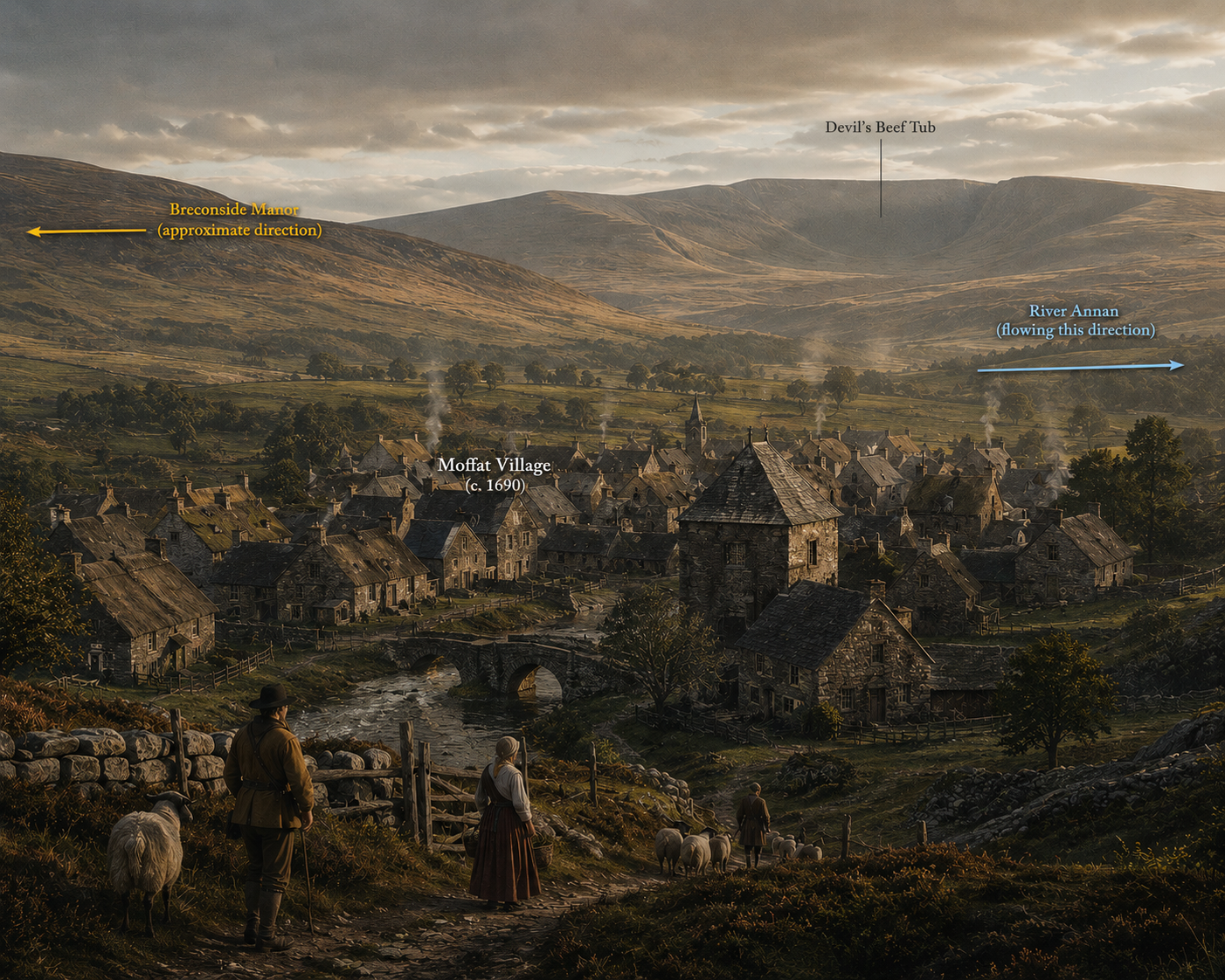
A contemporary legal transaction records John Carruthers of Holmains dealing with a Carruthers tenant at Knows, one of the holdings belonging to the Holmains estate.
Standing alone, the record proves very little.
It neither names William Carruthers nor identifies his parents.
Nor should it be treated as evidence that it does not contain.
Its value lies in what it quietly confirms.
The record demonstrates that multiple Carruthers households existed within the immediate orbit of the Holmains estate during precisely the generation in which William appears. Rather than revealing a single isolated family, it reminds us that the broader Carruthers community extended well beyond the line of successive lairds.
Like the Breconside transaction, it is not the foundation upon which this reconstruction rests.
It is simply another small piece of a much larger historical picture.
The Missing Generation
Perhaps the greatest obstacle in reconstructing William's ancestry is the documentary gap itself.
No surviving charter identifies William Carruthers as a younger son of the Ninth Laird of Holmains.
Neither, however, does any surviving document exclude that possibility.
Instead, we find ourselves looking into one of the least well-documented generations of the family, where younger sons become increasingly difficult to follow after leaving the principal inheritance.
That silence has sometimes been interpreted as evidence against a Holmains connection.
In reality, it may simply reflect how Scottish estate records were created.
History carefully preserved the succession of Holmains because the estate passed from one laird to the next.
It did not necessarily preserve the lives of every brother who did not inherit.
For genealogists, this is a familiar challenge. The absence of evidence is not always evidence of absence.
Sometimes it simply reflects the limitations of the surviving record.
Following the Weight of the Evidence
Historical reconstruction is rarely built upon one spectacular discovery.
More often, it emerges from numerous independent pieces of evidence that begin pointing toward the same conclusion.
Consider the cumulative picture.
Margaret Chalmers belonged to a well-documented landed family.
Her mother descended from the Johnstones of Breconside.
Members of the Carruthers of Holmains conducted documented legal business with the Breconside family during the same generation.
William Carruthers appears at exactly the right point in time, yet without surviving documentation identifying his parents.
Scottish inheritance practices routinely left younger sons with only fragmentary documentary trails, particularly once they established independent households.
None of these observations independently proves William's parentage.
Together, however, they create a historical context that is difficult to dismiss.
Rather than portraying William as an isolated figure who appeared without ancestry, property, or social connections, the surviving evidence consistently places him within the same world occupied by the Carruthers of Holmains and the families with whom they regularly interacted.
The conclusion is necessarily cautious.
The precise relationship—whether as a younger son, grandson, nephew, or another close cadet relation—remains unknown.
But the documentary evidence strongly suggests that William belonged much more closely to the Holmains family than surviving records explicitly reveal.
Why Reconstruct William This Way
Some readers may ask why Kings of the Blue Ridge reconstructs William Carruthers as probably belonging to the cadet branch of the Carruthers of Holmains when no surviving document states that conclusion outright.
The answer is rooted in historical method.
History is rarely preserved through one perfect record.
If that were the standard, enormous portions of seventeenth-century Scotland would disappear from the historical narrative altogether.
Instead, historians evaluate chronology, geography, social custom, documented family relationships, estate history, legal transactions, and the broader historical context to determine which explanation best fits the surviving evidence.
That is precisely the approach taken here.
This reconstruction is not presented as proven fact.
Nor is it based upon family tradition alone.
It represents the interpretation that presently best explains the surviving documentary record.
Should an undiscovered charter, family Bible, testament, or estate paper someday identify William's parents with certainty, that evidence should immediately take precedence.
Good history welcomes better evidence.
A Family Nearly Forgotten
At present, the documentary record does not allow William Carruthers to be identified with certainty as a younger son of the Ninth Laird of Holmains. Although, it’s highly probable.
It does, however, place him within the same generation, the same region, the same social sphere, and the same documented network surrounding the Holmains family.
Until stronger evidence emerges, that remains the most historically convincing explanation for William's origins.
Perhaps that is the greatest lesson genealogy teaches us. Sometimes history survives in one remarkable charter or testament.
More often, it survives in dozens of quiet records that, when assembled with patience and care, reveal the outline of a family that time nearly forgot. And occasionally, those forgotten lives become the foundation upon which entirely new generations—and entirely new stories—are built.