The Estate of Dam
A Border Gentleman at the Crossroads of History
Long before the Chalmers family became connected to the royal bloodlines of Scotland through marriage, they had already established themselves as one of the respected landed families of Dumfriesshire. Their home was Dam, a modest but strategically important estate lying between the ancient lands of Morton, Pantonacre, and Ludovickland in Nithsdale. Unlike the great royal castles that dominate Scotland's tourist guides today, Dam represented something equally important—the working estate of the Scottish gentry.
It was here that James Chalmers of Dam built the household that would eventually unite with the distinguished Johnstones of Corehead, connecting two influential Border families whose descendants would carry their heritage for generations.
A Gentleman of the Border
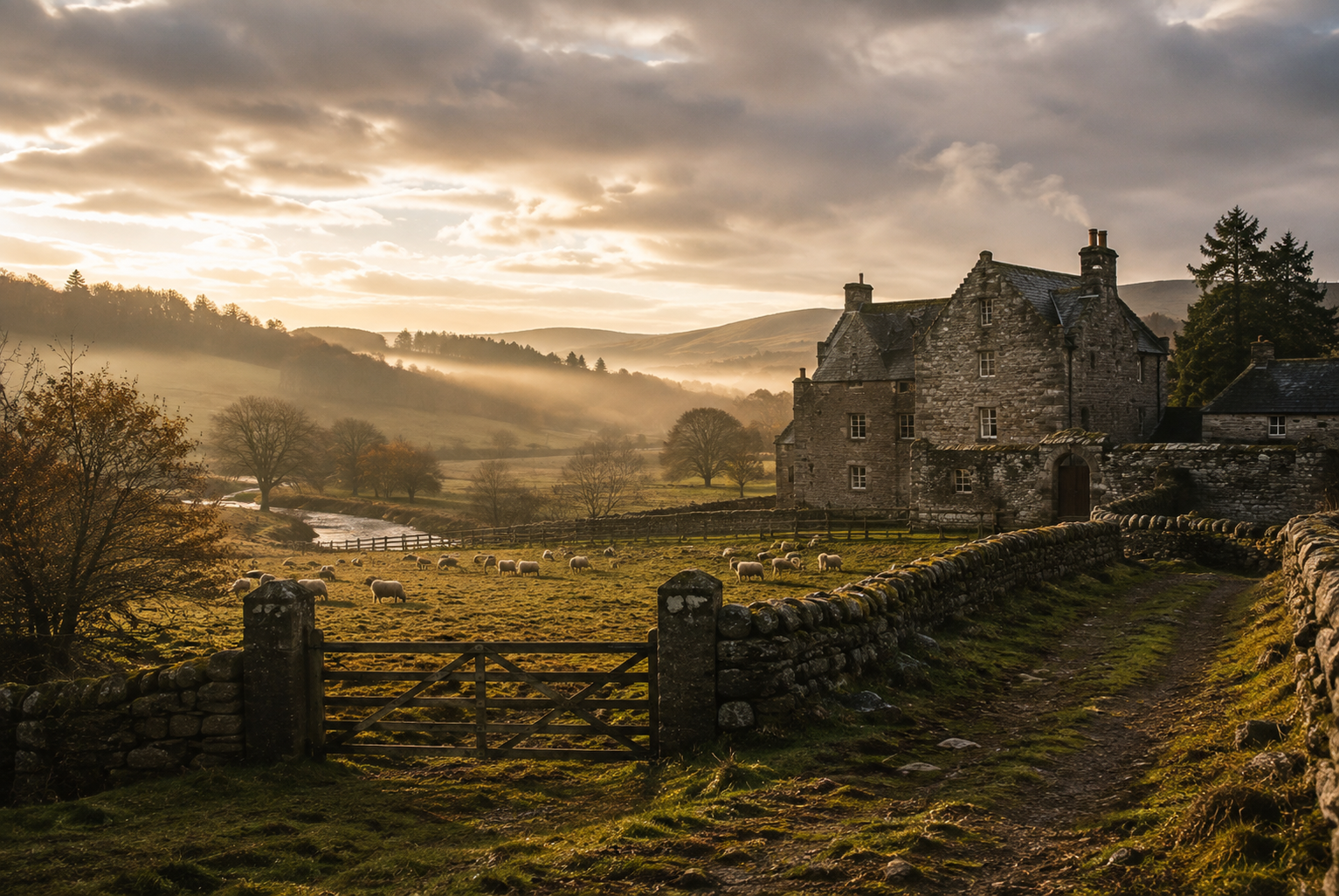
James Chalmers was born into a Scotland still recovering from generations of civil conflict, religious upheaval, and political uncertainty. The Chalmers family were not wandering farmers or frontier settlers. They belonged to Scotland's landed gentry—a class entrusted with administering estates, serving local government, witnessing legal transactions, and maintaining order throughout their districts. The estate of Dam occupied productive agricultural land in western Dumfriesshire, surrounded by fertile fields, grazing livestock, woodlands, and the roads connecting Nithsdale with Annandale. While the great nobles governed entire regions, men like James Chalmers formed the backbone of local society.
Building a Working Estate
Life at Dam revolved around careful management. Every season demanded planning.
Tenant farmers cultivated oats, barley, peas, and hay while herds of cattle and flocks of sheep provided the wealth upon which the estate depended. Horses remained essential, not only for farming but also for travel between neighboring estates and the sheriff courts of Dumfriesshire.
Within the household, servants maintained kitchens, bakehouses, dairies, smokehouses, and store rooms filled with salted meat, cheese, grain, and ale prepared to last through the long Scottish winters.
Estate accounts recorded rents, livestock, repairs, and agricultural production with remarkable precision. A successful gentleman needed to understand both law and farming equally well.
Scotland Under Cromwell
James's early adulthood unfolded during one of the most extraordinary periods in British history.
In 1650, Oliver Cromwell invaded Scotland after the execution of King Charles I. English armies defeated Scottish forces at Dunbar and Worcester, bringing the kingdom under military occupation. For nearly a decade, Scotland ceased to function as an independent kingdom. English soldiers occupied major towns. Heavy taxes funded the occupation.
Traditional noble authority weakened as military governors enforced Parliament's rule. Although Dam lay away from the largest garrisons, families throughout Dumfriesshire felt the effects. Roads carried soldiers as often as merchants, and every landowner faced new financial burdens imposed by the occupying government.
The Return of the King
Everything changed in 1660.
After years of republican government, Charles II returned to Scotland and England during the Restoration. For many landed families, including the Chalmers household, the return of the monarchy brought renewed political stability and the restoration of traditional government. Yet peace proved temporary. The Crown soon sought tighter control over the Church of Scotland, igniting fierce resistance among Presbyterians across the southwest.
The Border During the Killing Times
By the late 1670s and early 1680s, Dumfriesshire had become one of the centers of religious conflict. Secret outdoor worship services—known as conventicles—were held throughout the hills and valleys despite government bans. Royal troops rode constantly across the countryside searching for ministers and worshippers.
Government officers demanded food, horses, and lodging from local estates. Neighbor often found himself divided against neighbor. Families like the Chalmers walked an extraordinarily delicate line. As respected landowners, they were expected to cooperate with government officials while preserving the stability of their own communities. Every political decision carried consequences, and every public action was carefully observed.
A Marriage of Influence
Against this turbulent backdrop, James Chalmers married Janet Johnstone, daughter of James Johnstone of Corehead and Janet Douglas.
The marriage united two distinguished Dumfriesshire families. From the Johnstones came generations of Border leadership and public service in Annandale. From the Douglases flowed one of Scotland's oldest aristocratic bloodlines, reaching back through medieval earls, royal commanders, and some of the nation's greatest heroes. Together, these families strengthened both their social standing and their political influence throughout the southwest of Scotland.
A Changing Kingdom
The Glorious Revolution of 1688 once again transformed Britain.
King James VII was driven from the throne. William III and Mary II assumed the crown.
Throughout Scotland, local governments, militia commissions, and regional leadership were reorganized almost overnight. Families who had successfully navigated decades of civil war, occupation, restoration, and religious conflict suddenly found themselves adapting to yet another political order. The Chalmers family survived because they understood that true leadership required flexibility as much as conviction.
The Legacy of Dam
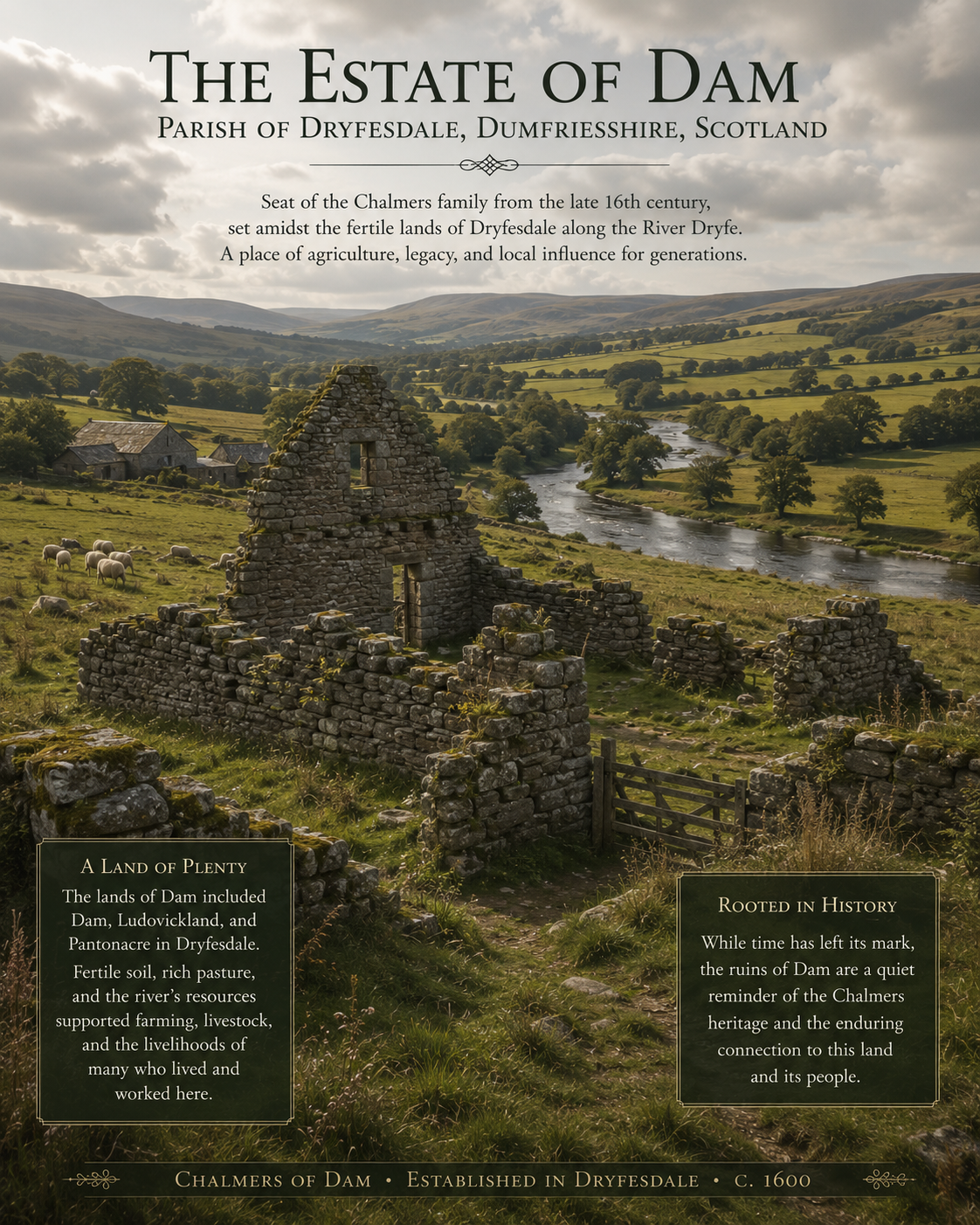
Today, little remains of the estate that once anchored the Chalmers family within the Dumfriesshire gentry. Yet Dam represented something far greater than a single house or farm. It was the place where legal ability met agricultural stewardship. Where Border resilience met noble ambition. Where one strategic marriage connected the Chalmers family to the Johnstones, the Douglases, the Lockharts, and ultimately to Scotland's royal bloodlines.
Long before their descendants appeared in America, the foundations of that remarkable story were already being written among the quiet fields of Dam—where faithful stewardship, education, public service, and carefully forged alliances shaped a family whose influence would reach far beyond the hills of Dumfriesshire.