The Coffin Ships
The Coffin Ships Before the Irish Famine
When most people hear the phrase “coffin ships,” they immediately think of the Great Irish Famine of the 1840s — overcrowded vessels carrying starving emigrants across the Atlantic toward North America. Yet the grim reputation surrounding Atlantic migration by sea did not begin during the famine itself.
Long before the black years of potato blight devastated Ireland, the Atlantic crossing already carried fear, disease, uncertainty, and death.
For generations, emigrants leaving Scotland, Ulster, and the wider Irish Sea world entered an ocean migration system that was often dangerous, poorly regulated, and deeply unforgiving. By the eighteenth century, thousands of ordinary families boarded cramped wooden sailing vessels bound for the American colonies with little understanding of what awaited them beyond the horizon.
Many never arrived. The term “coffin ship” truly became attached to the famine period because the ships themselves became associated with mass death.
Leaving the Old World
To step aboard an emigrant ship in the early 1700s was not simply to begin a journey — it was to sever yourself from an entire world.
Families departing from ports along the Scottish coast, Ulster harbors, or northern English ports often knew they would never again see the villages, kirkyards, farms, or coastlines they left behind. Some carried letters of introduction or small family Bibles. Others boarded with little more than blankets, tools, clothing, and whatever food could survive the crossing.
For poorer emigrants especially, the voyage itself existed somewhere between hope and desperation.
Economic hardship, rising rents, failed harvests, political instability, religious tension, and generational poverty pushed many toward the Atlantic world. In the Scottish Borders and Ulster alike, entire kinship networks gradually became tied to migration patterns stretching toward Pennsylvania, the Carolinas, Virginia, and the Appalachian frontier.
But the ocean stood between survival and catastrophe.
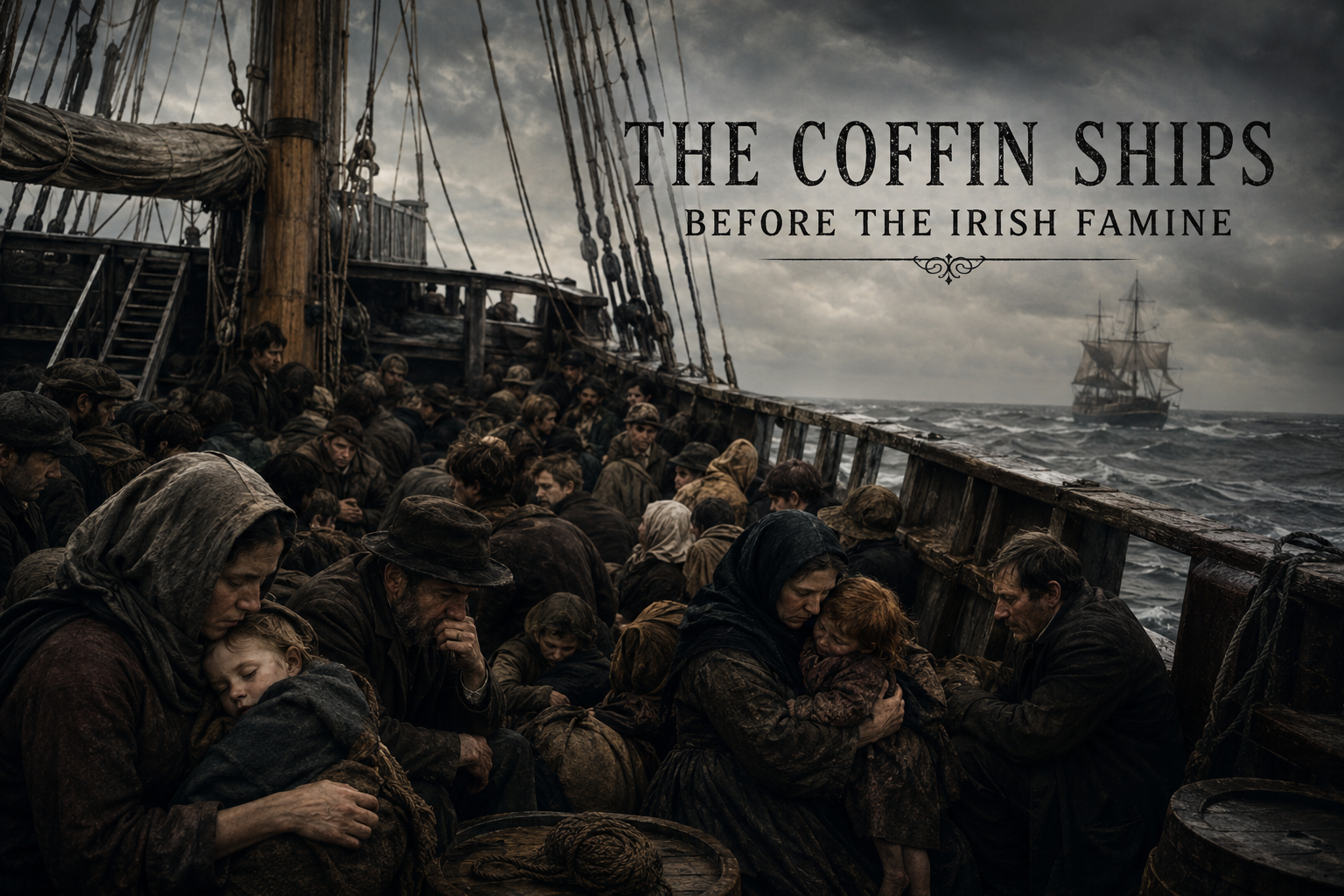
The Reality Below Deck
The romantic image of early migration often disappears once the conditions aboard these vessels are examined closely.
Most emigrant ships were not designed for passenger comfort. They were merchant vessels first — adapted temporarily to carry human cargo across the Atlantic. Below deck, space was cramped, dark, damp, and poorly ventilated. Families slept packed tightly beside strangers among chests, barrels, livestock, and supplies.
The smell alone could become overwhelming.
Saltwater seeped through timbers. Air stagnated below deck during storms. Seasickness spread rapidly. Human waste accumulated in confined spaces while vermin moved through bedding and food stores. Fresh water often spoiled during the voyage. Rations could become moldy, rotten, or insufficient long before landfall.
Passengers frequently battled:
dysentery
typhus
fever
malnutrition
dehydration
respiratory illness
infection
Children were especially vulnerable.
Storms transformed the crossing into terror. During rough seas, passengers could remain trapped below deck for days while waves hammered the hull overhead. Darkness, vomiting, fear, prayer, and the sound of cracking timber became part of daily existence on the open Atlantic.
And always there remained the possibility that the ship itself might never arrive.
Death at Sea
Mortality aboard emigrant ships long predated the Irish Famine era.
Disease outbreaks regularly swept through Atlantic crossings during the eighteenth century. Infants died. Elderly passengers weakened quickly. Fever spread easily through crowded holds. When death occurred at sea, burial came swiftly.
Wrapped in cloth or weighted canvas, bodies were committed directly into the ocean.
For many emigrants, the Atlantic became an unmarked grave separating generations forever from their ancestral homelands.
The phrase “coffin ship” eventually became most associated with the famine migrations because mortality reached horrific levels during the 1840s. Yet the underlying dangers — overcrowding, disease, poor provisioning, exploitative shipowners, and vulnerable passengers — had existed for generations beforehand.
The famine years simply exposed the system at its absolute worst.
The Scots-Irish Atlantic World
For Scots-Irish and Border-descended families, migration often unfolded gradually across generations rather than through one single departure.
Some families first moved from southwestern Scotland into Ulster during the seventeenth century. Later generations departed Ulster for Pennsylvania or the American South during the eighteenth century. Maritime routes linking Dumfriesshire, Galloway, Belfast, Londonderry, Whitehaven, and Glasgow became part of an interconnected migration network carrying ordinary people steadily westward.
The Atlantic crossing became a defining emotional rupture within many family histories.
Parents left behind children. Brothers separated permanently. Widows boarded ships seeking survival. Young laborers signed indentures to pay for passage. Entire futures depended upon surviving weeks or months at sea.
And for every successful arrival, countless untold stories vanished into the water itself.
Fear, Faith, and the Horizon
To stand on the deck of an emigrant vessel leaving the British Isles was to watch the known world disappear slowly into mist.
Passengers gathered along the rails staring back toward fading coastlines — the hills of Scotland, the shores of Ulster, the cliffs of Ireland, or the gray outline of Wales shrinking behind them. For many, it was the final sight of home they would ever carry.
Religion became central aboard many crossings.
Passengers prayed through storms. Psalms echoed below deck. Ministers sometimes traveled among emigrants while families clung to scripture, superstition, or old folk beliefs to endure the uncertainty surrounding them. Sailors themselves often carried deep maritime superstitions shaped by generations of Atlantic danger.
At night, the sea could feel endless.
Only stars, darkness, and the creaking of timber surrounded those crossing toward an unknown continent.
Before the Famine, Before the Legend
The Great Irish Famine later transformed the image of the coffin ship into one of the most enduring symbols of Atlantic suffering. But the roots of that tragedy stretched far deeper into the earlier migration world of Scotland, Ulster, and the British Atlantic.
The ocean crossing was always dangerous.
Long before the famine, ordinary emigrants already understood that boarding a ship meant gambling their lives against weather, disease, hunger, and the sea itself. Some arrived in America carrying little but survival. Others disappeared entirely from the historical record somewhere between coastlines.
Yet despite the risks, they continued to go.
Because behind every departure stood the same fragile hope carried by generations before them: that somewhere beyond the horizon, life might become possible again.