The Girl, Bacon Level & the Chattahoochie
Recently, I published a family history called ‘Kings of the Blue Ridge’.
It spans 7 chapters and 7 generations, from the ship to shore, from Pennsylvania to the Great Wagon Road to North Carolina, then Tennessee. The final chapter lands in eastern Alabama, across the Chattahoochee River from Georgia.
A piece of my family history. A branch in my maternal line.
I opened with my great-great-great-grandparents, William John Dean (1843) and Martha Jane Graham (1853), who were both raised in Chambers County, in the old farm country around ‘Bacon Level’ in the mid-1800s.
Bacon Level?
A 1900 Alabama Baptist newspaper that describes Bacon Level as a small village near Rock Mills.
As children, William and Martha knew mostly farms, open fields, wagon roads, and small communities. Cotton was everywhere because their families depended on it. They planted and picked it and hauled it to market.
The Chattahoochee ran along the eastern side of Chambers County and formed the state line with Georgia. It was the lifeblood, highway, and boundary line of the whole region. Long before white settlers arrived, the valley was the ancient homeland of the Lower Creek Nation.
In 1820-1832, the federal government forcibly removed the Muscogee people.
This opened the river bottomlands to an influx of white land speculators, cotton planters, and farming families migrating from Georgia and the Carolinas.
The river corridor was dense with sweetgum, river birch, willow, and towering loblolly pine, draped in wild muscadine vines and Spanish moss. The waters were teeming with channel catfish, redear sunfish, and freshwater mussels, which offered an easy supper when times were lean, but the river also brought dangers—alligators, water moccasins, and the ever-present threat of flooding.

Chattahoochee River 1880
The Chattahoochee ran along the eastern side of Chambers County and formed the state line with Georgia. For the families living there, the river wasn’t much of a border. People crossed back and forth all the time. They had relatives on the other side, went to church there, and crossed for work or market day. Ferries, bridges, and wagon roads kept these communities connected.
William was about fourteen years old. Martha was seven. The 1860 census gives a good glimpse of how close their families were.
The Deans were recorded at dwelling 1026. Martha’s family lived at dwelling 1074, only forty-eight households farther along the census taker’s route. Her father, John Graham, was forty-one years old and listed as a farmer.
Chambers was rural, and census takers traveled from one farm and road to another. It tells us that the two families lived in the same part of northern Chambers County years before William and Martha ever married.
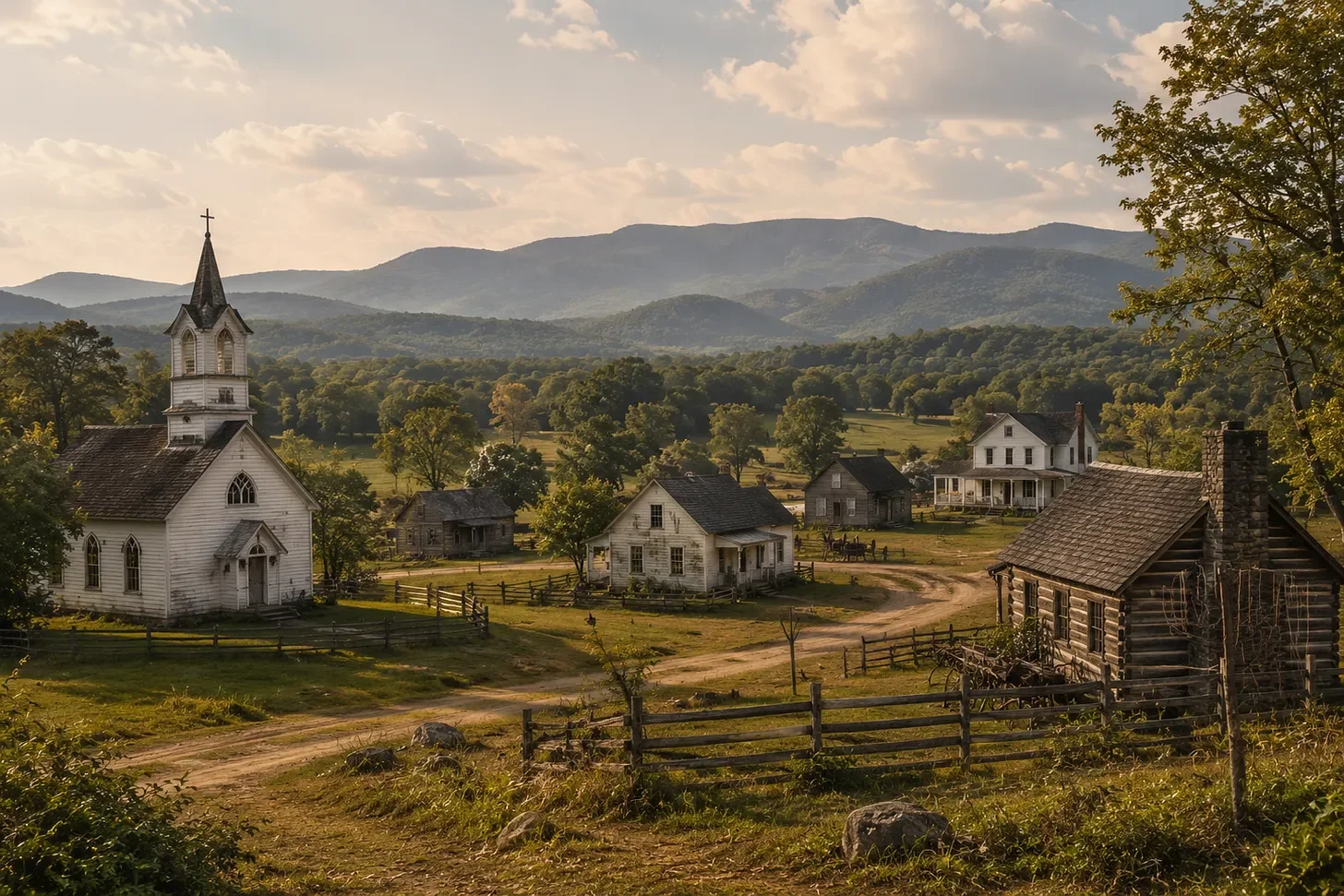
Bacon Level is in Randolph County, just north of Chambers County, Alabama.
Then, in 1861, everything changed. The Civil War began.
Familiar faces vanished from the neighboring farms one by one. Men William had grown up with left Chambers and Randolph Counties for Confederate regiments, leaving families behind to manage farms and somehow keep crops in the ground.
William was only about eighteen when the war began, but he did not appear in the ranks then.
By the war’s final year, the Confederacy was desperately short of men. The age limits for military service had been expanded, reserve units were being organized, and men who had remained at home earlier in the war were increasingly pulled into service.
That is where William suddenly appears in the surviving military record.
I found William Dean listed as a private in Company E of Fannin’s 1st Georgia Reserves.
Why was this young Alabama man serving in a Georgia reserve unit so late in the war?
The geography may help explain it. William grew up in eastern Alabama, where the Chattahoochee was a state line on a map but not necessarily a boundary in everyday life. Families, markets, roads, and communities reached across into western Georgia.
Fannin's 1st Georgia Reserve was organized in spring 1864, and National Park Service research documents that Fannin's regiment was sent to Andersonville, arriving there in May 1864 to serve in connection with the prison defenses/guard force.
No evidence shows when William entered the company, whether he volunteered or was conscripted, or whether he ever fought in a battle. What I can establish is that, as the Confederacy was collapsing, William Dean’s documented name entered the ranks.
In spring 1865, the war finally ended, but peace wasn’t instant. The South was crushed. Slavery had ended; without workers in the fields, large farms began to break up, and southern families were forced to find a new way to survive.
William was back home by 1867, because his name was on the Alabama voter-registration rolls during Reconstruction.
His occupation was recorded as ‘fisherman’. Fishing was not separate from the farm world of eastern Alabama; it was part of it.
Fishing was an occupation and source of income in nineteenth-century Alabama, not simply recreational fishing. Contemporary accounts describe settlers fishing both for their own tables and for profit, using seines, nets, traps, and other methods. Commercial fishing could provide income, although profits were generally modest.
The Chattahoochee was also genuinely rich fishing water. A nineteenth-century history of the river around Columbus describes freshwater fish being taken “in abundance,” including seasonal shad runs, while later fisheries records confirm the Chattahoochee as an established fishery.
And William’s location makes this especially interesting. Chambers County actually bordered the physical Chattahoochee. According to an 1870 description of the county, the river there was not navigable by steamboats. A bonus?
He was home from the war for about a year and a half or so. Just enough time to save up for a bride he probably had his eye on.
William Dean and Martha “Mattie” Jane Graham were married on Sunday, August 22, 1869, in Chambers County, Alabama, with their union officially recorded in the county courthouse register at LaFayette.
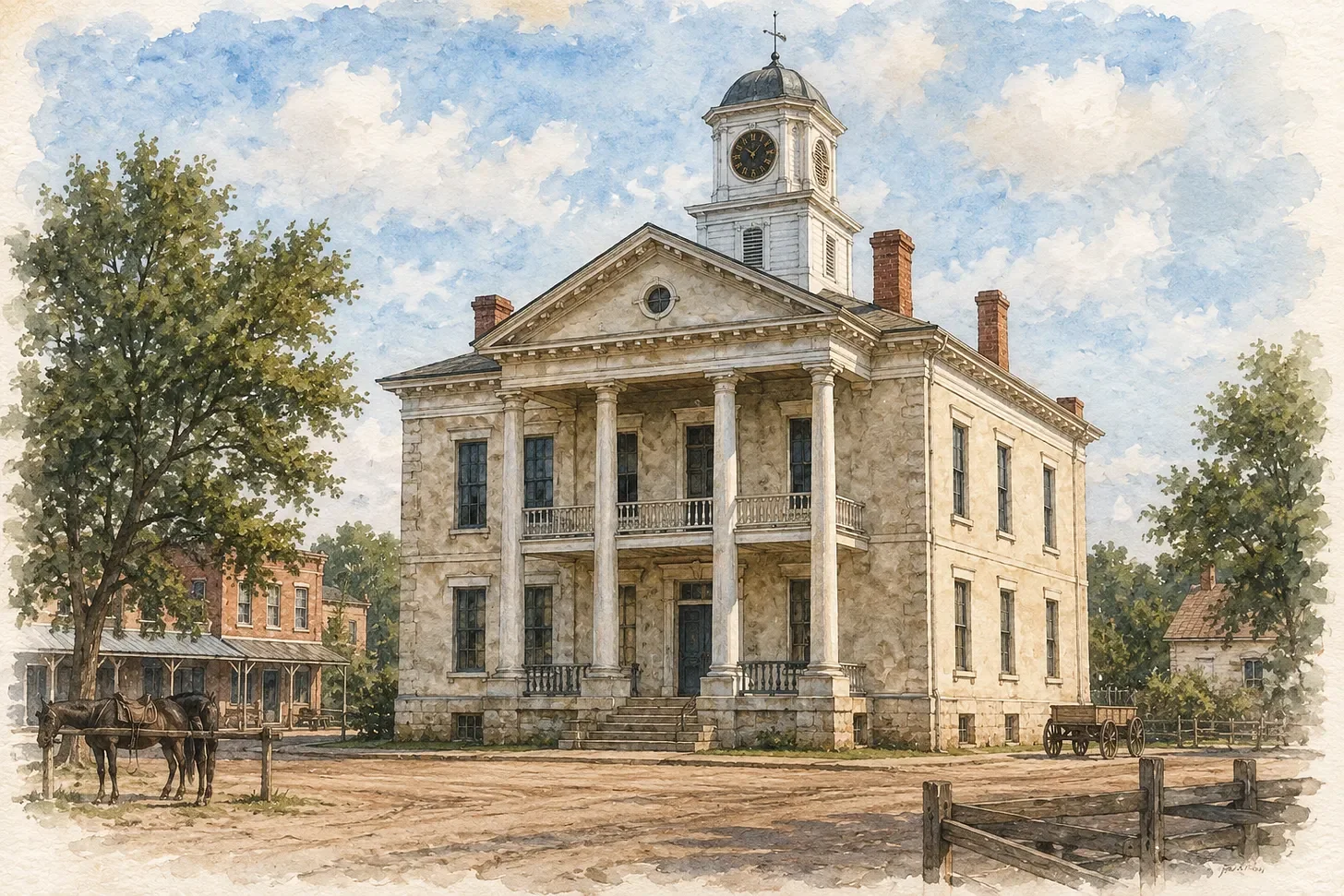
County Courthouse at LaFayette
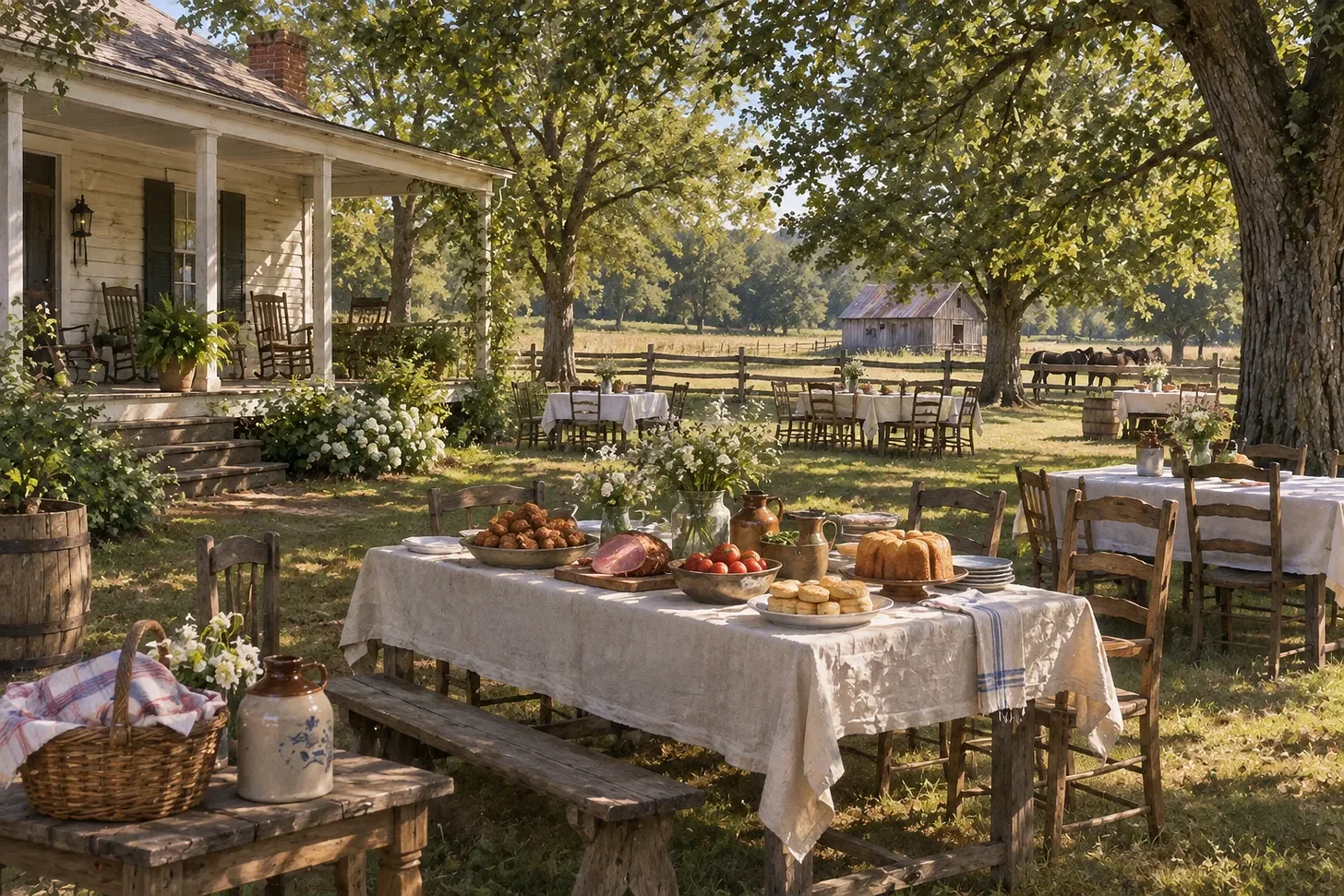
In their rural farming community, weddings rarely took place in churches; instead, the ceremony was almost certainly held at the Graham family home, either in the parlor or outdoors beneath the shade of oak trees to escape the stifling August weather.
East Alabama in late summer was intensely hot and humid, with temperatures in the nineties and country tracks baked into dry red dust that kicked up behind arriving buggies and wagons.
With the South still cash-poor just four years after the Civil War, the gathering was simple, practical, and focused on family. Mattie would not have worn a single-use white bridal gown, but rather her finest “Sunday dress” of sturdy calico or wool that would serve for church services for years to come, while William wore a clean homespun suit and brushed boots.
A local preacher or justice of the peace led them through a short, solemn exchange of vows before a room full of kin. Afterward, the families probably shared a neighborly meal laid out on the porch—platters of fried chicken, cold ham, garden tomatoes, biscuits, and pound cake brought in covered baskets—while neighbors caught up on crop news and enjoyed the brief celebration before the fall cotton harvest began.
In 1873, the young couple welcomed their first son, Emers Eugene Dean. By 1879, Emers, already six years old, welcomed a baby brother, Lee, into the family.
In rural Chambers County, running a home with small children meant hard, nonstop physical labor shaped by the weather. Summers were hot and sticky, often in the high nineties. Cooking over an open fire or woodstove heated the cabin up like an oven, and with no window screens, flies and mosquitoes flew straight inside.
The winter was damp and cold; it blew right up through the floorboards, so a fireplace fire had to burn day and night. When hard rains hit, the red dirt roads turned into thick mud that trapped families on their farms for days.
Martha’s work started in the dark around 5:30 in the morning.
She stirred up the fireplace coals, carried the first heavy bucket of water in from the well, and baked biscuits and fried pork for breakfast. After that came milking the cows, straining the milk into stone jars, and feeding the chickens. She spent her afternoons hoeing the garden or teaching one of the kids how, then churning butter, making lye soap, or canning berries and drying fruit for the winter.
After a big noon dinner of peas and cornbread, she washed greasy pots with boiling water and went right back to work.
Yes, “noon dinner” was a very common phrase.
People used it to be completely clear which meal they were talking about, especially when giving directions, scheduling work, or setting a time for guests to arrive (e.g., “Come by for noon dinner”).
Because the evening meal was called supper, using the phrase noon dinner made sure everyone knew the meal was being served right in the middle of the day at twelve o’clock, rather than later in the afternoon.
At night, by firelight, she mended work clothes, carded cotton, and cared for sick children with home remedies like castor oil and turpentine.
The sheer physical weight of the work was constant. Just to have enough water for drinking, cooking, and cleaning, Martha and the older children had to haul hundreds of pounds of water up from the well every single day. Monday washday took all day out in the yard, boiling clothes in big black iron pots, scrubbing them with harsh homemade soap, and wringing out wet denim until their arms ached. Through all of this, Martha had two boys at her feet relying on her from morning until night.
By 1883, their first daughter, Miss Ella Dean, was born.
The GIRL of my story —

Ella Dean (1883-1949)
Ella Dean was born at the edge of a great change. During her childhood, Bacon Level and the Chattahoochee area were part of Ella’s everyday world.
Growing up in Bacon Level meant living in scattered farm country rather than in a town with busy streets. Children knew dirt and wagon roads, fields, patches of woods, creeks, and neighbors who might live some distance away. Children made their own amusement outdoors, wandering the woods, picking berries and gathering wild muscadines with her older brothers, skipping stones, or wading in the pond shallows during the heat of summer.
Her sister, Anna N. Dean, was born in 1885, and Millie L. Dean was born in 1887.
By 1892, the family welcomed their youngest child, Lula Ray Dean.
The Chattahoochee Valley began to industrialize in the 1890s. Cotton mills sprang up along the river, rail lines brought in machinery and carried finished goods away, and new streets and houses appeared around the factories. People who had spent their lives working on farms suddenly had another way to earn a living: a regular wage from a nearby mill.
By the time Ella was a teenager, the countryside she had been born into was becoming a very different place. The countryside was taking shape. New factories, such as the West Point Manufacturing complex and the Lanett Cotton Mill, were under construction and would soon be operational.
When Lanett Mill opened in July 1894, people across the surrounding farm country took notice. Here was a place hiring hundreds of workers and offering something very different from farming: cash wages and steady work close to home. Word must have traveled quickly through Chambers County and across the river into Georgia. Within a year, the mill employed an estimated 750 people, and houses were going up nearby for the workers and their families. In February 1895, the old town of Bluffton was renamed Lanett.
By the 1900 US Census, the Dean family was living together at 99 Cherry Street in Lanett Cotton Mill’s employee housing, commonly known as the ‘mill village’.
William’s occupation was again recorded as ‘Fisherman,’ and Martha was still ‘Keepin House.’ It appears twenty-one-year-old Lee was single, living in a John W. Grubbs’s household, and working there as a farm laborer.
And the four other children, Emers, Ella, Anna, and Millie, were working in the mill.
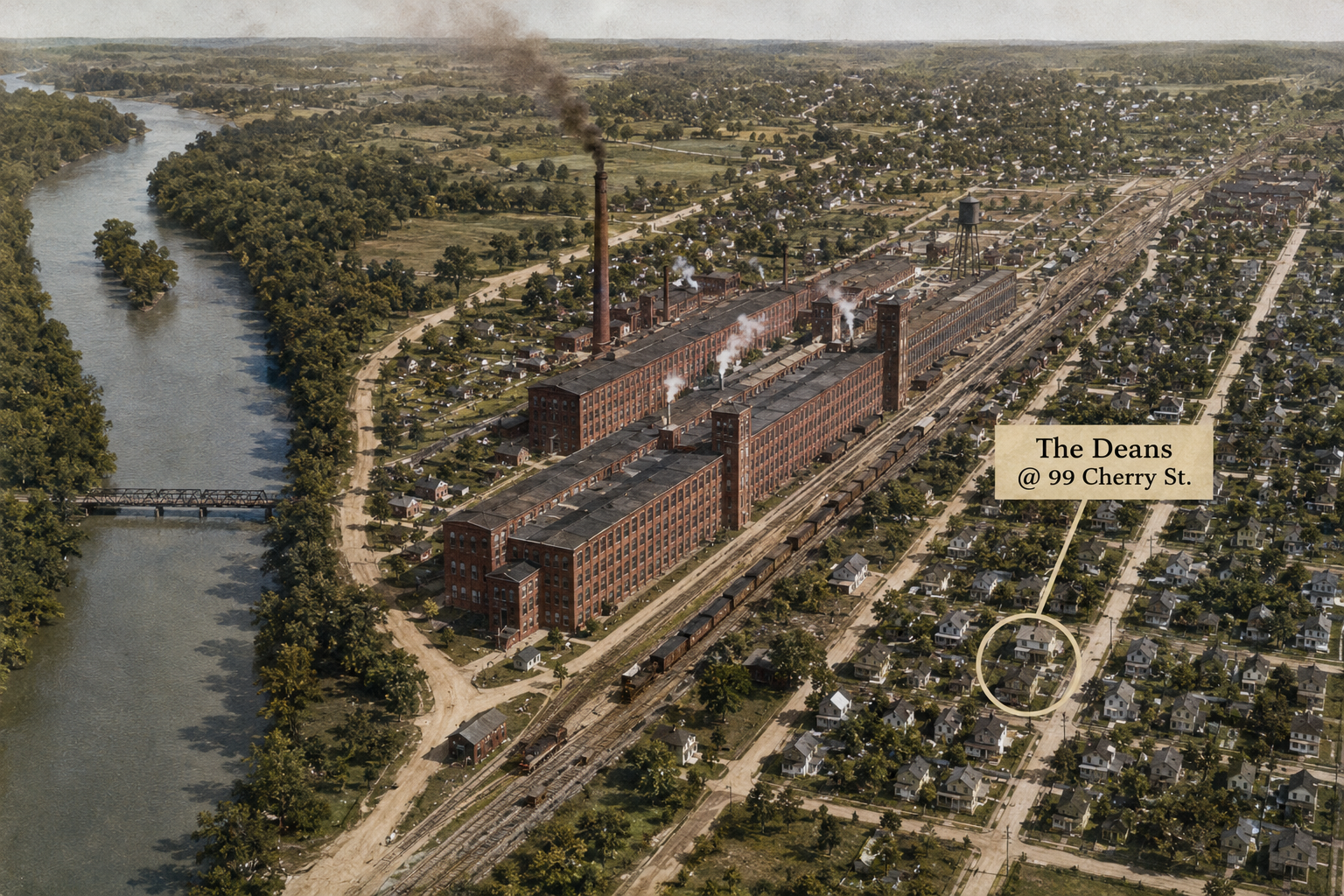
The Deans lived in the ‘mill village’ of workers at Lanett Mill in 1900
The census records show that at twenty-seven, the eldest son, Emers, was working as a ‘tubber’ in the mill’s dye house. Eighteen-year-old Ella and sixteen-year-old Anna were spending their days on the factory floor as ‘cotton mill spoolers’, while twelve-year-old Millie was already contributing to the family income as a cotton spinner!
At twelve, Millie was already earning wages alongside her older brothers and sisters. Alabama had no effective minimum-age law keeping a child her age out of the mill in 1900, and across the South, families often depended on the wages their children brought home.
Childhood existed alongside a workday governed by the mill.
In 1900, Alabama did not yet require all children to attend school. Statewide compulsory attendance came later, so twelve-year-old Millie and sixteen-year-old Anna could legally work rather than attend school.
The spinning room in the mill was loud, hot, and dusty. The machines ran for hours at a time; the clatter was so constant that workers often had to shout or use hand signals to communicate. Fine cotton fibers floated through the air, settling on clothing, hair, and skin; everyone would breathe that dust day after day.
As a cotton spooler, Ella would have spent most of her shift on her feet, watching rows of moving spindles, repairing broken threads, replacing bobbins, and keeping the machinery running.
Ella had a lazy eye. That didn't hold her back one bit.
The work required constant attention. A broken thread had to be caught quickly before it caused trouble farther down the line, and the machinery did not slow down because a worker was tired. Ella worked alongside other girls and women doing the same repetitive jobs, and she spent much of the day moving back and forth along the same rows.
The mill whistle decided when the day began, when there was a break, and when everyone could finally go home.
Three years later, Alabama tightened its child-labor laws.
1903 Law: Alabama set 12 years of age as the minimum working age, though it made exceptions for orphans and children from dependent families. It also began restricting hours and night work for younger children.
When the new law took effect in 1903, 125 underage children were reportedly removed from the Lanett mills in a single day.
In those few words, we catch the very moment Alabama was beginning to question how young was too young to work in its cotton mills.
Millie had been working there only three years earlier, at age 12.
By 1903, it would not have removed Millie from the mill anyway—she was already about fifteen.
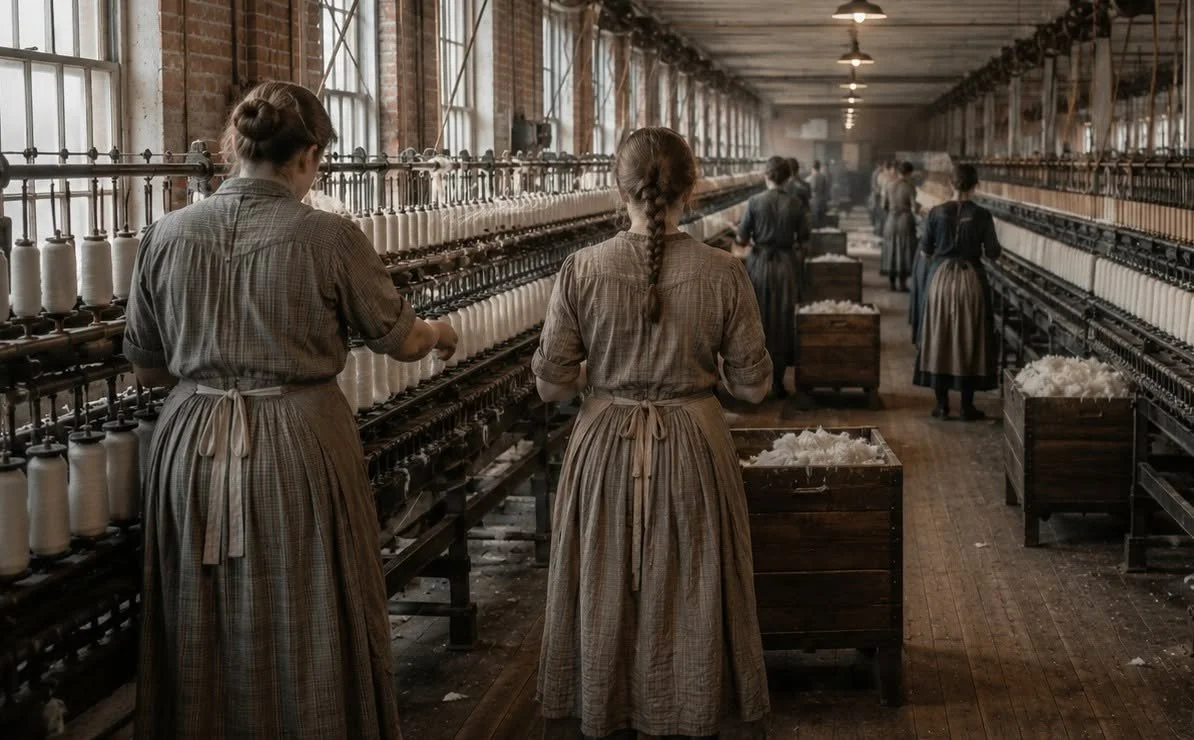
a vision of Lanett Mill · Chambers, Alabama
Only seven-year-old Lula remained at home, free from the mechanical schedules that had claimed her older siblings.
It appears that neither William nor Martha ever worked inside the factory. Yet, the family lived together for many years right outside of it.
Life in the mill village had advantages, especially for families arriving from the countryside. The company provided modest houses near work, along with access to a store, school, churches, and other services that were harder to reach in rural areas. A regular paycheck also offered something farm life could not always guarantee.
But there was a trade-off: the company could be both employer and landlord.
Families often rented company houses and bought necessities at the company store, sometimes using credit that was deducted from wages. That made daily life convenient, but it could also leave a family owing money before the next payday. Lose the mill job, and a worker could lose much more than a paycheck—the family’s house, credit, and place in the village could all be tied to the same employer.
By the 1910 census, the eldest son—Emers —is listed at another dwelling in the same mill village, living with his new wife.
The Dean household endured decades of change, from a Bacon Level farm to a new house in a mill village. William lived long enough to see the transformation from a scattered agricultural community into the industrial valley that his children would benefit from.
A few years later, on January 22, 1902, Ella’s father, William John Dean, died. His death marked the end of a life lived in the old rural South before the war, through its final desperate year, and back to rebuild during Reconstruction. He spent his last years working between the land and the river in eastern Alabama. I have found no evidence of the cause of his death. William was 58 years old.
Martha Dean was left to carry the family forward.
While the Dean family was anchoring their lives to the mill village next to the Chattahoochee, a young man from the limestone hills of Middle Tennessee was preparing to cross their path.
Edgar Grizzle had spent his first 15 years entirely within the quiet geography of Civil District 10 in Cannon County.
His journey by train to the big city for work was where the girl of his dreams
Miss Ella Dean was waiting…
To Be Continued…
Part 2 : Edgar Grizzle · From the Mill to the Ridge