1st of Holmains
Roger de Carruthers was born into a country fighting to survive. The Carruthers name was already established in Annandale, Scotland before Roger appeared. We assume he was born around 1355 and can reconstruct the world around him.
The great names of the Scottish Wars of Independence were not yet distant history. Robert the Bruce had been dead only twenty-one years. Men who had ridden and fought in those wars were still alive. Their sons certainly were, and families throughout southern Scotland were still living with the consequences of invasions, confiscated estates, shifting loyalties, and land changing hands.
England was not some foreign kingdom far beyond the horizon. For a boy growing up in Annandale, it was down the road.
The western Border lay close enough that politics between kings could quickly become a local problem. Armies crossed it. Livestock disappeared across it. Landholders on either side had relatives, enemies, and interests that did not stop neatly at the frontier. Periods of truce could bring a measure of quiet, but quiet was never quite the same as security. Even during the comparatively calmer early years of Robert II’s reign, small-scale warfare continued along the Borders. Roger also grew up under a Scottish king who knew captivity firsthand. David II, son of Robert the Bruce, was captured by the English at Neville’s Cross in 1346 and remained a prisoner for eleven years. Scotland eventually agreed to pay an enormous ransom for his release. The financial and political consequences lingered well into the years when Roger was probably coming of age.
In 1361, King David II granted John de Carruthers half of the lands within the tenement of Mouswald. John may have been Roger's uncle, who died without issue, or his father. Roger’s ancestry remains unclear. Still, the connection is not guesswork pulled from thin air. Property provides the clue. The half of Raffols associated with John in 1361 later appears among the lands belonging to the holder of Holmains. Last century, Carruthers & Reid documented this continuity and regarded it as evidence that John and Roger were closely related.
So we can imagine Roger growing up not as an isolated young man who suddenly appeared from nowhere, but within an already established Carruthers presence in Annandale. Precisely where he slept as a child, who taught him to ride, whether his mother lived to see him become a landholder, and whether he had brothers competing with him or sisters married into neighboring families — those intimate parts of his life have disappeared.
His surrounding world, however, has not. Much of it is documented.
By the time Roger reached adulthood, Scotland itself was changing.
David II died unexpectedly at Edinburgh Castle in 1371, only forty-six years old and without a child to inherit the throne. He had been married twice, but neither marriage produced a surviving heir. His death ended the direct royal line of Robert the Bruce, which must have felt significant in a country where Bruce was still very much in living memory. The crown passed instead to David's nephew, Robert Stewart, the son of Bruce's daughter Marjorie.
At fifty-four, Robert was hardly a young king when he became Robert II, but his accession began something enormous: the Stewart dynasty, the family that would occupy the Scottish throne for the next three centuries and eventually inherit the crown of England as well. For Roger de Carruthers, living down in Annandale, this was not distant royal history. A new family now sat on Scotland's throne, and the powerful Border lords around Roger would find their places in the new order.
Roger therefore lived through one of those moments that later historians recognize immediately, although ordinary people living through it could not possibly have known what it would become.
The first Stewart was on the throne.
In England, the aging Edward III was nearing the end of his long reign. His son, the Black Prince, died in 1376; Edward himself followed in 1377, leaving the English crown to his ten-year-old grandson, Richard II.
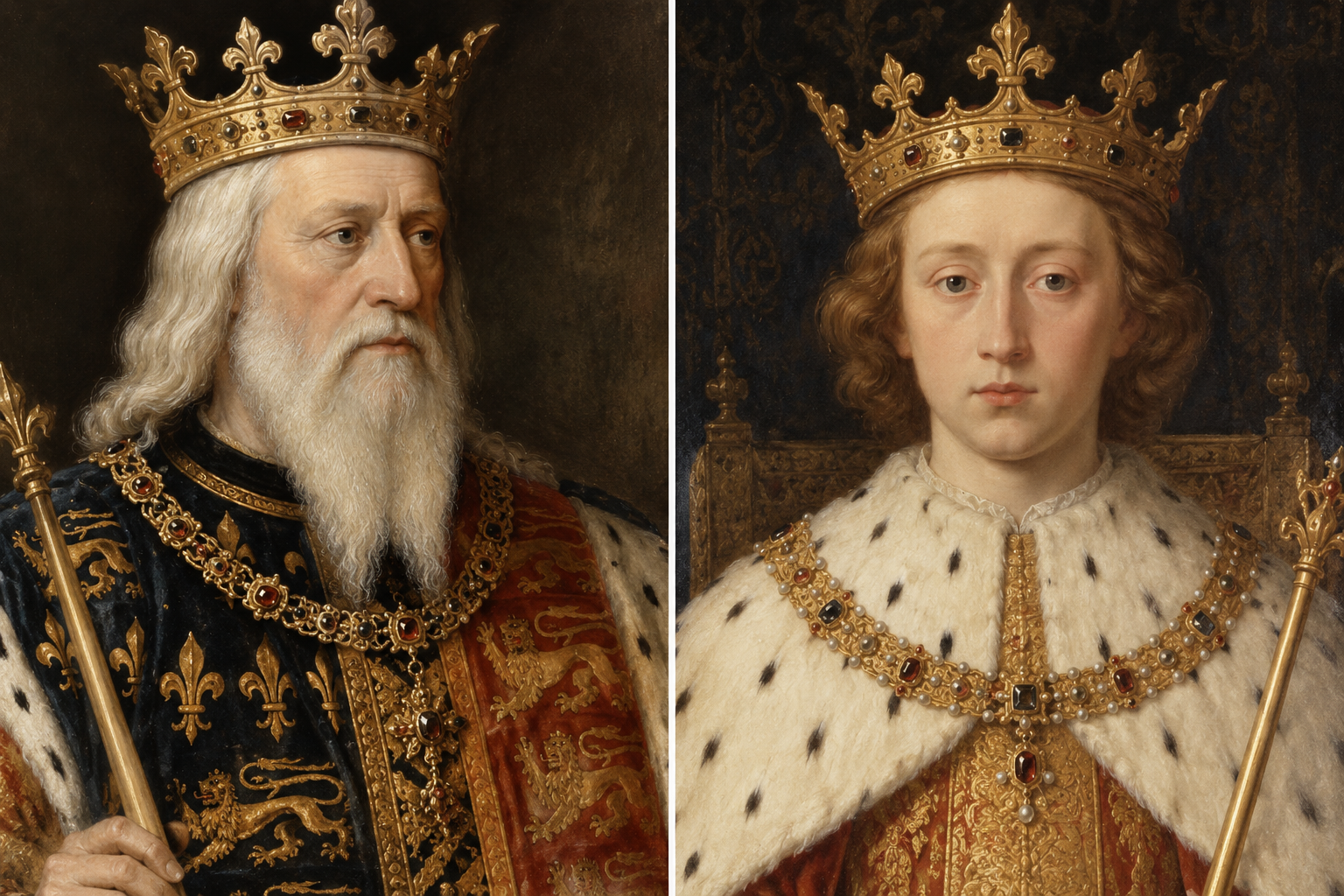
King Edward III & Richard II
Farther south, England and France remained locked in the struggle we now call the Hundred Years’ War.
Roger’s own concerns were much closer to home. Annandale had its own lord…
George Dunbar, Earl of March, was among the most powerful magnates in southern Scotland. By the early 1370s, he styled himself Lord of Annandale, and in 1372 he also served as a Warden of the Marches.
That put Roger in the orbit of a man whose authority mattered enormously in the Border country.
We do not know how Roger first came to Dunbar’s attention.
Perhaps Roger’s family connection and existing property gave him standing. Perhaps he had already performed some service for Dunbar. Perhaps the Carruthers name carried enough local standing that Roger was a natural choice to place on lands the earl needed in reliable hands. Medieval charters rarely pause to explain the human conversation behind the parchment. But something had happened.
In 1375, after years when Roger was invisible to us, the record suddenly finds him.
And it finds him receiving land.
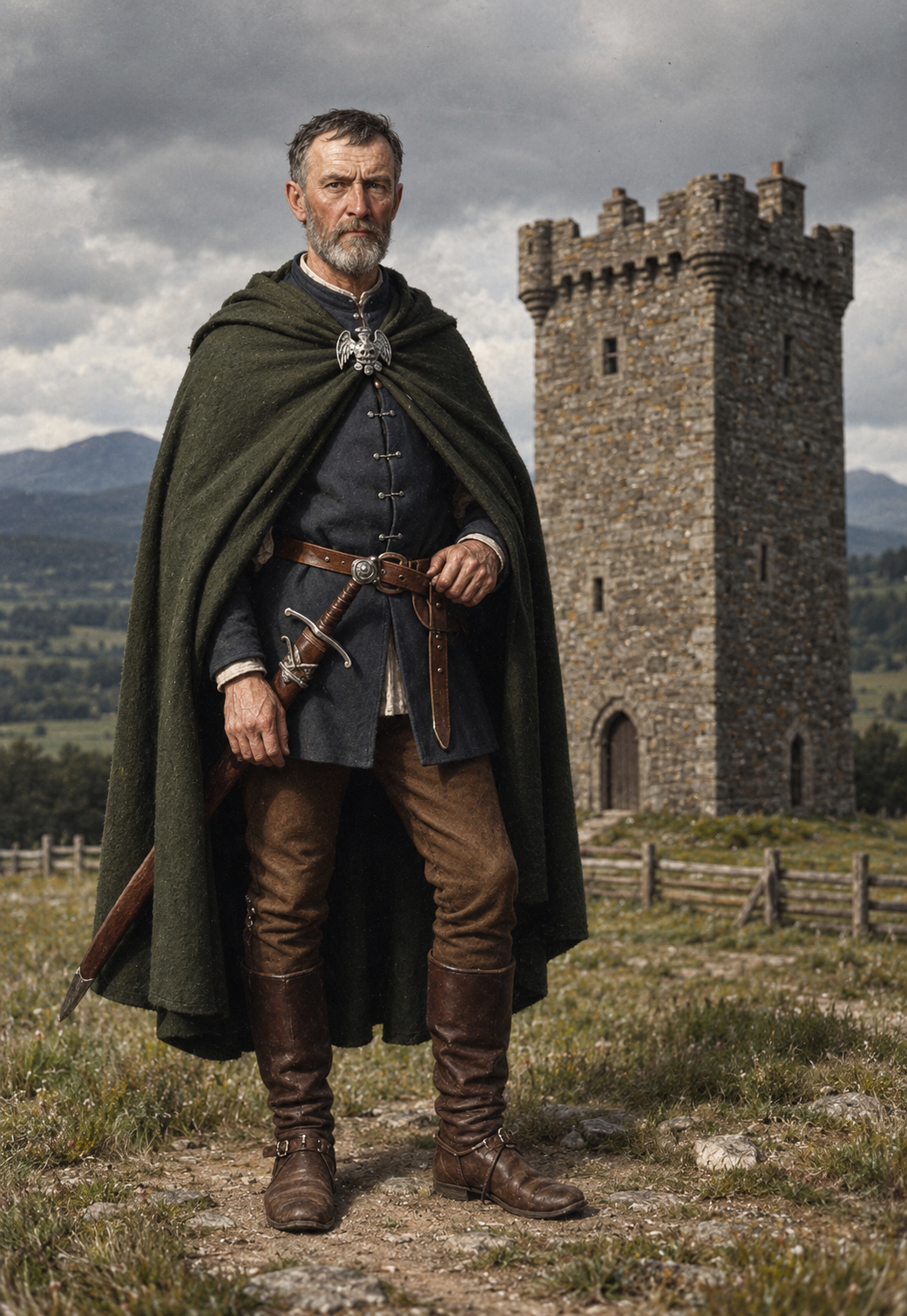
A vision of Roger de Carruthers, 1st of Holmains / c. 1420
George Dunbar granted Roger de Carutheris a substantial collection of holdings in Annandale: £4 of land in Little Dalton, eight merks of land in Holmains, and forty-shilling land in Fourteenaikerbank, together with associated rights, including the patronage of the church at Little Dalton. Carruthers & Reid regarded this grant as the documentary beginning of the Holmains house. This was more than acreage.
Land meant rents and produce. It meant tenants and obligations. It meant a place within the local hierarchy and a property that could be passed to an heir. Roger was no longer simply another Carruthers moving through the scattered medieval record.
He had acquired a place his name would become permanently associated with —Holmains.
The estate was not yet the great barony his descendants would know. That came much later. Roger began with something smaller: a cluster of properties placed in his hands by one of the most powerful lords in southern Scotland.
Inside Roger's house, winter would have been felt too. Before the later stone tower at Holmains, even a substantial laird's dwelling offered nothing resembling modern comfort. Fire was the center of domestic life, providing heat, light, and a place for cooking. Smoke, damp wool, wet leather, dogs, stored food, rushes, and woodsmoke were ordinary parts of the atmosphere.
A man of uncertain parentage, born somewhere in the troubled world of fourteenth-century southern Scotland, who had lived through the last years of David II and the arrival of Scotland’s first Stewart king.
Roger may be the first Carruthers we can securely place at Holmains, but he did not start the name. The name itself appears to have come from the land. Long before Roger, before Robert the Bruce and even before Scotland existed in the form Roger would have recognized, an old Brittonic fort stood on Birrens Hill near Waterbeck, above the land later known as Carruthers.
The earthworks can still be traced there. The traditional explanation of the name connects it with the Brittonic caer, meaning a fort, and a personal name rendered as Rydderch or Rythyr. Over time, the country around the old fort became known as Carruthers, and the people associated with that place eventually carried its name.
That is worth remembering when we encounter medieval men styled de Carrutheris. The name originally indicated where a man belonged. Roger de Carruthers was not carrying a surname invented by some distant ancestor for decoration. His name tied him to a particular corner of Annandale.
The roots beneath that landscape are much older. The ancient people associated with this part of southern Scotland were the Selgovae, a Brittonic population living in the region during the Roman period. Modern Carruthers Y-DNA research has produced an intriguing additional clue: researchers associated with the clan report a paternal genetic line with an ancient Scandinavian connection, apparently reaching Scotland long before the Viking Age and eventually becoming established among the Annandale population.
That is fascinating evidence about deep population history, but it should not be mistaken for a family tree. We cannot draw a genealogical line from Roger back to a named Selgovae warrior two thousand years earlier. What it does suggest is something broader and perhaps more interesting: the ancestry represented by the later Carruthers family had very deep roots in the people who inhabited this landscape.
By the Middle Ages, the family finally began to emerge as individuals.
One of the earliest recorded bearers of the name was William de Carruthers, who donated to Newbattle Abbey during the reign of Alexander II in the thirteenth century.
Later came Simon de Carruthers, a churchman associated with Middlebie. These scattered appearances show the name was established well before Roger’s lifetime.
Their history became closely intertwined with the ‘Bruce Lords of Annandale.’
Family members held local responsibilities, including stewardship of Annandale, and by the early fourteenth century the family had risen well beyond simply being people who happened to live on land called Carruthers. In 1320, Robert the Bruce granted lands at Mouswald to Thomas Carruthers. From that grant developed the great Carruthers house of Mouswald, the senior family of the name for more than two centuries.
Roger therefore grew up with something his earliest namesake ancestors had not possessed: a family history already attached to land, office, and lordship.
He would have known the Carruthers name around him. Carruthers churchmen, landholders, and men connected with Annandale's administration.
So Roger was not founding the Carruthers family in 1375.
He was doing something more specific. He was founding a new house of it.
That distinction becomes important because medieval families did not remain neatly gathered beneath a single roof. Sons married, received property, entered the Church, served powerful lords and established households of their own. One branch might rise while another disappeared. Land created new identities within the same wider family.
And in Roger’s case, the land would give his descendants their name for centuries:
Carruthers of Holmains.
There is an irony here that Roger could never have anticipated. Mouswald was the senior house in his own world. Holmains was the younger branch just beginning to take shape. Yet the male line of Carruthers of Mouswald eventually failed in 1548 with Simon’s early demise.
Holmains survived, and the family's seniority ultimately passed to Roger’s descendants.
More than six centuries after Roger first appears in connection with Holmains, that name still survives in the recognized chiefship. The present chiefly line identifies itself as Carruthers of Holmains.
Roger, of course, knew none of that. Holmains was simply an opportunity opening before him. What Roger received was a collection of medieval holdings spread across the countryside, each with its own value, tenants, fields, grazing land, and obligations.
For Roger, this was success.
Land was wealth, but in fourteenth-century Annandale it was also standing. A man who held property from a lord such as George Dunbar entered a relationship built on service and loyalty. Roger could collect the income his lands produced, but he was also responsible for them. Tenants had to be managed, rents collected, boundaries defended, and disputes settled. When his lord required the obligations attached to the land, Roger was expected to answer.
And this was not a quiet corner of Scotland in which to do it.
The English Border remained closed, and the countryside Roger now had a personal interest in protecting lay in a region where raids and renewed warfare could undo years of work in days. A bad harvest could hurt. A feud could hurt. An armed party coming north from England could do considerably worse. The security of a landed family depended partly on the strength of the people around it.
Roger was beginning to build that kind of position.
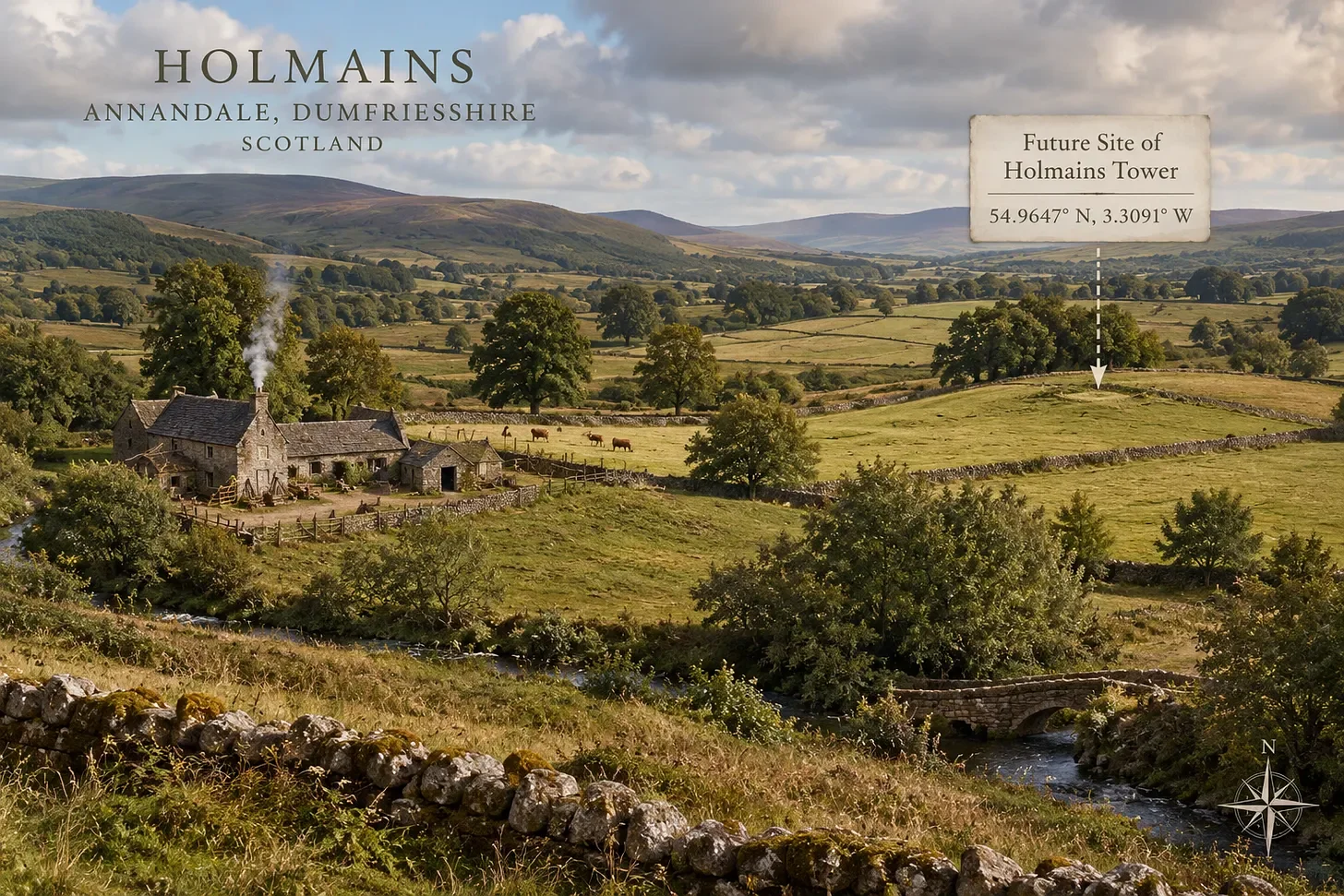
A vision based on land maps of the Holmains property & modern day ruins.
His home may have been modest by the standards we associate with later Scottish lairds: a defensible residence surrounded by the practical buildings needed to run an agricultural estate.
Roger was doing more than accumulating acreage. He was creating a place from which a family could operate. Children could grow up there. Marriages could be negotiated there. An heir could inherit it. A man once identified primarily by his family name could now begin a line eventually identified by its estate.
Little Dalton
Of all Roger’s holdings, Little Dalton offers perhaps the closest glimpse into the community surrounding him.
His grant included not only the land but also patronage of the church of Little Dalton. That was a meaningful right. The church stood at the center of medieval life. People were baptized there, married within the religious community it served, heard Mass, buried their dead, and marked the passing years through the Christian calendar.
Patronage connected Roger directly to that institution.
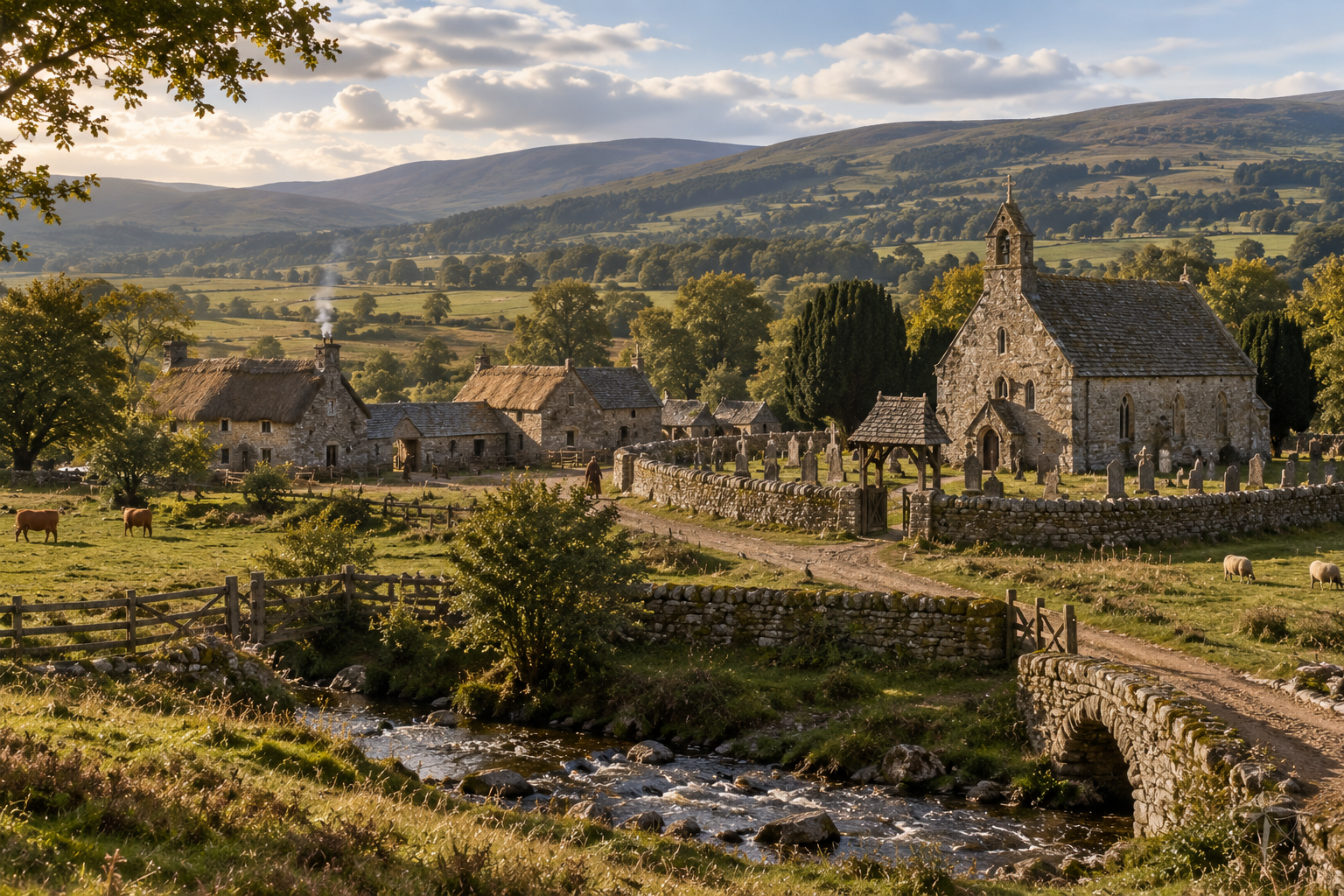
Little Dalton 1400
We cannot confidently name his wife. His burial place is unknown.
Roger was still alive in 1425.
Somewhere in that year, Roger’s life ended, and another generation took his place.
By 1426, John Carruthers held Holmains and is recognized in historic documents as Roger’s son.
It is tempting to wonder whether Roger himself lies somewhere in that landscape, beneath a long-lost stone or beneath ground that no longer remembers his name. That absence feels particularly noticeable because Little Dalton would later become so closely associated with the Holmains family, and its dead.
And Holmains eventually became the senior Carruthers line.
There is something wonderfully accidental about that. Roger did not establish Holmains because he knew his descendants would one day represent the senior surviving house of Carruthers.
He could not have imagined people discussing his family more than six hundred years later.
He was a fourteenth-century Annandale landholder trying to establish himself and his heirs.
But in that, he succeeded extraordinarily well.
The 1st through the 7th of Holmains appear to be in my tree.
I am getting to know them one by one. ;)
For Your Reference;
Arthur Stanley Carruthers & R. C. Reid, Records of the Carruthers Family — Chapter V: “Holmains.” This is the most important source for Roger de Carruthers and the 1375 grant of Little Dalton, Holmains, and Fourteenaikerbank. Read the Holmains chapter online
Clan Carruthers Society — “Mouswald to Holmains: The Charter of 1361.” Includes the surviving charter of King David II to John de Carruthers, a photograph of the document, and a modern transcription. View the 1361 charter and transcription
Dalton & Carrutherstown Community Council — Little Dalton Kirk. History and archaeology of the medieval kirk on the Holmains lands, including its later use as the burial ground of the Carruthers of Holmains. Little Dalton Kirk history
19th great-grandfather of author Krysta Abesamis
Researched & Written by author Krysta Abesamis
Note on Historical Images. Some images used in this article are AI-assisted historical reconstructions, created to help visualize people, places, buildings, and events for which no surviving photograph or contemporary image exists. These images should not be considered documentary evidence.