The Scottish Enlightenment
When a Small Nation Changed the World
There are moments in history when an entire society seems to awaken. New ideas spread rapidly, old assumptions are challenged, and ordinary streets become the stage for extraordinary change. For Scotland, that moment was the Scottish Enlightenment.
Between roughly 1740 and 1800, Scotland became one of the most intellectually influential places on Earth. From the closes of Edinburgh to the lecture halls of Glasgow and the courts of the Scottish legal system, philosophers, scientists, physicians, historians, engineers, ministers, and booksellers helped shape the modern world. Their ideas would influence the American Founding Fathers, transform economics, revolutionize medicine, and inspire generations of thinkers across Europe and beyond.
For those tracing Scottish ancestry, understanding the Scottish Enlightenment means understanding the world in which many of our ancestors lived.
A Nation Rebuilt
The Scotland of the early eighteenth century was still recovering from decades of political and religious upheaval.
The Union of 1707 united the Scottish and English Parliaments, creating the Kingdom of Great Britain. The Jacobite Risings of 1715 and 1745 divided loyalties across the Highlands and Lowlands. Economic opportunities were changing rapidly, and many families faced difficult decisions about land, trade, education, and emigration.
Yet these same challenges encouraged Scotland to invest in something remarkable—education.
Unlike much of Europe, Scotland already possessed an extensive parish school system. Literacy rates were unusually high, universities welcomed students from modest backgrounds, and learning became a source of national pride.
Knowledge became Scotland's greatest export.
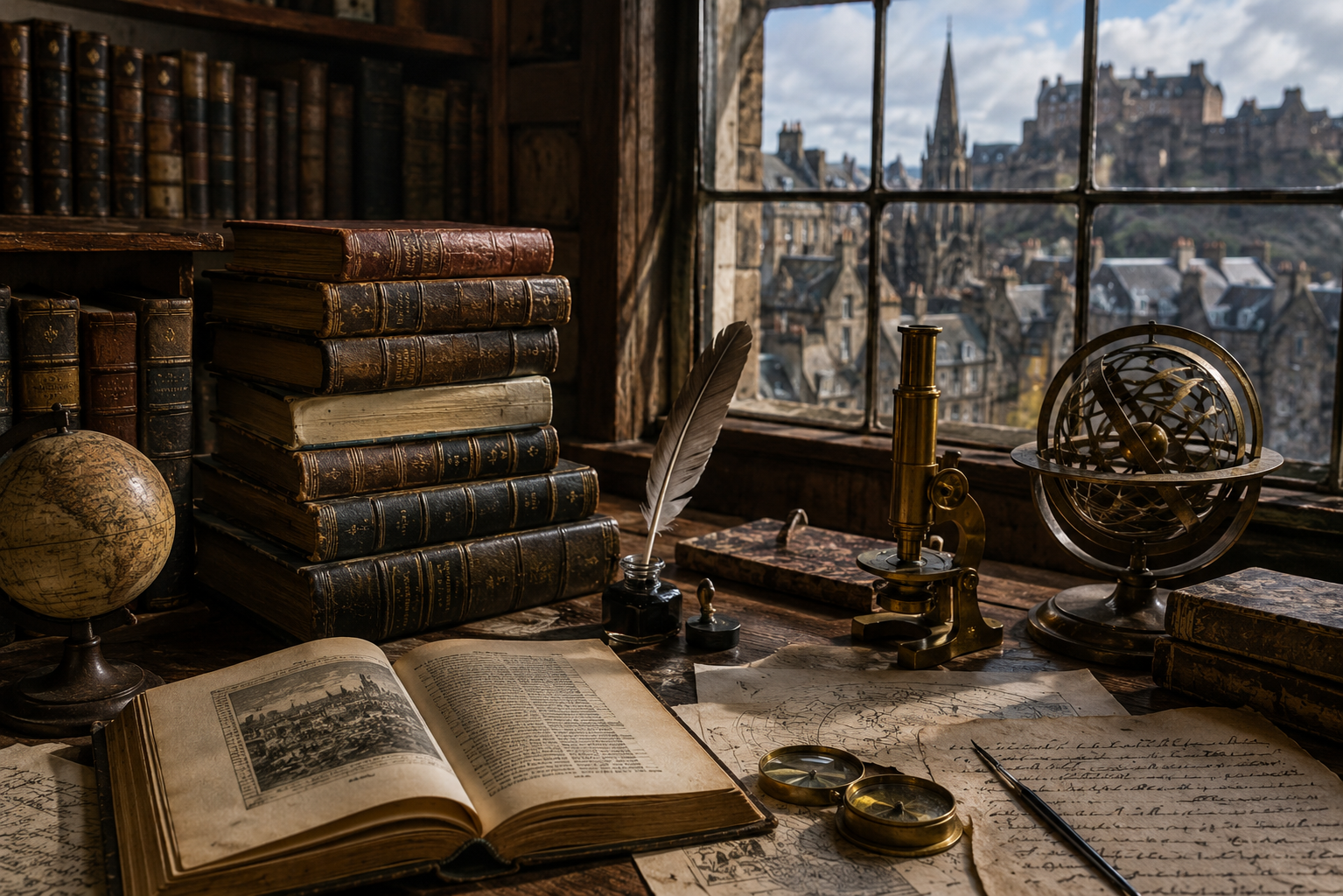
Edinburgh: The Athens of the North
No city symbolized this transformation more than Edinburgh.
Its medieval streets were crowded with lawyers, ministers, physicians, printers, booksellers, professors, merchants, and students. The courts, the university, Parliament House, and the great libraries stood within walking distance of one another.
It was here that ideas were exchanged daily in taverns, coffeehouses, bookshops, drawing rooms, and debating societies.
Visitors began calling Edinburgh the "Athens of the North."
Unlike ancient Athens, however, this intellectual revolution was driven not by emperors or kings but by conversation.
The Power of the Printed Word
The Enlightenment could not have flourished without books.
Printers worked constantly to satisfy growing demand for philosophy, science, religion, history, law, poetry, geography, medicine, and political debate. Booksellers became essential figures in Scottish society, connecting readers with the latest works from Edinburgh, London, Amsterdam, Paris, and beyond.
Parliament Close stood at the center of this publishing world. Surrounded by Parliament House, St. Giles' Cathedral, and the city's legal community, it became home to many of Edinburgh's booksellers and printers.
Among them was Andrew Chalmers, whose documented business in Parliament Close placed him within one of the busiest intellectual districts in Britain. Every volume that crossed his counter carried more than ink and paper—it carried ideas capable of changing lives.
Booksellers were not merely merchants.
They were distributors of knowledge.
The Men Who Changed the World
The Scottish Enlightenment produced an astonishing number of influential thinkers.
David Hume challenged traditional assumptions about philosophy, history, and religion through careful observation and reason.
Adam Smith, whose The Wealth of Nations transformed economics, explained how markets and individual enterprise could shape prosperity.
Adam Ferguson explored civil society and the development of nations.
Thomas Reid offered an influential philosophy of common sense that challenged skepticism.
In medicine, William Cullen and Joseph Black revolutionized chemistry and clinical practice.
In engineering, James Watt dramatically improved the steam engine, helping to power the Industrial Revolution.
Together, these men—and many others—changed not only Scotland but the modern world.
A Culture of Conversation
The Enlightenment was never confined to universities.
Ideas flowed through clubs, libraries, dinner tables, and coffeehouses. Gentlemen debated philosophy. Lawyers argued constitutional questions. Ministers discussed theology. Physicians exchanged scientific discoveries.
Books circulated constantly.
Reading became fashionable among the middle classes, while private circulating libraries allowed ordinary families access to works they could never have afforded to purchase.
Even disagreement became productive.
One of the great debates of the period concerned language itself. Some educated Scots embraced English pronunciation and manners as the path to advancement throughout Britain. Others defended Scotland's distinctive speech, traditions, and identity.
These conversations reflected a nation defining itself in an increasingly interconnected world.
Why It Matters to Family History
Genealogy often focuses on names, dates, and places.
The Scottish Enlightenment reminds us that our ancestors also lived among ideas.
An ancestor who practiced law in Edinburgh, attended the university, worked as a printer, sold books, served the courts, or simply learned to read participated in a society experiencing one of history's greatest intellectual transformations.
The books they purchased, the sermons they heard, the newspapers they read, and the conversations they joined all shaped the world they passed to future generations.
Scotland's Enduring Legacy
The Scottish Enlightenment left a legacy far beyond Scotland's borders.
Its influence can be found in modern economics, constitutional government, education, medicine, engineering, philosophy, historical scholarship, and scientific inquiry. Universities around the world continue to teach ideas first developed in eighteenth-century Scotland.
Perhaps its greatest achievement, however, was demonstrating that a relatively small nation could transform the world through learning rather than conquest.
In the narrow closes of Edinburgh, surrounded by ancient stone buildings and crowded bookshops, generations of printers, scholars, lawyers, ministers, physicians, and booksellers quietly helped shape the modern age.
For descendants researching families from eighteenth-century Scotland, the Scottish Enlightenment is more than a chapter in history.
It is the remarkable world in which many of their ancestors lived, worked, learned, and left their own small mark upon history.