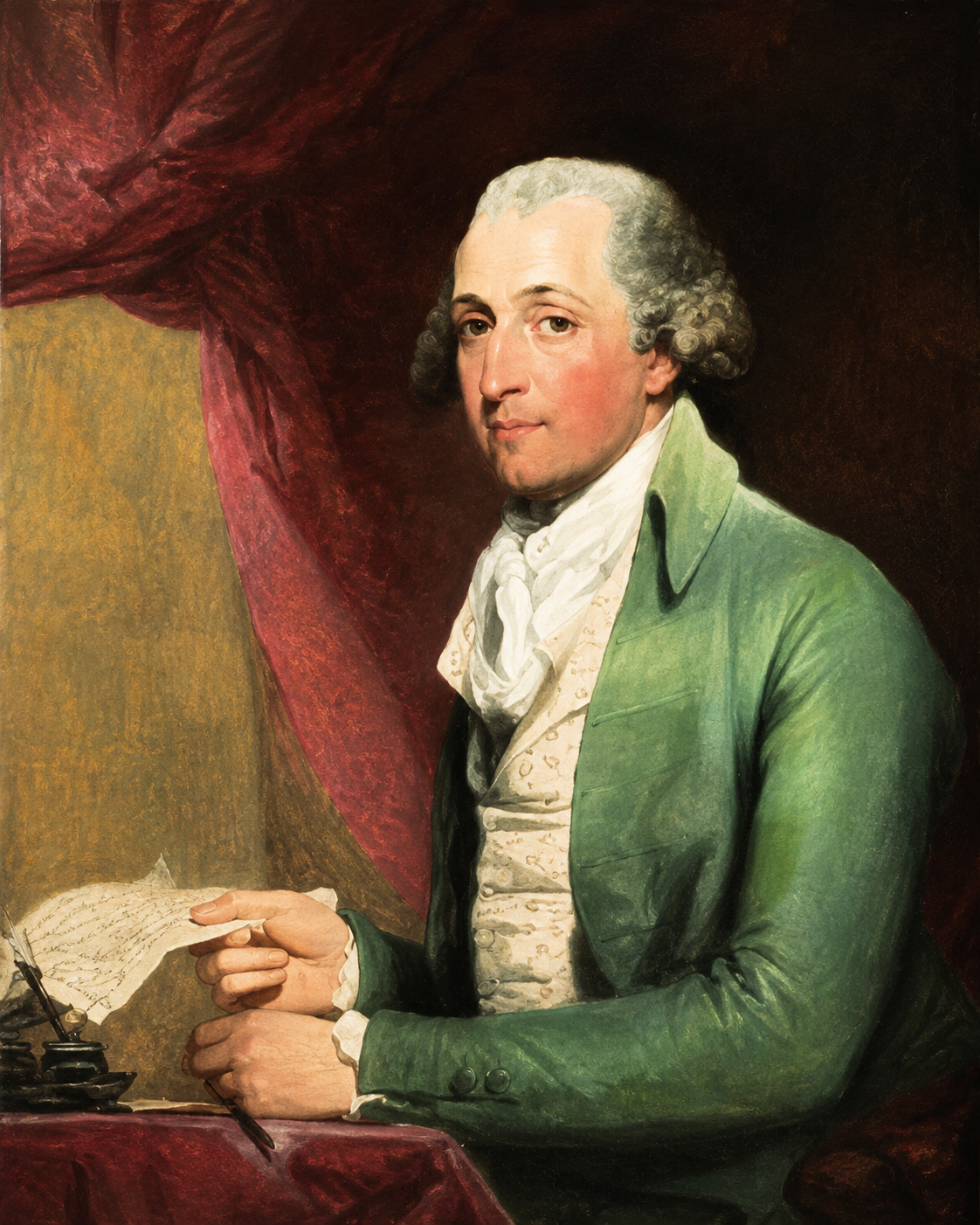
William Bayard
The Merchant Prince Who Helped Finance a New Nation
While soldiers secured America's independence on the battlefield and statesmen debated the shape of its new government, another class of influential men quietly built the financial foundations upon which the young republic would stand. They were merchants, bankers, insurers, and investors whose fortunes rose and fell with the success of the United States itself. Among the most respected of this financial elite was William Bayard, a New York merchant whose commercial empire stretched across the Atlantic and whose investments helped stabilize the fragile economy of the early republic.
William Bayard was born on September 25, 1761, in New York City into one of colonial America's most prosperous merchant families. His father, Samuel Bayard, belonged to a long-established Dutch and Huguenot lineage whose roots reached back to the earliest years of New Netherland. The Bayards had accumulated wealth through shipping, banking, and international commerce, placing young William among the colonial elite from birth. Yet privilege offered no protection from the upheavals that soon engulfed the American colonies.
As Bayard entered his teenage years, relations between Britain and her North American colonies deteriorated rapidly. The protests over taxation, the Boston Tea Party, and the increasingly harsh responses from Parliament transformed political disagreements into open rebellion. New York, positioned between New England and the southern colonies, became one of the most contested cities in British America. Its harbor bustled with commercial opportunity while simultaneously serving as one of the British Empire's most valuable military ports.
The outbreak of the American Revolution in 1775 forced the Bayard family into an impossible position. Like many wealthy New York merchants whose fortunes depended upon Atlantic trade, members of the family maintained Loyalist sympathies. When British forces captured New York City in 1776, the city remained under British occupation for nearly seven years. The conflict disrupted commerce, divided families, and shattered fortunes across the region. William reached adulthood while witnessing firsthand how political revolution could overturn generations of carefully accumulated wealth.
Following the Treaty of Paris in 1783, the young merchant faced a transformed nation. Independence had been won, but peace did not immediately bring prosperity. American commerce had to be rebuilt almost from scratch. Long-established trade routes required renegotiation, foreign credit remained uncertain, and merchants struggled to adapt to an economy no longer protected—or restricted—by the British imperial system. Bayard quickly demonstrated an extraordinary ability to navigate these challenges.
Reestablishing commercial connections throughout Europe, the Caribbean, and the expanding American coastline, he built one of New York's most successful mercantile firms. His ships carried flour, grain, tobacco, cotton, and manufactured goods between the United States and international markets, helping restore New York's position as one of the Atlantic world's great commercial centers. As American trade expanded during the closing years of the eighteenth century, Bayard's fortune grew alongside the nation's economy.
The financial revolution launched by Alexander Hamilton during the Washington administration opened entirely new opportunities for investors. Hamilton's decision to fund the national debt at full value transformed government securities into reliable financial assets. Merchants with sufficient capital began purchasing federal bonds, not merely as speculative investments but as expressions of confidence in the stability of the new republic. William Bayard became one of the nation's most prominent holders of these securities, joining influential financiers such as Robert Morris, Andrew Craigie, and other leading members of America's emerging financial class.
His participation reflected more than personal ambition. The willingness of merchants like Bayard to invest heavily in federal securities provided the young government with desperately needed credibility both at home and abroad. European bankers watched these developments closely. Every successful bond issue strengthened confidence that the United States intended to honor its obligations, laying the foundation for future economic growth.
Bayard's business interests soon expanded beyond traditional shipping. He invested in banking institutions, insurance companies, urban real estate, and commercial partnerships that fueled New York's rapid transformation into the nation's financial capital. The city's wharves filled with vessels from Britain, France, Spain, the Caribbean, and South America, while counting houses along Wall Street increasingly replaced Philadelphia as the center of American finance. Bayard stood among the merchants helping direct that remarkable transition.
His prominence naturally brought him into the social circles of many leading figures of the Early Republic. Politicians, foreign diplomats, judges, military officers, and wealthy businessmen regularly gathered in the drawing rooms of New York's commercial elite, where discussions ranged from international trade and banking to constitutional politics and foreign affairs. Although Bayard rarely sought elected office himself, his influence reached deeply into the economic decisions shaping the young nation.
The opening years of the nineteenth century brought both extraordinary opportunity and mounting uncertainty. The Napoleonic Wars engulfed Europe, disrupting Atlantic commerce on an unprecedented scale. Britain and France each attempted to restrict neutral shipping, placing American merchants in an increasingly dangerous position. Cargoes faced seizure, insurance costs soared, and international trade became entangled in the broader struggle between Europe's great powers. Merchants like Bayard had to navigate a constantly shifting landscape of embargoes, blockades, and diplomatic crises while protecting their commercial enterprises.
The outbreak of the War of 1812 further complicated matters. Once again, American merchants confronted interrupted trade routes, financial instability, and uncertain markets. Yet New York's commercial community demonstrated remarkable resilience. Even amid wartime disruption, Bayard and his contemporaries continued investing in the long-term future of the nation's economy, convinced that American commerce would emerge stronger once peace returned.
William Bayard died on February 17, 1826, after witnessing one of the most remarkable economic transformations in modern history. During his lifetime, he had seen the American colonies evolve from dependent provinces of the British Empire into an independent nation rapidly establishing itself as a commercial power. The modest merchant houses of his youth had grown into sophisticated financial institutions, while New York itself had begun its ascent toward becoming one of the world's great centers of banking and international trade.
Unlike many Revolutionary statesmen, Bayard left few famous speeches and held few celebrated public offices. His legacy was measured instead in ships launched, businesses financed, markets expanded, and confidence restored. Every successful merchant voyage strengthened the nation's economy. Every investment in government securities reinforced public credit. Every commercial partnership helped transform the fragile republic into a country capable of competing on the world stage.
History often celebrates the soldiers who won America's independence and the politicians who drafted its Constitution. Yet nations also require merchants willing to risk capital, investors willing to trust new institutions, and entrepreneurs capable of building prosperity from uncertainty. William Bayard belonged to that remarkable generation. Through disciplined commerce, financial vision, and unwavering confidence in the future of the United States, he helped lay the economic foundations upon which nineteenth-century America would build its extraordinary rise.
His life serves as a reminder that the American experiment succeeded not only because courageous men fought for liberty, but because equally determined merchants believed that liberty could become profitable, sustainable, and enduring for generations to come.