2nd of Holmains
Holmains was becoming a family name in Scotland…
Roger de Carruthers, 1st of Holmains, gave his branch of the family a place to belong. By 1426, another Carruthers appears there — John Carruthers, 2nd of Holmains, presumed to have been Roger’s son.
Sadly, I haven’t found his birth date or evidence of his wife, the mother of his son and heir, the 3rd of Holmains.
Instead, the records show land. John inherited more than fields. The later stone tower we associate with Holmains had not yet appeared. This was a working estate with mud at the door and farm animals outside. Not really a glamorous Annandale laird life.
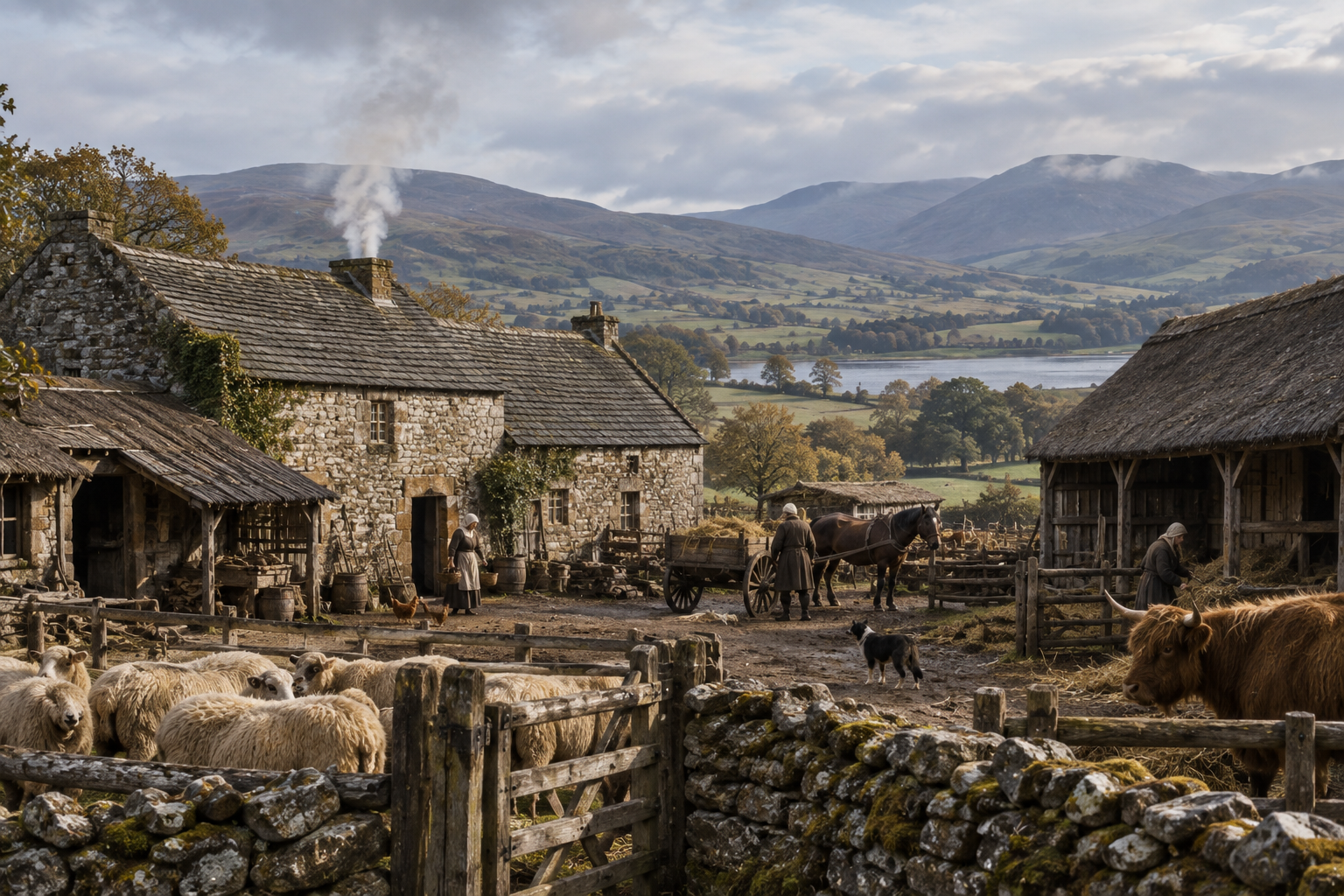
A vision of Early Holmains Land c. 1420 — 55°03’49.7”N 3°23’06.7”W
By 1426, John was holding his lands under Archibald Douglas, 5th Earl of Douglas.
In return, John owed feudal obligations attached to the land grant.
John’s land interests include Holmains and Little Dalton, Ecclefechan, Plewlands, Copwood, Bengahill, Moffat, Tundergarth, Glaisters, Newlands and Ruthwell. These weren’t all neighboring fields. They were scattered across the countryside, stretching north toward Moffat and south toward the Solway.
I find language in the old record sounds wonderfully romantic today.
John held £10 lands at Ecclefechan, some merk lands elsewhere, something called ‘husbandlands’ at Ruthwell—and, tucked into the list, a saltcoat?
Land was commonly identified in value, while a husbandland was an agricultural holding associated with a tenant farmer.
So, the ‘little saltcoat at Ruthwell’ property is my favorite! What is it??
Salt production was part of the coastal economy. A saltcoat was used to make salt, essential in a world without refrigeration.
A ‘salt-working property’ preserved meats & fish and would have helped food survive the winter. Tenant farmers on the land would have done this kind of work. It would have been part of his estate's income and resources.
Along the Solway in Scotland, workers could gather seawater—or salty sand and mud that could be washed to produce concentrated brine—and bring it back to the saltcoat. They then heated the brine in shallow pans until the water evaporated and salt crystals were left behind. It was slow work, and it consumed a great deal of fuel, which meant keeping the fires going for hours. The finished salt could then be dried and stored for use or sale. For John’s estate, this little operation mattered: salt wasn't simply something sprinkled on food. It was one of the things that kept meat and fish edible long after they were butchered or caught. It probably supplied local households and added greatly to the economic value of John's lands.
Very cool Microhistory!!
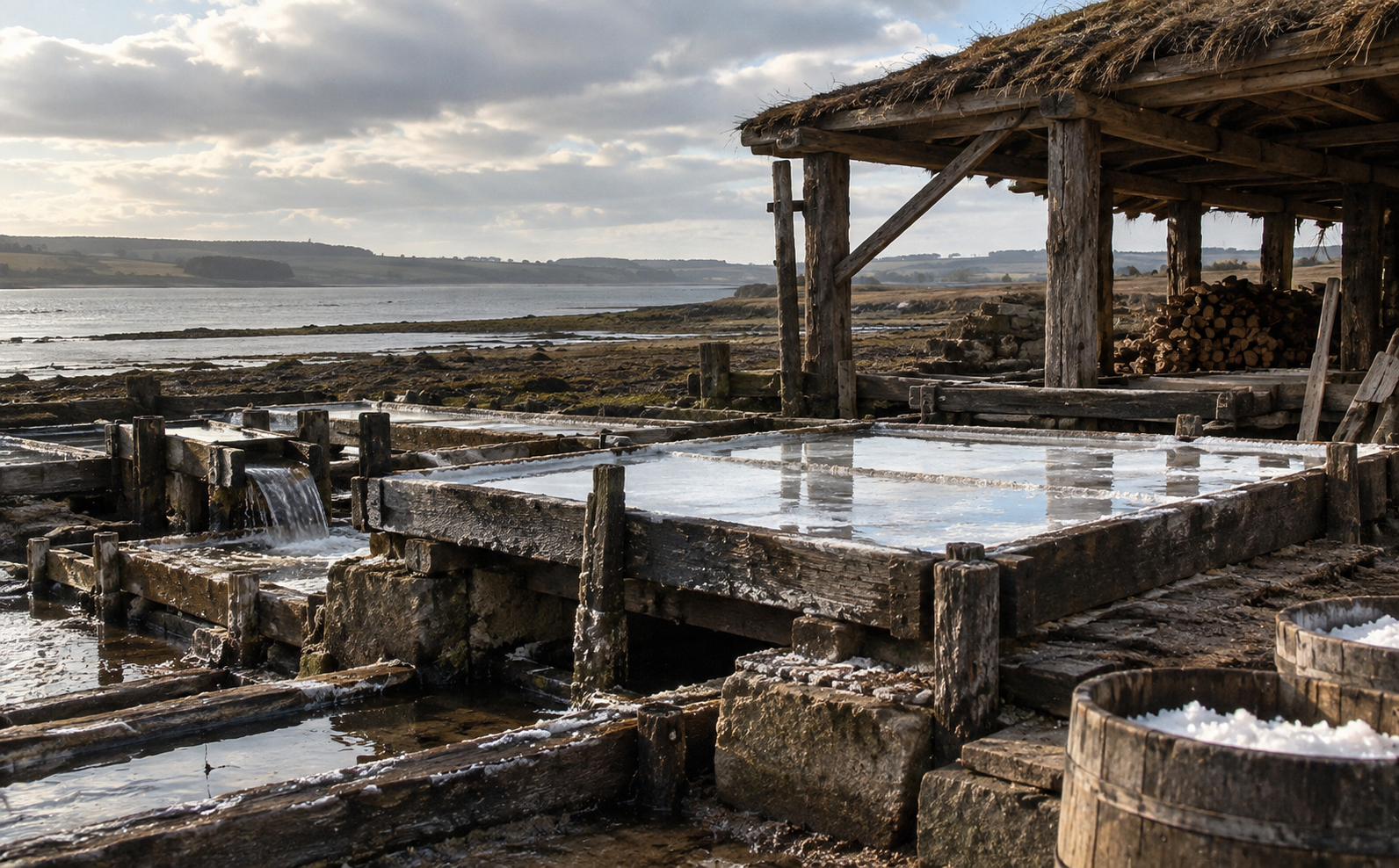
A vision of the saltcoat property in Ruthwell, Scotland
By the mid-fifteenth century, the Douglases were becoming almost too powerful and began to behave more like rivals to the Crown than as its subjects. James was in this orbit, they were his landlords!
Things finally exploded under King James II.
In 1452, James personally killed William Douglas, 8th Earl of Douglas, at Stirling Castle after a meeting between the two men went horribly wrong. Douglas had entered the castle under a royal safe-conduct. According to contemporary accounts, an argument broke out, the King stabbed him, and members of the royal party joined in.
Imagine news like that reaching Annandale.
The King of Scotland had just killed the head of the family that had dominated much of southern Scotland—
and John Carruthers held lands within that Douglas world!
Whatever John personally thought about it, the struggle came much closer to home.
In 1455, the remaining Black Douglas forces met the King's supporters at the Battle of Arkinholm, near present-day Langholm in Annandale. The Douglases lost badly. Their power was broken, their lands were forfeited, and the political landscape John had known for decades was being rearranged around him.
I don't yet have evidence of what Grandpa John himself did at Arkinholm. So I wouldn't put a sword in hand just because a battle happened nearby.
But he was alive. He was a landed man in Annandale. And the great lordship above his family had just collapsed.
For all the upheaval above him, there is no evidence that John lost Holmains or his established lands; the Carruthers estate appears to have carried on through the crisis…
The Woman at Holmains
Revisiting, sadly we know almost nothing about John’s wife, the mother of his son & heir.
Carruthers & Reid were unusually direct about the problem, writing simply that no solid reference to her exists. Modern pedigrees have sometimes supplied the name Elizabeth Carmichael, but I have not found contemporary evidence strong enough to attach that name confidently to the 2nd Laird.
Damn.
John, 2nd of Holmains, must therefore have died sometime after his documented appearance in 1457 and by 1471. We do not know where he died or where he was buried.
We do know, however, that John, 3rd of Holmains Carruthers, followed him.
With the same first name repeated generation after generation, the records become increasingly difficult to separate cleanly, which is one reason the early Holmains chronology has caused so much confusion.
What matters here is that by 1471, the succession had moved forward and the next generation was appearing in possession of the family lands. John’s achievement becomes clearer when we compare the beginning and end of his life. He came into a house founded only one generation earlier, when Roger received the original Holmains properties in 1375.
By John’s time, the estate had expanded considerably; the family was involved in the legal affairs of Annandale, and its children were marrying into other landed houses.
Good work, John.
I have 7 ‘Lords of Holmains’ in this line of my family tree…
2nd of Holmains is my 18th-great-grandfather.
For Your Reference;
Arthur Stanley Carruthers & R. C. Reid, Records of the Carruthers Family, Chapter V, “Holmains.” Principal source for John Carruthers, 2nd of Holmains: the 1425/26 Douglas grant, his expanded lands—including the two husbandlands and saltcoat at Ruthwell—his unidentified wife, his service on the Moffat inheritance jury in 1457, and his death before his heir's succession in 1471. The authors also explain the uncertainty surrounding the earliest Holmains generations.
Read Records of the Carruthers FamilyGeorge Chalmers, Caledonia: or, A Historical and Topographical Account of North Britain. Particularly useful for the microhistory of John's Ruthwell saltcoat. Chalmers records salt manufacture on the Solway from the medieval period, several saltworks in Ruthwell parish, and the traditional Annandale method of obtaining salt from the coastal sands.
Read the digitized volumeHistorical Manuscripts Commission & Register of the Great Seal of Scotland, A.D. 1424–1513. These are among the underlying documentary sources cited by Carruthers & Reid for the early Holmains family, including the Carruthers–Corry connection.
18th-great-grandfather of author Krysta Abesamis
Researched & Written by author Krysta Abesamis
Note on Historical Images. Some images used in this article are AI-assisted historical reconstructions, created to help visualize people, places, buildings, and events for which no surviving photograph or contemporary image exists. These images should not be considered documentary evidence.