A Pearl of Lochleven
My favorite museum portrait of a redhead is of my cousin, Agnes Douglas. She was born into a household that had already played an extraordinary role in Scottish history. She was one of eleven children of William Douglas (abt 1538-1606) of Lochleven (later the 6th Earl of Morton) and his wife, Agnes Leslie. Daughter of George Leslie, 4th Earl of Rothes, married in 1554. Seven of those children were daughters, remembered together as the most beautiful “Seven Pearls of Lochleven”.
Agnes & her sisters grew up in the well-known Lochleven Castle, which stands on an island in Loch Leven, surrounded by water and separated from the mainland by a short but strategically useful crossing.
Lochleven was beautiful, but living there was not always pleasant. The castle sat low on an island in the middle of the loch, exposed to Scottish rain, wind, and months of damp weather. Water was obviously its greatest defense and probably one of its greatest hassles. Stone walls in rooms heated only intermittently by fireplaces. Surrounded by wet cloaks, muddy shoes, smoke, and the smell of animals, all daily outside your window. Ugh.
There were advantages. The Douglases had privacy, security and control over nearly everyone who approached them. The loch supplied fish; the estate on the mainland supplied meat, grain, ale, fuel and other necessities. The boats kept the household connected to Kinross and the surrounding countryside. The upper rooms must have had views for miles… and for children, an island castle probably offered a fun daily playground to get lost in, but everything depended upon those boats. Visitors, letters, fresh provisions, servants and news all had to cross the water. Bad weather could make that crossing unpleasant or delay it altogether.
For the Douglas girls, however, this was simply home.
Christian Douglas-Oliphant-Home (c.1560-1606)
She is the pearl who lost her husband at sea… Laurence Oliphant became involved in the turbulent politics surrounding James VI and the Raid of Ruthven. Forced into exile, he sailed for France with her brother, Robert Douglas, Master of Morton. Their ship never made it. For years, no one seemed to know exactly what happened to them. They may have drowned or been attacked by pirates. And that really is the worst: not knowing. Yet, she did not remain a widow for long. On January 9, 1586, Christian married Alexander Home, 6th Lord Home, who later became the 1st Earl of Home.
Margaret Douglas-Wemyss (c.1555-1581)
Her future husband received a charter involving the lands of Methil and other properties erected into a barony. By August 1581, sadly, she was dead.
Mary Douglas-Ogilvy (c.1557-1624)
She married Walter Ogilvy of Deskford in 1582. Mary has been identified as the likely woman behind the Scottish sonnet sequence Lithocardia, presented not merely as beautiful but as an intelligent bibliophile.
Euphemia Douglas-Lyon (c.1560)
Married Sir Thomas Lyon of Auldbar, known as the Master of Glamis. She was his second wife. Thomas was no minor laird: he was an important political operator in the reign of James VI and Lord High Treasurer of Scotland. That’s hot!
Elizabeth ‘Countess of Erroll’ Douglas-Hay (c.1568-1631)
Reportedly the youngest of the seven, married Francis Hay, 9th Earl of Erroll, one of Scotland’s great hereditary nobles and Lord High Constable of Scotland. But James VI did not approve. William Douglas was severely reprimanded by James VI for marrying his daughter to Erroll not merely without royal permission, but against the King’s express prohibition. She was a rebel!
Jean Douglas (c.1570-)
Jean has left little trace in the surviving genealogical record. Oddly, she is the only pearl I have found, with so little confirmed info on her.
Agnes Douglas-Campbell (c.1574-1607) featured in this article.
The same isolation that made the castle an uncomfortable place to live at times was exactly what made it such an effective place to imprison a queen…
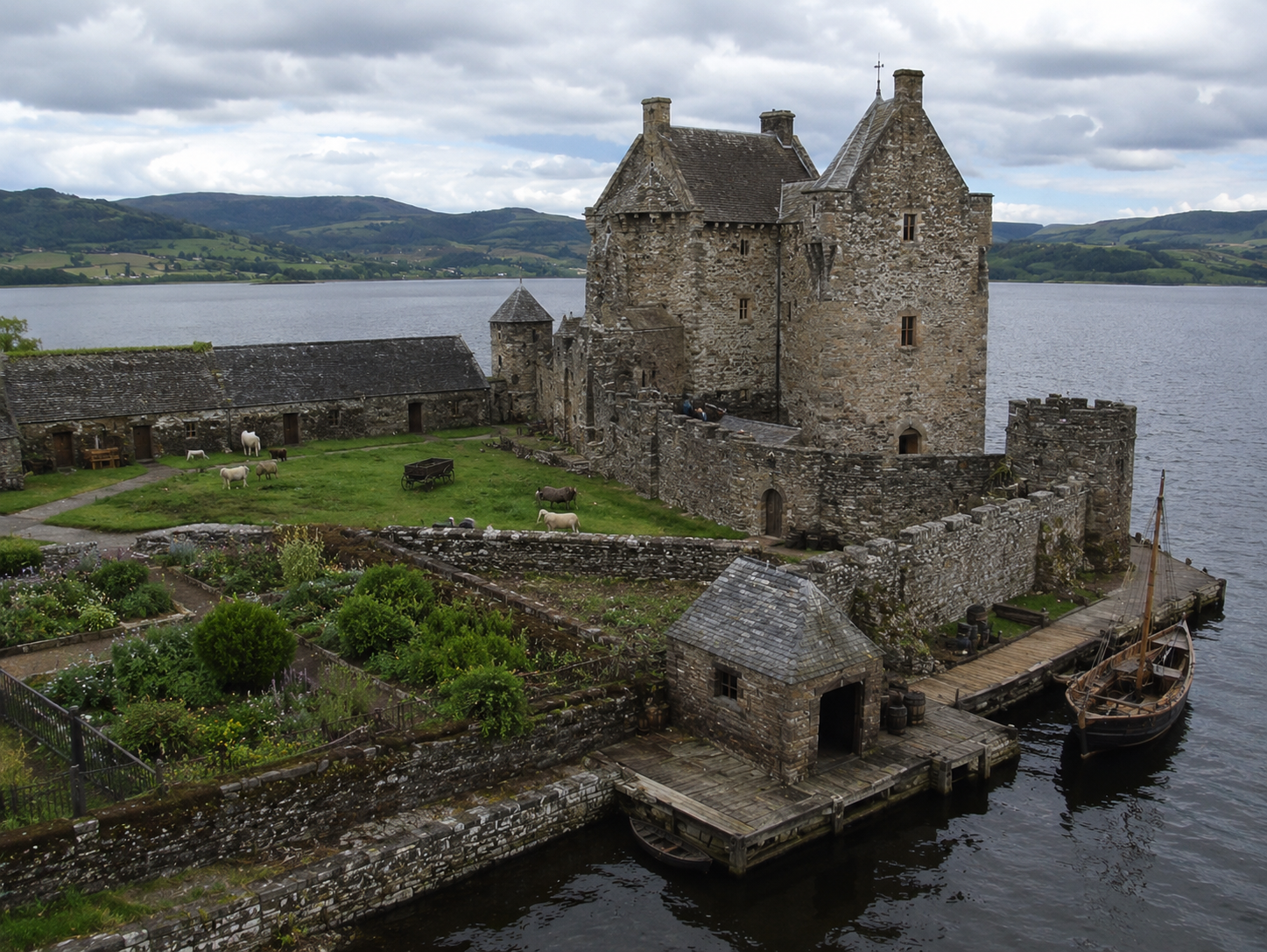
Lochleven Castle 1500
Six years before Agnes Douglas was born, Mary, Queen of Scots, had been imprisoned there. Her parents had been personally involved. By the time the Queen arrived at Lochleven on June 17th, 1567, some of Agnes’ older sisters were already children running around the castle. ‘Queen Mary’ lived within the Douglas household for more than ten months, primarily in the Glassin Tower, under guard. Some of William’s daughters even slept in Mary’s bedchamber; their presence added another layer of security around a royal prisoner whose escape could have enormous political consequences.
Their father had been formally ordered by the Confederate Lords to receive Mary into his castle and “keep her surely” until further orders. After Mary surrendered to the Confederate Lords at Carberry Hill on June 15th, the coalition of Scottish nobles who had risen against Mary and Bothwell took control of her. This was a serious government responsibility, not merely hospitality with locked doors.
Inside the castle, however, much of Mary’s daily life fell to Agnes Leslie, William’s wife and the future mother of Agnes Douglas. She became Mary’s principal female companion, spending much of the day with her and reportedly sometimes sleeping in Mary’s chamber. Mary became seriously ill soon after arriving and miscarried twins during her first weeks at Lochleven.
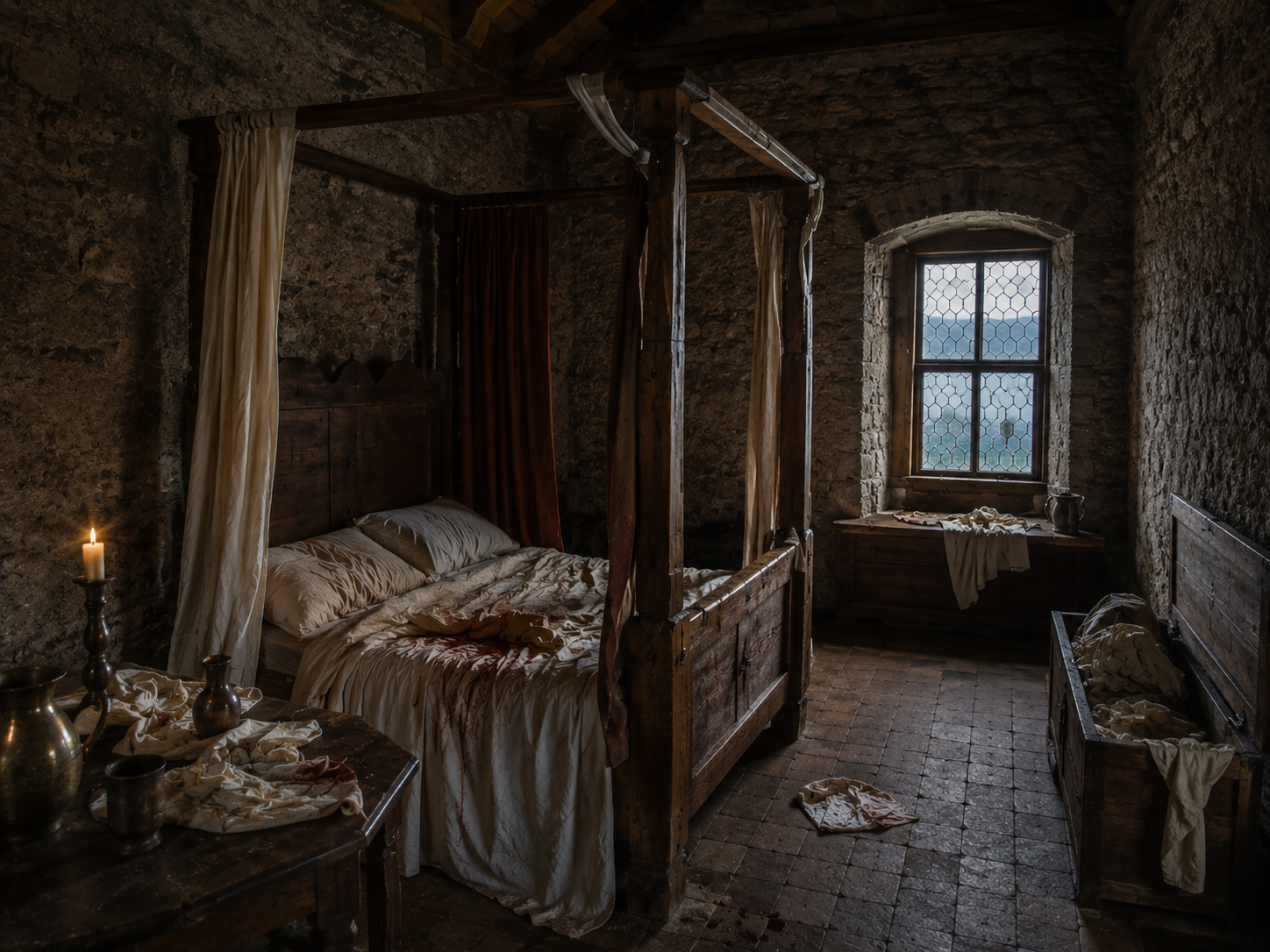
Agnes Leslie is believed to have helped nurse Mary through that miserable period. This was an unusually intimate form of captivity. The woman guarded Mary’s privacy, accompanied her throughout the day, and shared the female spaces of her confinement. At the time, Agnes Leslie was also managing her own pregnancy.
Daughter Agnes Douglas grew up in the same rooms and courtyards where Mary, Queen of Scots, had been held under guard, had miscarried twins, signed away her crown, and eventually slipped across the water to freedom.
The successful escape on May 2nd, 1568, was essentially a Douglas family conspiracy against the wishes of William Douglas of Lochleven. The two central figures were George Douglas, William’s younger brother, and Willie Douglas, a young dependent of the Lochleven household.
William was personally answerable for his prisoner. Parliament later formally declared that he had performed his duty in receiving and keeping her; he was definitely not involved with her escape.
The wife & mother Agnes Leslie’s role is murkier. She was Mary’s close female companion during the captivity, but I would not say she helped Mary escape. Mary's successful escape occurred while Agnes Leslie was recovering from childbirth; this reduced Agnes Leslie's ability to fully supervise Mary as closely as usual, creating the perfect opportunity to escape.
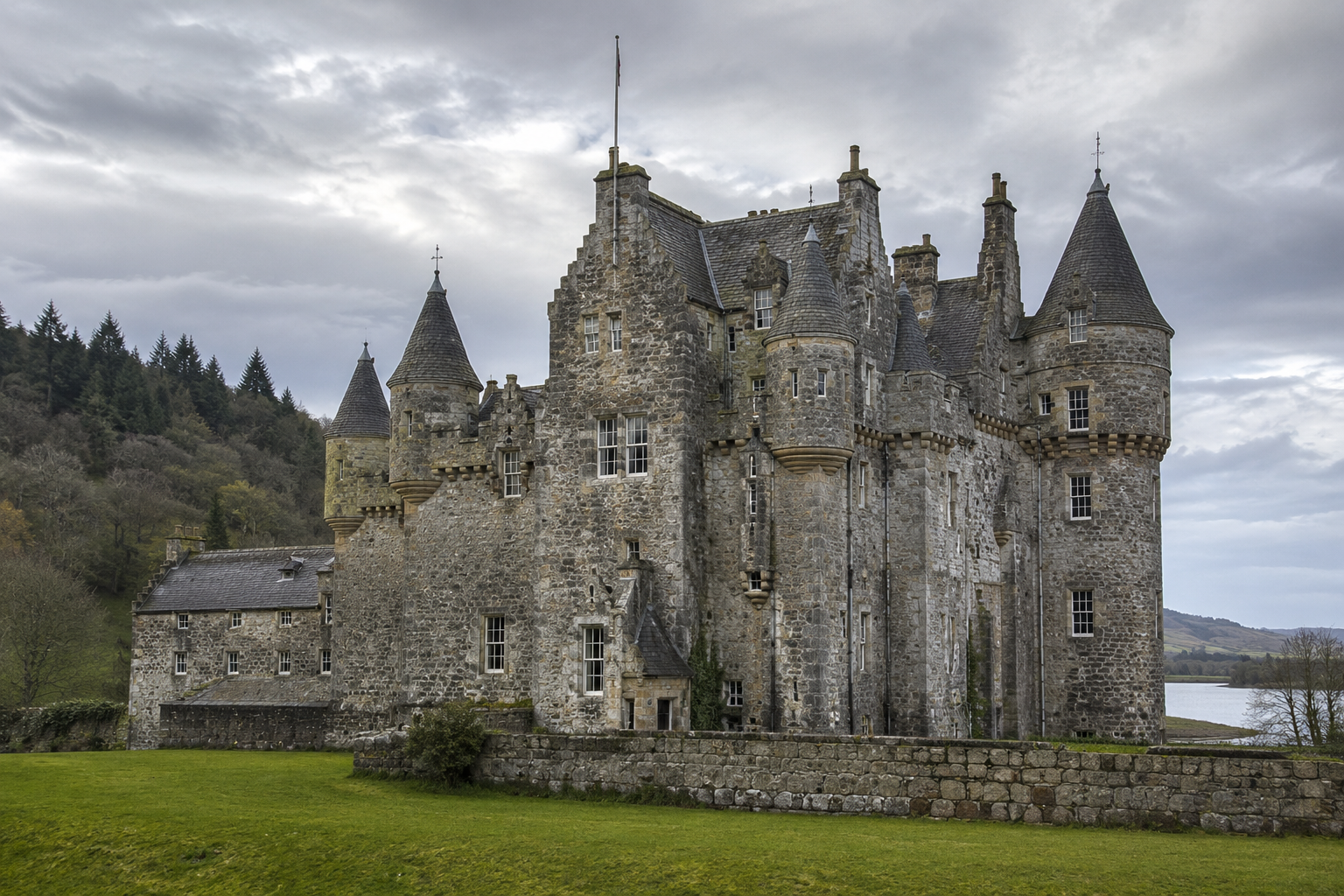
Inveraray Castle
Agnes was still young when the family’s fortunes changed again. In 1588, her father succeeded as 6th Earl of Morton. The daughter of the laird of Lochleven was now Lady Agnes Douglas, daughter of an earl.
On 24 July 1592, Agnes married Archibald Campbell (1575-1638), 7th Earl of Argyll, at Dalkeith Palace. She was about eighteen. It appears to have been a strong marriage. The Campbells were a major family in Scotland, with extensive lands and influence across the western Highlands. Agnes left one powerful political family for another, and became the ‘Countess of Argyll ‘.
Look at Agnes: in black and richly adorned with jewelry, has clothing and accessories that immediately mark her status. I love the royal feel. The portrait is traditional, as such portraits were meant to be, yet her face and hair, framed by that lace, are stunning. The portrait remains in the Scottish National Collection.
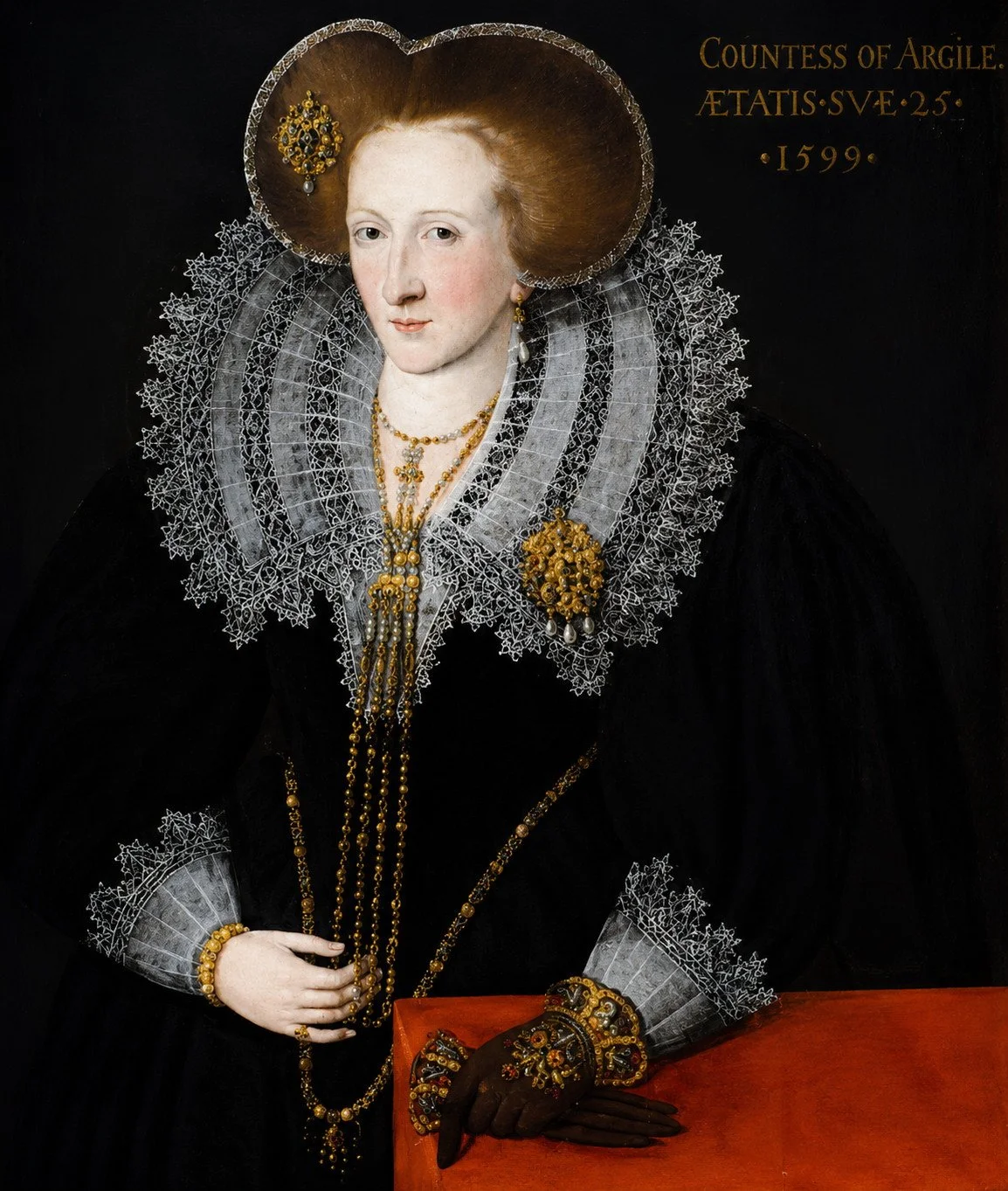
Agnes Douglas-Campbell 1599
The political world in Scotland changed beyond recognition.
In a kinda dark ‘Pearls of Lochleven’ family moment, Agne’s sister Elizabeth’s husband was among the Catholic earls openly confronting royal forces. On October 3rd, 1594, Francis Hay fought at the Battle of Glenlivet, where the Catholic army of Huntly and Erroll defeated the much larger royal force commanded by Agnes’s man, Archibald Campbell, 7th Earl of Argyll.
Two of the beautiful Douglas sisters who had grown up in the same family were now Countesses of Erroll and Argyll, while their husbands stood on opposite sides of a battlefield. This was probably heartbreaking for both of them.
On 24 March 1603, Elizabeth I died at Richmond Palace. James VI of Scotland inherited the English and Irish crowns and became James I of England. The king who had inherited Scotland as an infant during Mary, Queen of Scots’ imprisonment now ruled from London.
While Scotland seemed to be catching fire around her, Agnes was at home raising children. Much of her young adult life was taken up by the ordinary demands of her growing household: pregnancies, feeding babies, nurses, castle servants, clothing, illnesses, and the endless management expected of a countess.
Agnes Douglas-Campbell died on 3 May 1607, about thirty-three years old.
O, I just had to know why —
The chronology presents a plausible childbirth/postpartum timeline, though I would not call it proven. Her only son, Archibald Campbell, was born, as documented, in ‘Spring 1607’. Several secondary accounts place his birth in April 1607 and describe Agnes as dying about a month afterward!
So young! Like most of my ancestral crushes. I am moved by their early demises.
Genealogical sources disagree over the exact number of children. Stronger peerage compilations give four children.
July 24th 1592 — Agnes marries Archibald Campbell, 7th Earl of Argyll
1594 — daughter Anne born
Later — Annabella and Jean (probably after her sister)
Spring 1607 — Agnes gives birth to her only son, Archibald
3 May 1607 — Agnes dies …. & her husband survived her by more than thirty years.
So yes, I think childbirth or postpartum complications have to be considered seriously. I feel strongly about this being her end.
Her entire adult life, essentially, was spent as Countess of Argyll. She was married for 14 years and about 9 months. Three daughters and one son.
Around 33, I’m sure she was still absolutely gorgeous.
She was buried at Kilmun, among the Campbells. Archibald followed her there in 1638, more than thirty years after her death. Their son Archibald eventually came home to Kilmun as well, buried there after his execution in Edinburgh in 1661. (Find out more about him in my next article.)
The Douglas name appears repeatedly in my family tree research. My documented branch runs through Margaret Chalmers’ mother, Janet Johnstone, to Janet Douglas, daughter of James Douglas of Morton and Christian Lockhart, and so on…
Agnes is a cousin to me, surrounding my Douglas ancestry.
Cheers to her for leaving us such a killer portrait for eternity!
Her smirk leads me to believe she was possibly a handful.
Of course, as a redhead, I am biased.
;)
For Your Reference;
National Galleries of Scotland — Agnes Douglas, Countess of Argyll (c.1574–1607); portrait attributed to Adrian Vanson and identification of Agnes and her sisters as the “seven pearls of Lochleven.”
Sir James Balfour Paul, The Scots Peerage — Douglas of Lochleven/Morton and Campbell of Argyll pedigrees.
George Harvey Johnston, The Heraldry of the Douglases — Douglas branches and the traditional Whittinghame connection of the Dumfriesshire Douglases of Morton.