Women Floral Artists Under The Scope
Marianne’s father, Frederic North, was a Norfolk landowner and MP. Her mother, Janet Marjoribanks, came from a well-regarded Scottish family. Marianne grew up with a younger sister, Catherine, a brother, Charles, and an older half-sister, Janet.
Marianne North was born on October 24th 1830, in Hastings, Sussex, into a family whose circumstances gave her the freedom to pursue her interests; they traveled, and she spent much of her childhood outdoors. The family divided its time between Hastings, London and Norfolk.
In nineteenth-century England, Marianne was generally expected to learn music, drawing and polite conversation. This mattered more than preparation for a profession. A university education was not common for women of her generation.
She later admitted she learned much of her history from Walter Scott, Shakespeare, and Robinson Crusoe.
By 1847, she was sixteen, and her family departed for an extended stay on the European continent. They temporarily settled in Heidelberg, Germany. Marianne was encountering unfamiliar landscapes, architecture, gardens, and people.
Marianne’s first creative love was not art but music — she trained to be a vocalist, but when her sonorous contralto voice broke down, so did that path.
When the family returned to England in 1850, Marianne began taking flower-painting lessons from a Dutch artist she identified in her memoir as Miss van Fowinkel.
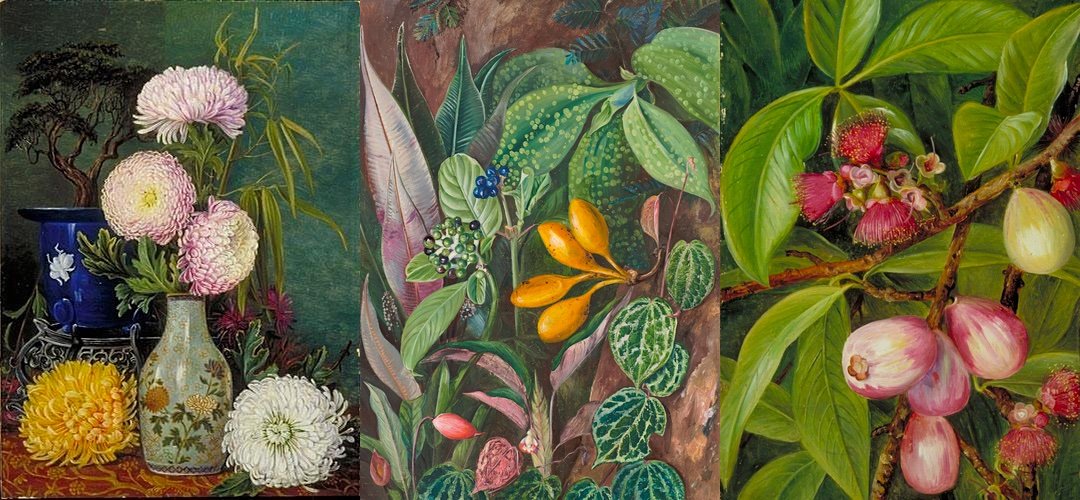
Botanical paintings by Marianne North (1830–1890). Left to right: Japanese Chrysanthemums, Cultivated in This Country (1876); Group of Bornean Plants (1876); and Foliage, Fruit and Flowers of a Rose-Apple, Java (c. 1876). Oil paintings. Marianne North Gallery, Royal Botanic Gardens, Kew, London
Flower painting was considered a suitable accomplishment for a young Englishwoman, but Marianne was beginning to take it more seriously.
She continued her artistic education under Valentine Bartholomew, a fashionable flower painter who had worked with Queen Victoria. His lessons helped her develop her understanding of botanical subjects, although she had not yet settled on the distinctive style that would eventually make her famous. Painting wasn’t her only interest.
Marianne had a beautiful singing voice and studied with Charlotte Sainton-Dolby, one of Britain's leading contraltos. For a time, music seemed likely to become her principal artistic pursuit. But difficulties with her voice eventually forced her to abandon that ambition.
Fortunately, she had painting to fall back on.
In January 1855, Marianne's mother died. She was twenty-four, unmarried, and increasingly devoted to her father, Frederic. Their close relationship would shape the next fourteen years of her life. Frederic North had served in Parliament since 1830, representing Hastings. His political career placed the family in circles of considerable social influence, while their financial security gave Marianne opportunities most aspiring women artists could never have afforded.
She did not need to earn her living from painting.
Women who depended on their artwork for income faced the demands of publishers, patrons, commissions, and fashionable tastes. Marianne could pursue subjects that simply interested her, without worrying whether anyone would buy the finished picture.
During the following years, she accompanied her father on journeys through Europe and the Mediterranean. They visited Switzerland, Austria, Italy, Spain, and other destinations, often spending time in gardens and landscapes that Marianne enjoyed sketching. Travel was becoming part of her artistic education. The 1850s and 1860s were also decades of extraordinary botanical exchange. British gardens were receiving plants from Asia, Africa, Australia, and the Americas, carried through expanding networks of trade, scientific collecting, and empire.
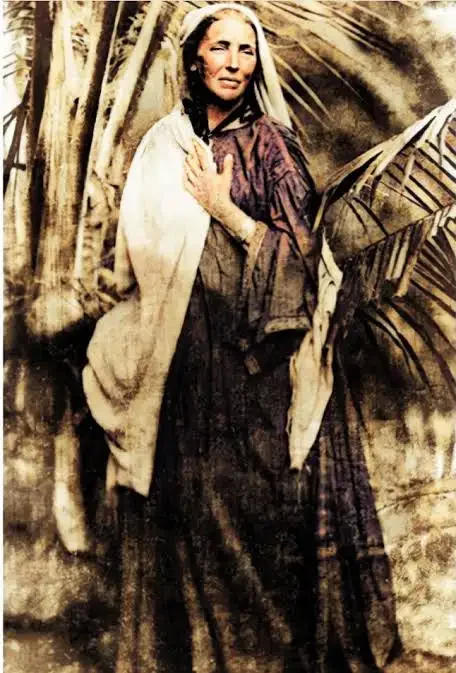
Marianne North
At the Royal Botanic Gardens at Kew, researchers could study and cultivate unfamiliar species thousands of miles from their native habitats. Marianne became particularly fascinated by the spectacular tropical flowering tree Amherstia nobilis. Sir William Hooker, director of Kew, showed her its remarkable blossoms, an encounter she remembered years later.
She had seen what gardeners could accomplish under glass. But an entire world lay beyond those greenhouses.
In 1867, while visiting the Continent, Marianne studied oil painting with the Australian artist Robert Dowling. Until then, she had worked principally in watercolor. Oil paint offered something different. Its richness and durability suited the dense vegetation, brilliant flowers, and complicated landscapes that increasingly attracted her attention. She would eventually abandon watercolor almost entirely. Oil paint was really spoiling her!
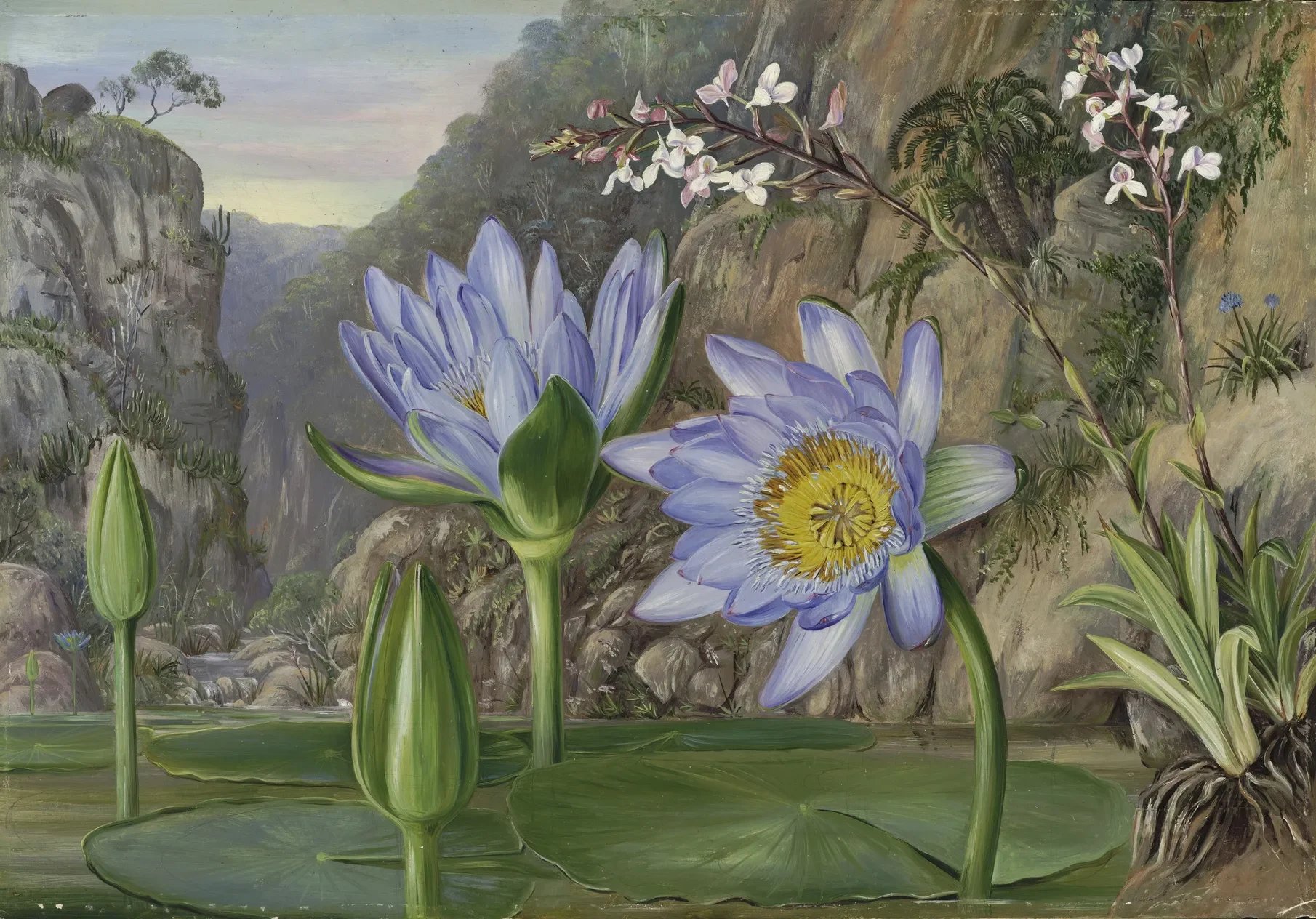
North Nymphaea stellata, South Africa. (© RBG Kew)
By the late 1860s, Marianne was approaching forty. She remained unmarried, had no children, and enjoyed a degree of personal independence unusual for women of her generation. Yet much of her life still revolved around her father's companionship.
Then, in October 1869, Frederic North died.
Marianne was devastated.
For years, they had traveled together, sharing the experiences that had broadened her world. Now, at thirty-eight, she faced arranging her life without him. His death marked a turning point. She possessed financial independence, an increasingly serious interest in painting, and years of experience traveling abroad. She was also no longer tied to her father's parliamentary responsibilities or daily companionship.
In 1871, Marianne departed England for North America, beginning the first of the great independent journeys that would eventually take her around the world.
She was forty years old.
The botanical artist whose paintings would one day fill an entire gallery at Kew was only just beginning her most remarkable work.
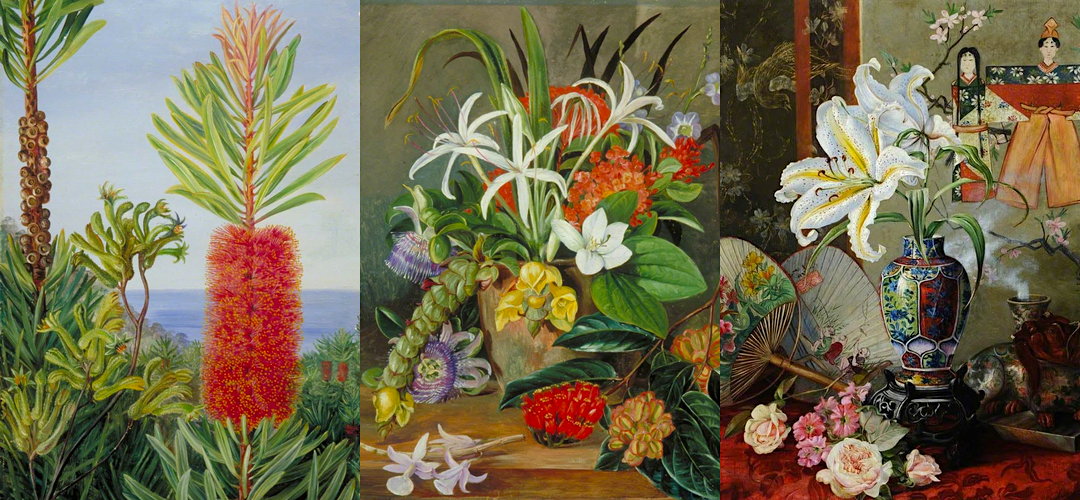
Three botanical paintings by Marianne North (1830–1890). Left: West Australian Vegetation (c. 1880–1881), Royal Botanic Gardens, Kew. Center: Floral Still Life; Right: Japan (1850–1890), National Trust Collections, Gawthorpe Hall Collections.
Marianne had long wanted to paint tropical plants where they actually grew, rather than studying specimens brought back to England or cultivated in glasshouses.
An invitation to spend the summer of 1871 with friends in the United States offered her an opportunity. She arranged introductions to people in Brazil and the West Indies, packed her painting materials, and crossed the Atlantic.
Her first destinations were Canada and the United States!
For a woman accustomed to European travel, North America offered something different. Railways and steamships made long distances accessible, though travel still involved complicated connections, unfamiliar accommodations, and the constant business of managing luggage.
Marianne visited friends, explored gardens, and admired New England's landscapes. She was particularly taken with the autumn foliage.
In New Hampshire, she traveled across Lake Winnipesaukee, where the brilliant reds of the maples and the blue-and-white autumn flowers caught her attention. Her descriptions reveal something important about how she saw a landscape: she noticed its plants individually, even when surrounded by spectacular scenery.
She also encountered people who would influence her ambitions.
Among them were the naturalist Louis Agassiz and his wife, Elizabeth Cary Agassiz, whose published account of their Brazilian expedition had introduced readers to the natural history of South America.
Elizabeth was herself a writer and an active participant in scientific and educational circles. Marianne's encounter with the Agassiz family placed her among people who saw travel as a way to study the natural world, not merely enjoy its scenery.
But the tropical vegetation she had dreamed of painting was still farther south.
On Christmas Eve 1871, Marianne arrived in Jamaica.
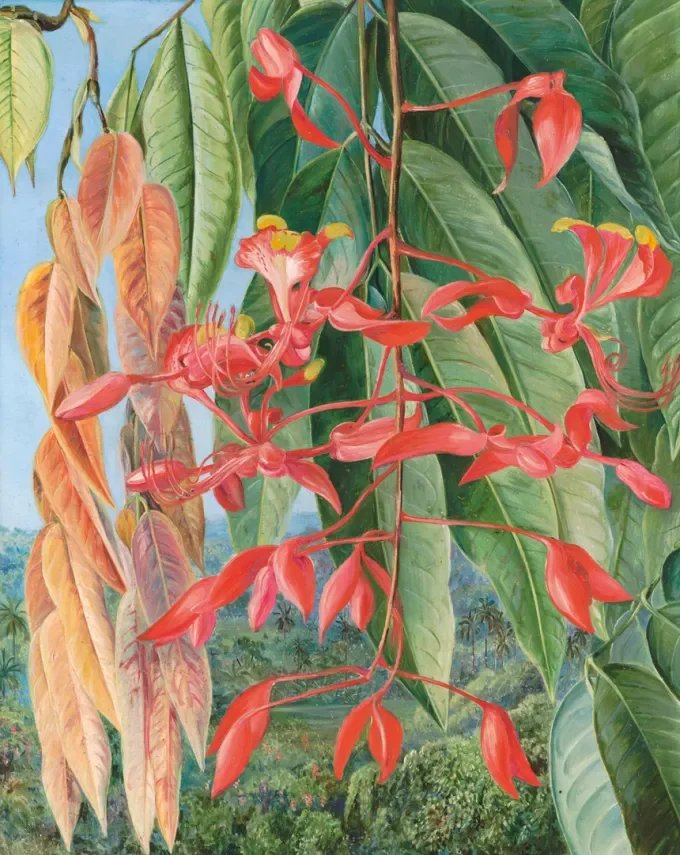
Amherstia nobilis, Singapore, 1876. (© RBG Kew)
The following morning, she visited a market in Kingston. It was Christmas Day, and the streets were filled with people. A band played while residents walked through the town.
The scene was very different from an English Christmas.
Jamaica had been under British colonial rule for more than two centuries. Emancipation had ended slavery in the British Caribbean in the 1830s, but the island's economy and society remained deeply marked by plantation agriculture, racial inequality, and the struggles of formerly enslaved communities.
Marianne arrived as a financially independent British visitor. Her freedom to travel, arrange introductions, and devote months to painting was closely connected to the privileges of her class and nationality.
She spent approximately five months on the island, exploring its vegetation and painting the tropical plants that had drawn her across the Atlantic.
Bananas, palms, flowering trees, and tangled growth offered subjects quite unlike the cultivated flower arrangements of her early lessons.
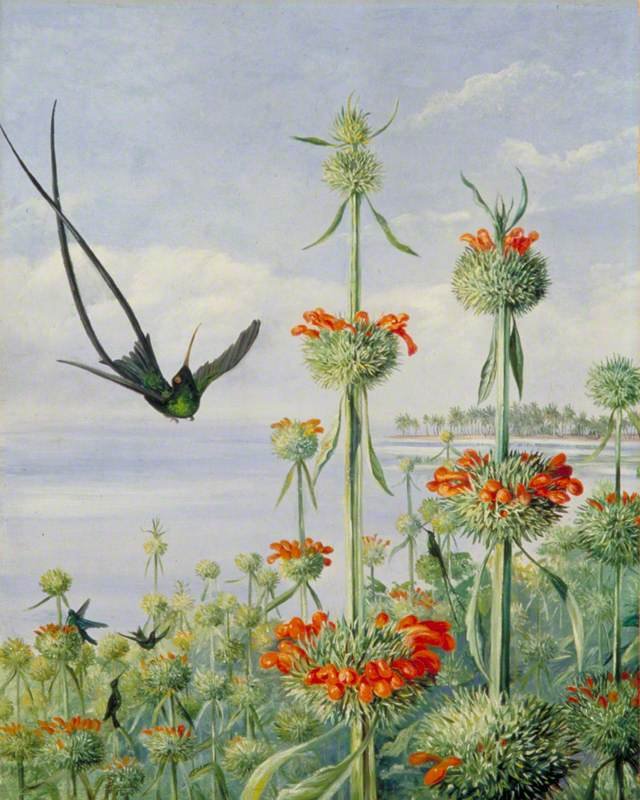
Leonotis leonurus (Lion’s Tail) with Hummingbirds - Marianne North Gallery, Royal Botanic Gardens, Kew, London
These paintings were not simply botanical specimens placed against empty backgrounds. Marianne wanted to show plants growing among their neighbours, with the surrounding vegetation, landscape, and sometimes human activity included.
That choice would become one of the defining characteristics of her work.
She returned to England in June 1872, but did not remain there long.
Later that summer, Marianne set out for Brazil.
This journey took her much deeper into the tropical environment she had wanted to experience. She spent extended periods painting in the countryside, including time in a secluded forest dwelling where she could work close to the vegetation.
Brazil in the early 1870s was an independent empire ruled by Pedro II. Slavery remained legal, although the Free Womb Law of 1871 had begun a gradual and incomplete process of emancipation.
As in Jamaica, Marianne's artistic travels unfolded within a society shaped by unequal access to land, labor, and freedom. Her paintings record the natural environments she encountered, while her recollections provide glimpses of the people, households, and working arrangements that made her journeys possible.
The Brazilian forests gave her an extraordinary range of subjects. Orchids, climbing plants, flowering trees, and unfamiliar fruits crowded the landscape.
Painting them required patience. She had to work with changing light, unpredictable weather, insects, and the difficulties of transporting materials through unfamiliar country.
Yet she continued producing paintings directly from the plants before her.
By the time Marianne returned to England in September 1873, she had spent much of the previous two years travelling through North America, the Caribbean, and Brazil.
She was no longer simply a wealthy Englishwoman who enjoyed flower painting.
She had begun building a substantial visual record of plants in their native environments, informed by firsthand observation and shaped by her own artistic decisions.
And she had discovered that she could organize these journeys without her father's companionship.
There would be many more.
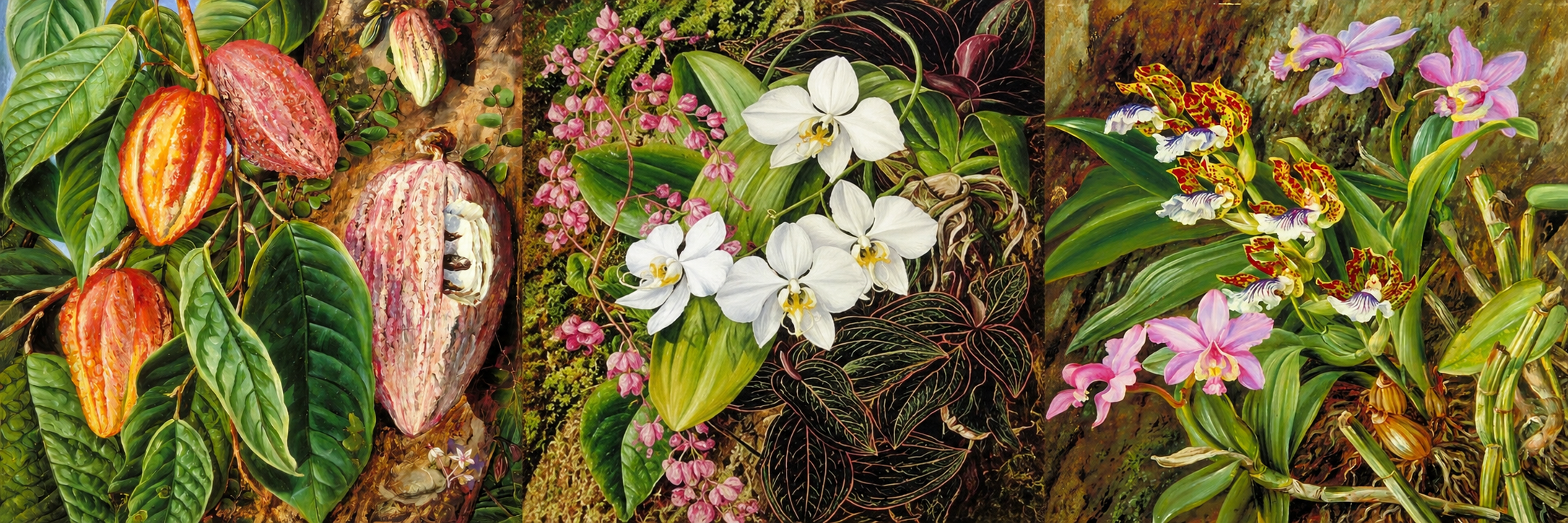
Botanical paintings by Marianne North (1830–1890): Flowers and Fruit of the Cocoa Tree, Painted at Singapore (1876); Bornean Orchids (c. 1876); and Brazilian Orchids (1873). Collection: Royal Botanic Gardens, Kew, Marianne North Gallery
A Gallery of Her Own
Marianne North had discovered that she could travel independently, and she had no intention of stopping.
In 1875, she set out again, traveling through Tenerife and California before crossing the Pacific to Japan. From there, her journeys took her through parts of Southeast Asia, including Singapore, Sarawak, and Java.
She painted wherever she could arrange a place to work. Sometimes that meant staying with British officials or acquaintances; at other times, she found accommodation close to the plants she wanted to study. Her introductions and financial independence opened doors that would have remained closed to many women of her generation.
She was not collecting botanical specimens in the conventional scientific manner. She was recording living plants in their surroundings, often including the trees, hills, coastlines, and neighboring vegetation that helped explain where they grew.
That distinction matters. A pressed flower could preserve a plant's physical structure, but Marianne's paintings showed its colors, its habitat, and its relationship to the landscape.
Her travels continued through India, Ceylon (now Sri Lanka), Australia, New Zealand, South Africa, and the Seychelles.
By then, she was producing paintings in remarkable numbers.
In 1879, Marianne approached Sir Joseph Dalton Hooker, director of the Royal Botanic Gardens at Kew, with an unusual proposal.
She wanted to give Kew her paintings and pay for a building to house them.
Sir Joseph Dalton Hooker accepted.
The resulting gallery opened in 1882, while Marianne was still alive. Her paintings covered the walls, arranged closely together to reflect her wishes.
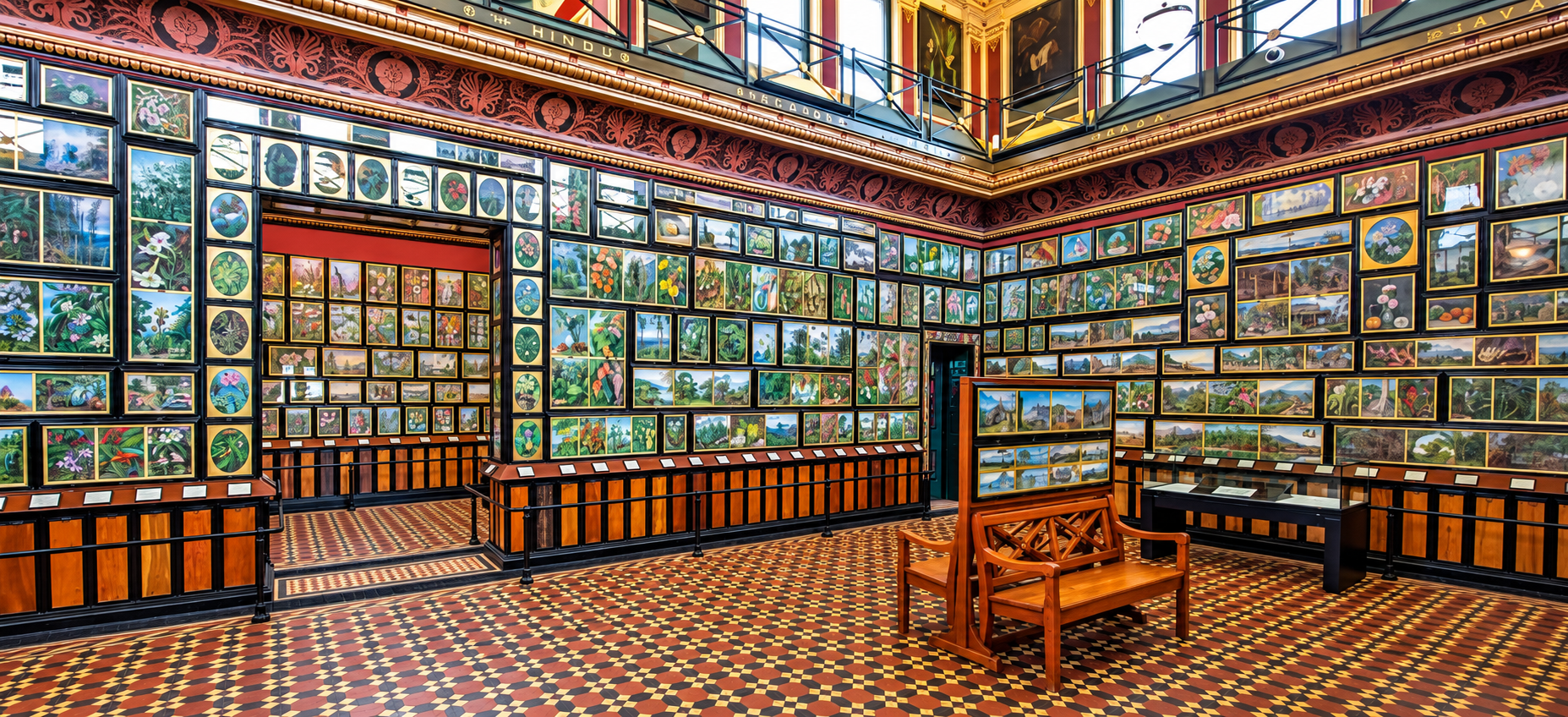
Marianne North Gallery · RBG Kew
This was not a temporary exhibition of a fashionable lady's accomplishments. Marianne had financed a permanent public space for her work within one of Britain's most important botanical institutions.
She also designed the decorative scheme, including the arrangement of the paintings and the use of woods gathered from different parts of the world.
The gallery offered visitors something few could otherwise experience: a visual journey through the vegetation of distant countries, painted directly from nature by a woman who had traveled to see it.
And Marianne was not finished.
After meeting Charles Darwin in 1880, Marianne was encouraged to visit Australia to see its unusual vegetation. Darwin particularly wanted her to see and paint the remarkable plants of that continent.
She traveled there in 1880–1881, then went to New Zealand before returning to England.
Later journeys took her to South Africa and the Seychelles. In 1884–1885, she visited Chile, where she painted the region's distinctive vegetation, including the extraordinary Araucaria trees.
Kew added her paintings from these later journeys to its collection.
Marianne was now in her fifties. Years of travel had taken a physical toll, and her health increasingly limited what she could undertake.
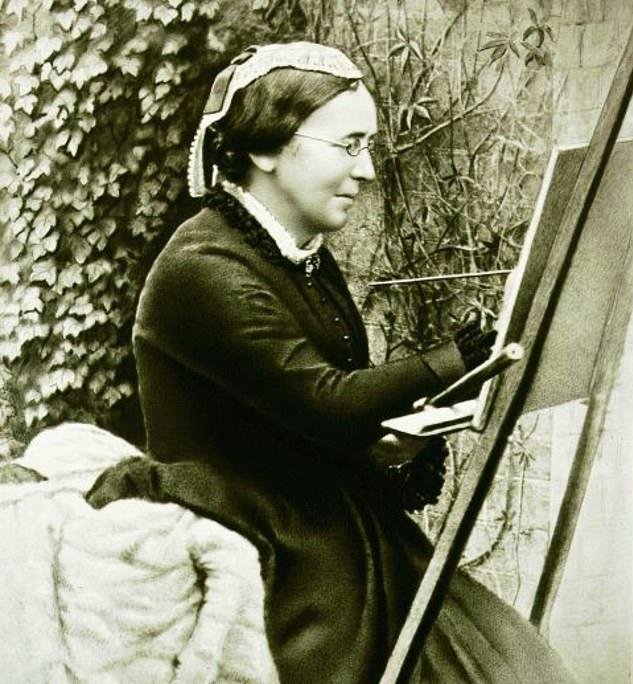
Marianne North (c.1880s)
The woman who had once depended on her father's companionship had spent more than a decade traveling across continents, managing her own arrangements, and pursuing an artistic project of extraordinary scale.
Her final years
In 1883, Poor health forced Marianne to abandon her visit to the Seychelles and return to England, according to the Royal Botanic Gardens, Kew. We rarely know someone’s ‘cause of death’. Yet, a biographical timeline published reports that she was diagnosed with liver disease in 1888.
Marianne eventually settled at Alderley in Gloucestershire, where she devoted herself to her garden and continued working on her paintings and recollections. She died there on 30 August 1890, aged fifty-nine.
Historic England explicitly confirms her burial at St Kenelm's.
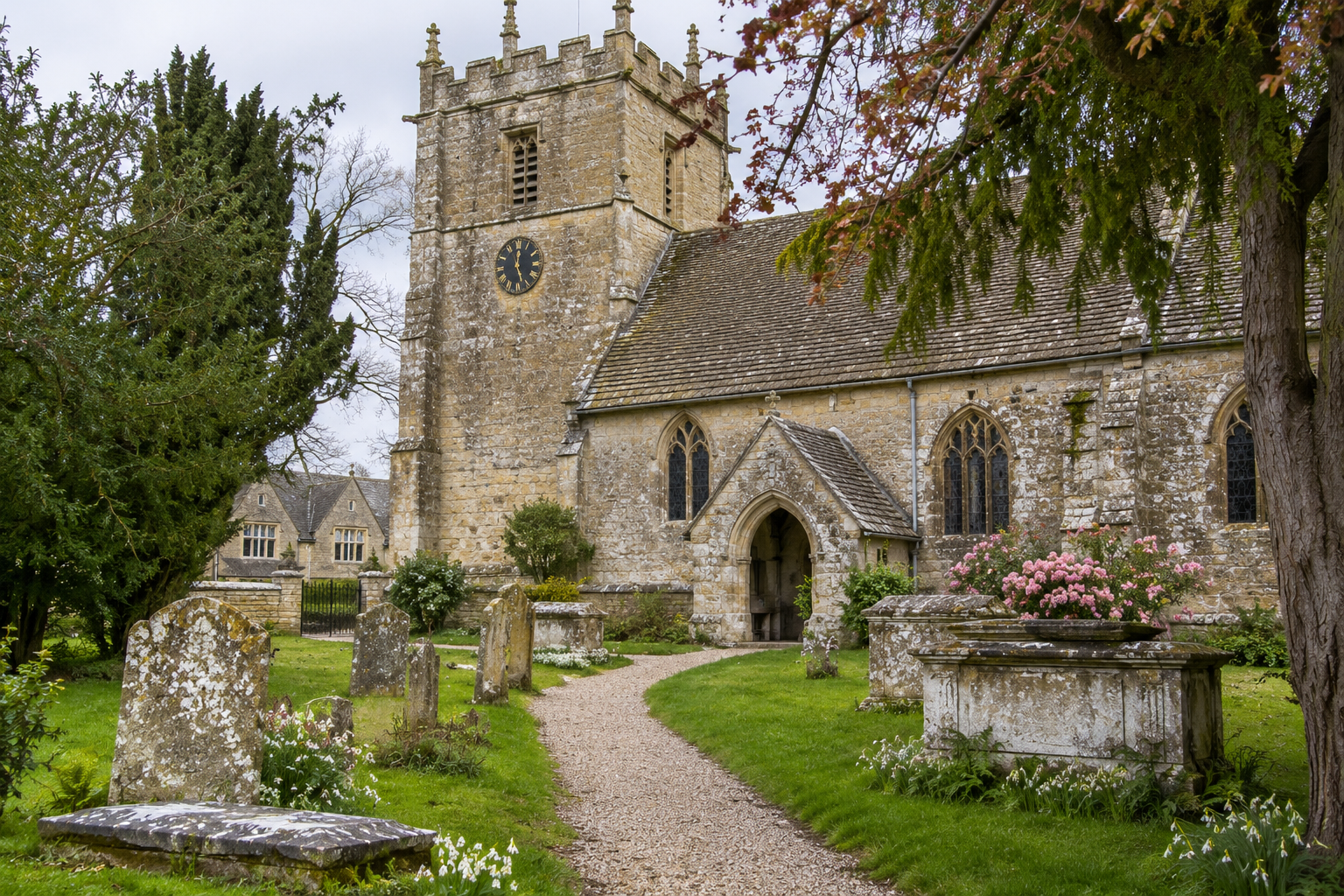
A vision of the churchyard of St Kenelm's Church, Alderley, Gloucestershire, England
(51.61554° N, 2.33576° W)
From a distance, I haven't been able to establish the exact position of her headstone within the churchyard.
Her autobiography, Recollections of a Happy Life, was published posthumously in 1892, edited by her sister, Janet Catherine North Symonds. Its pages preserve the observations, encounters, frustrations, and occasional humor of a woman who spent much of her adult life moving between unfamiliar places.
The title is revealing, although it should not lead us to imagine that Marianne's life was without grief or difficulty. Especially losing her parents so young in life.
She had lost her mother when she was twenty-four and her father when she was thirty-eight. She never married, and she lived much of her later life outside the domestic arrangements expected of women of her social position.
Her inheritance made her independence possible. What she chose to do with that independence was her own achievement.
What Marianne left behind
Today, the Marianne North Gallery at Kew contains more than 800 of her paintings.
Her work has sometimes occupied an uncertain position between botanical illustration and fine art. She was not producing the isolated, carefully dissected specimens associated with scientific botanical plates. Nor was she simply painting decorative flowers for a drawing room.
She painted plants as she encountered them, in the landscapes where they lived. How satisfying.
She had the money to travel, the curiosity to keep going, and the determination to make something lasting from what she saw.
More than a century after her death, visitors can still walk into her gallery at Kew and see the world through her eyes…
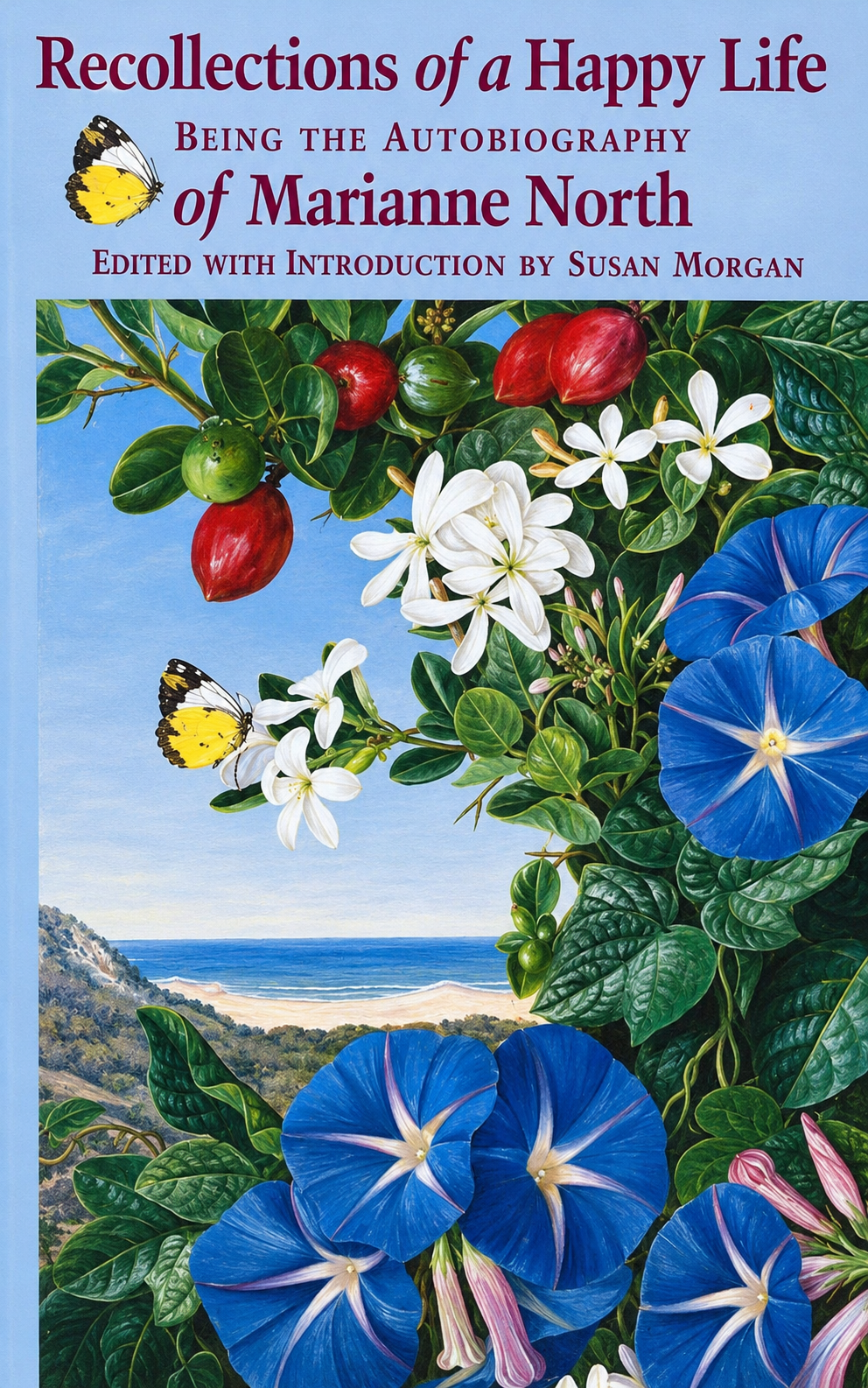
Examine Marianne's accounts of where she stayed, whom she met, how she traveled, and what happened while she painted. Her recollections give us the small, personal details missing from conventional biographies.
For Your ReferenceNorth, Marianne. Recollections of a Happy Life: Being the Autobiography of Marianne North. Edited by Mrs. John Addington Symonds (Janet Catherine North Symonds). 2 vols. London: Macmillan and Co., 1892.
Our principal source for her childhood, family relationships, education, early travels, personal observations, and painting experiences.
North, Marianne. Some Further Recollections of a Happy Life: Selected from the Journals of Marianne North, Chiefly between the Years 1859 and 1869. Edited by Mrs. John Addington Symonds. London: Macmillan and Co., 1893.
Especially useful for the years she traveled with her father, her developing artistic interests, and her life before becoming an independent traveler.
Hemsley, W. Botting. “The Marianne North Gallery of Paintings of ‘Plants and their Homes,’ Royal Gardens, Kew.” Nature 26 (15 June 1882): 155–156.
An especially valuable contemporary account of the gallery's opening, published during Marianne's lifetime. Read the original 1882 article.
Darwin Correspondence Project. “Marianne North,” biographical register and correspondence, including Darwin's letter of 2 August 1881.
Primary documentary material for her relationship with Charles Darwin. Darwin Correspondence Project.
Royal Botanic Gardens, Kew. A Guide to the Marianne North Gallery.
Essential for the gallery's history, her donation, Joseph Dalton Hooker's involvement, the arrangement of her paintings, and later expansion. Kew's gallery guide (PDF).
Royal Botanic Gardens, Kew. “Six Things You Should Know About Marianne North.”
Biographical chronology, artistic techniques, travels, and the creation of her gallery. Read Kew's biography.
Royal Botanic Gardens, Kew. “Marianne North Gallery.”
Official institutional description of the collection and its significance. Kew gallery collection.
Historic England. “Marianne North Gallery, Royal Botanic Gardens, Kew.” National Heritage List for England, entry 1251787.
Architectural history, gallery design, original arrangements, and the artist's role in commissioning the building. Historic England listing.
Middleton, Dorothy. “North, Marianne (1830–1890).” Oxford Dictionary of National Biography. Oxford University Press, 2004. A scholarly biographical reference for her family, life, travels, and final years.
Morgan, Susan. Place Matters: Gendered Geography in Victorian Women's Travel Books about Southeast Asia. Rutgers University Press, 1996. Chapter 4, “Botany and Marianne North: Painting ‘A Garland about the Earth.’”
Particularly relevant to Marianne's independence, Victorian gender expectations, and the colonial world through which she traveled. View the book and contents. fulcrum.org
Dowe, John L. “The Australian Paintings of Marianne North, 1880–1881.” Cunninghamia 20 (2020).
Detailed research into her Australian travels and paintings, with artwork documentation and historical references. Read the research paper (PDF).
Royal Botanic Gardens, Kew. “Marianne North: An Unsung Pioneer of Botanical Art.” Google Arts & Culture.
Illustrated overview of her life, painting practice, and surviving collection. View the illustrated exhibition
Researched & Written by author Krysta Abesamis