Women Floral Artists Under The Scope
In the Cornish countryside, Emily Stackhouse studied familiar hedgerow flowers and less common native plants; she examined their structures, recorded their names, and painted them in amazing detail.
What began as a study of plants developed into an impressive body of botanical artwork.
Emily created hundreds of watercolors, and her illustrations eventually reached readers across Britain through popular natural-history books. Her paintings helped people recognize and understand the plants growing in their own countryside, even if the gig offered little credit to an emerging artist.
Born on July 15, 1811, in Modbury, Devon, England. Emily was the daughter of the Reverend William Stackhouse and his wife, Sarah. She was an infant while Britain was still fighting Napoleon, and King George III's illness led to the Regency under his son, the future George IV. Jane Austen published Pride and Prejudice, offering a contemporary portrait of women's marriage prospects, property, and social expectations.
Seemingly, Emily spent most of her childhood in the rolling green hills and wildflower-strewn meadows, which offered endless beauty to an artist who loved flowers.
Emily was nineteen when her father inherited the family’s country estate and moved them near Probus. The property included a substantial Queen Anne house, surrounded by the rural landscape of a county celebrated for its unusual flora. For a young woman already surrounded by relatives interested in plants and natural history, Cornwall offered an extraordinary outdoor classroom.
Her great-uncle, John Stackhouse, had been a respected botanist. Other family connections extended into the period’s scientific circles. Botany was part of the intellectual world Emily had been born into.
During the 1830s, Emily began producing an extensive series of botanical watercolors. She recorded plants with remarkable precision, identifying them by their English and Latin names and often noting where and when she found specimens.
These were beautiful pictures, and they were also legitimate records of botanical observation.
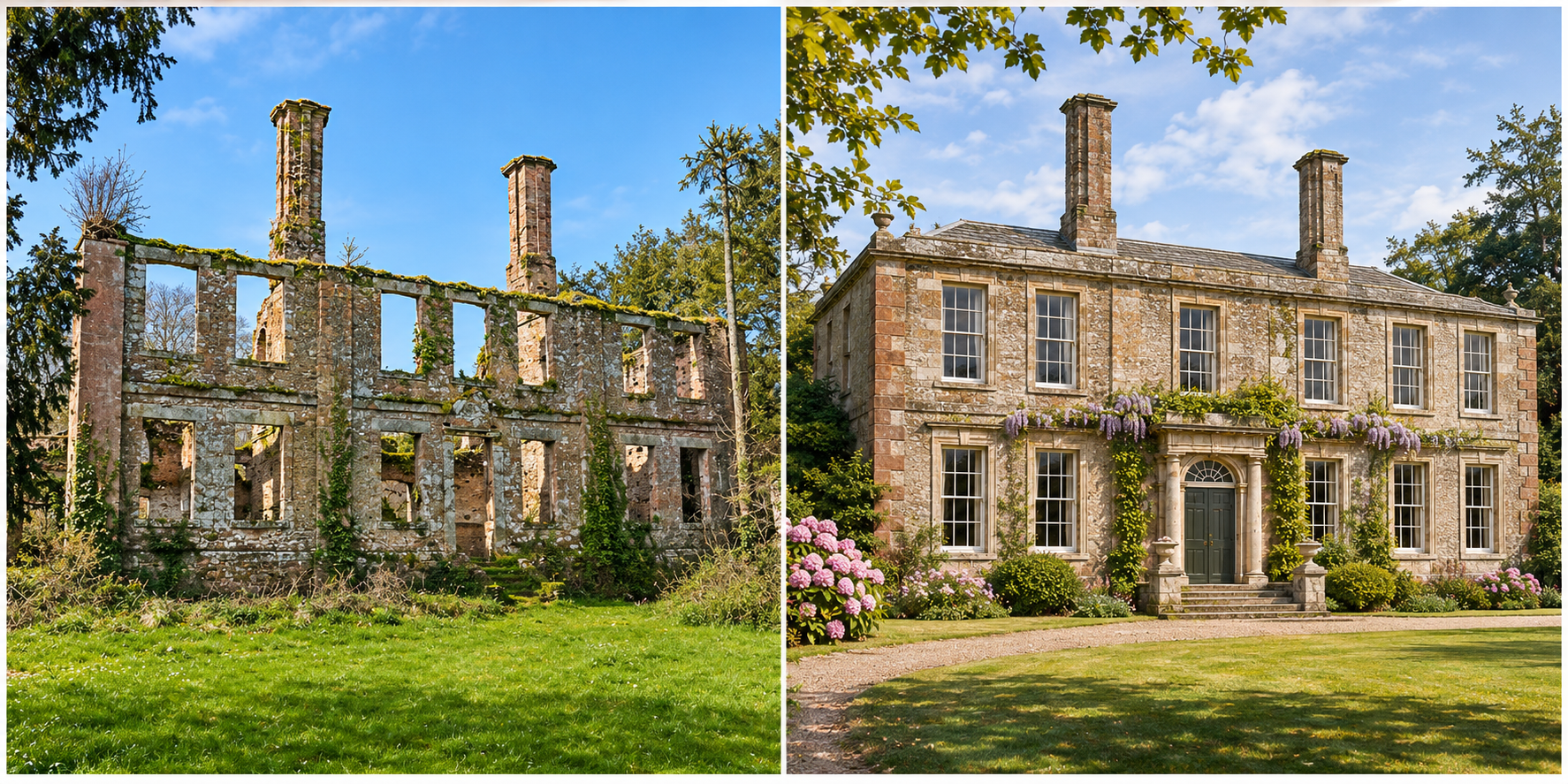
Trehane House, Probus, Cornwall. Left: Ruins of Emily Stackhouse's family home. Right: A vision of the house c. 1830–1870
In the 1820s, private gardens were filled with plants from distant countries as Britain became increasingly fascinated with the natural world. Scientific study and new illustrated books made botany accessible to readers.
For Emily Stackhouse, now in her twenties, this growing interest coincided with her own development as a botanical artist.
Botany was an acceptable intellectual pursuit for respectable women, when practiced through flower painting and collecting. Yet men largely controlled the scientific institutions that classified, published, and authorized botanical knowledge.
By 1830, the Horticultural Society of London began admitting women for membership. It was a modest but meaningful change. Opportunities for women and formal recognition were limited. Emily was devoted to identifying and recording plants. She included botanical names and often noted where and when she found specimens.
Emily worked in the British countryside, documenting plants at a time when natural history depended heavily on careful observation and accurate illustration.
And she was remarkably productive…
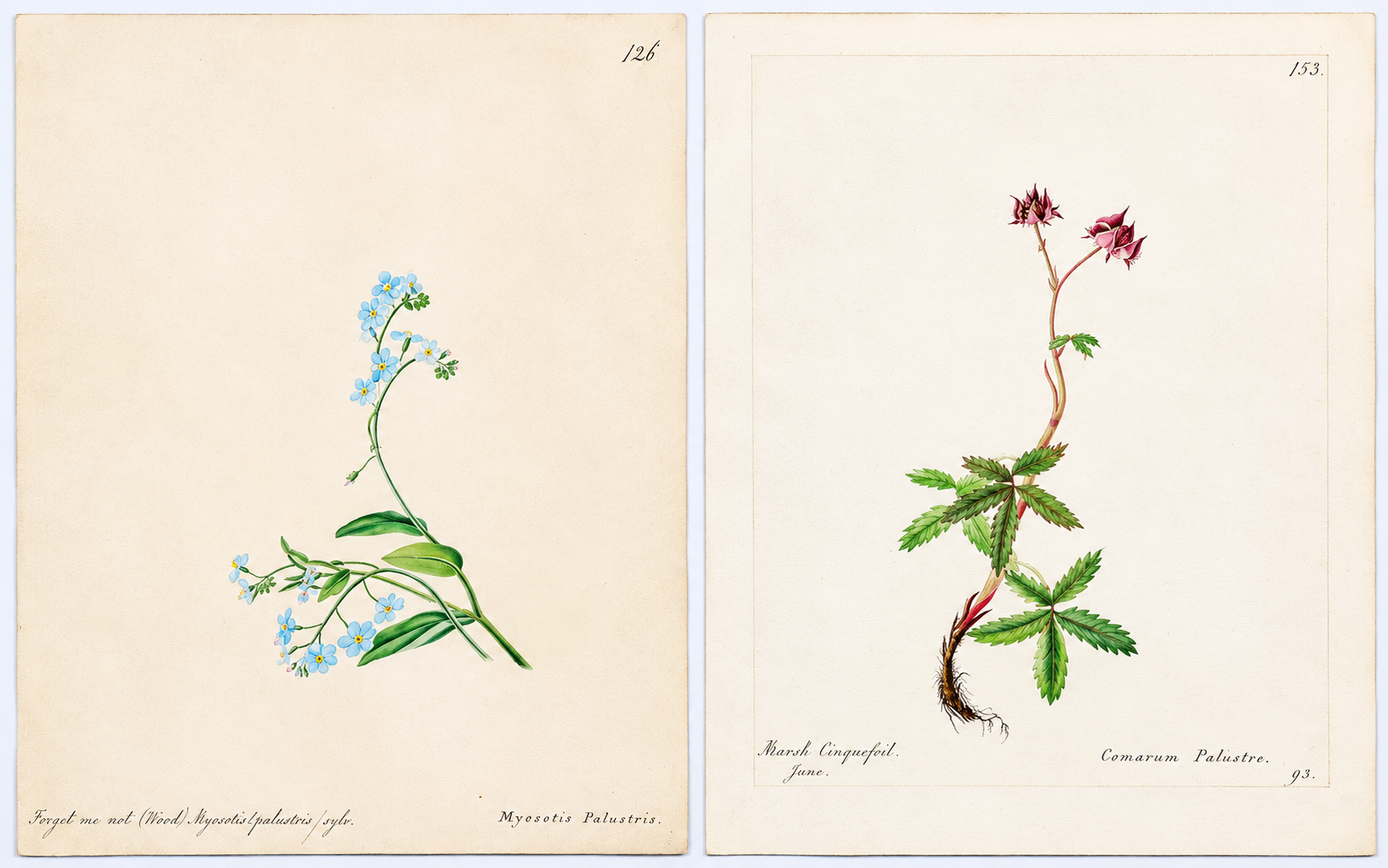
Emily Stackhouse (1811–1870) : Original Watercolors
1. Left — Forget-me-not (Myosotis palustris), also known as Water Forget-me-not.
2. Right — Marsh Cinquefoil (Comarum palustre), also known as Marsh Fivefinger.
A decade later —Emily had accumulated an impressive collection of botanical watercolors. Her subjects included familiar wildflowers, plants growing in marshy ground, and species that might easily be overlooked by someone passing through the countryside.
Her paintings of Myosotis palustris (Water Forget-me-not), Comarum palustre (Marsh Cinquefoil), and Verbascum blattaria (Moth Mullein) reveal how carefully she observed individual specimens.
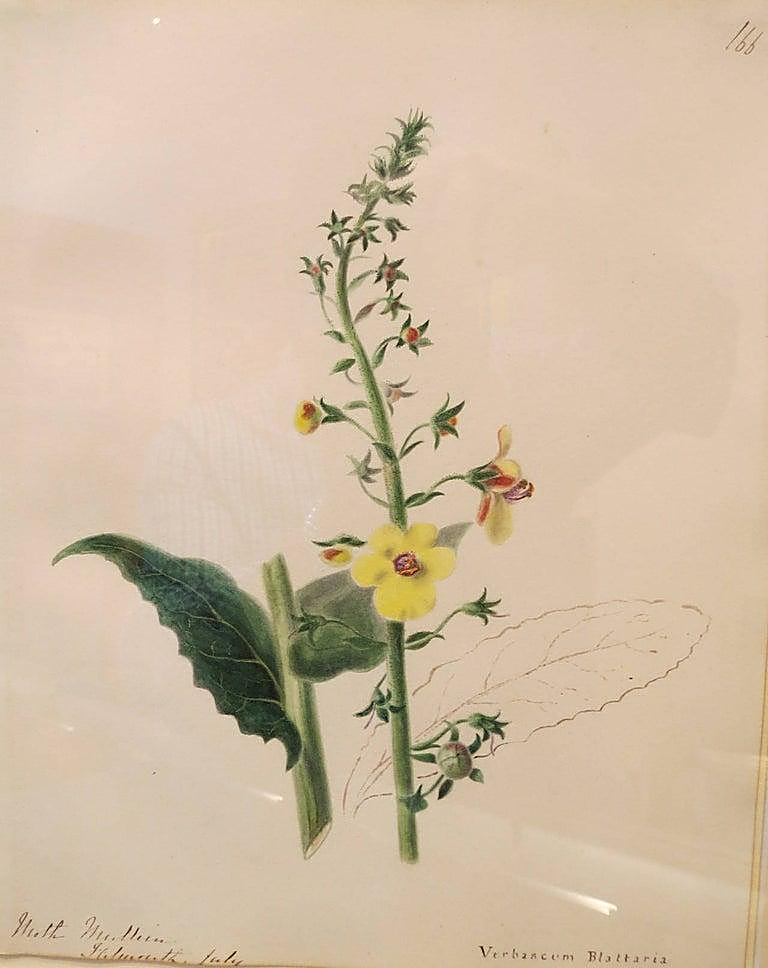
Moth Mullein c. 1840
Some surviving sheets bear handwritten numbers, plant names, and collecting notes. These small inscriptions are especially interesting because they preserve something of Emily's working methods. She wasn't simply filling an album with flowers. She was organizing botanical information.
Her work developed during an extraordinary period for British natural history.
In 1841, the botanist William Jackson Hooker became the first official director of the Royal Botanic Gardens at Kew. Under his leadership, Kew became an increasingly important center for botanical research, collecting, and correspondence.
Naturalists throughout Britain exchanged specimens, drawings, and information. Much of that work relied on people outside universities and scientific institutions, including women who studied plants in their own communities.
Emily's botanical interests eventually brought her into contact with this wider scientific world.
One of the most important figures in Emily's artistic career was the Reverend Charles Alexander Johns, a naturalist and author born in 1811.
During the 1840s, Johns became acquainted with her botanical watercolors and recognized their usefulness for his illustrated books on British plants.
His publications included Forest Trees of Britain (1847–1849), A Week at the Lizard (1848), and Flowers of the Field (1851). Emily's drawings served as models for engravings reproduced in these books, published by the Society for Promoting Christian Knowledge.
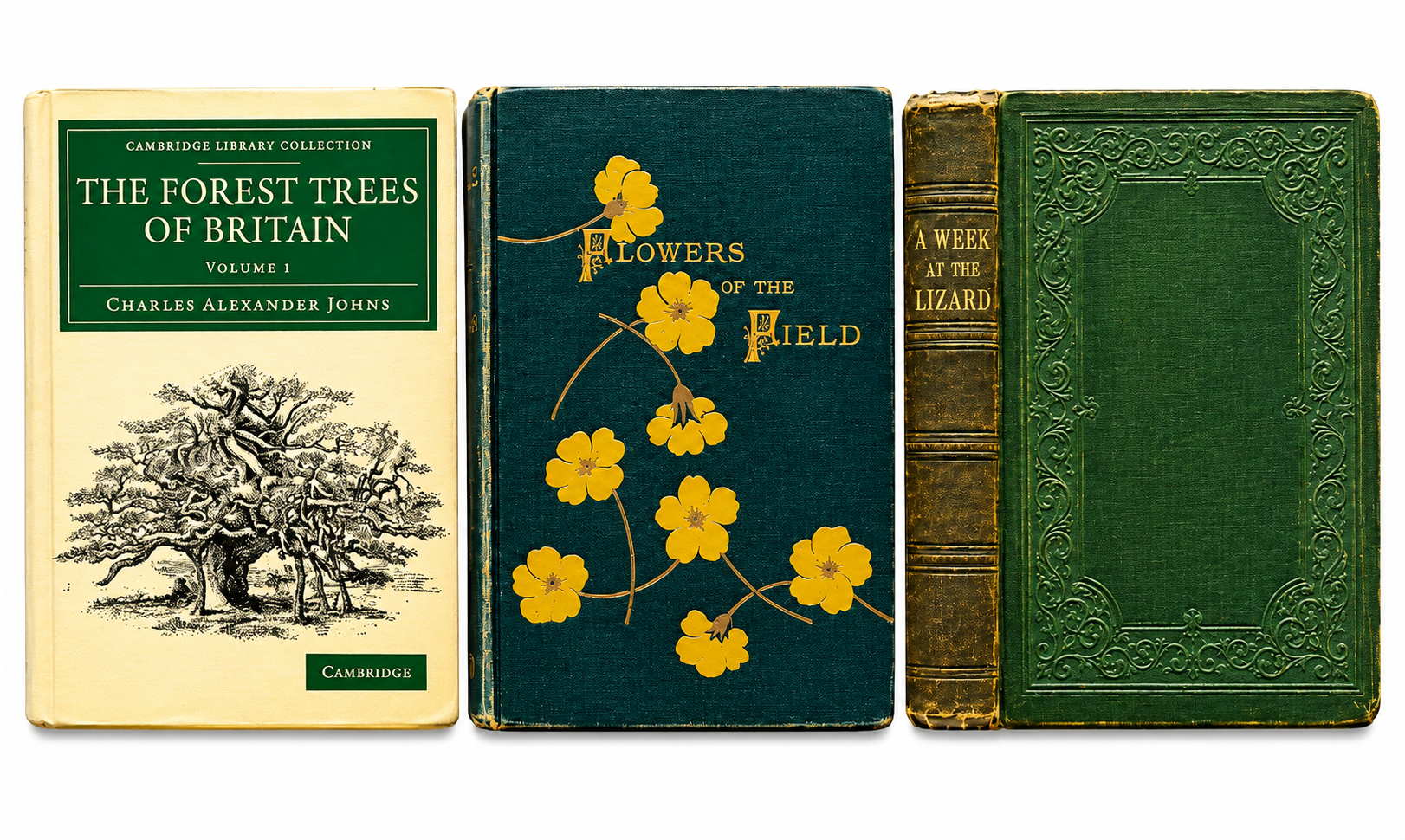
That meant her work could reach readers far beyond Cornwall. A plant she had carefully examined and painted could appear in a book used by families, students, and amateur naturalists throughout Britain.
But there was a catch.
Although her illustrations made the books useful, Emily did not receive the prominent recognition Johns enjoyed as their author. Some engravings bore the initials E. S., but her contribution was not consistently acknowledged.
The problem went beyond a missing name. Later writers even confused Emily Stackhouse with Johns's sister, also named Emily. Art dealer Clifford Evans's research eventually helped untangle that mistaken attribution.
A woman whose botanical work circulated widely, yet whose identity as its creator became obscured.
Emily's contemporaries did not overlook her accomplishments entirely.
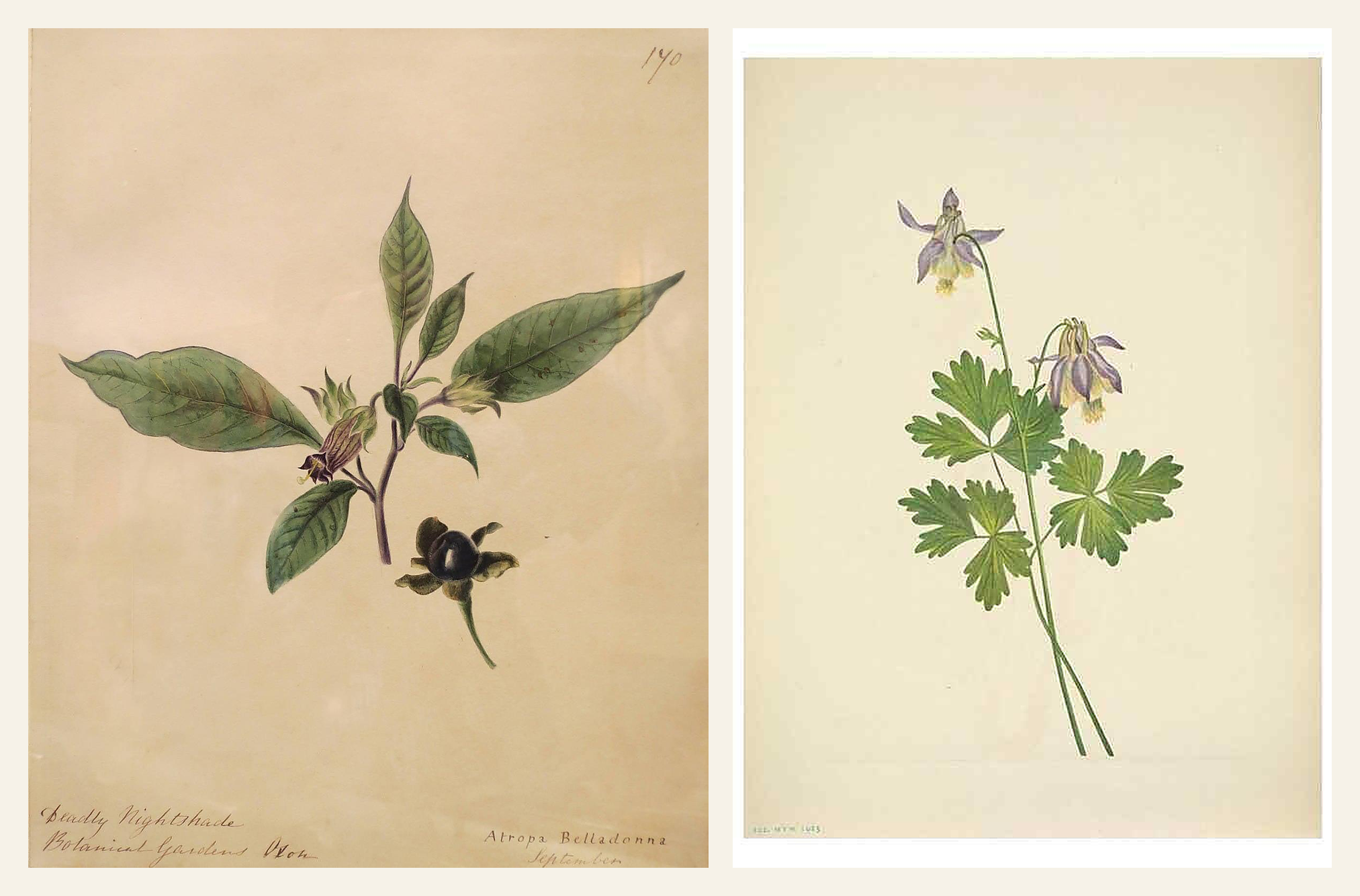
Deadly Nightshade (Atropa belladonna) Watercolor on paper · Botanical Gardens, Devon
and Common Columbine (Aquilegia vulgaris), Watercolor on paper
In 1846, she received a bronze medal at the Royal Cornwall Polytechnic Society's annual exhibition. She received another in 1853, recognition that brought her botanical studies to the attention of judges and visitors in Cornwall.
These awards are worth remembering. Emily was not simply an anonymous amateur whose work was discovered long after her death. Her abilities were publicly recognized during her lifetime, even if that recognition did not translate into lasting national fame.
She also pursued a particularly demanding branch of botany: the study of mosses. Her collecting and identification work became extensive enough to attract notice within Cornwall's natural-history community.
Another Cornish botanist, Elizabeth Andrew Warren, provides a more personal connection to that world. Elizabeth corresponded with Emily, and they relayed requests to William Hooker on behalf of ‘women botanists in her circle’. Emily was therefore part of a genuine network of scientific exchange, not merely an artist working in isolation at Trehane.
There is a promising documentary connection, although I haven't yet located a surviving letter written by Emily herself. Evidence exists of Elizabeth’s letters to William…
Elizabeth Warren (1786–1864) corresponded with William Hooker for approximately 25 years, beginning in late 1834. Her surviving letters document the exchange of plant specimens, identification requests, and botanical information.
More importantly, a biographical study of Warren identifies Emily Stackhouse as one of those who commemorated Elizabeth Warren after her death in 1864. That gives us a more specific connection, assuming the two women belonged to the same botanical circle.
For now, her surviving paintings and published illustrations establish something important: Emily Stackhouse was both a skilled artist and an active contributor to nineteenth-century botanical knowledge.
The documentary record is beginning to show how she worked, whom she knew, and why her contribution was so easily separated from her name.
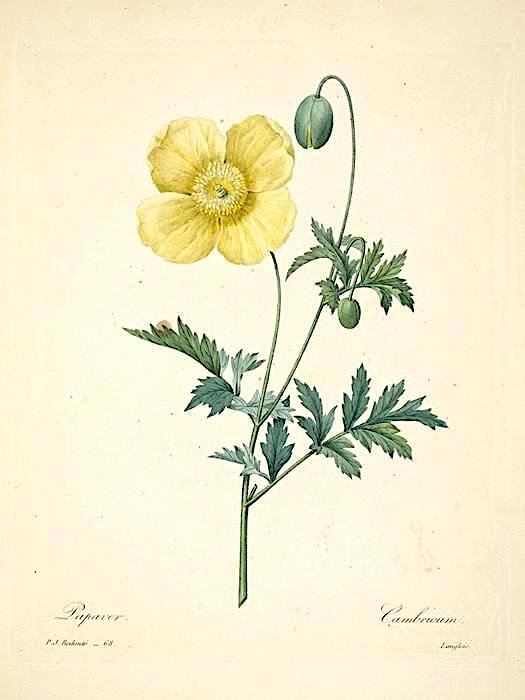
Yellow Poppy — Papaver cambricum 1851
In May 1850, artist Elizabeth Warren wrote to Sir William Jackson Hooker about an unusual broom growing on the Cornish cliffs. The flowers were pale rather than the familiar bright yellow, and Warren thought the plant sufficiently interesting to bring to Hooker's attention. She enclosed a botanical drawing by Emily Stackhouse.
It was a brief exchange, but the surviving letter tells us considerably more about Emily than the drawing alone. Warren explained that Emily had already illustrated numerous British plants and supplied artwork for the Reverend Charles Alexander Johns's botanical publications. She also revealed that she had personally introduced Emily to Johns.
That is an important detail. We can now trace one of Emily's professional opportunities to another woman within Cornwall's botanical community.
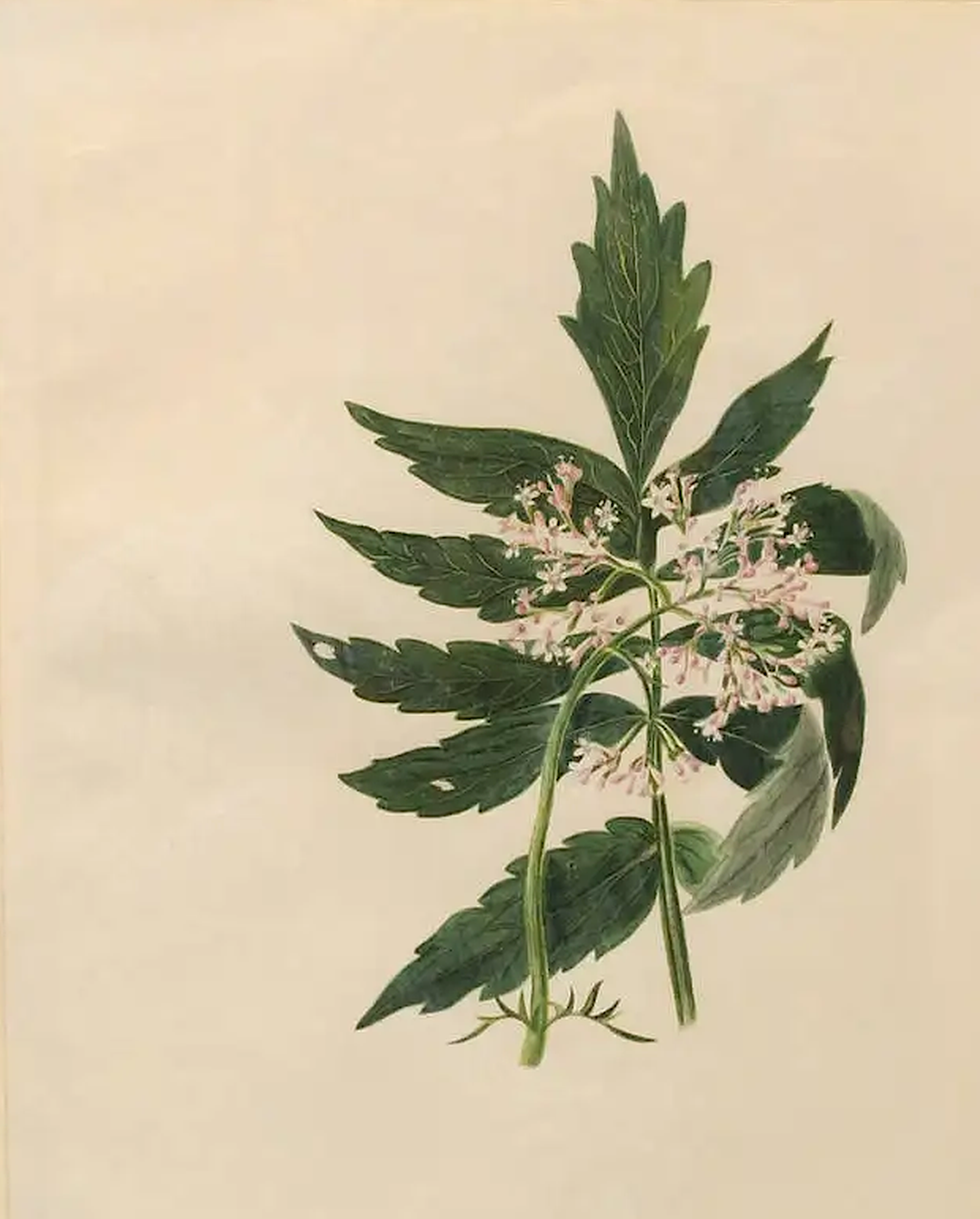
Great Wild Valerian (Valeriana officinalis), Watercolor on paper. Ashley John Gallery.
Warren's letter included an intriguing request from Emily. She wanted her original drawing returned unless Hooker considered the plant worthy of engraving. If he did, she would prefer to receive a copy of the published engraving.
There is something wonderfully practical about that request.
Botanical illustrations took time, especially when the artist was expected to capture a plant's distinguishing features accurately. Emily evidently valued her original work and wanted to know what would become of it. Whether she hoped for professional recognition, a useful scientific reproduction, or simply a copy for her own collection is not recorded. What survives is her interest in the drawing's fate.
Two years later, in December 1852, Warren again wrote to Hooker, this time about plants discovered at Trehane.
Jonathan Stackhouse junior had found Asperula arvensis and Lathyrus cicera growing in a field of vetches. The specimens were unusual enough to warrant further examination.
Unfortunately, the mature seed pod of the Lathyrus had been lost.
Emily supplied a drawing of it.
That small detail is easy to overlook, but it illustrates why botanical artists mattered to nineteenth-century natural history. A specimen could be damaged, misplaced, or deteriorate before anyone could identify it. A carefully executed drawing could preserve details that might otherwise disappear.
In this case, Emily's work helped document a botanical observation made on her family's estate.
It also places her within the everyday business of scientific collecting. Someone found a plant. Someone examined it. Someone prepared a drawing, and the information traveled by post to a botanist whose opinion was sought.
The process was nothing particularly glamorous. Much of natural history depended on precisely this kind of patient work.
REMEMBERING her friend ELIZABETH
Emily’s dear friend, artist Elizabeth Andrew Warren, died in May 1864, aged seventy-eight.
The following year, Emily Stackhouse contributed a written tribute to Warren's memory, published in the proceedings of the Royal Institution of Cornwall.
It is one of the most personal pieces of evidence we have encountered in Emily's story.
Emily remembered Warren's painstaking work identifying and arranging botanical specimens for the institution's museum. She praised the care Warren had devoted to its herbarium and recalled Warren's early interest in the study of algae, at a time when seaweeds had not always received serious scientific attention.
But Emily's remembrance went beyond Warren's accomplishments.
She emphasized Warren's willingness to help those with less botanical knowledge, her kindness, and her modest character.
Those observations are especially meaningful when we consider what Warren did for Emily herself.
When Warren died, Emily helped ensure Warren's contributions would be remembered.
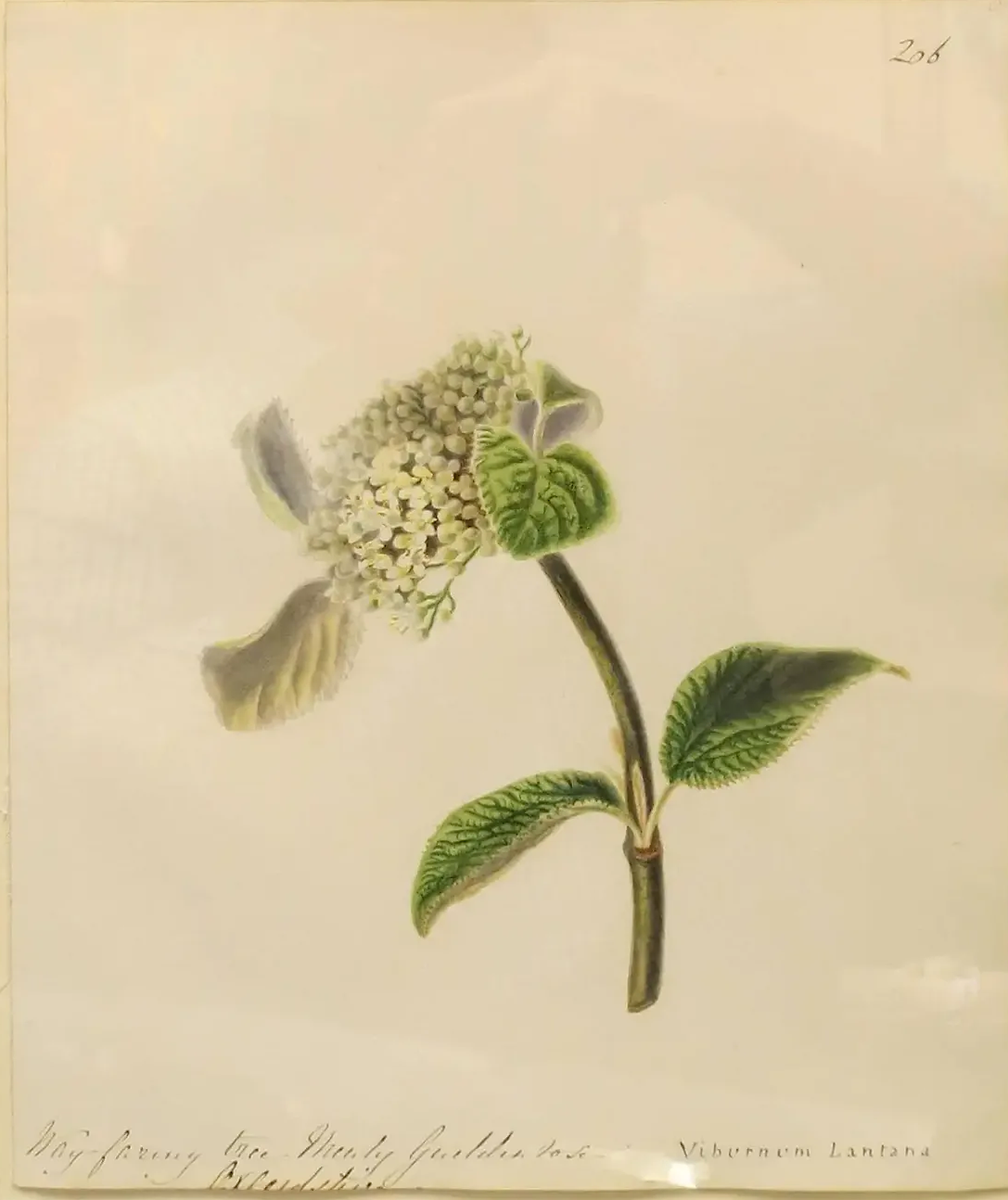
Wayfaring Tree (Viburnum lantana). Watercolor on paper. Ashley John Gallery.
Emily Stackhouse's botanical paintings remain the most visible part of her legacy, but surviving letters about her offer something equally valuable.
They place her at Trehane, examining plants gathered from nearby fields. They show her drawing an unusual flower for one of Britain's leading botanists to examine as she considers publishing her work. They also reveal another female artist who helped make those opportunities possible.
For all the attention paid to the great male names of Victorian botany, much of the actual work depended on collectors, correspondents, illustrators, and local naturalists whose contributions were less consistently recorded.
Emily belonged to that world. She died in 1870.
Her drawings traveled farther than she may ever have imagined, appearing in books that introduced generations of readers from around the world to Britain's plants.
A century and a half later, those illustrated watercolors are helping us remember Emily, too.
For Your Reference1. Dare, Deirdre, and Melissa Hardie. A Passion for Nature: 19th-Century Naturalism in the Circle of Charles Alexander Johns. Hypatia Publications, 2008. Particularly Clifford B. Evans's chapter, “A Botanist Who Painted: Emily Stackhouse,” pp. 173–186. Essential for Emily's biography, artistic contributions, and the recovery of her identity. *VIA Google Books2. English, Catharine and Guy. Elizabeth Andrew Warren: Algologist and Botanist of Flushing. 2020. Especially the transcriptions of Warren's correspondence with William Jackson Hooker, including the letters of 1850, 1852, and 1855 that connect Emily directly with botanical investigations. Read the illustrated historical study VIA *theartssocietyfalmouth.org3. Royal Botanic Gardens, Kew. Directors' Correspondence, letters from Elizabeth Andrew Warren to Sir William Jackson Hooker. Particularly DC33, folio 433 (23 December 1852), and DC35, folio 421 (11 December 1855). Primary documentary evidence of Emily's botanical work and scientific connections, as cited in the English study. VIA *theartssocietyfalmouth.org4. Johns, Charles Alexander. Flowers of the Field (1851); The Forest Trees of Britain (1847 onward); and A Week at the Lizard (1848). Society for Promoting Christian Knowledge. Historical publications containing illustrations associated with Emily's work. View Johns's digitized historical publications. VIA *Biodiversity Heritage Library5. Cornwall Artists Index. “Emily Stackhouse (1811–1870).” West Cornwall Artists Archive. Biographical reference covering her upbringing at Trehane, work for Johns, artistic recognition, later rediscovery. Read the artist biography. Cornwall Artists Index6. Toovey's Auctioneers. “Emily Stackhouse — Botanical Studies,” Lot 123, 15 February 2023. Catalogue of approximately 300 botanical watercolours, many with handwritten plant identifications, collecting locations, and months. Particularly valuable for documenting her surviving original artwork. View the collection and photographs. VIA *Toovey'sResearched & Written by author krysta abesamis