Bonds of Manrent
I found a ‘Bond of manrent’ for James Douglas of Drumlanrig, my 15th-great-grandfather.
What did it mean when one man promised to become another man’s “man”?
How did my ancestors, including the Douglases, Johnstones, Maxwells, and Carruthers, navigate these networks?
For centuries in Scotland, knowing who your friends were could matter almost as much as knowing who owned the land.
This was especially true in places like the Borders, where families lived amid old rivalries, disputed property, cattle raids, and the constant possibility that a quarrel between two men could quickly escalate into a quarrel between two families. The king had laws and courts, of course, but Edinburgh could feel very far away when trouble arrived at your door.
One answer was the bond of manrent.
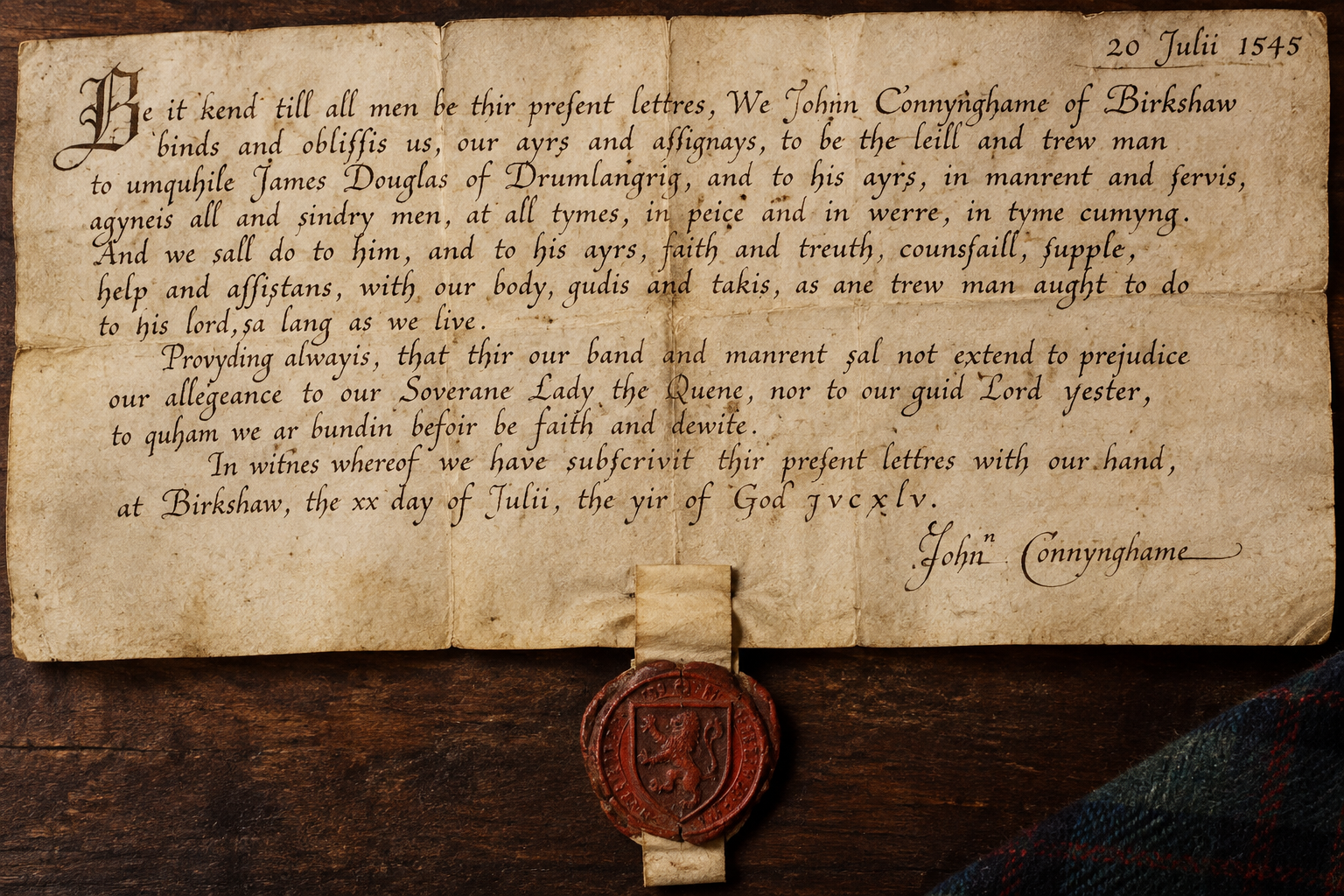
A reconstruction of a sixteenth-century ‘bond of manrent’
It was a written agreement in which one man promised loyalty and service to another, usually someone more powerful. The wording varied, but the idea was fairly plain: I will stand with you, advise you, help you, and serve you. In return, the other man might offer protection, influence, money, land, or the security that came from belonging to a powerful following.
These were not necessarily agreements between equals. A small laird attaching himself to a great Border lord knew exactly what that lord’s name could mean. If there was a dispute over land, an enemy at the gate, or a feud gathering around him, he was no longer standing alone.
And that is what makes these old documents so interesting. They show us relationships that a pedigree cannot.
We do not have to imagine how this worked. On 20 July 1545, John Cunningham of Birkshaw entered into a bond of manrent with James Douglas of Drumlanrig. Cunningham pledged his loyalty and service to Douglas, but with an important exception: his existing allegiance to the Queen and Lord Yester came first.
That small qualification tells us something about the world these men lived in. Loyalty was layered. A man could owe duty to the Crown, obligations to his family, and service to a powerful lord at the same time. The bond put one of those relationships into writing.
Behind Cunningham stood more than one man. Relatives, tenants, servants, horses, property, and local connections all counted. When a powerful lord gathered his following, these written promises became very real. His strength reached far beyond the walls of his castle, extending into the countryside through the men who had pledged to stand with him.
Some of those promises were important enough to put on parchment.
A family tree tells us who married whom and who inherited from whom. A bond of manrent tells us who trusted whom, who needed whom, and whose side a man had promised to take when things went wrong.
In the Scottish Borders, this network of obligation became part of everyday power. Families such as the Douglases, Maxwells and Johnstones did not exercise influence simply because they possessed impressive houses and large estates.
Their strength came from these networks of pledged men spread across the countryside. That is worth remembering when we look at an old Scottish family name in a charter or pedigree.
The person on the page did not live alone inside his little branch of our family tree.
Around him was another, almost invisible tree made up of alliances, favors, protection and promises.
That sense of obligation reached far beyond a single piece of parchment. Scottish history is filled with men who followed their lord into rebellion, feud, exile, and battle because loyalty was understood as something personal. It could bind a man to his kin, his laird, his king, or sometimes force him to choose between them. A signature on a bond of manrent was only the written part of something much larger. When the time came, the promise was expected to walk off the parchment with him.
For Your Reference;
National Records of Scotland, AD1/104, Bond of manrent by John Conynghame of Byrkschaw to James Douglas of Drumlangrig, 20 July 1545.
Dictionary of the Scots Language — historical usage and meaning of manrent.
Sir James Balfour Paul, ed., The Scots Peerage — useful for placing the great families who made and received such bonds within their wider kinship and political networks.