My Ship Dudes · James Carruthers
A long way from DumfriesshirE
A Diaspora Series — James Carruthers (c.1695-1732) 🚢🌊🏴🇺🇸
James was probably the fourth son of William of Breconside & Margaret Chalmers. Research strongly suggests he was born around 1695 in Breconside, in the parish of Moffat, Annandale, Dumfriesshire, Scotland. His family seat was Breconside Tower.
He is my 8th-great-grandfather. A primary ship ancestor.
His people had held ground along southern Scotland’s western marches for centuries. The Carruthers name was stitched deeply into the fabric of this region, stretching back through hundreds of years of local history. The notorious ‘Border Reiver’ era was winding down, but a frontier like that does not forget overnight.
Just beyond the grazing line of the Breconside estate, the ground dipped into a steep hollow in the hills.
They called this area the Devil’s Beef Tub
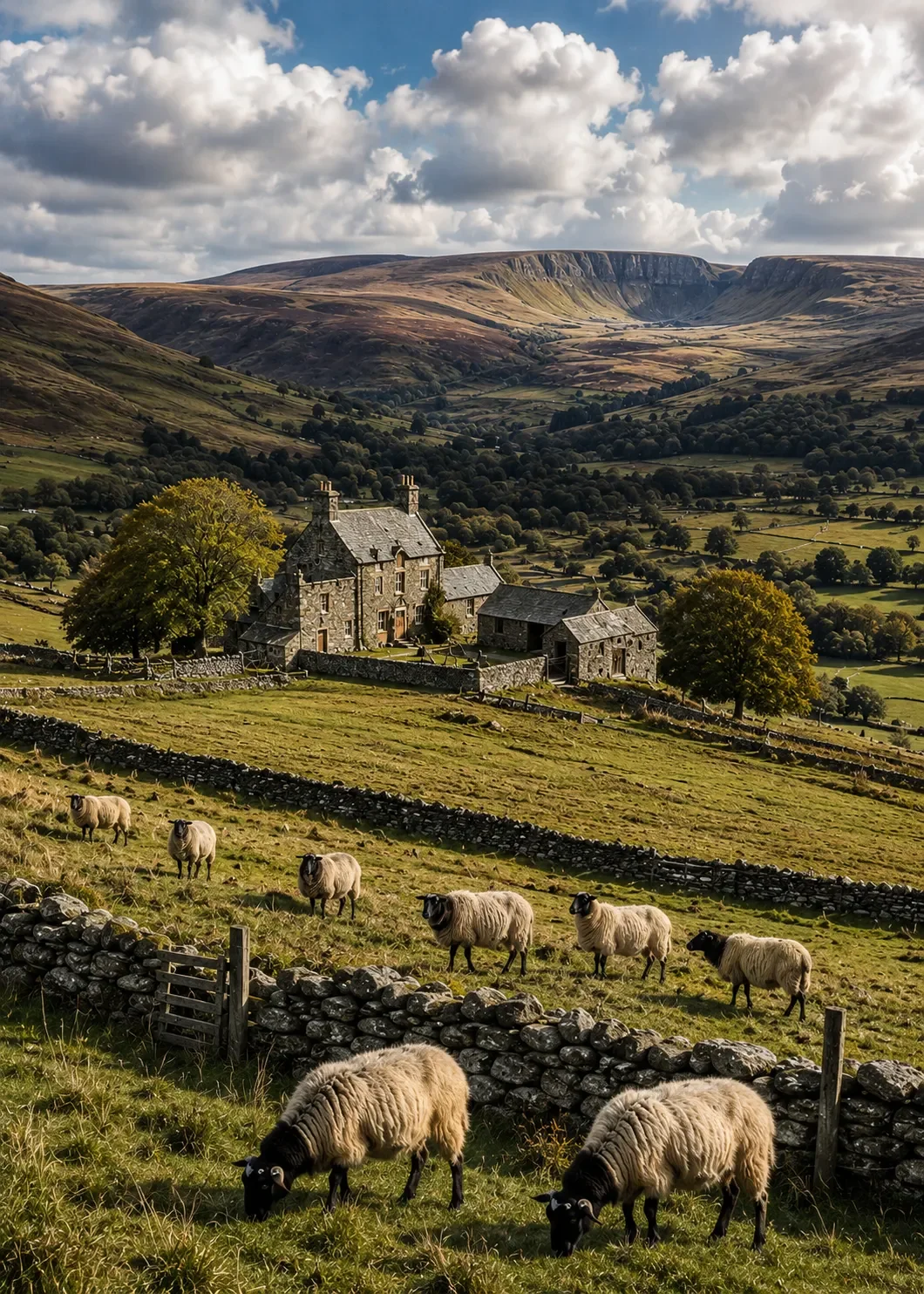
Breconside Estate 📍 55.389° N, -3.445° W
Historical records indicate that the Breconside lands passed to this branch of the family through Margaret's mother, Janet Johnstone, whose family belonged to one of the most influential riding clans of the western marches. That inheritance gave this younger branch of the Carruthers family both financial stability and a permanent foothold in Annandale.
For William and Margaret, maintaining the estate required constant attention. In a region where prosperity was measured by acres and livestock as much as by titles, they managed a largely self-sufficient household. Their upland pastures supported Cheviot sheep and cattle, while smaller fields produced oats and other essential crops. Barns, stone outbuildings, horse stalls, kitchen gardens, walls, and storage spaces formed the working landscape around Breconside.
Together, they directed the labor of servants, shepherds, seasonal workers, horses, and sheepdogs, whose combined efforts kept the estate running year-round.
Their partnership was tested almost immediately.
During the devastating Seven Ill Years of the 1690s, repeated crop failures, severe winters, livestock losses, and widespread hunger pushed Scotland into one of its greatest subsistence crises. Rural communities were particularly vulnerable. Southern Scotland remained heavily dependent on livestock and oats, and survival could hinge on what a household produced and preserved.
By 1696, when James was an infant, Scotland had entered some of the crisis's darkest years. In the uplands of Dumfriesshire, difficult terrain made transportation and outside assistance unreliable. Food shortages spread through the countryside, while livestock starved or died in the bitter weather.

Dumfriesshire countryside 1700
William's management of the estate and its hardy livestock, together with Margaret's stewardship of the household's dwindling resources, may have helped Breconside endure those desperate years.
The hardships of James's childhood coincided with sweeping political changes across Britain.
In 1702, Queen Anne inherited the crowns of England and Scotland, and the outbreak of the War of the Spanish Succession drew Britain into a massive European conflict. Although the great battles occurred far from Annandale, ordinary families felt their effects through heavier taxation, military conscription, disrupted trade, and growing economic uncertainty.
As a younger son with little expectation of inheriting the family estate, James increasingly faced the same reality confronting countless Border families. Population growth, subdivided estates, rising rents, and limited opportunities meant many younger sons would have to seek their futures elsewhere.
Then came the Acts of Union in 1707. The creation of the Kingdom of Great Britain transformed Scotland's political landscape forever. While merchants celebrated expanded trade opportunities, many ordinary Scots regarded the union with suspicion. Throughout Dumfriesshire, conversations about loyalty, taxation, identity, and sovereignty became increasingly common. Only two years later, another catastrophe struck.
The Great Frost of 1709 proved one of the coldest winters Europe had seen in centuries. Rivers froze solid. Livestock perished in the fields. Grain shortages worsened dramatically, while food prices climbed beyond the reach of many rural families.
By the opening decades of the eighteenth century, reports began filtering back from across the Atlantic describing fertile land in Pennsylvania and opportunities unavailable within Britain's increasingly crowded agricultural economy. At the same time, political uncertainty deepened once again.
In 1715, after Queen Anne's death and George I's accession, supporters of the exiled Stuart dynasty launched the first Jacobite Rising. Across Scotland, loyalties fractured between Hanoverian supporters and Jacobite sympathizers. Even in the Borders, politics became intensely personal as neighbors and families found themselves divided over dynasty, religion, and national identity.
The American colonies increasingly represented something different.
They offered inexpensive land, religious freedom, and opportunities beyond what Scotland's crowded tenant system offered. Like many Presbyterian families of his generation, James Carruthers looked westward.
The colonies were rapidly becoming a beacon for families seeking inexpensive land, expanding frontier settlements, and opportunities that no longer existed within Scotland's increasingly crowded tenant system. Migration rarely began with isolated individuals.
Instead, it unfolded through neighbors, relatives, and congregations who crossed the Atlantic in successive waves, encouraged by reports of fertile land and growing settlements in Pennsylvania.
James Carruthers joined that migration. Family tradition places his arrival in Pennsylvania around 1730, although no surviving passenger list or contemporary document has yet established the exact year of his voyage.
No passenger lists exist for British subjects coming from Ireland to Pennsylvania in the late 1720s. The Pennsylvania State Archives notes that pre-Revolution passenger lists generally do not cover British subjects moving from Ireland because they were already subjects of the Crown.
James did not sail directly from southwest Scotland; he must have spent time in Ulster, where he met his wife, Mary Morrison, because his documented son, Robert Carruthers, my 7th-great-grandfather, was born in Donegal, Ireland. (Global DNA projects confirm this guy)
Fifteen years later, the family journeyed to the New World.

Like many emigrants of the period, they likely traveled within a broader Presbyterian migration network rather than as isolated individuals. Later records place the Carruthers family among the Morrisons, Gillespies, Caldwells, Porters, Ewings, and other Scots-Irish families, whose names repeatedly appear together in the earliest surviving records of southern Lancaster County. Whether these relationships originated in Scotland, developed in Ulster, or formed after arrival in Pennsylvania remains uncertain, but the repeated association of these families strongly suggests they were part of the same community.
The Atlantic crossing itself demanded remarkable endurance.
Eighteenth-century voyages typically lasted six to ten weeks, sometimes much longer when the weather turned unfavorable. Crowded passenger quarters below deck offered little comfort. Fresh water was carefully rationed, and food steadily deteriorated during the voyage. Disease spread easily among closely packed travelers, while violent storms, rough seas, and the ocean's constant uncertainty reminded every passenger that reaching America was never guaranteed.
For those who survived the voyage, stepping ashore in Pennsylvania marked the beginning of an entirely different life.
Interestingly, Scottish and Ulster settlers were considered ‘British subjects’ and arrived in Pennsylvania with an immediate legal advantage.
Unlike many European immigrants, they did not first have to naturalize and wait to gain the rights of British subjects in the British colonies. They could immediately enter into contracts, conduct business, purchase or lease land, and establish themselves in the colony without delay…
By the early 1730s, James Carruthers appears in the developing Scots-Irish settlements of what was then Lancaster County, Pennsylvania. The region east of the Susquehanna River quickly became a principal destination for arriving Presbyterian settlers.
Towering hardwood forests covered much of the countryside. Primitive wagon tracks wound through rolling hills, while scattered log cabins marked isolated homesteads carved from the wilderness. Streams, fertile valleys, and rich bottomland attracted families willing to trade years of exhausting labor for the chance to establish their own farms.
These migrations were rarely blind ventures. Families often followed routes established by relatives, neighbors, or members of the same congregation who had already settled the frontier. Letters, personal recommendations, and word from returning travelers informed prospective emigrants about where productive land remained available.
Often, several related households coordinated parts of their journey, sharing the cost of passage, tools, wagons, livestock, and supplies before beginning the difficult work of carving farms from the Pennsylvania wilderness.
Throughout these transitions, the Presbyterian Church remained the center of this family’s community life.
Congregations preserved familiar worship, reinforced longstanding kinship ties, maintained Scottish naming traditions, and helped new arrivals establish themselves in unfamiliar surroundings. They served as schools, gathering places, centers of mutual aid, and the social heart of the growing frontier.
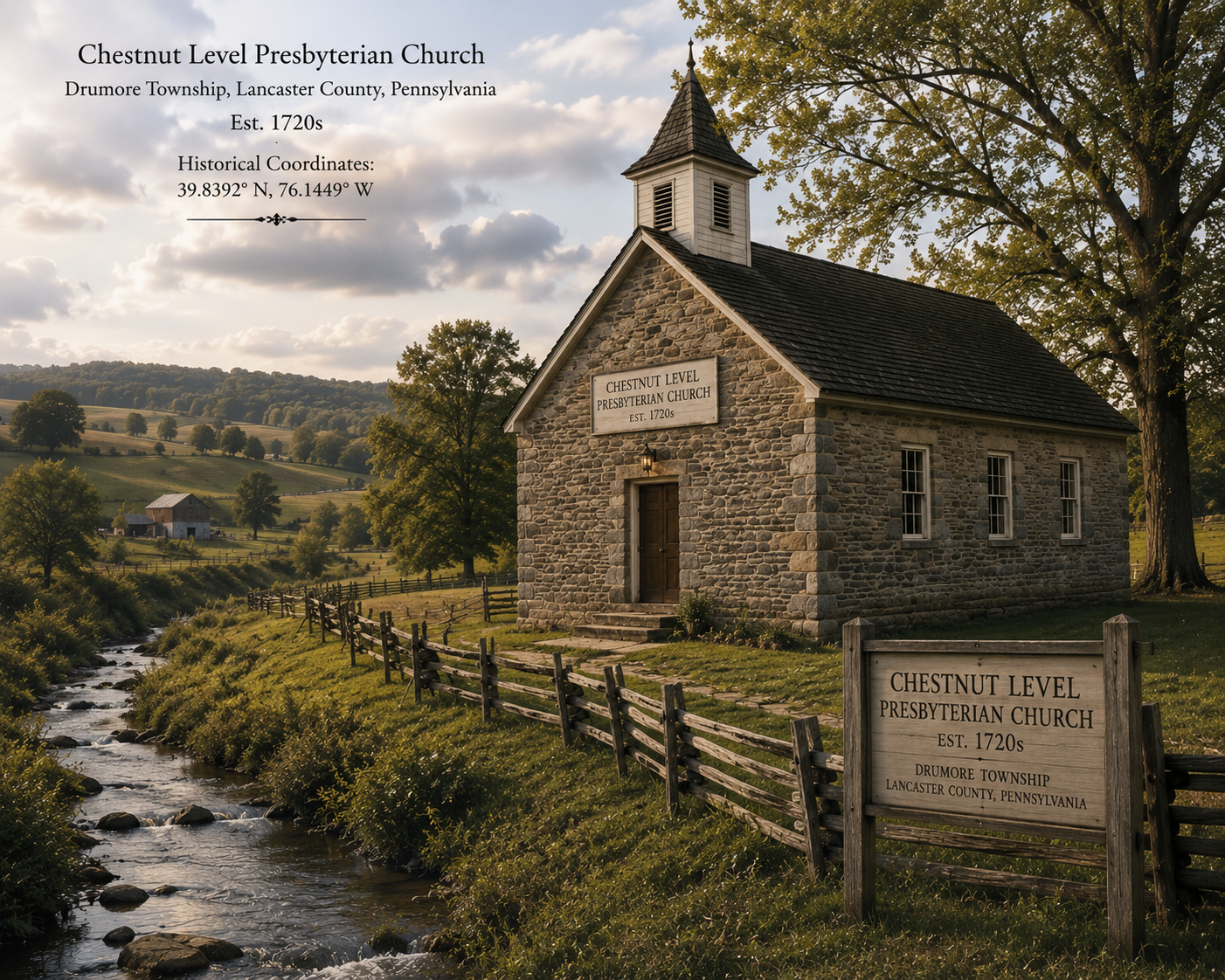
Like countless frontier women of the eighteenth century, wife and mother Mary Morrison would have been the household's stabilizing force, managing food production, directing domestic labor, preserving the family's Presbyterian faith, and raising her children amid the hardships of frontier life. Widowhood demanded extraordinary resilience, and women like Mary became the quiet foundation on which many early settlements endured.
The family was finally in America, farming with their people.
They had made it.
Then James Carruthers died around 1732, shortly after settling in Pennsylvania.
When James died, he left behind a young widow and children in an unfamiliar and demanding land. He disappeared from land records, and his sons took over.
Among those children was Robert Carruthers, traditionally identified as James's eldest surviving son. Robert and his siblings came of age in Pennsylvania.
By approximately 1744, surviving records indicate that members of the extended Carruthers migration network began moving southward into North Carolina backcountry along the Great Wagon Road…
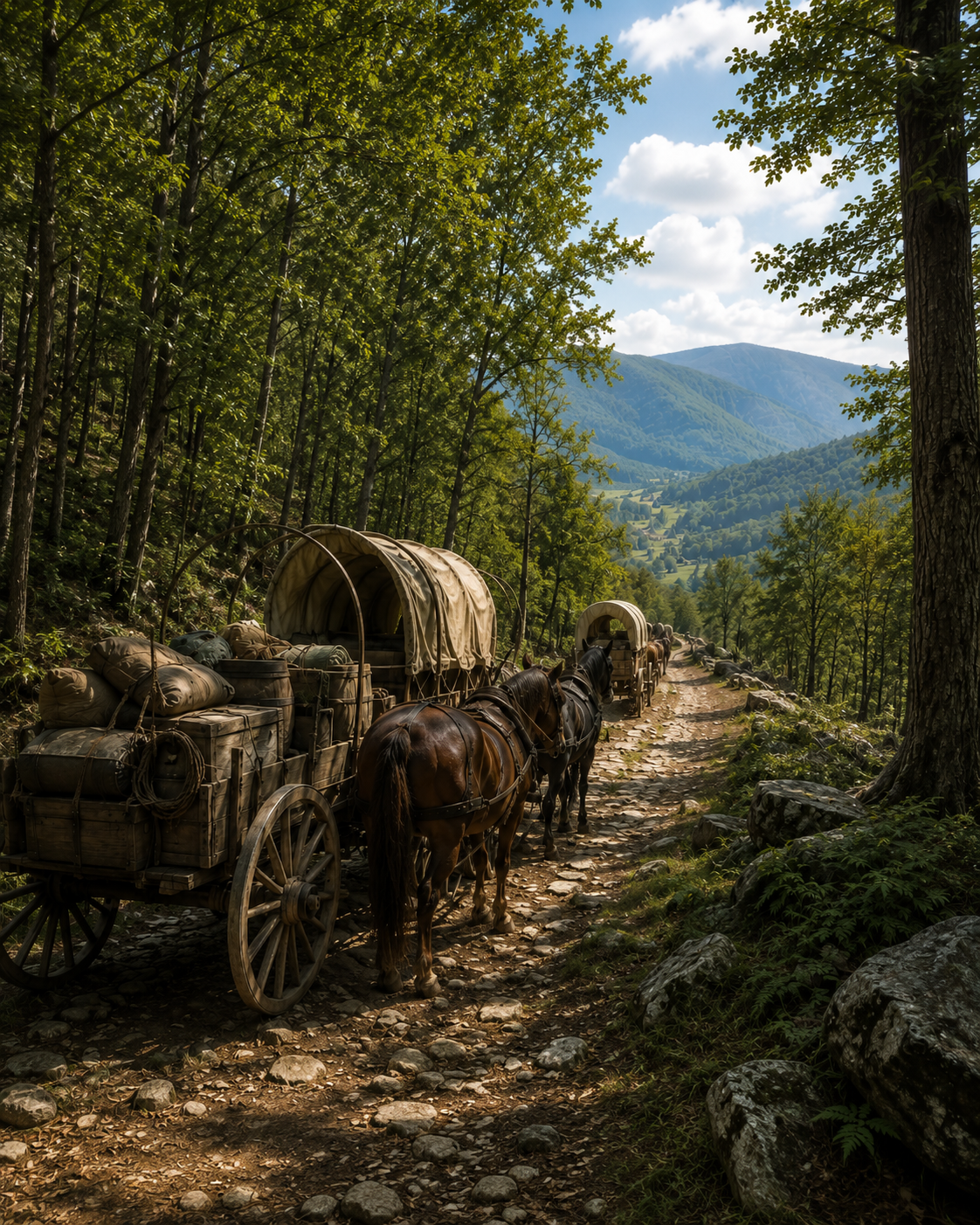
This remarkable overland highway became the principal migration corridor connecting Pennsylvania with Virginia and the Carolina backcountry. Tens of thousands of Scots-Irish families followed its valleys southward during the eighteenth century, carrying with them their Presbyterian faith, agricultural traditions, Border heritage, and tightly woven family relationships.
Their churches, farming practices, language, and inherited order culture soon became woven into the fabric of the Carolina frontier.
The world beyond their farms in the New World, however, remained anything but peaceful.
To be continued…. Robert Carruthers I
For Your Reference;
James Carruthers (1695–1732) & Mary Morrison (1698–1777)
Research Note: Chapter 1 has been reconstructed from Dumfriesshire parish registers, Scottish Border land records, Ulster emigration records, Lancaster County colonial court documents, Pennsylvania land records, and early North Carolina Presbyterian church records. —including Pennsylvania land records to reconstruct the family's migration and settlement.
1736 Testament · The Register of Testaments for the Commissaries of Dumfries contains the testament of James Carruthers, identified as the fourth son of William Carruthers of Dam and Margaret Chalmers. This Scottish testament appears to have been created after James's death in America in order to settle remaining Scottish affairs.
https://www.electricscotland.com/webclans/atoc/recordsofcarruthers.pdf
II. Primary Records & Colonial Land Footprints
Dumfriesshire Parish Records
Scope: Transcriptions of early parish registers, regional testaments, and estate papers documenting the children of William Carruthers of Dam and Margaret Chalmers, including James Carruthers.
Source Link: https://www.scotlandspeople.gov.uk
Lancaster County Court of Quarter Sessions
Scope: Original session papers, road petitions, and civil proceedings documenting the early Scots-Irish settlements of southern Lancaster County during the family's arrival in Pennsylvania.
Source Link: https://www.pa.gov/agencies/phmc.html
Ulster Land and Tenant Records
Scope: Original land registries, flax rolls, and Donegal Presbyterian parish papers documenting the Scots-Irish communities of the Lifford and Letterkenny districts during the early eighteenth century.
Source Link: https://www.nidirect.gov.uk/proni
III. Death & Burial Records
Steele Creek Presbyterian Church Cemetery Collection
Scope: Early gravestone indexes, monument transcriptions, and congregational surveys documenting the death of Mary Morrison Carruthers in 1777.
Source Link: https://archives.ncdcr.gov
Pennsylvania Probate & Administration Records
Scope: Estate dockets, orphan's court proceedings, administration bonds, and related probate records consulted in the continuing search for documentation surrounding the death of James Carruthers.
Source Link: https://www.pa.gov/agencies/phmc.html
IV. Ancestral Lines
James Carruthers —Parents: William Carruthers of Breconside & Margaret Chalmers
Scope: Primary documentation includes Dumfries Sheriff Court records, estate transfer records of Dam, and the Last Will and Testament of William Carruthers (1720), together with associated sasines documenting the transfer of family lands.
Source Link: https://www.scotlandspeople.gov.uk
Mary Morrison — Parents; James Morrison & (unknown)
Scope: Primary documentation includes Ulster Presbyterian records, Donegal land records, migration studies, and colonial Pennsylvania evidence documenting the Morrison family's movement from Ulster into Pennsylvania.