Christian Lockhart of Lee
From Lanarkshire to the Douglases of Morton
Christian Lockhart (1608) was born into one of the old landed families of Lanarkshire during the opening years of the seventeenth century. Her exact birth date has disappeared from the surviving record, but her parentage places her firmly within the Lockharts of Lee, a family whose roots in the district stretched back through generations of Scottish landholding, marriage, and royal service.
She was a daughter of Sir James Lockhart of Lee and his third wife, Jean Auchinleck of Balmanno. The older Lockhart pedigrees specifically identify Sir James's third wife as Jean, daughter of Sir George Auchinleck of Balmanno, and record children from their marriage. Later genealogical compilations place Christian among those children.
Christian's story would eventually carry her south from the Lockhart country of Lanarkshire into Nithsdale, where she became the wife of James Douglas of Morton and the mother of another generation of the Douglases of Morton.
The Lockharts of Lee
Christian's paternal identity centered upon Lee, near Lanark.
The Lockharts had been established in Lanarkshire for centuries, and by Christian's generation the family had divided into a substantial network of landed branches. Her father's marriages and children connected Lee with families scattered across central and southern Scotland.
One complication is important when reconstructing Christian's life. There were several men named James Lockhart of Lee, including the much better documented Sir James Lockhart, Lord Lee, born in 1596, who later became a prominent judge and political figure.
That later Sir James was not Christian's father.
Christian belonged to the preceding generation of the family. Keeping the generations separated is essential because modern pedigrees and online family trees can easily collapse the two men into one.
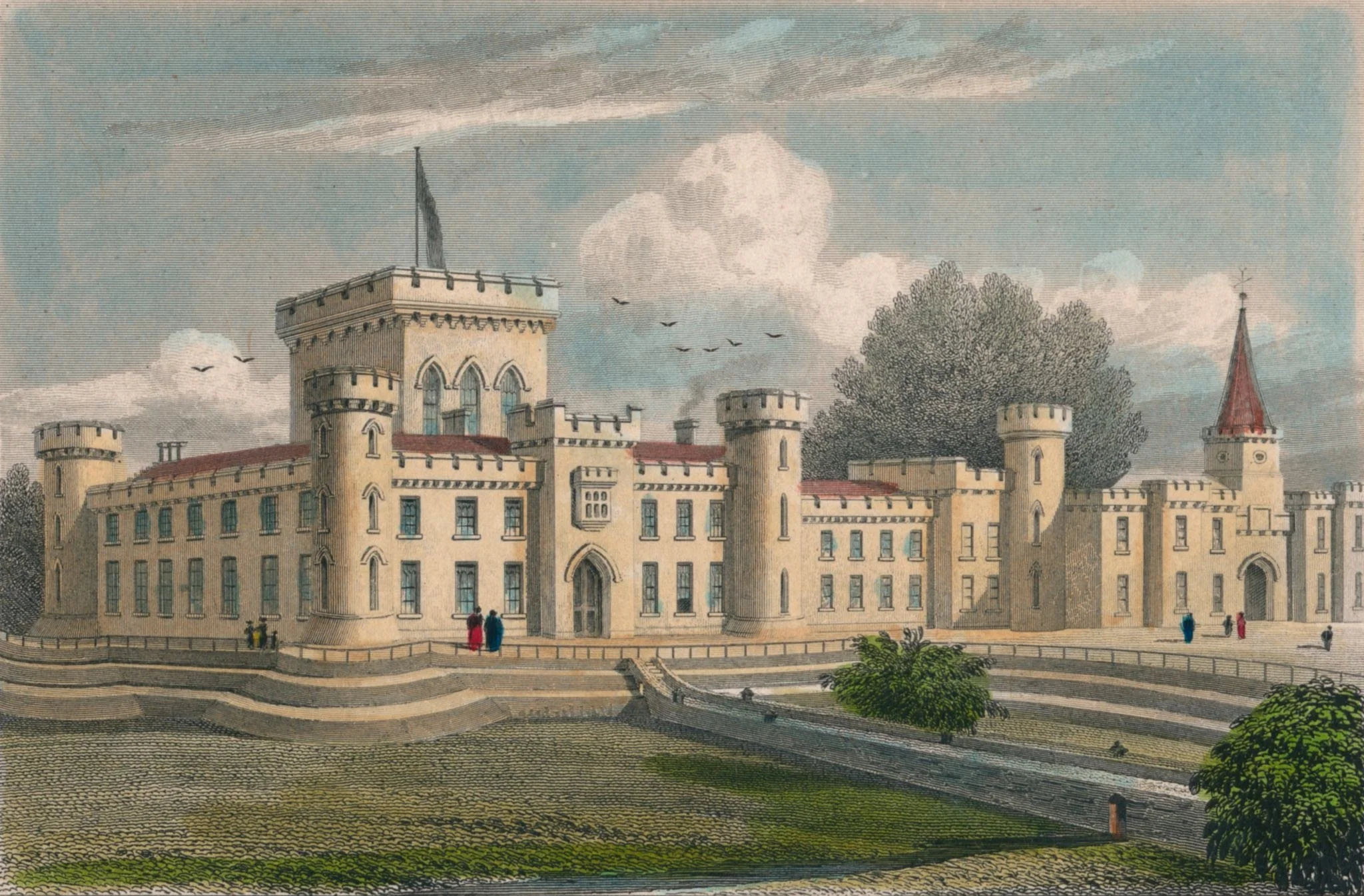
Lee Castle, Lanarkshire — the ancestral seat of the Lockharts of Lee. The castle shown here reflects its nineteenth-century rebuilding; Christian Lockhart grew up on the Lee estate more than two centuries earlier, when an older family residence occupied the site.
Her Mother: Jean Auchinleck of Balmanno
Christian's mother brought another significant Scottish family into her ancestry.
Jean Auchinleck was a daughter of Sir George Auchinleck of Balmanno, a lawyer and Senator of the College of Justice. The Auchinlecks belonged to a landed family associated with Balmanno, and Sir George's career placed Jean's family within Scotland's legal and governmental world.
Thus Christian's childhood inheritance came from two directions:
the Lockharts of Lee through her father,
and the Auchinlecks of Balmanno through her mother.
Her parents' marriage also produced a sizeable network of children whose later marriages extended the family's connections still farther across Scotland.
A Large Lockhart Family
Christian appears among a broad group of Lockhart siblings and half-siblings.
The reconstructed pedigrees associate her immediate family with Sir William Lockhart of Carstairs, John Lockhart, Samuel Lockhart of Castlehill, Grisel Lockhart, Mary Lockhart, Elizabeth Lockhart, Janet Lockhart, Catherine Lockhart, Jean Lockhart and others. As with many seventeenth-century pedigrees, the precise placement of every daughter deserves caution, but the larger picture is unmistakable: Christian grew up within an extensive landed kinship network.
Marriage was one of the principal ways such networks expanded.
Christian herself would marry a Douglas.
One of her sisters would marry a Carruthers.
An Unexpected Carruthers Connection
Among the most intriguing relationships in Christian's family is that of Janet Lockhart.
The Lockhart pedigree identifies Janet as another daughter of Sir James Lockhart of Lee and Jean Auchinleck, and records her marriage in 1635 to James Carruthers of Holmains. Burke-derived material independently preserves the same marriage.
That makes Janet Lockhart and Christian Lockhart sisters according to the established pedigree tradition.
It is an intriguing connection because the Carruthers name becomes important much later in this family's broader genealogical story.
Christian Marries a Douglas
On 28 May 1623 or 1624, Christian Lockhart married James Douglas of Morton.
James belonged to the Douglases of Morton in Nithsdale, a family distinct from the better-known Douglas Earls of Morton.
He was the son of Hugh Douglas of Morton and Nicolace Maitland of Auchingassel.
On 20 July 1624, James received sasine as his father's son. In 1636 he acquired additional lands including Auchinsell, Muirhill, and Blackmyre.
For Christian, marriage meant leaving the Lockhart landscape of Lanarkshire and entering the Douglas world of Morton in Nithsdale.
Morton
The move placed Christian within a landscape very different from Edinburgh or the royal court.
Morton lay among the hills and valleys of Dumfriesshire, surrounded by agricultural lands, small settlements, estates, burns, and the fortified residences of families whose histories were deeply entwined with the Scottish Borders.
The Douglas family retained a real association with Morton during Christian's lifetime. The estate records and later family history document James and his descendants in possession of Morton lands, while other family events were remembered as occurring at Morton Castle.
This was the environment in which Christian raised her family.
And by the 1630s, the household was growing.
Christian's Children
Published Douglas pedigrees identify three sons of James Douglas and Christian Lockhart:
William Douglas of Morton
Archibald Douglas of Fingland
Samuel Douglas of Auchinshinnoch
The same family reconstruction also identifies their daughter:
Janet Douglas, born about 1635 at Morton, who later married James Johnstone of Corheid.
Other evidence suggests James and Christian may have had additional daughters whose identities were not preserved as consistently as those of the sons.
That imbalance is typical of older pedigrees. Sons who inherited land generated sasines, retours, dispositions, and estate records. Daughters often become visible only when a marriage contract or another family's genealogy happens to preserve them.
Christian herself survives largely for the same reason.
She stands at the intersection of three pedigrees:
Lockhart → Douglas → Johnstone.
Scotland Begins to Fracture
Christian's married adulthood coincided with one of the most violent transformations seventeenth-century Scotland experienced.
Religious and political conflict intensified during the reign of Charles I, culminating in the National Covenant of 1638 and eventually the interconnected conflicts now called the Wars of the Three Kingdoms.
By then Christian was raising children at Morton.
Her husband was drawn directly into the machinery of local government.
James Douglas of Morton served as a Commissioner of Supply for Dumfriesshire between 1643 and 1649.
Commissioners of Supply were landed men entrusted with implementing taxation and other governmental demands within their counties. During wartime, these responsibilities placed families like the Douglases of Morton within the practical machinery supporting armies and government.
For Christian, national upheaval was therefore not merely news arriving from Edinburgh.
Its administrative consequences reached the household in which she lived.
We do not know Christian's personal political allegiance or religious opinions. No diary or surviving letter has yet been found that allows her to speak for herself. Those beliefs should not be invented.
But we can reconstruct the world surrounding her.
She lived through covenanting conflict, civil war, military mobilization, political upheaval, and the execution of Charles I in 1649.
The Scotland in which Christian had married James Douglas a quarter-century earlier had changed dramatically.
The End of the Morton Household
James Douglas of Morton died about 1652–1653. Published Douglas material places his death around this period, after nearly three decades as head of the Morton family.
Their son William Douglas succeeded him and was formally retoured to his father in 1656, with another retour recorded in 1663. William eventually sold the Morton lands to the Earl of Queensberry in 1672.
Christian's own death remains uncertain.
No sufficiently reliable record has yet been identified establishing exactly when or where she died. Rather than borrow a date from an online family tree or another woman of the same name, her biography is better left with that uncertainty acknowledged.
Her documentary trail fades.
Her family does not.
From Lockhart to Douglas to Johnstone
Christian's daughter Janet Douglas carried the family story forward.
In 1657, Janet married James Johnstone of Corheid, joining the Douglas family of Morton to another important Dumfriesshire landed family.
That marriage eventually carries the lineage into the Johnstone and Chalmers families.
Seen across several generations, Christian occupies an unusually interesting position.
Behind her stood the Lockharts of Lee and the Auchinlecks of Balmanno.
Beside her stood a sister who married into the Carruthers of Holmains.
Through Christian's own marriage came the Douglases of Morton.
Through her daughter Janet came the Johnstones of Corheid.
These relationships reveal something easily lost when genealogy becomes a collection of isolated names and dates. Seventeenth-century landed families existed within networks. Marriage joined estates, reinforced friendships, created legal obligations, moved property, and bound households across counties.
Christian Lockhart was one of the women through whom those networks were built.
We may not possess her letters or know the exact dates marking the beginning and end of her life. Yet her place within that world remains visible.
From Lee and the Lockharts of Lanarkshire, Christian traveled into the Douglas country of Morton and Nithsdale. There she raised a family while Scotland fractured around them, and through her daughter Janet her ancestry passed into another generation.
Four centuries later, Christian's surviving documentary footprint is small.
Her place in the family story is anything but.
For Your Reference;
The Heraldry of the Douglases, for James Douglas of Morton, Christian Lockhart, the Morton lands, and James's service as Commissioner of Supply.
Published Lockhart of Lee pedigrees and Burke's Peerage, for Christian's parentage through Sir James Lockhart of Lee and Jean Auchinleck of Balmanno and the wider Lockhart family.
Douglas family and estate material concerning Morton Castle and the Douglases of Morton, for Christian's marriage, children, and the family's seventeenth-century Nithsdale setting.
12th Great Grandmother of author Krysta Abesamis.