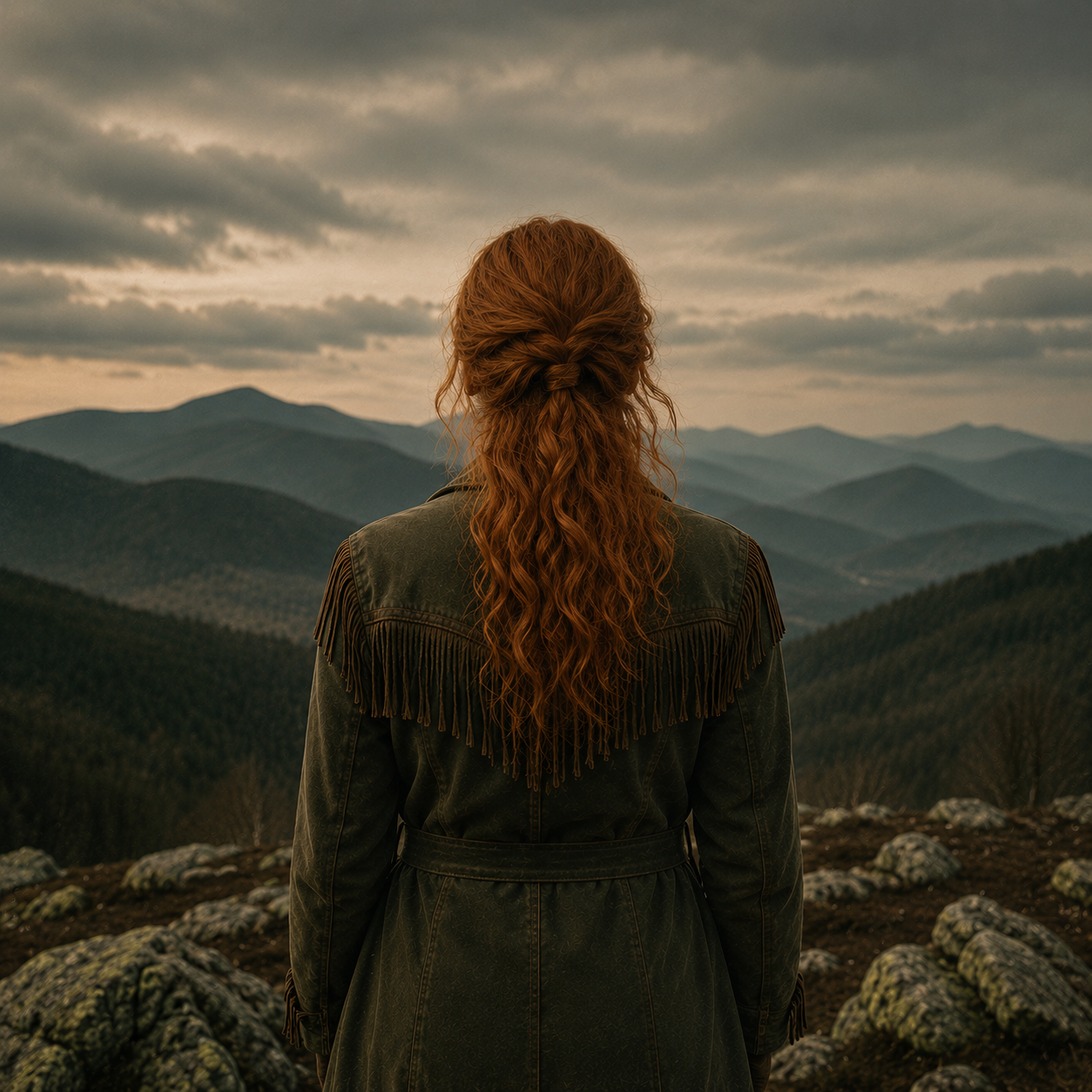
Janet Douglas · Morton & Corheid
A Life Between the Douglases and Johnstones
Janet Douglas was born about 1635 into the Douglas family of Morton in Nithsdale, Dumfriesshire, a landscape of rolling uplands, fertile valleys, fortified houses, and old landed families whose alliances shaped life throughout southwestern Scotland. She was the daughter of James Douglas of Morton and Christian Lockhart, daughter of Sir James Lockhart of Lee. Through her parents, Janet belonged to two established Scottish landed families—the Douglases on her father's side and the Lockharts on her mother's.
Janet's Douglas family should not be confused with the better-known Douglas Earls of Morton. Her family possessed the lands of Morton in Nithsdale and belonged to a different Douglas branch. Her father, James, had succeeded to family property by 1624 and later acquired additional lands including Auchinsell, Muirhill, and Blackmyre.
The surviving evidence also makes Janet's traditional association with Morton Castle considerably more plausible than it first appears. The Morton family continued to possess the Mains and castle lands during this period, and another family marriage is specifically documented as occurring “at the Castell of Mortoun” in 1670. Although Janet's precise birthplace still cannot be demonstrated from a surviving baptismal record, Morton was unquestionably the landscape of her family and childhood.
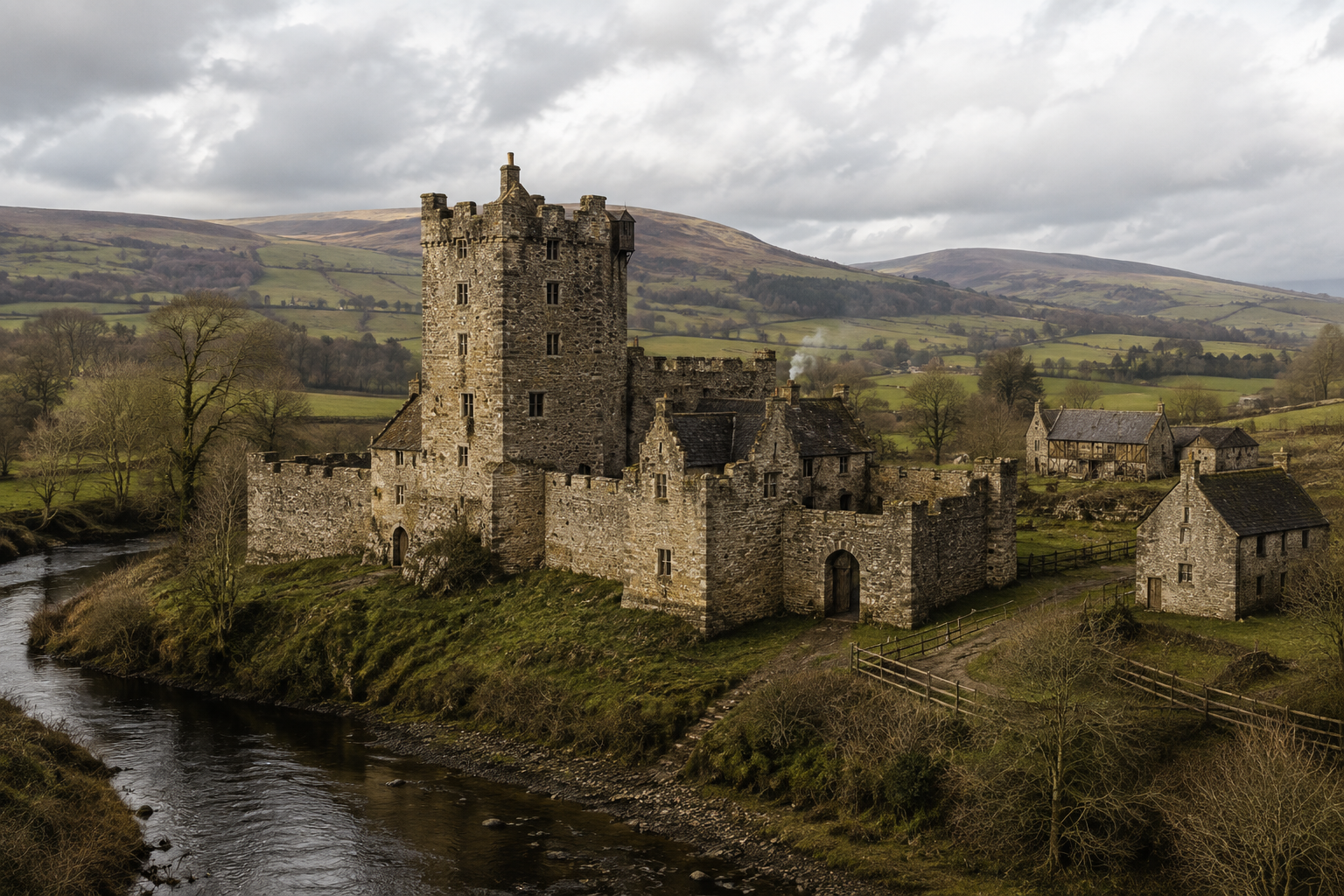
Castle Morton · Scotland 1600
A Childhood During Scotland's Upheaval
Janet entered a Scotland approaching one of the most turbulent periods in its history.
During her childhood, disputes over religion and royal authority erupted into the Covenanting movement and Wars of the Three Kingdoms. Armies moved across Scotland and England, political loyalties divided families and communities, and local landowners found themselves responsible for raising men, money, horses, supplies, and provisions.
Janet's father was directly involved in that world.
James Douglas of Morton served as a Commissioner of Supply for Dumfriesshire during the 1640s, and in 1644 he appears among men appointed to the committee for Nithsdale and Annandale.
Janet was still a child.
This does not allow us to claim that she personally witnessed particular battles or political meetings, but it does place her childhood household directly within the machinery of county government during a period of national crisis. Decisions concerning military levies, taxation, religion, and political allegiance were not distant affairs for the family of Morton.
They were part of the world in which Janet grew up.
The Douglas and Johnstone Families
Among the landed families moving through the same Dumfriesshire political world were the Johnstones of Corheid, whose lands lay around the upper Annandale and Moffat country.
The documentary record places James Johnstone of Corheid within the same broader regional political network as Janet's father during the 1640s.
That is an important piece of context for what happened later.
We cannot know exactly when Janet first met the younger James Johnstone or how their marriage was negotiated. Yet the evidence suggests that the Douglas and Johnstone households did not suddenly encounter one another at a wedding. Their fathers belonged to the same relatively small world of southwest Scottish landowners, heritors, commissioners, and local officials.
The marriage that eventually joined their children therefore grew from a landscape in which the two families were already known to one another.
The Loss of Her Parents
Janet's family changed dramatically while she was still young.
Her mother, Christian Lockhart, died around 1652, and her father James Douglas also died around this period. Janet was probably still in her teens.
Her brother William Douglas succeeded their father in the Morton lands and was formally retoured as heir during the 1650s. Other brothers included Archibald Douglas of Fingland and Samuel Douglas of Auchinshinnoch.
The surviving family evidence suggests that James Douglas and Christian Lockhart had a larger household than some of the older male-line pedigrees acknowledge, with later accounts remembering both sons and daughters.
Janet therefore belonged not simply to a pedigree but to a substantial sibling network whose members continued to occupy and marry from the Morton estate.
16 April 1657
On 16 April 1657, Janet Douglas married James Johnstone of Corheid, son of James Johnstone of Corheid and Rachel Whyteford, or Whiteford.
Family histories place the marriage at Morton Castle.
The precise wording of the original marriage contract has not yet been recovered, so the castle venue should remain identified as a strong family-history tradition rather than an absolute documentary certainty. Nevertheless, the date and marriage are independently preserved in Douglas family material, and the continued family use of Morton Castle makes the setting entirely plausible.
For Janet, the marriage united two families deeply rooted in Dumfriesshire.
She left the Douglas household of Morton and became part of the Johnstone world of Corheid, Moffat, and upper Annandale.
The Remarkable Woman Who Became Her Mother-in-Law
Janet's new family had an interesting history of its own.
Her mother-in-law, Rachel Whyteford, belonged to the Whiteford family and married the elder James Johnstone of Corheid. Historical accounts associate that marriage with lands around Moffat and Kirkpatrick, where the Johnstones developed substantial local interests.
Rachel is also remembered in Moffat tradition in connection with the discovery of the mineral spring that eventually helped transform the town into a fashionable spa destination.
Whether Janet personally participated in the earliest development of the spring cannot presently be established, but she married directly into the family around which that tradition developed.
Her life therefore connected two distinctive landscapes: Morton and Nithsdale through her birth, and Corheid and Moffat through her marriage.
Janet's Children
The surviving Douglas family reconstruction identifies at least three children of Janet Douglas and James Johnstone:
William Johnstone
Janet Johnstone (married James Chalmers of DAM)
Rachel Johnstone
Exact birth dates remain uncertain and should not be forced into the chronology from unsourced online family trees.
This is particularly important because some modern trees assign children to Janet before her documented 1657 marriage. Until original baptismal, sasine, or testamentary evidence establishes those dates, they should be treated as estimates rather than facts.
For our Chalmers history, their daughter Janet Johnstone is especially important. Through her, the Douglas–Johnstone network would eventually intersect with the Chalmers family.
Life at Corheid
Janet's married life unfolded during another difficult chapter of Scottish history.
The monarchy was restored under Charles II in 1660, but religious conflict did not disappear. Southwestern Scotland became one of the centers of Covenanting resistance, with conventicles—unauthorized Presbyterian religious meetings—held in fields, homes, hills, and isolated gathering places.
The Johnstones were drawn into the administrative world surrounding these events.
Records associated with the Annandale estates show James Johnstone of Corhead participating with other Dumfriesshire heritors in investigations concerning suspected attendance at field conventicles. In one surviving report, tenants associated with Corhead were suspected of attending such meetings around Crawfordmuir.
For Janet, this meant living within a household situated directly amid the political and religious pressures of Restoration Scotland.
Again, the records tell us what surrounded her rather than what Janet herself believed. We do not presently know her personal religious convictions, and they should not be invented.
But the world around Corheid was anything but quiet.
James Johnstone and Public Life
Janet's husband eventually emerged beyond estate affairs into county politics.
James Johnstone of Corhead appears among the parliamentary representatives associated with Dumfriesshire around 1690–1693, during the extraordinary political transformation following the Revolution of 1688–89 and the accession of William and Mary.
If Janet was still living at this time, she would have witnessed her husband move from the world of the landed Dumfriesshire heritor into parliamentary affairs.
Unfortunately, that is precisely where the surviving chronology becomes uncertain.
The date and place of Janet Douglas's death have not yet been securely established.
A date of 1 June 1673 found in some modern family trees should not presently be accepted as hers. That date appears to have become entangled with another Douglas woman connected to the Johnstone family. Until a testament, burial entry, sasine, or other contemporary record establishes Janet's death, the responsible conclusion is simply:
Her death date remains unknown.
A Woman Between Two Powerful Family Networks
Janet Douglas did not leave behind a diary, memoir, or collection of letters through which we can hear her own voice.
Like many seventeenth-century Scottish women, she emerges indirectly—from land records, marriages, family pedigrees, the political activities of her father and husband, and the descendants who followed her.
Yet those fragments reveal a life situated at the intersection of remarkable historical forces. She was born into the Douglases of Morton during the Covenanting upheavals. Her mother connected her to the Lockharts of Lee.
Her father participated in the government of Dumfriesshire during wartime. She married into the Johnstones of Corheid, whose interests stretched through Moffat and upper Annandale.
Her married household experienced the religious and political tensions of Restoration Scotland. And through her children, the family network continued into another generation. Janet's importance does not depend upon making her a countess, a courtier, or the heroine of events for which no evidence survives. Her real life is more interesting than that. She belonged to the network of landed Scottish women through whom property, kinship, alliances, memory, and family identity passed from one generation to another.
Somewhere between the old stone walls of Morton and the hills surrounding Corheid, Janet Douglas lived through one of the most unsettled generations in seventeenth-century Scotland.
For Your Reference;
William Fraser, The Douglas Book and related published Douglas pedigrees and estate material concerning the Douglases of Morton.
Drumlanrig Castle and the Douglases, for the Morton estate, James Douglas, Christian Lockhart, and the family's continued association with Morton Castle.
Historical records of Dumfriesshire and the Annandale charter material for the Johnstones of Corheid and seventeenth-century county affairs.
11th Great Grandmother of author Krysta Abesamis