The Dinwoodie–Jardine feud
Blood, Land and Vengeance in Annandale
The feud between the Dinwoodies of Dinwoodie and the Jardines of Applegarth belongs to the violent world of late-medieval Annandale, when a quarrel between neighboring landed houses could become inseparable from the much larger political struggles surrounding them. By the opening years of the sixteenth century, both families were established in the same relatively small corner of Dumfriesshire. The Dinwoodies possessed the lands that carried their name in Applegarth parish, while the Jardines were among the principal landholders of the parish itself. Contemporary judicial evidence confirms that hostility between them became deadly: one Laird of Dinwoodie was killed at his own place, and another Dinwoodie laird was reportedly slain only a few years later in Edinburgh.
This was not simply a romantic “clan feud” of the sort later Border literature sometimes created. The surviving records place the violence inside a much larger system of alliances, landholding, cattle raiding and political loyalty. Annandale at the turn of the sixteenth century was divided by struggles involving the Johnstones, Maxwells, Carlyles, Jardines, Dinwoodies and other neighboring houses. A dispute between two lairds could therefore become part of something much larger, with an attack upon one family understood as an attack upon its allies.
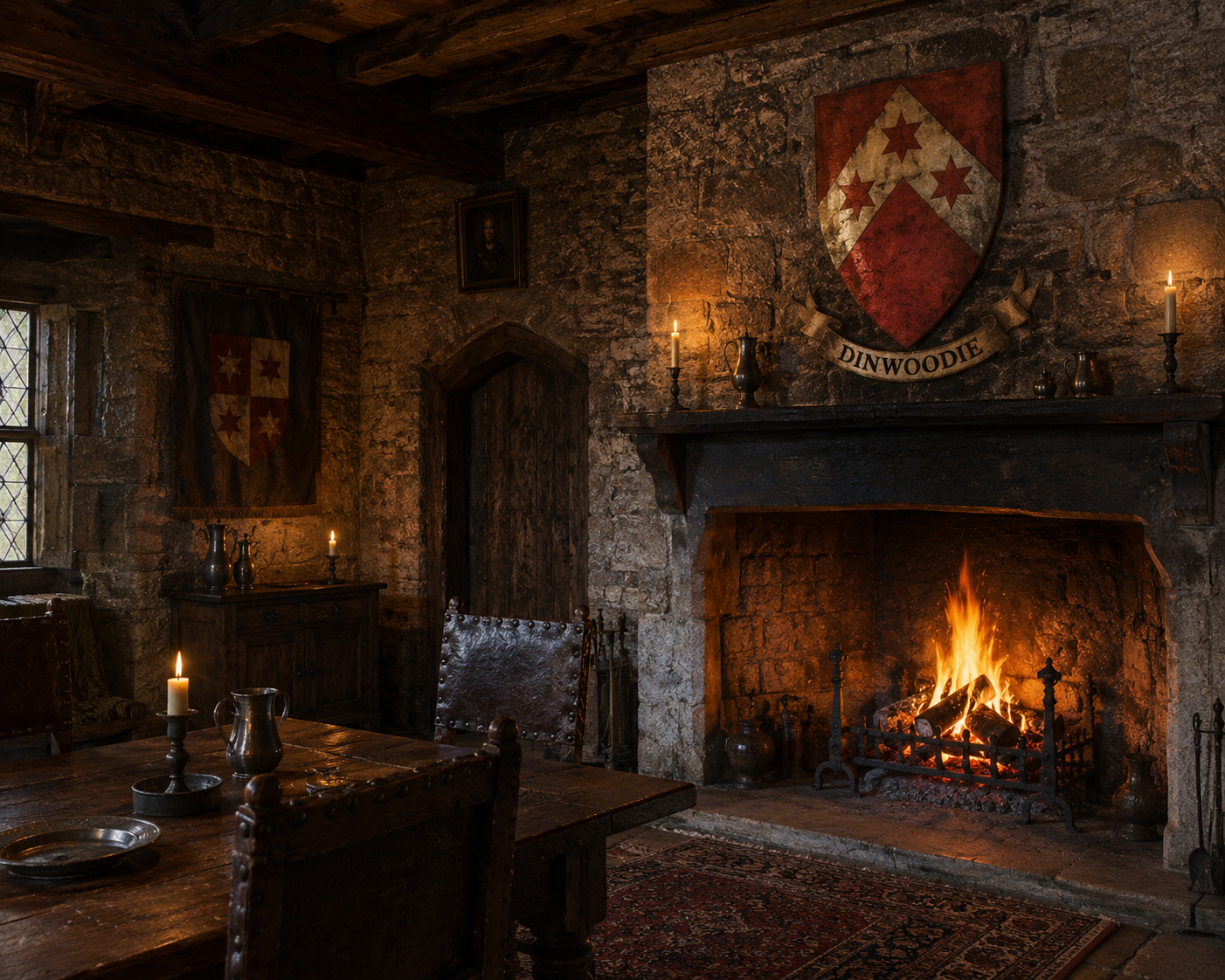
The Dinwoodies of that Ilk
The Families Were Neighbors
The geography helps explain the intensity of the quarrel. The Dinwoodies were not distant rivals who occasionally encountered one another at court. Their lands lay in Applegarth, the same parish in which the Jardines were a dominant landed family. A nineteenth-century account of Dumfries describes the Dinwoodies as long settled upon lands bearing their name and specifically identifies the Jardines as their powerful neighbors.
That meant the two houses inhabited the same landscape of farms, roads, grazing land, tenants and fortified residences. Whatever the original cause of their hostility, it could not easily be escaped.
A later Dinwoodie family history presents an intriguing reconstruction of how the trouble developed. It argues that the feud probably became entangled with the larger struggle between the Johnstone and Maxwell interests in Annandale. According to that reconstruction, the Dinwoodies were closely aligned with the Johnstones, while the Jardines supported the opposing Maxwell/Carlyle interest. Dinwoodie territory consequently occupied an uncomfortable position between allied and hostile estates.
That interpretation is plausible and helps explain the violence, but it needs to be distinguished from the harder evidence. I do not possess a document announcing the beginning of the Dinwoodie–Jardine feud or explaining its original cause. What history possess are the consequences.
And those consequences were extraordinary.
Thomas Dunwedy Is Killed at Dinwoodie
Sometime around 1502–1503, violence reached the Dinwoodie home itself.
Thomas Dunwed or - Thomas Dinwoodie in modern spelling—was killed at his place of Dunwedy. Later narrative accounts describe armed men entering Dinwoodie Tower and killing the laird there. The killing was attributed to the Jardine side, although the surviving judicial proceedings do not permit us simply to state that Alexander Jardine personally ordered the murder.
What happened afterward is much better documented.
At the Justice-Ayre held at Dumfries in August 1504, John Jardine of Sibbald-besyde and Robert Brig, who was residing with Alexander Jardine of Applegarth, appeared in connection with the killing. The record concerned their “art and part” in the slaughter of Thomas Dunwedy of that Ilk at his place of Dunwedy.
“Art and part” is important language. In Scots criminal law it encompassed participation in an offense rather than necessarily alleging that the accused personally delivered the fatal blow.
But there was another remarkable element.
The accused men produced a royal remission.
Because they possessed the king's remission, they were released. Alexander Jardine undertook to produce them again if required. A contemporary-style judicial process had therefore occurred, men associated with the Jardine household had been implicated in the killing, and yet the matter did not end with their execution or imprisonment.
For the Dinwoodies, however, their laird was still dead.
James IV and a Border He Could Barely Control
All of this occurred during the reign of James IV, one of Scotland's most energetic kings. James attempted to impose royal justice upon the Borders, personally traveled through southern Scotland and held courts intended to deal with precisely the kind of disorder that plagued Annandale.
Yet the records from the 1504 Dumfries assizes show how difficult the problem really was.
Alongside ordinary offenses such as illegal salmon fishing appear horse theft, robbery and homicide. A history of Dumfries specifically notes that the court had to confront the killings of both the Laird of Dinwoodie and the Laird of Mouswald by neighboring landholders. The Jardines of Applegarth and Sibbald-besyde were brought into the proceedings concerning Dinwoodie but escaped conviction.
This is the world in which the extended Carruthers family was living as well. These were not isolated stories happening somewhere else in Scotland. Mouswald, Holmains, Applegarth and Dinwoodie belonged to the same Border society. Families witnessed one another's charters, married into neighboring houses, served as sureties, appeared together before courts and sometimes rode on opposing sides of disputes that could last for generations.
The Dinwoodie–Jardine feud gives us an unusually vivid window into what that society could become when those relationships broke down.
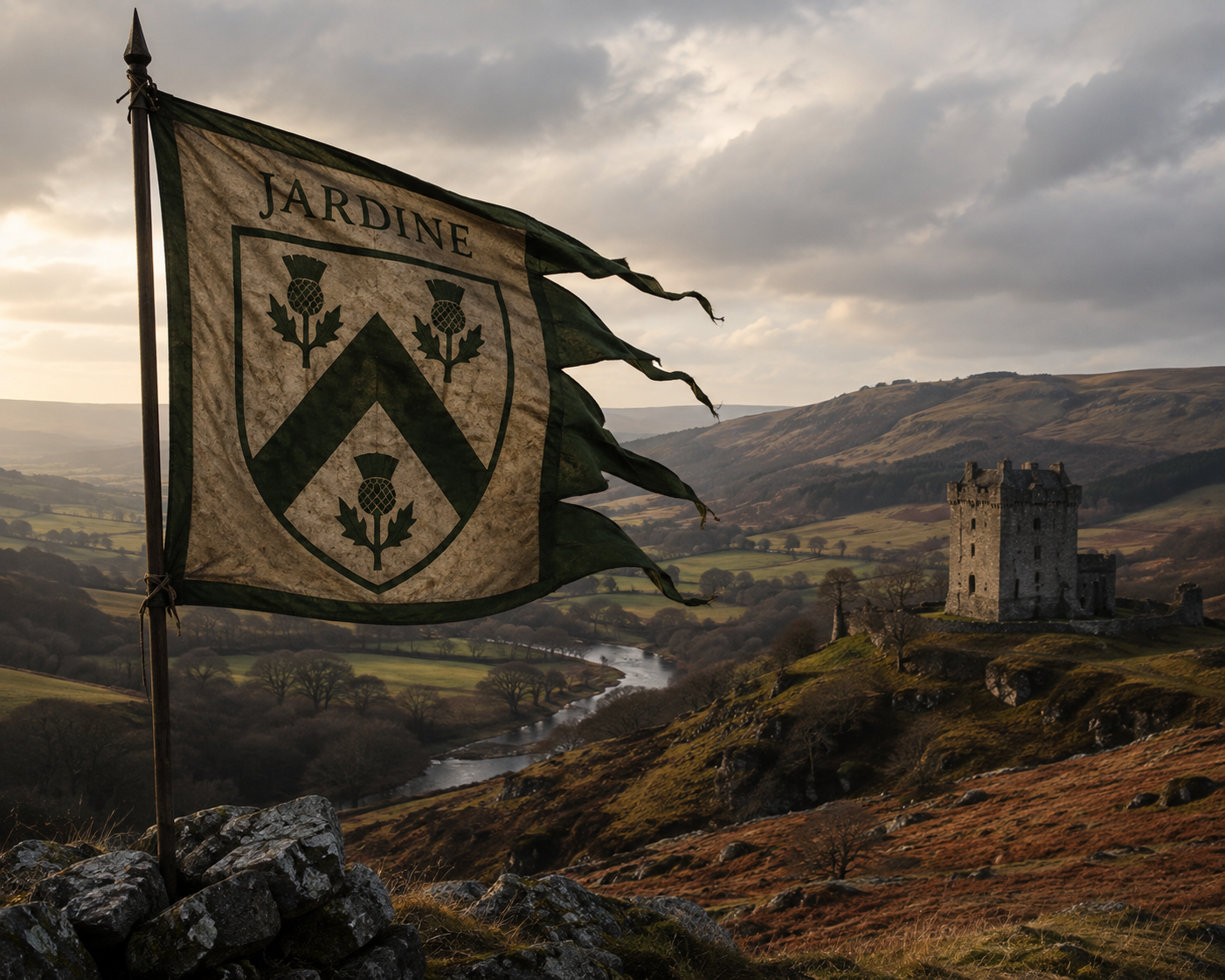
The Jardines of Applegarth
A Son Inherits More Than Land
Thomas's death did not end the Dinwoodie line.
Another Thomas Dunwedy succeeded him. A later Dinwoodie history cites an entry recording sasine to Thomas Dunwedy in Annandale in 1502, apparently marking the transition to the next laird.
If the reconstruction is correct, the younger Thomas inherited something much more dangerous than an estate.
He inherited his father's enemies.
That was one of the defining characteristics of a Border feud. Vengeance did not necessarily end with the men who began the quarrel. Sons inherited alliances, obligations and grievances along with the lands themselves. An attack upon a father could become the political inheritance of his heir.
And approximately a decade after the first killing, the Dinwoodies suffered another extraordinary loss.
The Second Laird Is Killed — This Time in Edinburgh
Around 1512, another Laird of Dinwoodie was killed.
But this time the murder did not take place in the contested countryside of Annandale.
It happened in Edinburgh.
A historical account preserved in the nineteenth-century Scottish Nation states that the Laird of Dinwiddie was slain there by two men who subsequently escaped into the sanctuary of Holyroodhouse. The same source notes that Sir James Balfour attributed the killing to “the Jardans” — the Jardines.
That detail changes the scale of the story.
If the attribution is correct, the feud had followed a Dinwoodie laird roughly seventy miles from Annandale into the royal capital. Even Edinburgh did not necessarily provide safety from a Border enemy.
The killers' reported flight to sanctuary at Holyrood is equally revealing. Medieval sanctuary could temporarily protect offenders who reached a recognized sacred precinct. Thus a homicide committed close to the political center of Scotland could still become entangled with older legal and ecclesiastical protections.
However, we need to preserve an important distinction in our biography work: the 1504 proceedings are substantially firmer evidence than the later attribution of the 1512 killing to the Jardines. The second murder is reported in later historical sources drawing upon earlier material, and although the Jardines were blamed, I would describe their responsibility as reported rather than proven beyond question.
A Feud Inside a Greater Feud
The most interesting explanation for the Dinwoodie–Jardine conflict is that it became a feud within a feud.
The Dinwoodies appear associated with the Johnstone interest, while the Jardines became associated with the opposing Maxwell network. One Dinwoodie family history explicitly describes Dinwoodie territory as effectively a buffer between the Johnstones to the north and Jardines to the south and interprets the family quarrel as a local manifestation of the larger struggle engulfing Annandale.
The alliances are not merely a later invention. Later evidence demonstrates that the Jardines remained connected with the Maxwell interest and the Dinwoodies with the Johnstones. A genealogical history summarizing the great Maxwell–Johnstone feud likewise identifies Maxwell and Jardine on one side and Johnstone and Dinwiddie on the other.
That larger feud would eventually culminate in one of the most famous encounters in Border history, the Battle of Dryfe Sands in 1593, where Lord Maxwell was killed and the Johnstones achieved a devastating victory. The Dinwoodie–Jardine killings occurred decades earlier, but they demonstrate how deeply rooted these networks of hostility had already become.
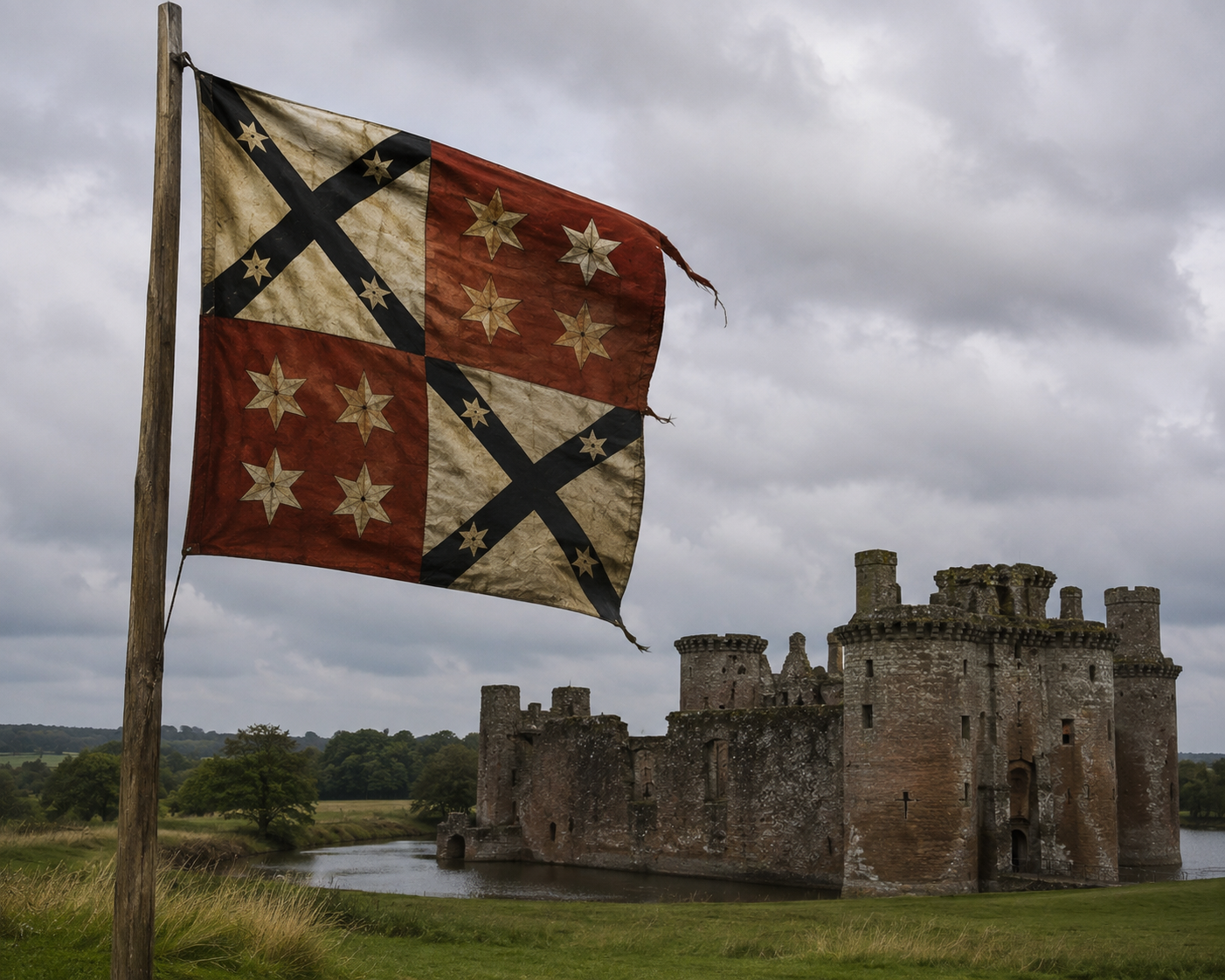
The Maxwells at Caerlaverock Castle
And Yet These Families Had to Live Beside One Another
Perhaps the strangest thing about Border feuding is that enemies could not simply disappear from one another's lives.
They remained neighbors.
The same surnames continued to appear in the same parishes, courts and land transactions. Political alliances changed. Marriages created new relationships. A family hostile in one generation could become connected in another. Men who had ridden against one another might later find their descendants standing on the same side of a completely different dispute.
This is why the feud should not be imagined as a permanent war in which every Dinwoodie automatically attacked every Jardine whenever they met. Feuds had periods of violence, negotiation, remission and relative quiet. The documentary record disproportionately preserves the moments when something went terribly wrong.
But in the opening years of the sixteenth century, something clearly had gone terribly wrong between these two houses.
Within roughly a decade, two successive Lairds of Dinwoodie were dead. Men connected with the Jardine household were formally implicated in the first killing, while historical tradition attributed the second killing to Jardines as well.
Why This Matters to the Carruthers Story
The Dinwoodie–Jardine feud matters to my Carruthers research for more than background color.
The Carruthers of Holmains lived in precisely this world. Their estates lay within the same political geography, and their own surviving records show Carruthers men participating in the legal, military and kinship networks of the West March. Understanding the Dinwoodie and Jardine conflict helps us understand why marriages, witnesses, sureties and alliances in these records matter so much.
It also provides a warning for reconstructing the unidentified wives of the earliest Holmains lairds.
A proposed Dinwoodie, Jardine, Johnstone, Murray, Stewart or other neighboring wife cannot be accepted merely because the social connection looks plausible. These families certainly knew one another. Their lives intersected constantly. But proximity and political alliance demonstrate opportunity for a marriage, not the marriage itself.
Ironically, the feud shows us why such proposed relationships can look so convincing. These were not random surnames later genealogists attached to one another. They really did inhabit the same tightly interconnected world.
The Two Dead Lairds
The surviving story of the Dinwoodie–Jardine feud is therefore unusually stark.
Around 1502–1503, Thomas Dunwedy of that Ilk was killed at Dinwoodie. At the Dumfries Justice-Ayre in 1504, men associated with the Jardine family were brought before royal justice in connection with his slaughter, but produced a royal remission. Approximately a decade later, another Laird of Dinwoodie was killed in Edinburgh, with later historical authorities again attributing the murder to Jardines.
Behind those killings stood something larger than two angry men. There were neighboring estates, competing loyalties, cattle raids, royal officers, powerful regional families and a Border society in which kinship could provide both protection and enemies.
This was Annandale on the eve of Flodden.
It was also the world of the early Carruthers of Holmains.
And for the Dinwoodies, the feud demonstrated the most dangerous reality of Border life: a stone tower could protect a family from raiders, royal justice could summon an enemy before a court, and the king himself could attempt to impose order upon the Marches.
None of those things necessarily kept a laird alive.
For Your Reference;
Alexander Trotter, East Galloway Sketches; or, Biographical, Historical, and Descriptive Notices of Kirkcudbrightshire and later Dinwoodie family material preserving the family's Border traditions; the Dinwoodie account should be used cautiously where it reconstructs motives not stated in contemporary records.
Robert Pitcairn, Ancient Criminal Trials in Scotland — proceedings associated with the 1504 Dumfries Justice-Ayre and the killing of Thomas Dunwedy of that Ilk, cited by later histories of the Dinwoodie family.
William McDowall, History of the Burgh of Dumfries — discussion of the Dinwoodie–Jardine feud, the killing at Dinwoodie and the subsequent judicial proceedings.
Robert '5th Lord' Maxwell is 14th Great Grandfather of author Krysta Abesamis