The passage itself isn’t particularly glamorous. It looks like the sort of place you might walk straight through without thinking much about it. But look up and suddenly there is this wonderful old stonework hanging over the street.
I find two stone men staring down at me.
They are perched above a little passage between buildings, surrounded by carved leaves and great bunches of fruit. Between them is a date: 1925
So, of course, I need to know what it is.
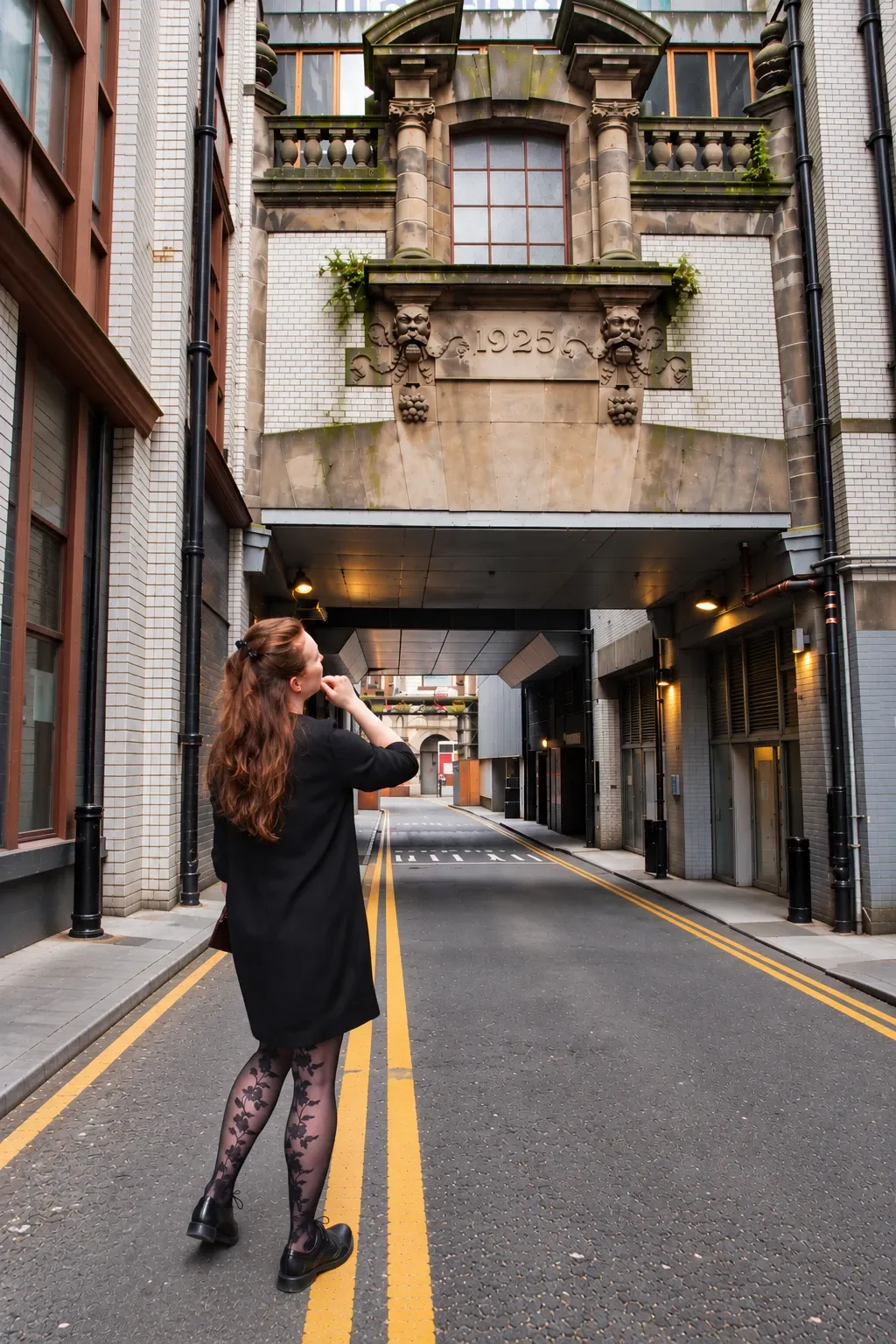
Investigating the 1925 passage at Merchant City House, Glasgow
Today this is part of Merchant City House, in the block between Queen Street and Miller Street in central Glasgow. The building is protected as a Category B listed building, and it sits within Glasgow’s Central Conservation Area. Its recent refurbishment has been carried out to preserve surviving historic details, including original decoration, the old staircase, and its cast-iron balustrade.
But this corner of Glasgow had a commercial life long before someone carved 1925 over my head. And that story leads to a man named James Arthur.
Before the Stone Men
In 1849, James Arthur went into business with Hugh Fraser, a real Glasgow draper and businessman. They opened a drapery shop at the corner of Buchanan and Argyle Streets. Their partnership eventually split: James Arthur kept the wholesale operation, Arthur & Co., while Hugh Fraser kept the retail side.
Fraser's business grew through his descendants and then ultimately became the retail company we know as the ‘House of Fraser‘. The wholesale side also took off.
By 1856, it had grown enough that the partners moved it to larger premises around Miller Street, where it began trading as Arthur & Co. When Arthur and Fraser separated professionally in 1865, James Arthur kept the wholesale business.
And Arthur & Co. became huge.
By 1878, the company’s registered office was at 78 Queen Street. By the time James Arthur died in 1885, the Queen Street warehouse contained about fifty departments.
The company dealt in clothing, furniture, bedding, musical instruments, watches, clocks, jewelry, stationery, ironmongery and other goods. It had factories elsewhere in Britain and Ireland and warehouses as far away as South Africa, Australia, New Zealand and Canada.
One nineteenth-century description called the enormous Queen Street warehouse one of Glasgow's architectural “lions.”
And it kept spreading.
In 1898, Arthur & Co. acquired additional property at 61–67 Miller Street, further knitting together its holdings across this city block.
So that little passage I am standing beneath belongs to a part of Glasgow that once hummed with an enormous wholesale trade. Imagine this area then…
Carts coming and going. Parcels. Crates. Cloth. Furniture. Workers moving merchandise through warehouses. Clerks upstairs keeping accounts. Buyers and commercial travelers arriving from elsewhere in Scotland and beyond.
Suddenly, that funny little passage doesn’t seem quite so insignificant.
And then, sometime in 1925, somebody decided the entrance deserved two magnificently grumpy stone men watching over it.
I find that Historic Environment Scotland's archive has plans for the Arthur & Co. premises across Queen Street, Ingram Street, and Miller Street, but the online catalog doesn't identify or name the sculptures.
So whoever redesigned this entrance in 1925 wasn’t creating a new passage.
They dressed up an old one.
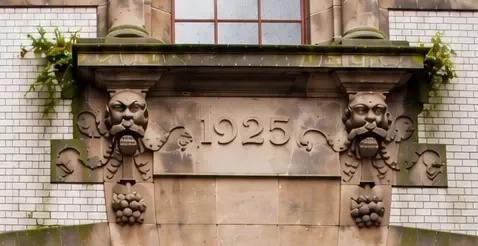
In 1925, ‘Canada Court’ acquired this wonderfully theatrical stonework: fruit, leaves, scrolls and two rather grumpy gentlemen glaring down at everyone entering below.
I desperately wanted them to be James Arthur and Hugh Fraser.
They aren’t—or at least I can’t prove that they are.
I haven’t found a surviving description. Architecturally, they are better called grotesques or carved masks, not gargoyles. Gargoyles have the practical job of carrying rainwater away from a building. These two appear to have only one job:
Judging everyone who walks through...
Over a hundred years later, they’re still doing it!