A collision of Edinburgh’s history: public punishment, scientific controversy, urban improvement, and ordinary life.
I want to imagine standing in Edinburgh’s Old Town two hundred years ago, looking down a narrow passage towards the Cowgate. Somewhere above, a window opens. Two neighbors stop on the stairs to exchange a few words. This was the Edinburgh of closes and wynds, little passages that connected the Old Town's crowded streets.
Some led into private courtyards; others led to workshops, houses, or the steep slopes descending from the Royal Mile. People lived, worked, and raised families along them.
One of these passages was called Christie’s Close.

In 1923, Edinburgh historian Charles B. Boog Watson investigated the names of the city’s old closes and wynds. When he reached Christie’s Close, he could not establish its origin. He found a possible clue: a man named Thomas Christie owned property in nearby College Wynd in 1711. Unfortunately, Watson could find no evidence connecting him to the passage.
So, for now, who Christie is remains unidentified.
A Neighborhood Beneath the Bridge
Christie’s Close stood in a neighborhood on the verge of an extraordinary transformation.
By the early nineteenth century, Edinburgh’s authorities were determined to improve movement through the Old Town. Traveling between the Lawnmarket and the southern districts meant negotiating steep, narrow streets and crowded passages.
Their solution was ambitious: build a great new bridge across the Cowgate valley.
They laid the foundation stone for George IV Bridge on August 15, 1827. Construction continued through the early 1830s, creating an elevated thoroughfare designed by architect Thomas Hamilton. But the new bridge required space.
During the redevelopment, they cleared the old Christie’s Close, along with neighboring Libberton’s Wynd, Cooper’s Close, and Bathgate’s Close!
For people who used these passages every day, the changes must have been enormous.
Familiar routes disappeared, buildings were demolished, and an entirely different streetscape took their place.
Edinburgh gained a magnificent bridge, but what did it lose beneath it?
The Lives Behind the Stone Walls
Before George IV Bridge changed the landscape, the neighborhood around Christie’s Close was full of life.
Its neighboring passage, Libberton’s Wynd, was particularly lively. Old accounts describe tall buildings with projecting timber gables that nearly met overhead, leaving little sunlight to reach the street below.
Imagine living in one of those tenements! Several families might occupy a single floor, sharing cramped quarters above a passage filled with footsteps, conversation, and the occasional argument.
And then there was the matter of sanitation.
Edinburgh’s Old Town was notorious for household waste. Residents sometimes emptied slop buckets from upper windows, shouting “Gardyloo!” to warn anyone unfortunate enough to be walking beneath.
Not exactly the romantic Edinburgh we admire today!
Yet these passages also housed businesses, entertainment venues, and small gathering spots where the city’s social life unfolded.
A Tavern, a Poet, and a Rather Dark Street
Just around the corner from Christie’s Close, in Libberton’s Wynd, stood once a place called ‘John Dowie’s Tavern’, one of Edinburgh’s celebrated eighteenth-century drinking establishments. It wasn’t particularly grand.
Historical accounts describe small, gloomy rooms, some so dark they required artificial light even in daylight. The largest room accommodated about fourteen people, while others held only six.
Nevertheless, the tavern drew writers, antiquaries, lawyers, and other Edinburgh characters. Among its famous visitors was Robert Burns, who frequented Dowie’s during his 1786–1787 stay in Edinburgh.
The poet Robert Fergusson was another early visitor, as was David Herd, the collector of Scottish songs. This was the intellectual and social Edinburgh of the eighteenth century, flourishing in places that were anything but fashionable. Cool!
Only a short distance away stood Christie’s Close, whose own residents have proved much harder to identify.
The Gallows at the Top of the Wynd
This neighborhood had a considerably darker side.
At the upper end of Libberton’s Wynd, where it met the Lawnmarket, stood one of Edinburgh’s public execution sites.
On January 28, 1829, thousands gathered to witness the hanging of William Burke, the notorious murderer associated with supplying bodies for anatomical dissection.
The crowd gathered as the surrounding neighborhood was already being demolished for the new bridge.
It’s a remarkable collision of Edinburgh’s history: public punishment, scientific controversy, urban improvement, and ordinary life, all occupying the same little corner of the Old Town.
Today, brass markers in the pavement near the northern end of George IV Bridge commemorate the former gallows site.
What Remains Beneath Our Feet?
Here’s something I find especially fascinating.
Although Libberton’s Wynd disappeared from the street plan, traces of the old neighborhood survive beneath the National Library of Scotland.
Construction of the National Library of Scotland on George IV Bridge began in 1937, and it officially opened on 4 July 1956, by Queen Elizabeth II. Scottish architect Reginald Fairlie designed it. World War II interrupted construction.
Behind a door in the library’s lower levels lies a remarkable space known as the Void.
It runs between the library building and the masonry of George IV Bridge, revealing part of the steeply sloping ground and structures associated with the former wynd.
The library has investigated this space and the history of the streets that once occupied the site.
Imagine that! Above, readers quietly study books and manuscripts. Several floors beneath them are physical reminders of a neighborhood where Edinburgh residents once worked, drank, and hurried home.
It reminds us that when a city rebuilds itself, its past doesn’t always disappear completely.
1829–1834: George IV Bridge was constructed, demolishing Libberton's Wynd and neighboring passages.
1937–1956: The National Library building was constructed on the former neighborhood's site, replacing an earlier Sheriff Court building.
So the library itself came more than a century after the original wynd was demolished.
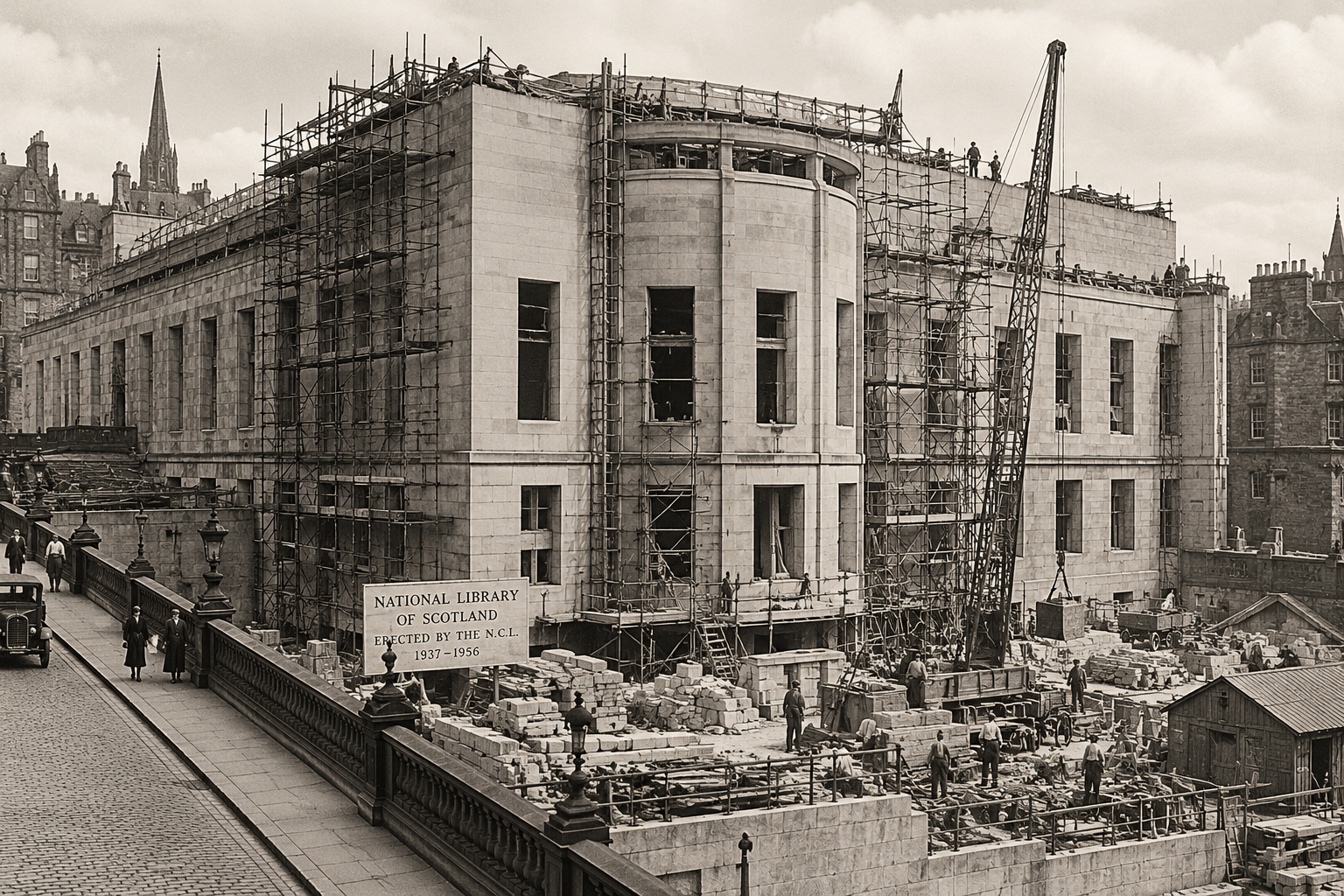
A vision of the library’s construction in 1937
The Mystery of Christie’s Close
So, who was Christie?
More than three centuries after a Thomas Christie appeared in a 1711 property record, we still cannot say whether he was the man behind the name. Shucks.
Perhaps that’s what makes these little Edinburgh passages so irresistible. Behind every familiar street sign is another question, another forgotten household, another story waiting to be uncovered.
I came looking for the story behind a name and found an entire neighborhood worth remembering!
For Your ReferenceCharles B. Boog Watson, Notes on the Names of the Closes and Wynds of Old Edinburgh, The Book of the Old Edinburgh Club, Vol. XII (1923).National Library of Scotland, Through the Void to Libberton's Wynd.Historic Environment Scotland, George IV Bridge, architectural and historical designation records.Researched & Written by author Krysta Abesamis