Oliver Ellsworth
The Quiet Architect of America's Judicial System
The American Revolution produced brilliant generals, fiery orators, gifted financiers, and celebrated philosophers. Yet once independence had been won, an entirely different challenge emerged. How could thirteen fiercely independent states become a single functioning nation governed by law rather than personality? Few men contributed more to answering that question than Oliver Ellsworth.
Born on April 29, 1745, in Windsor, Connecticut, Ellsworth entered the world during the reign of King George II, at a time when Britain's North American colonies were prosperous but still considered distant provinces of the empire. His father, David Ellsworth, was a successful farmer and respected member of the local community, while his mother, Jemima Leavitt, instilled in her children the discipline and education valued throughout colonial New England. From an early age, Oliver displayed a thoughtful, methodical temperament that contrasted sharply with the fiery personalities who would later dominate Revolutionary politics.
His formal education began at Yale before he transferred to the College of New Jersey, now Princeton University, where he studied under the influential Scottish Presbyterian minister John Witherspoon. The future signer of the Declaration of Independence believed that republican government demanded educated citizens grounded in moral philosophy, history, and law. Those lessons profoundly shaped the young Ellsworth, who returned to Connecticut to study law and was admitted to the bar in 1771. His legal practice quickly earned him a reputation for careful reasoning, measured judgment, and remarkable integrity—qualities that would define his public career.
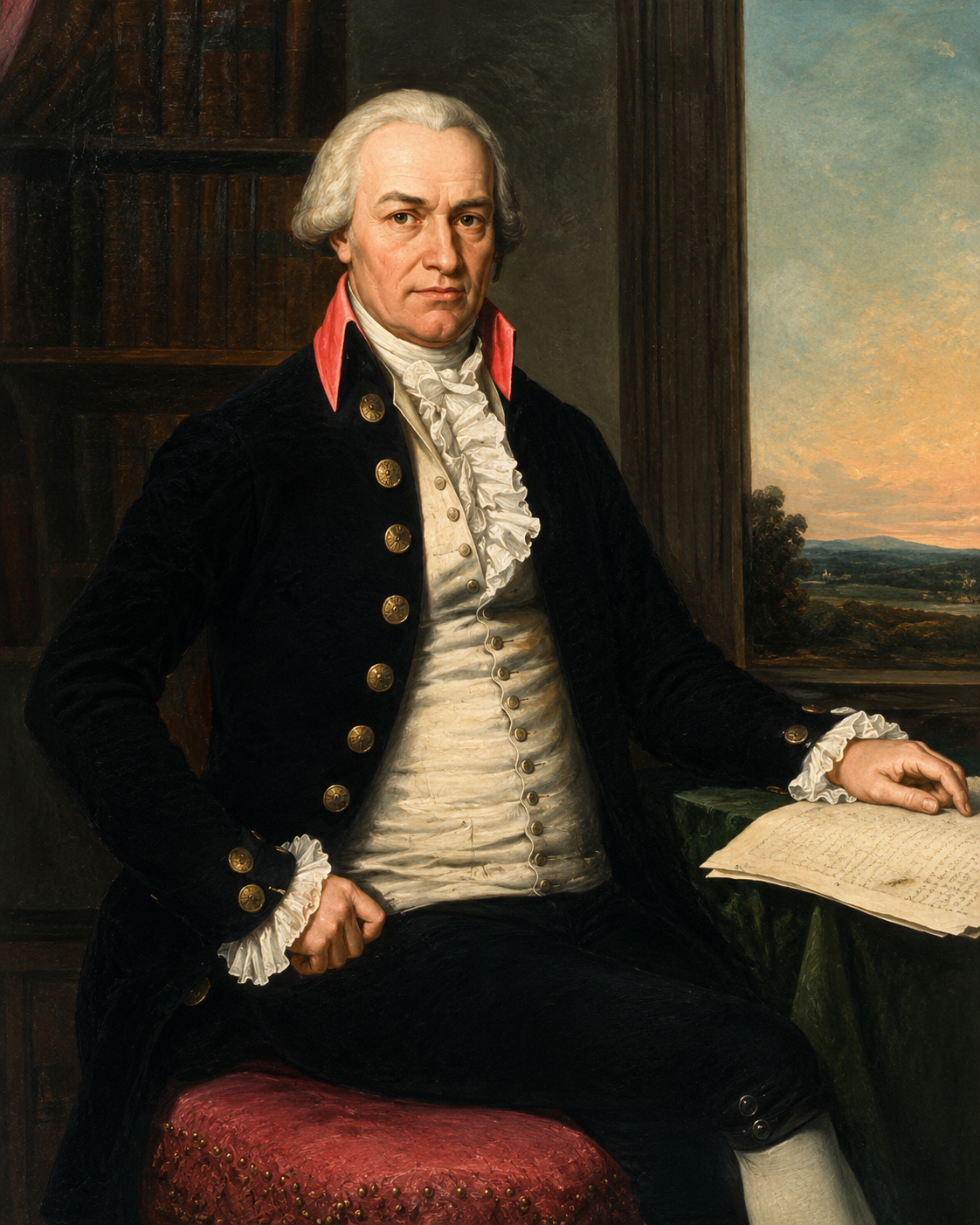
As tensions between Great Britain and the American colonies intensified during the 1770s, Ellsworth emerged as a firm but pragmatic supporter of colonial rights. He did not seek revolution for its own sake. Rather, like many colonial lawyers, he believed that English constitutional principles guaranteed liberties that Parliament had begun systematically violating. The disputes over taxation, representation, and imperial authority increasingly convinced him that the colonies would have to govern themselves if those liberties were to survive.
When open war erupted in 1775, Connecticut turned to Ellsworth for leadership. He served on the Governor's Council and soon represented his state in the Continental Congress, where he became acquainted with many of the men who would shape the future of the new republic. Among the closest of these relationships was his friendship with Roger Sherman, another Connecticut delegate whose practical wisdom closely matched Ellsworth's own. While larger personalities often dominated debate, Sherman and Ellsworth quietly earned the respect of their colleagues by solving problems rather than creating them.
Following the hard-won victory over Great Britain, the new nation faced an even greater test. The Articles of Confederation had successfully united the states during wartime but proved woefully inadequate for governing a growing republic. Congress possessed little authority, interstate disputes multiplied, and the national government struggled to pay its debts or regulate commerce. By 1787, delegates gathered in Philadelphia determined to draft an entirely new framework of government.
most enduring contributions in American history
The Constitutional Convention nearly collapsed over a bitter dispute between large and small states. Delegates from populous states demanded representation based upon population, while smaller states feared they would permanently lose their political voice. Weeks of debate produced little progress, and many believed the Convention would fail.
Working closely with Roger Sherman, Ellsworth proposed what became known as the Connecticut Compromise, or Great Compromise. The solution was elegant in its simplicity. Representation in the House of Representatives would be based on population, satisfying the larger states, while every state would receive equal representation in the Senate, protecting the interests of the smaller ones. The proposal broke the deadlock and allowed the Convention to continue. Without it, the United States Constitution might never have been completed.
Ellsworth's influence extended well beyond that famous compromise. During the Convention he argued forcefully for a strong but carefully limited national government, believing that liberty depended not upon weak institutions but upon balanced ones. He supported an independent executive, a bicameral legislature, and above all an impartial judiciary capable of interpreting the law without political interference. These principles became foundational elements of the Constitution adopted later that year.
When George Washington assumed the presidency in 1789, Congress faced the enormous task of transforming constitutional theory into a functioning government. Once again, Ellsworth stood at the center of events. Serving in the United States Senate, he became the principal author of the Judiciary Act of 1789, legislation that established the federal court system still recognizable today. The Act created district courts, circuit courts, defined the jurisdiction of the Supreme Court, and established the office of the Attorney General. While the Constitution authorized a judiciary, it was Ellsworth who gave that judiciary its practical form.
Modern Americans interact with institutions that Oliver Ellsworth helped design every day. Every federal courthouse, every district judge, every appeal moving through the federal courts traces its institutional ancestry to the framework he drafted more than two centuries ago.
In 1796, President George Washington nominated Ellsworth to succeed John Jay as the third Chief Justice of the United States. Although illness frequently interrupted his service, he strengthened the authority of the young Supreme Court during a period when its role remained uncertain. Rather than seeking public acclaim, Ellsworth focused on establishing the Court as a respected, independent branch of government worthy of public confidence.
His legacy was something far more enduring.
His final major public service carried him across the Atlantic. In 1799, President John Adams appointed Ellsworth as one of three American commissioners sent to France during the tense diplomatic crisis known as the Quasi-War. Relations between the two republics had deteriorated dangerously following the XYZ Affair, raising the specter of full-scale conflict. Through patient negotiation, Ellsworth helped secure the Convention of 1800, peacefully ending the crisis and preserving American neutrality during the height of the Napoleonic era. It was one of the young republic's first significant diplomatic victories.
Declining health eventually forced Ellsworth to resign as Chief Justice later that same year. He returned to his Connecticut home, where he spent his remaining years surrounded by family and the quiet countryside he had known since childhood. He died on November 26, 1807, leaving behind no great military victories, no soaring speeches, and no dramatic political rivalries.
Washington gave the nation leadership.
Jefferson articulated its ideals. Hamilton stabilized its finances. Roger Sherman helped preserve the Constitutional Convention.
Oliver Ellsworth built the legal framework that allowed all of those achievements to endure.
Every federal judge sworn into office, every constitutional case argued before the Supreme Court, and every citizen who seeks justice under the rule of law still walks through institutions whose foundations were carefully laid by this quiet Connecticut lawyer. While others captured the headlines of the Revolutionary generation, Ellsworth ensured that the republic they created would possess courts capable of protecting it for centuries to come.