Robert Carruthers Jr.
The Best-Documented Son of Robert Carruthers Sr. (1715)
Among the known children of Robert Carruthers Sr. (1715–1812) and Margaret Gillespie, none can presently be documented more thoroughly than their eldest known son,
Robert Carruthers Jr. (1763-1828)
Unlike many members of the family whose lives survive only through scattered references, Robert Jr.'s story can be followed across nearly half a century through Revolutionary records, federal census schedules, migration evidence, and probate proceedings.
Together, those documents preserve one of the clearest biographies within the early Carruthers family.
What We Know
The surviving documentary evidence consistently supports the following outline of Robert Jr.'s life:
✔ Son of Robert Carruthers Sr. and Margaret Gillespie (supported by compiled family histories and later genealogical reconstructions).
✔ Married Elizabeth Pattillo.
✔ Appears in the North Carolina Revolutionary Pay Vouchers, with payment recorded on 28 September 1784.
✔ Established a household in western North Carolina during the early years of the United States.
✔ Migrated to Maury County, Tennessee, during the opening years of the nineteenth century.
✔ Died in 1828, with probate proceedings identifying his widow Elizabeth and their heirs.
Although every stage of his life cannot yet be reconstructed, few members of this generation leave such a continuous documentary trail.
His Early Years
The earliest detailed family histories place Robert Jr. among the children raised within the frontier communities spanning Mecklenburg and Burke Counties, North Carolina.
Those same accounts associate the Carruthers family with neighboring frontier families including the Pattillos, Finleys, and Duckworths, all of whom appear repeatedly within the region's early settlement history.
Like many eighteenth-century frontier children, Robert grew up during a period of rapid expansion, political unrest, and eventually the American Revolution.
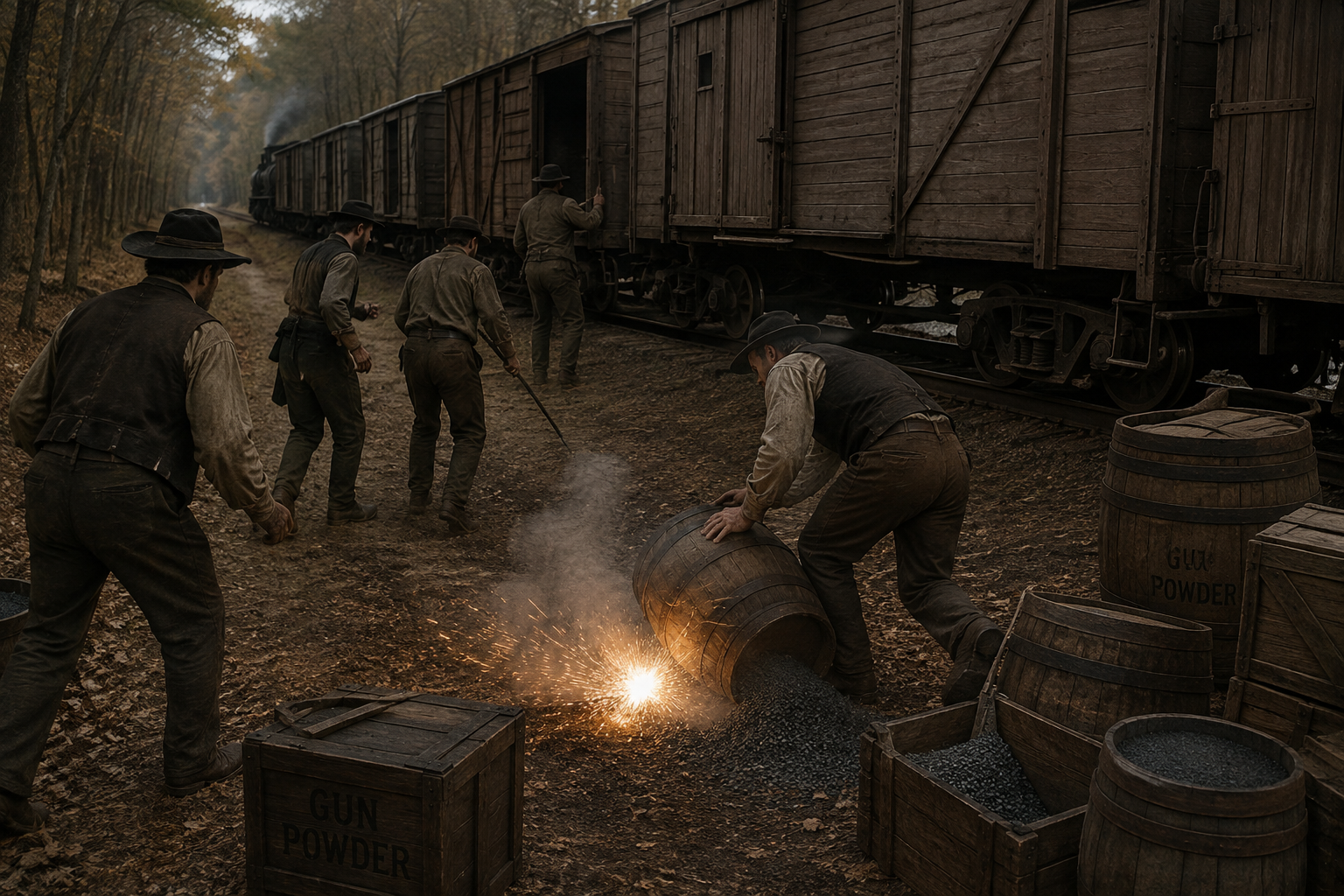
Robert Caruthers is named in James Ashmore’s sworn deposition as one of the disguised men who stopped wagons and destroyed gunpowder intended for General Waddell.
In 1771 — Colonial pardon proceedings Robert Caruthers is included among the accused men for whom a royal pardon was requested.
*The Cabarrus Black Boys were nine young men from Rowan and Mecklenburg Counties who took part in an infamous raid against a royal governmental military convoy during the Regulator Movement in North Carolina
Revolutionary Service
One of the most important surviving documents relating to Robert Jr. appears in the North Carolina Revolutionary Pay Vouchers.
On 28 September 1784, a payment was recorded for Robert Caruthers within Morgan District.
Issued after the Revolutionary War, these vouchers compensated soldiers and others whose military or public service had been recognized by North Carolina at a time when the state lacked sufficient hard currency.
Robert's appearance within this official government record confirms that colonial authorities acknowledged his Revolutionary-era service.
Although the voucher does not describe the nature of that service, it firmly places Robert among those recognized by the state following American independence.
Morgan District
The location of Robert's voucher is significant.
During the Revolutionary era, Morgan District encompassed much of western North Carolina, including:
Burke County
Lincoln County
Rutherford County
Wilkes County
At various times, the district also administered lands that would later become part of Tennessee.
This places Robert Jr. exactly where the Carruthers family was living during the closing years of the Revolution and fits the broader migration pattern documented for the family.
The First Federal Census
Robert next appears in the 1790 United States Federal Census, the first national census conducted after the adoption of the Constitution.
Living in Lincoln County, North Carolina, his household consisted of:
1 free white male aged sixteen or older (Robert)
1 free white male under sixteen
3 free white females
3 enslaved persons
Although census schedules reveal only numbers rather than names, the record demonstrates that Robert had established himself as a prosperous head of household during the first years of the new republic.
It also documents the presence of three enslaved individuals within his household.
Like many successful farmers throughout the North Carolina Piedmont during this period, Robert participated in the institution of slavery. While difficult to confront today, this remains an important historical fact that should be presented honestly as part of his life and the society in which he lived.
Burke County in 1800
A decade later, Robert appears once again.
The 1800 Federal Census places him in Burke County, North Carolina, where his household had grown considerably.
The census records:
2 boys under age 10
1 boy aged 10–15
1 young man aged 16–25
Robert, aged 26–44
2 girls under age 10
1 girl aged 10–15
Elizabeth Pattillo Carruthers, aged 26–44
Unlike the earlier census, no enslaved persons were enumerated within the household.
The reason for that change cannot presently be determined from surviving records. It may reflect changing economic circumstances, relocation, the sale of enslaved persons, or simple differences in enumeration.
Regardless, the census documents a thriving family with seven children still living at home as the nineteenth century began.
West to Tennessee
By approximately 1806–1807, Robert joined the growing migration into Tennessee.
Like his father before him, he followed the expanding American frontier westward, eventually settling in Maury County.
There, Robert spent the final decades of his life before dying in 1828.
His probate proceedings identify his widow, Elizabeth Patillo Carruthers, together with members of the next generation, providing one of the strongest documentary links connecting the North Carolina and Tennessee branches of the family.
A Remarkably Complete Documentary Trail
Taken together, the surviving records form an unusually coherent timeline.
1784 — North Carolina Revolutionary Pay Voucher recognizing Revolutionary-era service.
1790 — Federal Census documenting Robert's household in Lincoln County.
1800 — Federal Census recording the growing family in Burke County.
1806–1807 — Migration to Maury County, Tennessee.
1828 — Probate proceedings naming his widow and heirs.
For an eighteenth-century frontier family, this represents an exceptionally complete documentary sequence.
Family Tradition
One final story deserves mention.
Several independent family histories preserve an oral tradition stating that Robert enlisted before reaching eighteen years of age, fought during the Revolution, received a saber wound, was captured, and that his mother walked twenty miles to secure his release before he returned to military service.
No contemporary military record has yet been found confirming these events.
For that reason, the account should remain exactly what it presently is:
A long-standing family tradition—not yet a documented historical fact.
Even so, its remarkable consistency across multiple descendant accounts suggests that the story has deep roots within the Carruthers family and deserves preservation until future discoveries either confirm or refute it.
The Carruthers Siblings: A Working Reconstruction
Although no surviving family Bible or contemporary record has yet been discovered naming every child of Robert Carruthers Sr. (c.1715–1812) and Margaret Gillespie, a combination of Revolutionary records, census schedules, probate proceedings, migration patterns, and long-standing family traditions allows a cautious reconstruction of their family.
The individuals presently believed to belong to this sibling group include:
James Carruthers (c.1740–?) — A probable eldest son who appears in Revolutionary-era Mecklenburg County militia records. Although his later life remains only partially documented, his chronology and location strongly support his place within the family.
John "Hunting" Carruthers (c.1743–1820s) — A well-documented frontiersman associated with Muddy Creek in Burke County, North Carolina. Land records, tax lists, and his estate provide one of the clearest documentary trails among Robert Sr.'s children.
Robert Carruthers Jr. (c.1753–1828) — The best-documented child of Robert Sr. and Margaret Gillespie. Revolutionary records, federal censuses, migration to Maury County, Tennessee, and probate proceedings preserve an unusually complete record of his adult life.
Mary Zana Carruthers (c.1760–1855) — The youngest known daughter, who married Daniel Grizzle and later settled in Middle Tennessee. Her long life is documented through multiple census records, making her one of the family's best-recorded descendants.
As with much of eighteenth-century frontier genealogy, this reconstruction reflects the current weight of documentary evidence rather than absolute proof.
For Your Reference;
Revolutionary War Pay Voucher, 28 September 1784, North Carolina state records, documenting Robert Carruthers Jr.’s Revolutionary-era service/payment.
1790 United States Federal Census, Lincoln County, North Carolina, documenting Robert Carruthers Jr. as the head of his own household in the first federal census.
Maury County, Tennessee probate and estate records, 1828, documenting Robert Carruthers Jr.’s death and estate proceedings and identifying his widow Elizabeth Patillo Carruthers and their family.
5th Great-Grand Uncle of author Krysta Abesamis.
*Note on Historical Images
Some images used in this article are AI-assisted historical reconstructions, created to help visualize people, places, buildings, and events for which no surviving photograph or contemporary image exists. These images are interpretive illustrations, not historical photographs or authenticated portraits. Where possible, reconstructions are informed by surviving records, period architecture, clothing, landscapes, heraldry, and other historical references. They are included for visual context and storytelling and should not be considered documentary evidence.