Orphan Trains
By the middle of the nineteenth century, the city was growing at a staggering pace. Immigrants arrived by the thousands, families crowded into tenements, and poverty could turn desperate very quickly. A father’s death, a mother’s illness, an accident, or the loss of a job could leave a family with no money for rent and very little to eat. There was no modern welfare system to catch them.
Children felt that instability immediately.
Some sold newspapers, matches, flowers, or whatever else might bring home a few pennies. Others begged, scavenged, stole, or took whatever work they could find. Some slept in alleys, doorways, warehouses, or crowded lodging houses. Others still had a parent and a place to sleep, but their families were barely hanging on.
That distinction matters because the term “orphan train” can be misleading.
Not every child who eventually boarded one was an orphan.
Some had lost both parents, but others had a mother or father who was still alive. A parent might be sick, widowed, imprisoned, missing, or simply too poor to feed another mouth. Children could be abandoned or surrendered to charitable institutions. Brothers and sisters might enter care together after a family collapsed.
To reformers looking at New York’s streets, the situation seemed overwhelming.
One of them was Charles Loring Brace, a young Protestant minister who founded the Children’s Aid Society in 1853. Brace believed that keeping poor children in the same environment offered them very little chance of escaping it. He feared that children growing up on the streets would eventually be drawn into crime, prostitution, alcoholism, and the cycle of poverty he saw around him.
His answer was radical. Take the children out of the city.
Brace looked westward, toward the farms and small towns of the expanding United States. He believed rural families could offer what New York could not: fresh air, regular meals, useful work, schooling, religion, discipline, and a stable home.
The idea sounds simple until you consider what it actually meant.
A child could be taken from everything familiar, put aboard a train, carried hundreds of miles away, and placed with people he or she had never met. There might be no legal adoption as we understand it today. No one could guarantee the new family wanted a son or daughter rather than another pair of hands for the farm or the kitchen. Oversight existed, but it was nothing like the child-welfare system we would expect today.
And yet for a child sleeping on the streets of New York, hungry and alone, the offer of a home somewhere in the country might have sounded like salvation.
That is what makes the orphan trains difficult to reduce to a simple story of good or bad.
Beginning in the 1850s, children left Eastern cities by rail in organized groups. Over the decades that followed, the movement carried them into towns and farming communities across the Midwest and farther west. Estimates vary, but somewhere between 100,000 and 250,000 children are believed to have been relocated through what became known collectively as the orphan-train movement.
Those numbers are enormous. But they can also hide what actually happened.
Because each number was a child who eventually had to step off a train somewhere, look out at a crowd of complete strangers, and wait to find out what would happen next.
To Be an Orphan-Train Child
Once a child was selected to go west, there was usually some preparation. The children were cleaned up, given decent clothing, and grouped under the supervision of an agent. For some, those new clothes must have felt like the start of something exciting. For others, they may have been the first outward sign that their old life was disappearing. Then they boarded the train.
Most had no real idea what waited at the other end. They traveled away from New York and other Eastern cities through countryside many had never seen before, sometimes for days. Imagine that journey through the eyes of a child raised among brick buildings and crowded streets: mile after mile of farms, woods, rivers, little towns, and open land passing outside the window.
The children weren’t simply dropped off at random. Before a group arrived, representatives of the placing organization generally worked with people in the destination community to arrange for prospective families to be present. Notices could appear in local newspapers announcing that children were coming and telling interested families when and where to meet them.
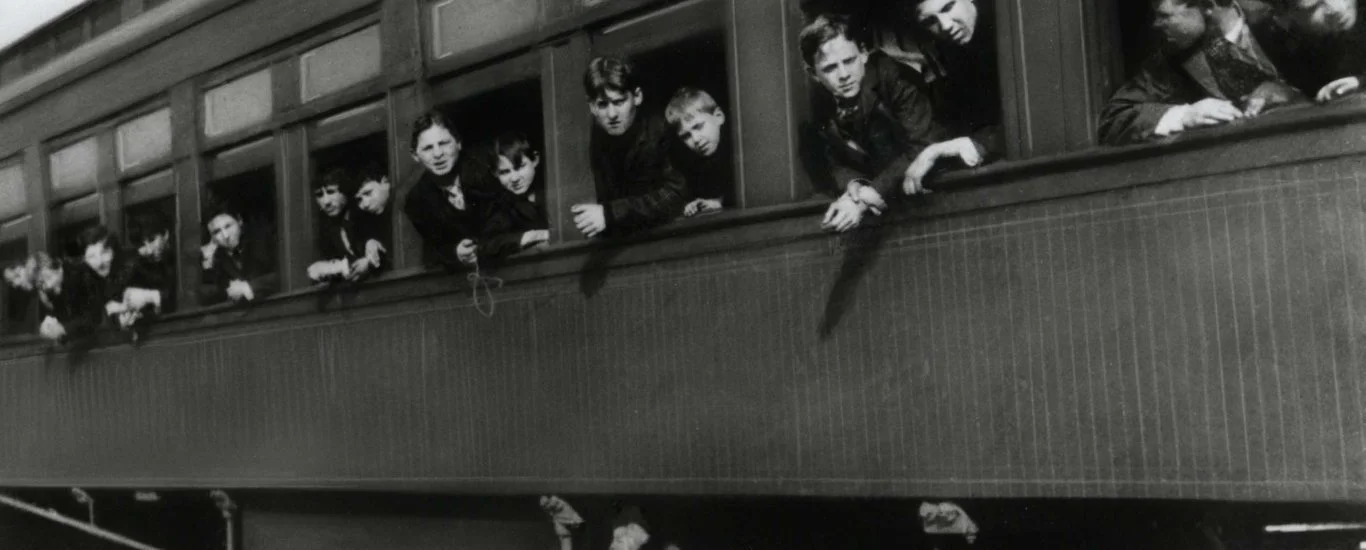
Orphan Train Movement · (photo; childrensaidnyc.org)
This part of the orphan-train story has stayed in people’s memories because it could be painfully public.
The children might be taken to a church, courthouse, hotel, opera house, or another meeting place and presented before the townspeople who had come looking for a child. Sometimes they stood together while adults walked among them. Prospective families asked questions. They wanted to know a child’s age, health, background, temperament, and what kind of work he or she could do.
Some accounts describe children being physically examined. A farmer interested in an older boy might feel his arms or look at his build. Teeth might be checked. A little girl could be questioned about cooking, sewing, or caring for younger children.
It could feel disturbingly like an inspection for sale.
But the children were not being auctioned, and nobody was supposed to be purchasing them. The purpose was to match them with families willing to take responsibility for them. That distinction matters historically, even if it may not have meant much to a frightened child standing in front of strangers.
The hardest moments must have belonged to brothers and sisters.
Siblings sometimes traveled west together, but traveling together did not guarantee staying together. A family might want one boy but not his brother, or a girl of a particular age but not her younger sister. Some siblings were placed near one another and remained in contact. Others were separated.
Then somebody chose you.
You left the other children, climbed into a wagon or carriage with strangers, and went home with them.
What happened after that varied enormously.
Some children found exactly what Charles Loring Brace had hoped they would find. They became sons and daughters in everything but name, attended school, grew close to their new families, married, inherited property, and later spoke warmly of the opportunity they had been given.
Others discovered that the family wanted labor more than a child.
On farms, boys could become another pair of hands for planting, harvesting, tending animals, chopping wood, or hauling water. Girls might cook, clean, wash clothes, mind younger children, or work alongside the household women. Work itself was not unusual for nineteenth-century children, including biological children. The problem was what happened when there was no affection, little schooling, poor treatment, or outright abuse.
Early orphan-train placements were not necessarily adoptions in the modern legal sense. Organizations placed children in homes under agreements and attempted varying degrees of follow-up, but protections were uneven and changed over the long life of the movement. A system spanning enormous distances could not always know what happened after an agent left town.
That is why there is no single answer to the question, “Were the orphan trains good or bad?”
Ask one rider, and you might hear about the parents who chose him and gave him the first secure home he had ever known. Ask another, and you might hear about years of labor and loneliness. Ask a third, and the answer might be much harder to sort out.
Fortunately, some of them left enough behind for us to find out.
Joan Lowery Nixon · Looking for Their Stories
Decades after the last orphan trains ran, author Joan Lowery Nixon became fascinated by the children who had ridden them.
Her Orphan Train Adventures introduced the history to a generation of young readers, beginning with A Family Apart in 1987.
What made the books memorable wasn’t simply the train itself. Nixon concentrated on the frightening uncertainty behind it: children leaving the only world they knew, siblings facing separation, and strangers deciding where they would live.
That is also where her work becomes interesting to me.
Nixon did what good historical storytellers do. She went looking for the small details that make a lost world feel real. She researched the orphan-train movement and drew upon the experiences surrounding the real children who had been sent west. Instead of treating them as one enormous group, she imagined what that history looked like from a child’s height.
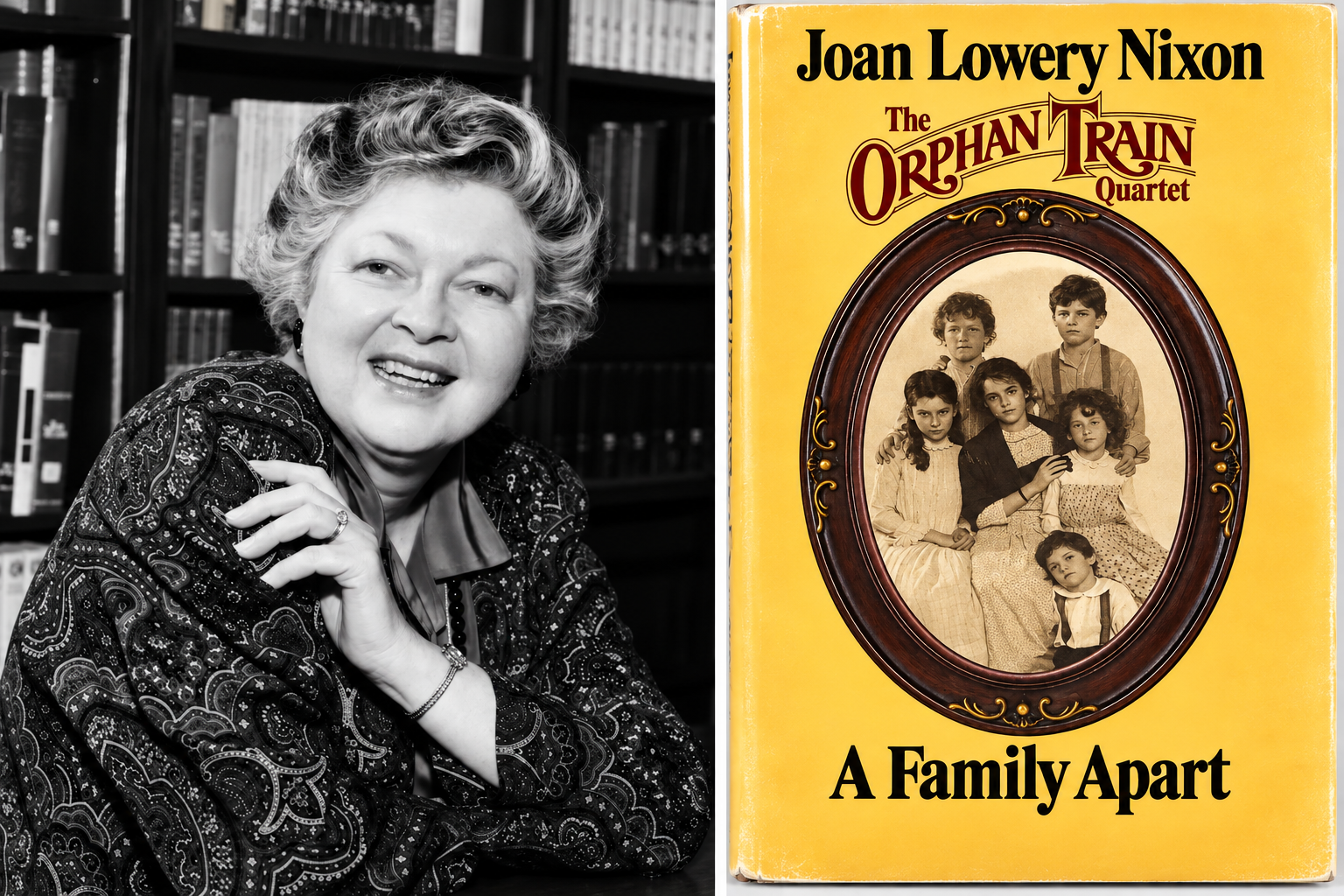
Joan Lowery Nixon · photo; gitten / Author of ‘A Family Apart’
The orphan trains continued until 1929, but by then America was beginning to rethink how to support children in trouble. Child-welfare agencies were developing, adoption was becoming more regulated, child-labor laws were expanding, and there was greater emphasis on helping struggling families stay together rather than simply removing their children.
The orphan trains had exposed both the possibilities and the dangers of placing children with strangers.
Some riders grew up believing the train had saved them. They found loving families, went to school, married, raised children of their own, and rarely looked back. Others never forgot the family they had lost. Some searched years later for parents or siblings, trying to recover names, places, and fragments of a childhood that had disappeared somewhere along the tracks.
That may be the most important thing to remember about the orphan trains.
No single orphan-train experience existed…
I have found only one questionable situation that stands out in my tree, where I think an orphan is presented as the family’s child…
I sincerely hope it was a happy one.
For Your Reference;
Children’s Aid — Orphan Train Movement — History of Charles Loring Brace, Children’s Aid Society, and the movement it began in 1853.
PBS American Experience — The Orphan Trains — excellent overview drawing on the experiences and recollections of orphan-train riders.
Joan Lowery Nixon, A Family Apart (1987) — the first of Nixon’s Orphan Train Adventures and a wonderful example of bringing this history down to a child’s experience.