Thomas Jefferson & the Separation of Church and State
Thomas Jefferson, the Separation of Church and State
When most Americans hear the phrase "separation of church and state," they often imagine it as a modern political idea. In reality, the concept emerged during one of the most transformative periods in Western history, when Enlightenment thinkers began challenging long-standing assumptions about government, religion, and individual liberty. Among the most influential voices was Thomas Jefferson, whose writings helped shape a new vision of religious freedom that would profoundly influence the United States and the generations of immigrants who made the American South their home.
To understand why Jefferson's ideas mattered, it is important to understand the world that existed before them.
For centuries, much of Europe operated under systems in which church and government were deeply intertwined. Kings often ruled by divine right. State-supported churches enjoyed legal privileges. In England, the Church of England held official status, while religious dissenters frequently faced restrictions, penalties, or exclusion from public life. Similar arrangements existed throughout Europe, where governments often favored one religious denomination over others.
For many Scots-Irish Presbyterians, this was not merely a political issue—it was personal.
The descendants of Scottish Presbyterians who settled Ulster had spent generations navigating complicated relationships with established churches and political authorities. Although they were Protestant, they were not members of the Church of England. In both Scotland and Ireland, questions surrounding religious authority, church governance, and political power remained deeply contentious throughout the seventeenth and eighteenth centuries. Many families who later migrated to Pennsylvania and the Carolina backcountry carried vivid memories of these struggles.
By the middle of the eighteenth century, a new intellectual movement was spreading across Europe and the American colonies. Known as the Enlightenment, it encouraged people to apply reason, observation, and critical thinking to questions that previous generations often accepted without challenge. Philosophers such as John Locke, Voltaire, Montesquieu, David Hume, and others argued that governments derived legitimacy from the people rather than divine authority alone. They promoted natural rights, individual liberty, freedom of conscience, and limitations on governmental power.
Thomas Jefferson emerged directly from this intellectual environment.
Born in Virginia in 1743, Jefferson belonged to a generation shaped by Enlightenment thought. He read widely, studied philosophy, law, science, and history, and became convinced that religious belief should be a matter of personal conscience rather than government control. In his view, true faith could not be compelled by law.
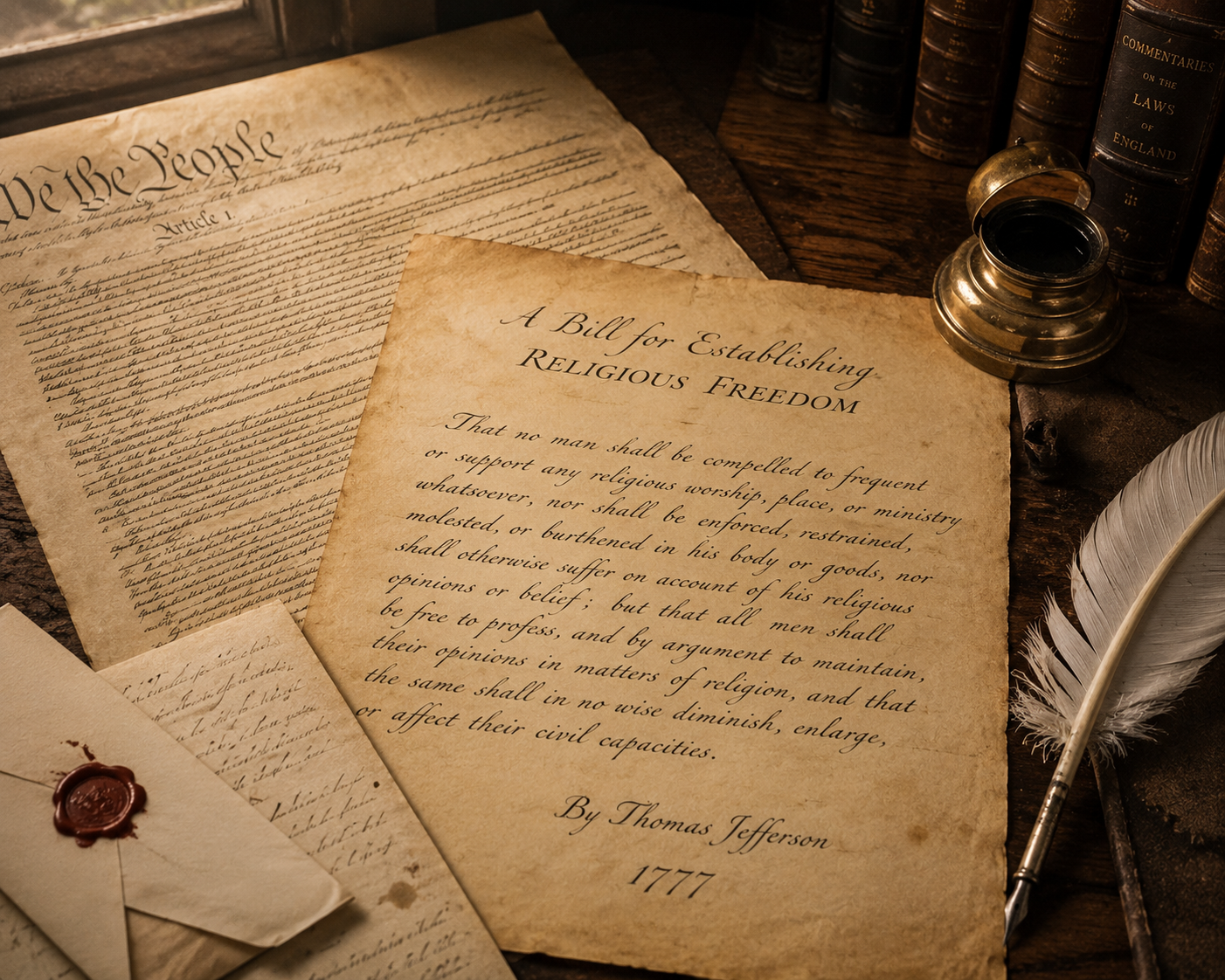
Jefferson began expressing these ideas publicly during the Revolutionary era. One of his most significant contributions came in 1777 when he drafted the Virginia Statute for Religious Freedom. The legislation proposed that no citizen should be compelled to support any religious institution and that individuals should be free to practice—or not practice—religion according to their own conscience.
The proposal proved controversial.
Many Americans remained deeply religious and worried that removing government support from churches might weaken public morality. Others feared that religious liberty could encourage social disorder or undermine traditional institutions. The debate lasted nearly a decade before the Virginia General Assembly finally adopted the statute in 1786.
Jefferson considered its passage one of the greatest achievements of his life.
Years later, when asked what accomplishments should appear on his tombstone, he chose only three: author of the Declaration of Independence, author of the Virginia Statute for Religious Freedom, and founder of the University of Virginia. Notably, he omitted any mention of serving as President of the United States.
The influence of these ideas expanded further during the drafting of the United States Constitution. Although the Constitution itself contains relatively little language regarding religion, the First Amendment, ratified in 1791, prohibited Congress from establishing a national religion and protected the free exercise of religion.
The famous phrase "separation of church and state" would come later.
In 1802, Jefferson wrote a letter to the Danbury Baptist Association of Connecticut in which he described the First Amendment as creating a "wall of separation between Church and State." Though the exact phrase appears nowhere in the Constitution, it became one of the most influential descriptions of the principle underlying American religious liberty.
For immigrant communities throughout the American South, these protections mattered enormously.
The backcountry settlements of Virginia, North Carolina, South Carolina, Tennessee, and Kentucky became home to Presbyterians, Baptists, Methodists, Lutherans, German Reformed congregations, Quakers, and numerous smaller denominations. Many settlers had left Europe precisely because they wanted greater freedom to worship according to their own beliefs. The absence of a national church allowed these communities to flourish without government interference.
The result transformed southern society.
Instead of a single established church dominating public life, the American South developed a remarkably diverse religious landscape. Small meeting houses appeared along frontier roads. Camp meetings attracted thousands. Independent congregations organized themselves according to local needs rather than state mandates. Religious revival movements spread rapidly through the countryside, contributing to what historians now call the Second Great Awakening.
Yet the system also produced challenges.
Without a state church providing common structure, American religion became increasingly fragmented. New denominations emerged frequently. Religious disputes sometimes divided communities. Questions about the proper relationship between faith and public life remained subjects of constant debate. Even today, Americans continue discussing issues that Jefferson's generation first confronted more than two centuries ago.
The advantages of the new system were substantial. Citizens gained unprecedented freedom to worship according to conscience. Minority faiths received legal protection. Religious innovation flourished. Government no longer possessed the authority to dictate belief or compel church attendance.
The disadvantages were equally apparent to critics. Some feared that weakening traditional religious institutions would erode social cohesion. Others worried that religion and morality would become increasingly detached from public life. These debates have persisted since the nation's founding and remain part of American political discourse today.
For families written about in the new book ‘Kings of the Blue Ridge’, the Carruthers, Morrisons, Gillespies, and countless other Scots-Irish settlers who moved through Pennsylvania and into the Carolina backcountry, Jefferson's ideas helped create a society fundamentally different from the one their ancestors had known in Scotland and Ulster. Churches remained central to community life, but government no longer determined which denomination citizens were expected to follow.
Perhaps that is the greatest legacy of Jefferson's vision.
The separation of church and state did not remove religion from American life. Rather, it created space for religion to thrive independently of government control. It allowed diverse communities to worship according to conscience while protecting citizens from state-imposed religious authority.
Like many Enlightenment ideas, it did not emerge overnight. Jefferson first drafted his religious freedom proposals in 1777. Virginia adopted them in 1786. The First Amendment followed in 1791. His famous "wall of separation" letter came in 1802. Even then, many states continued supporting established churches for years afterward. In practical terms, it took several generations before the principle became deeply rooted throughout American society.
The concept survived because it addressed one of the central questions of the modern world: how people with different beliefs can live together under a single government while preserving liberty for all. For the immigrants who helped build the American South, that question was not merely philosophical—it shaped the communities, churches, and institutions they passed down to future generations.