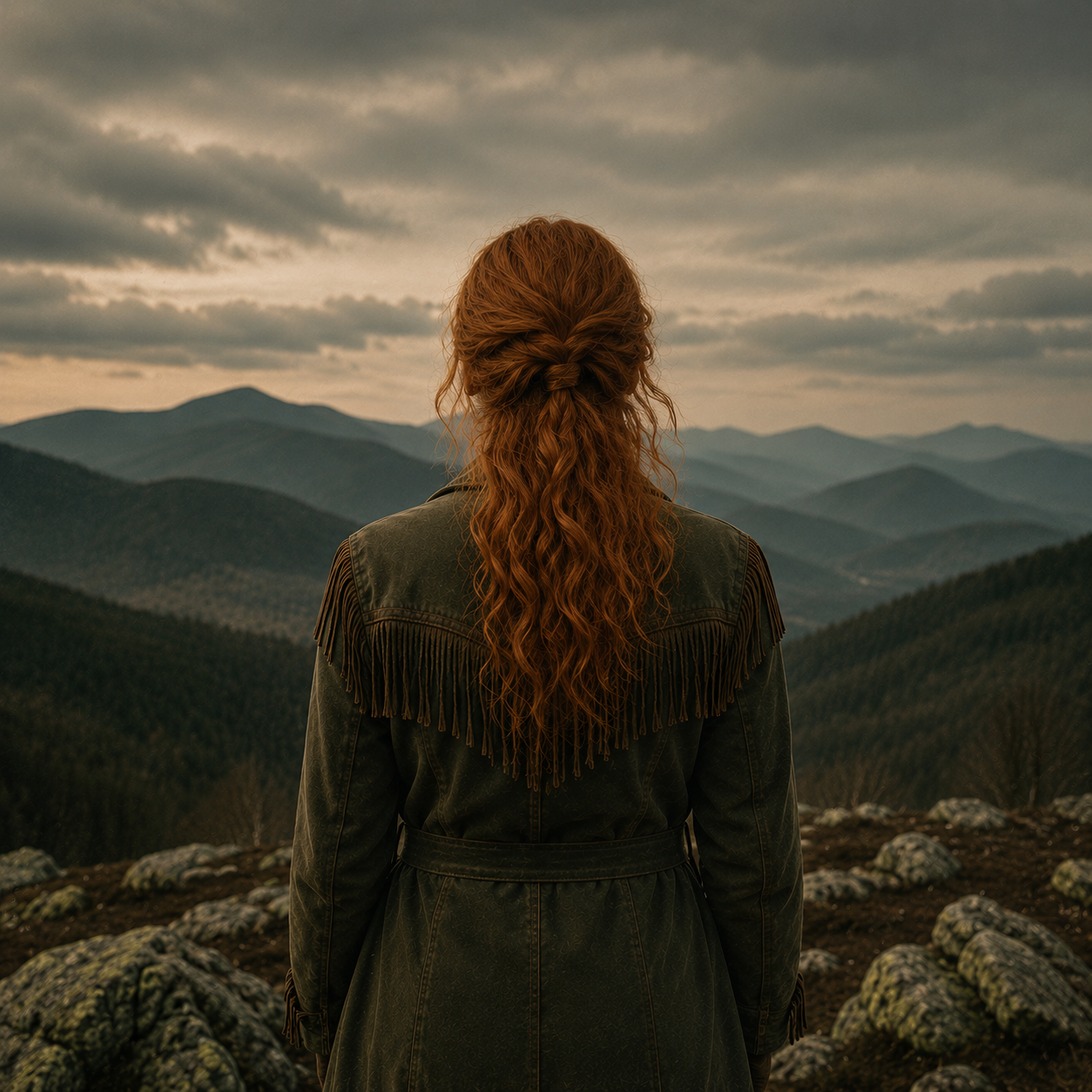
Galloway Folklore
When I was a small child, I heard of a place called Galloway. There was a fair maid and a prince there—or perhaps he was a knight. All I remember is the name—Gal-lo-way. In my childhood imagination, they belonged to the same world as castles, enchanted forests, and people who rode away on horseback into stories. It was a fairy-tale place found only in books.
I had no idea then that Galloway was real…
There’s a very good chance I was thinking of the story of Sir Gawain. He was one of King Arthur’s knights and a hero in the world of kings & castles and fairy-tale danger.

Sir Gawain and the Green Knight, illustration from the Pearl Manuscript, c. 1400. British Library, Cotton MS Nero A X. Artist unknown. Public domain
Oh, to be a grown adult now and know the know.
Historically, Galloway was a much older region of southwestern Scotland, with an identity that reached back centuries before today's county boundaries. Its heart lay west of Dumfries, stretching toward the Irish Sea.
My own ancestors were living in Dumfriesshire and Annandale, along the eastern edge of this Galloway world. People crossed these landscapes constantly. They married across parishes, crossed rivers, and carried stories. And this corner of Scotland gave those stories plenty to work with. To the south lay the Solway, with its dangerous tides and broad stretches of mud and sand. Inland were wooded glens and hills that could disappear into mist.
Long before anyone called these stories “folklore,” generations of people were already living among them.
“Now I am in the wilderness, all alone.”
— Sir Gawain and the Green Knight
This was a landscape where the weather could change the world around you in minutes. Mist settled into the hills and swallowed familiar landmarks. Burns rose after heavy rain. Winter darkness came early, and beyond the light of a farmhouse or village there were long stretches of road and open country in blackness.
Then there was the area known as Solway Firth. At low tide, enormous reaches of sand and mud appeared where hours earlier there had been water. Channels shifted, fog rolled in, and the returning tide could move with terrifying speed. People who lived around the Solway knew these dangers were real.
The supernatural did not belong only to wild, lonely places. It came right up to the farm's door.
You were rarely as alone as you thought.
The hills, burns, old mounds, and farms of Galloway had other residents—generations of people believed in.
They were the Fairy Folk, although calling them fairies gives the wrong impression entirely. These were not tiny winged creatures with wands fluttering around flowers, as in Victorian images.
They could look remarkably like us. They had families, homes, music, celebrations, tempers, and rules of their own. And they were said to live alongside people, just slightly out of sight.
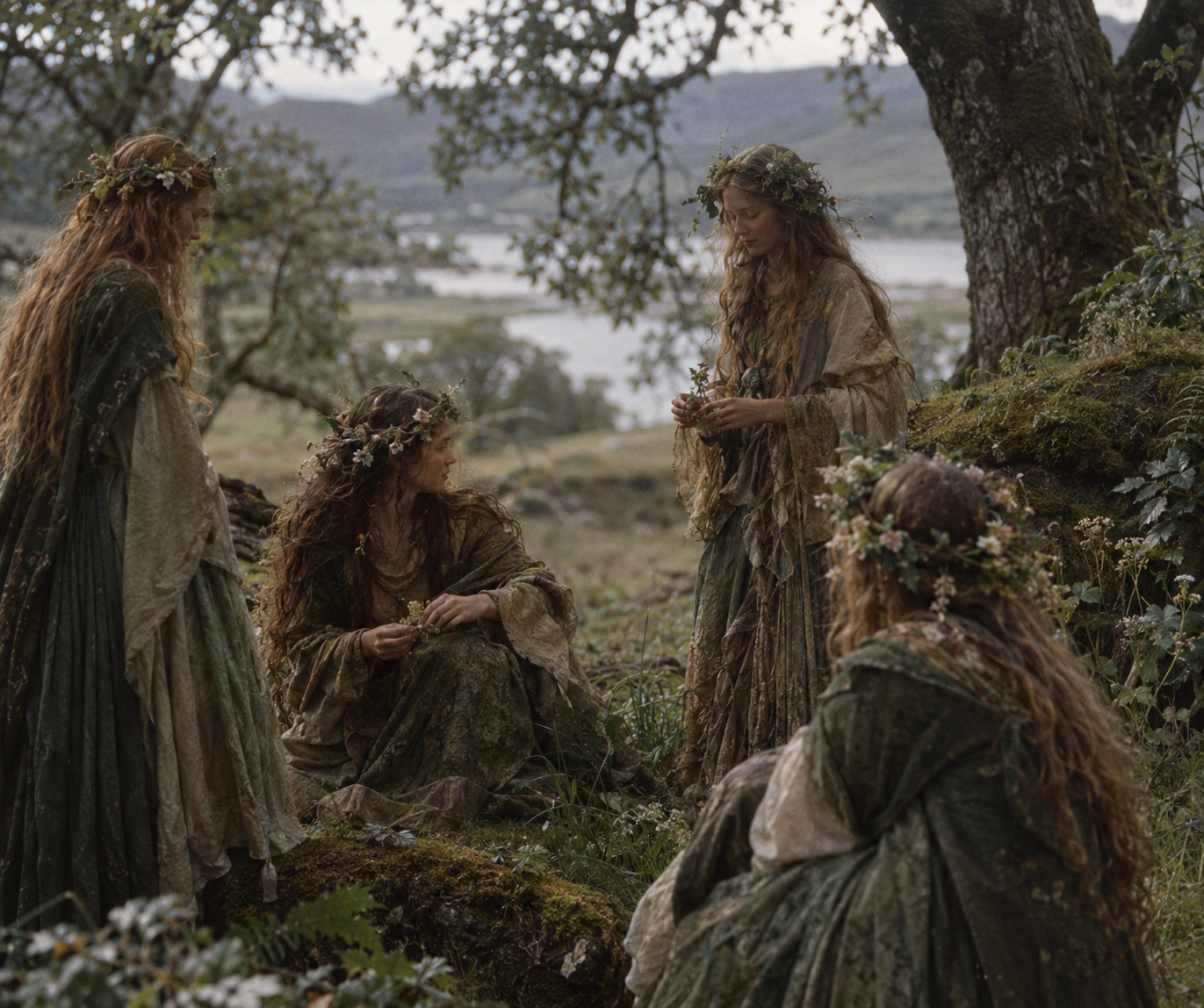
People were careful about what they called them. The Good Folk. The Fair Folk. The Good Neighbors. Lovely names, but not necessarily descriptions. There was a practical reason for being polite about beings who might overhear you. The old fairies could reward kindness and occasionally help around a farm, but they could also spoil milk, trouble livestock, lead travelers astray, or take considerable offense when humans interfered with them.
Certain places belonged especially to them. A grassy mound might not be merely a mound. Strange music heard inside a hill was best admired from the outside. And if you happened upon the Fairy Folk themselves, Fairy time did not always behave like human time, and stories told of people returning to discover that far more time had passed than they imagined.
What I love about these stories is that the fairies weren’t necessarily lurking in some distant enchanted forest. They could be next door. Beneath your familiar hill. Along the road home. Somewhere beyond the barn after everyone else had gone to bed. Your family might have lived on the same patch of ground for generations and understood that not everything on it necessarily belonged to you. And there was one particular thing the Fairy Folk were said to want from the human world.
Us.
Apparently, babies were irresistible.
Across Scottish folklore, one of the most persistent fears was that the Fairy Folk might steal a human child and leave something else in its place. The substitute became known as a changeling.
A healthy baby might fail to grow, behave strangely, or simply seem somehow different. In a world that could not explain many childhood illnesses, the answer sometimes became frighteningly simple: this isn’t the same child.
New mothers were vulnerable. Childbirth left women physically weakened, and both mother and baby occupied a strange little threshold between danger and safety during the first weeks of life. Folklore filled that uncertainty with precautions. Babies were watched carefully. Protective objects might be kept nearby. Iron, in particular, acquired a reputation for repelling fairies, as did Christian prayers and symbols.
Adults could disappear as well. A person who vanished unexpectedly—or returned after behaving strangely—might inspire whispers that the fairies had something to do with it. In some stories, the missing person had been taken beneath a hill or into a fairy gathering.
A sadder truth hides beneath the changeling stories. Some of the people described this way were almost certainly sick, disabled, or suffering from conditions their families could not understand. The belief could be terrifying when somebody genuinely believed the person sleeping beside them had been taken away.
The Brownie in the House
Not everything supernatural was waiting outside to steal you.
Some of it was doing the chores!
The brownie belonged to the house and farm. He was usually imagined as a small, rough-looking fellow who preferred to work when everyone else had gone to bed. A family might wake to find grain moved, a room tidied, animals tended, or some tiresome job mysteriously finished.
For a household where nearly everything had to be done by hand, having a brownie around was not the worst arrangement imaginable…
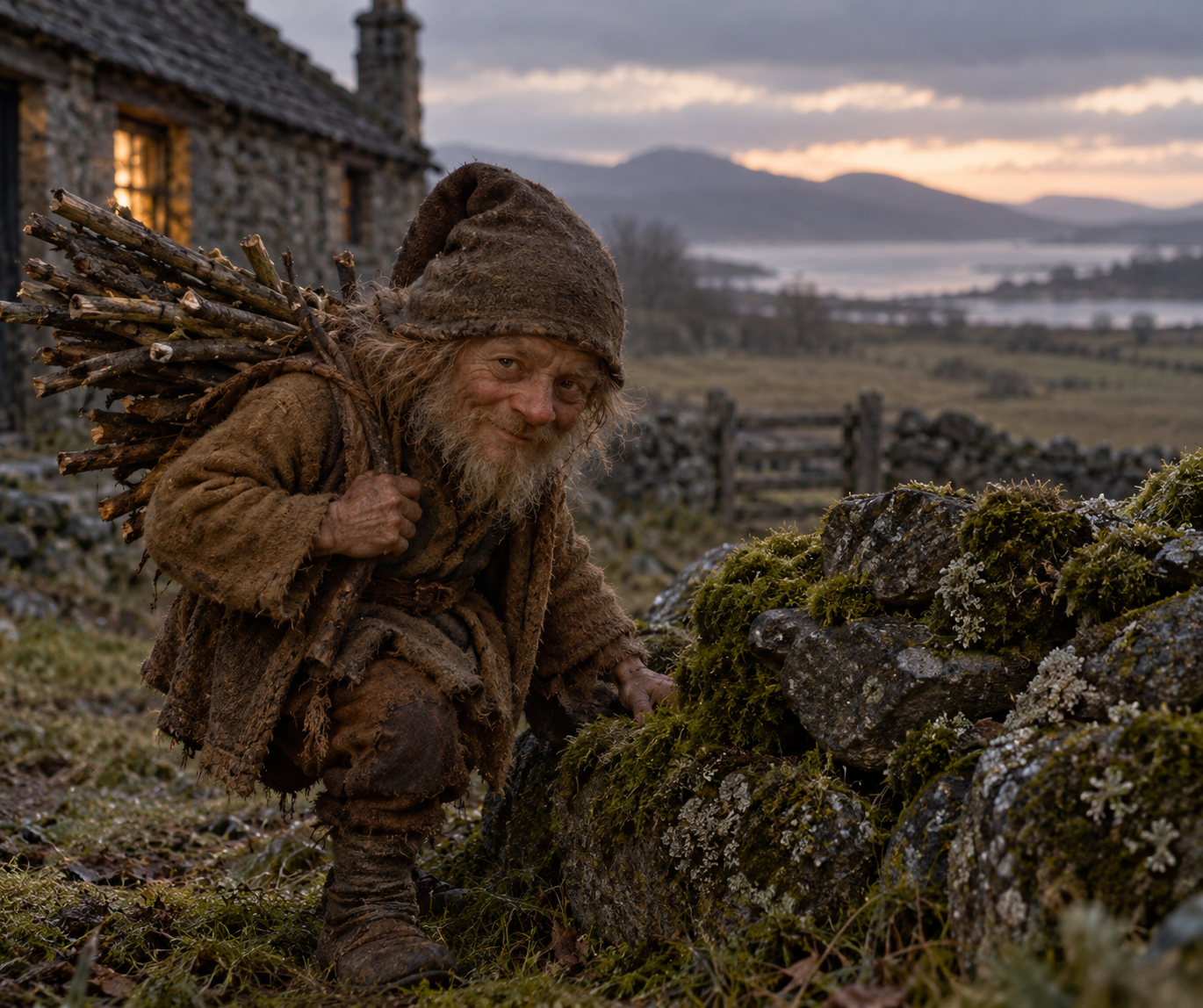
There was, however, an understanding. You did not treat him like a servant. A bowl of cream, milk or porridge might be left for him, but it was better thought of as hospitality than wages. Brownies were notoriously touchy about being paid for their work. If you tried to formalize the arrangement, your helpful little houseguest might decide he's been insulted and leave!
And whatever you did, be careful about giving him clothes. One of the most delightful recurring traditions says that a brownie presented with clothing would put it on and promptly disappear! Different stories give different reasons—perhaps the gift offended him, perhaps new clothes released him from his attachment to the household—but the result was much the same.
Congratulations on your generosity.
You now have a nicely dressed brownie and a barn full of chores…
That was the odd charm of him. Unlike the Fairy Folk beneath the hills, the brownie belonged to the intimate world of the kitchen, stable, and barn. He was supernatural, certainly, but he was also practically a member of the household—temperamental, useful, and best kept happy.
Outside the farm, however, there were things considerably less interested in helping.
And some of them lived in the water…
Something in the Water
Of all the places you might expect trouble, the water had an especially bad reputation.
Scotland’s rivers, lochs, and deep pools were home to creatures considerably less neighborly than the brownie. The best-known was the kelpie, a water spirit that most often appeared as a beautiful horse standing suspiciously close to the water. To a tired traveler—or a child delighted to find an unattended horse—it could look wonderfully inviting. That was the point.
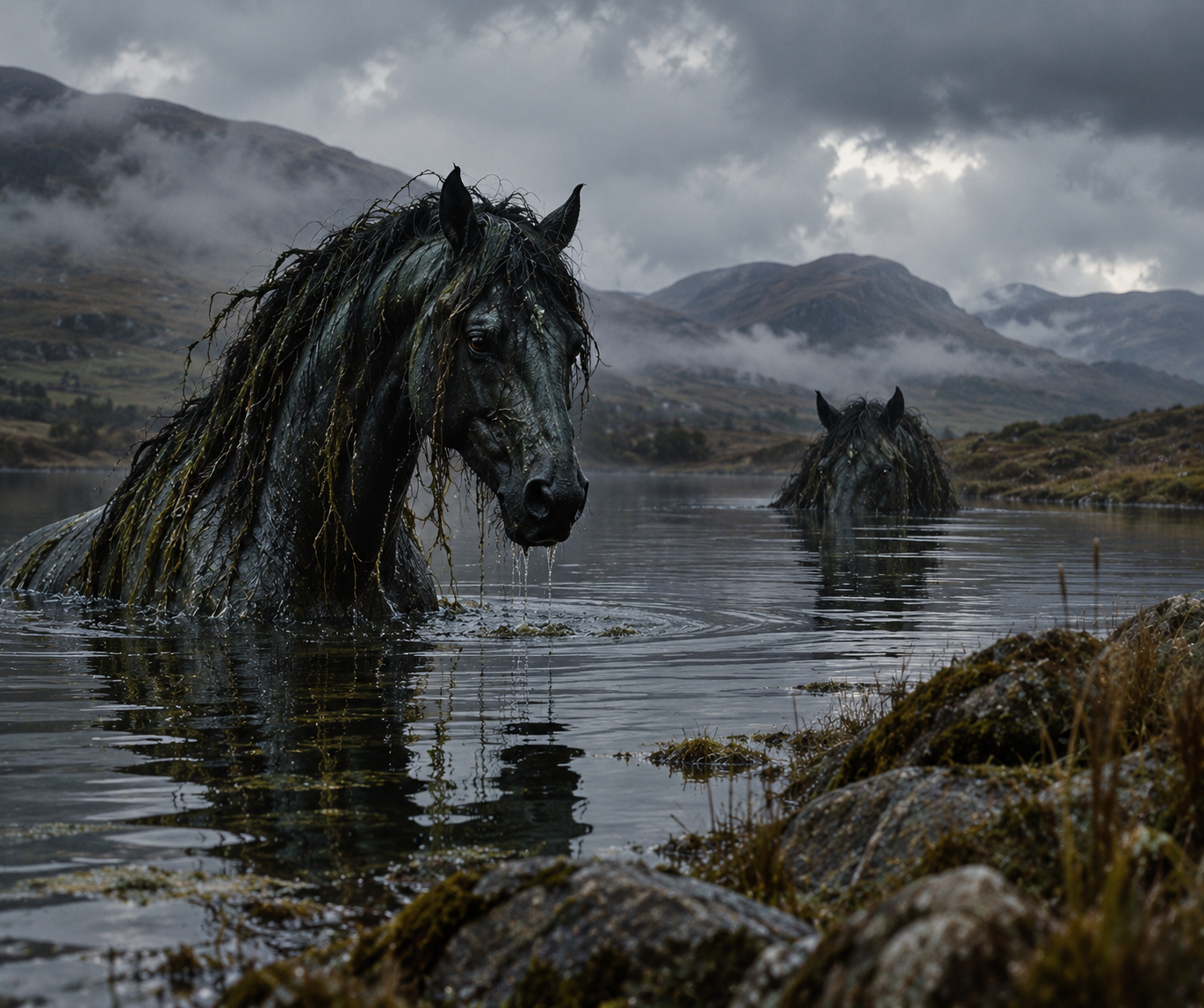
Climbing onto its back, things went badly very quickly. In the old stories, the rider discovered he couldn't get off. Hands stuck fast, the horse bolted toward the water, and horse and rider disappeared beneath the surface. Some versions have the kelpie take an attractive human form as well, making it much harder to recognize.
And then there was the Solway, where no supernatural creature was required to make the water frightening. Its tides could race across the flats and cut people off from shore, while shifting channels made familiar crossings dangerous. It is easy to see how a landscape like this collected stories about things beneath the surface.
Death did not always arrive without warning
Across Scottish folklore, other warnings came before the death itself. A sound heard in an empty room. Footsteps when nobody was there. A knock at the door with no one waiting outside. Dogs behaving strangely. These things could become omens, particularly when death followed soon afterward. Once that happened, the strange little incident that might otherwise have been forgotten became part of the family story.
Second sight was the belief that certain people could glimpse something that had not happened yet. It might be a death, a funeral procession, an approaching visitor, or another event still somewhere in the future. The person experiencing it did not necessarily ask for the ability, and what they saw was not always particularly useful.
Someone might glimpse a familiar figure walking along a road, standing near the house, or passing a window—only to learn later that the person had died somewhere else.
The dead did not always burst dramatically from graves or rattle chains through ruined castles.
Sometimes they simply came home.
For Your Reference;
J. Maxwell Wood, Witchcraft and Superstitious Record in the South-Western District of Scotland (Dumfries, 1911). This is the big one. Wood specifically collected traditions from Galloway and Dumfriesshire, with chapters devoted to fairies and brownies, changelings, wraiths and warnings, death customs, ghosts, and haunted houses. He even records Galloway fairy locations and local brownie traditions.
Read the complete 1911 book free at Project GutenbergThe Folklore Society — “Studies in Fairy Traditions.” Their collection includes Walter Gregor's “Stories of Fairies from Scotland” (1883) as well as scholarship on changelings and older fairy beliefs. It's a good scholarly backup for the wider Scottish traditions behind your Fairy Folk section.
The Folklore Society fairy-tradition collectionProject Gutenberg edition of Wood's 1911 volume. This catalogue page is useful for readers who want the downloadable EPUB/Kindle version; it confirms that the original work is public domain in the U.S. and lists its sections on Fairies and Brownies, Wraiths and Warnings, Death Customs, Ghost Lore and Haunted Houses.
Download the book in EPUB, Kindle or other formats
Note on Historical Images. Some images used in this article are AI-assisted historical reconstructions, created to help visualize people, places, buildings, and events for which no surviving photograph or contemporary image exists. These images should not be considered documentary evidence.