Artist Mary Delany
Women Floral Artists Under the Scope
What larger historical world can we see through this small piece of Mary’s life before she was recognized by the museum?
I want to know who she was before she was Mrs. Delany…
She was born Mary Granville on May 14, 1700, at Coulston in Wiltshire, England. The daughter of Colonel Bernard Granville and Mary Westcombe. She was the second of four children and the elder of two daughters. Her father belonged to a family with a long memory and a strong sense of its own importance. His grandfather, Sir Bevil Granville, had died fighting for Charles I during the Civil War.
Her family seemed tied to the Tory and Stuart political world.
Mary’s own projected future was tied to that network: she was being prepared for the possibility of serving Queen Anne.
She was not raised to become an artist.
She was being prepared for court…
At about six years old, Mary was sent to a small school run by Mademoiselle Puelle, a French refugee, who apparently kept her school deliberately small. Mary later remembered her as a good and kind teacher. French and music were part of her education there.
Then, at about eight, Mary’s life changed again; she went to live with her father’s sister Anne Stanley, usually called Lady Stanley, at Whitehall. It was part of a deliberate plan for her future, not because she had been orphaned or displaced. Lady Stanley was childless and had court experience herself; she had been a maid of honor to Queen Mary.
The plan was that Mary would enter the household of Queen Anne. Mary’s education had a purpose.
She needed the skills expected of a young gentlewoman who might live at court.
There, she learned French, English, history, music, dancing, and needlework.
Her hands were already being trained.
She learned to stitch carefully. She learned to draw and design. Music trained another kind of attention altogether. She was learning color, pattern, proportion and the patience required to make something well.
And it tells me that the seventy-two-year-old woman who eventually picked up her scissors had been making things with her hands since childhood.
Then Queen Anne died in 1714
The court future she had been educated for disappears. Her family’s political influence and prospects deteriorate. Her father’s circumstances become more precarious…
George I and the Hanoverians take over the throne.
Mary’s uncle, George Granville, Lord Lansdowne was a Tory; he was arrested in 1715 on suspicion over the Jacobite rising and imprisoned in the Tower.
Mary is fourteen years old.
Her family leaves London.
Yet, Uncle George was never brought to trial for treason.
He remained imprisoned for roughly a year and a half, and was released in February 1717. Afterward, his political position under the Hanoverians was essentially finished. He eventually spent several years abroad, including in France, before returning to Britain. He lived until 1735.
Mary’s uncle Lansdowne wasn't some distant uncle whose arrest merely makes the family tree colorful. He had been one of the important people directing her future—including, shortly after his release, becoming involved in arranging her marriage to Alexander Pendarves.
This made me very interested in investigating the Granville family's financial and political condition between 1714 and 1718. The family's loss of political influence may have materially contributed to their eagerness for her wealthy Pendarves match.
Because I discovered there was someone else.
At Buckland, Mary became attached to a young man remembered as Mr. Twyford, and she later believed that he loved her too. How far that relationship went is harder to know. A young gentlewoman like Mary did not have the privacy we associate with courtship today. Visits happened within households, letters could be discovered, and a friendship that began under the eyes of family could become serious without the couple ever being alone together.
What matters is that Mary remembered the attachment many years later and wrote about it. Her family did not permit the match. Soon another man was being chosen for her.
Mary was seventeen, already attached to someone else, and Alexander Pendarves was approaching sixty.
She married him on February 17th in 1718.
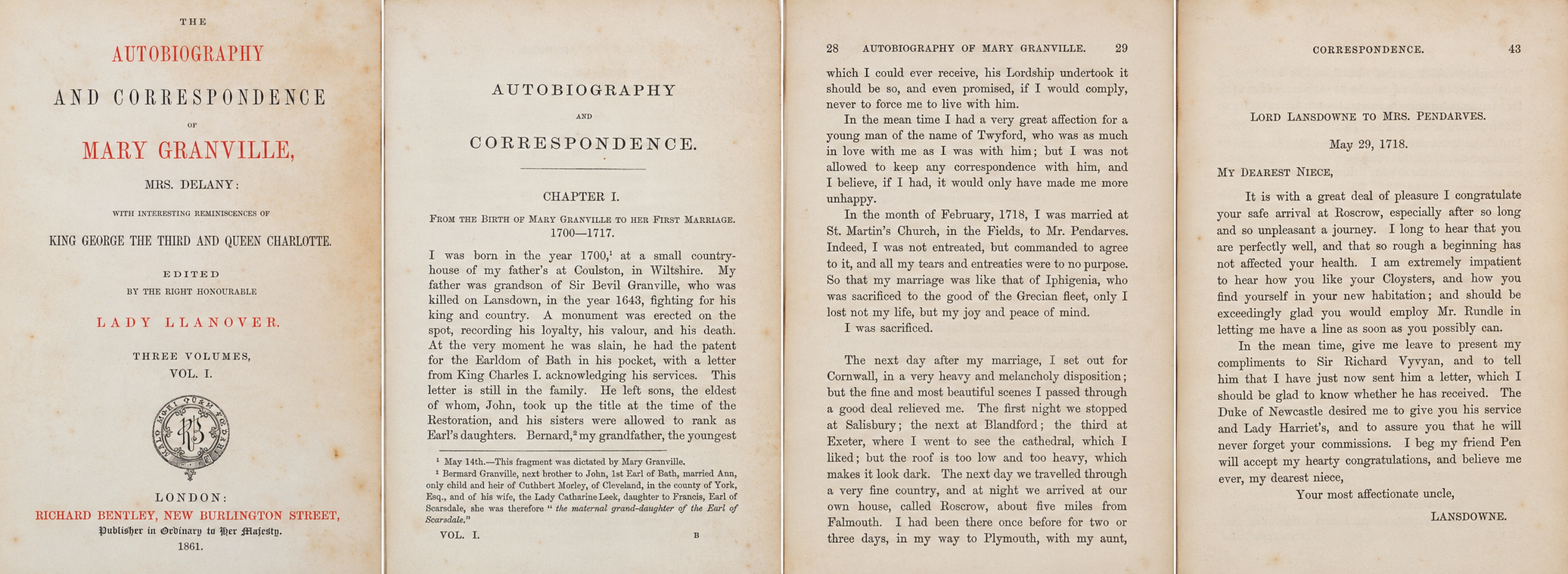
Mary wrote autobiographical recollections later in life.
Her descendant, Lady Llanover, later incorporated those manuscripts into —
The Autobiography and Correspondence of Mary Granville and
Mrs Delany (1861–62), together with Mary's extensive surviving letters.
Mary's father, Bernard Granville, was the less wealthy younger brother.
The Dictionary of Irish Biography says directly that Bernard depended upon his brother Lord Lansdowne for income. Bernard had also lost the political position he had held under the Tory regime.
A scholarly study of Mary's letters goes further: it describes Bernard as being in serious financial difficulty after losing his Hull post and having problems receiving money due through his wife's family.
Then comes the really valuable evidence: Mary herself tells us why Lansdowne wanted Pendarves.
In her autobiographical account, she says Lansdowne saw the marriage as a chance to secure the political support of an influential Cornish man whose services he wanted. Her devastating distinction was that her uncle had committed her to the match before obtaining her agreement: she said she was not really entreated, but “commanded.”
And Pendarves wasn't merely some rich old country gentleman. He was politically active in Cornwall.
Cornwall was part of Lansdowne's own political sphere.
Another piece I love because it's documented —a letter from Lansdowne to Mary after her marriage, congratulating her while discussing parliamentary business concerning Pendarves. It shows that political/property concerns remained very much present around this marriage.
And then Mary gives us something much more intimate. Looking back on the wedding, she compared herself to Iphigenia being led to sacrifice and wrote simply:
“I was sacrificed.”
She said she had lost not her life, but her “joy and peace of mind.”
That gives an impression of her state. How heartbreaking.
This isn't merely “rich family forces seventeen-year-old girl to marry rich old man.” It's much more historically revealing.
Mary had been raised for one purpose within her family's political world: court service. That opportunity disappeared when the political regime changed. Only a few years later, the same young woman could serve her family's interests another way: marriage.
So the larger historical world we're seeing through Mary is becoming very clear…
What happened to Mary after the family politics were settled and everyone went home?
She had to live with it.
Mary married Alexander Pendarves on February 17, 1718, at St. Martin-in-the-Fields in London.
She was seventeen. He was fifty-nine.
Soon afterward she traveled with him to Roscrow, his estate near Falmouth in Cornwall.
This was now her home, far from the people and places that had shaped her childhood.
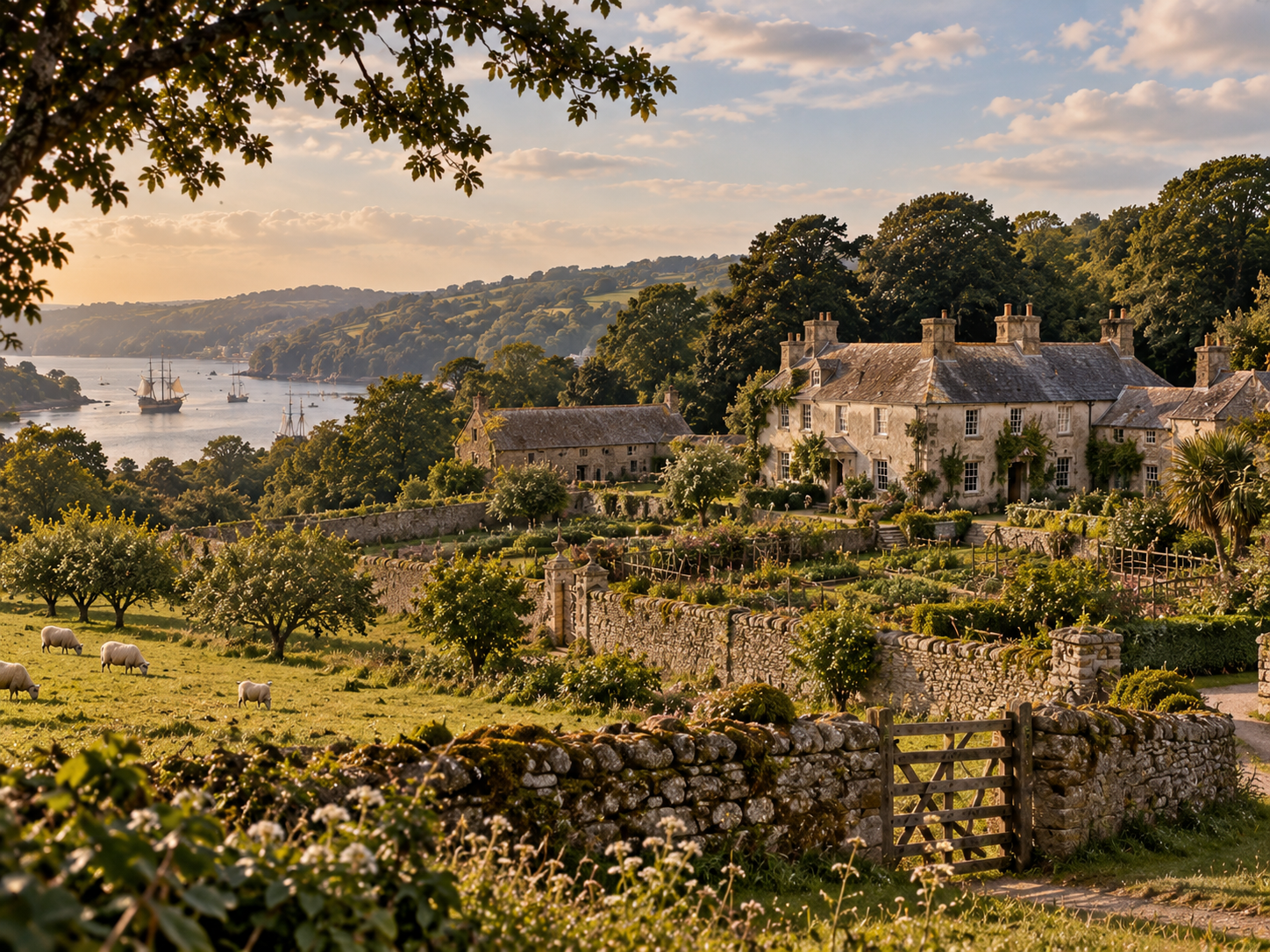
Roscrow — mansion and early gardens. Modern Coordinates: 50.119° N, 5.178° W.
What did it actually mean to become a wife at seventeen in the year 1718?
Marriage changed Mary's legal position as well as her address. Under the English common-law principle we now call coverture, a married woman's independent legal identity was heavily restricted. Property, money and contractual rights could pass under her husband's control, although marriage settlements and separate arrangements could protect some assets. The details mattered enormously.
They mattered to Mary.
Her husband controlled the household she had entered, but Mary still had her letters, her friendships and the accomplishments she had carried with her from childhood. Those matter because they give us glimpses of how she filled her days inside a marriage she had never wanted.
Pendarves himself was not an easy companion. Mary's later account describes a husband whose health and habits made domestic life difficult. He suffered badly from gout, an illness that could leave a person in considerable pain and unable to move easily.
Mary also remembered his heavy drinking.
That put the seventeen-year-old in the unprepared role of an elderly caretaker.
What an absolute drag for a teenager… along with everything else we can imagine happening.
She became a young wife living with an aging and frequently ill husband.
Her life in Cornwall was not lived entirely behind a closed door. The Pendarveses belonged to a network of Cornish families, and visiting was part of that world. Dinners, calls, letters and journeys connected one country house to another.
Mary was learning another kind of social geography. And embroidery. The time passed.
Who visited whom mattered. Which families were connected mattered. Even an apparently ordinary visit between neighboring houses might carry family, property or political meaning underneath it.
And Mary watched all of this.
She also wrote.
That may be one of the most useful things about following her closely. Letters gave an eighteenth-century woman something we easily overlook now: a place where a life could continue beyond the room she happened to be sitting in. A letter carried gossip, affection, frustration and news across miles. It maintained friendships. It allowed Mary to remain part of a world outside Roscrow.
Her marriage lasted seven years.
Then, in 1725, Alexander Pendarves died. Finally.
Alexander Pendarves (1659-1725)
Mary was only twenty-four years old. She was still young.
She had entered his house as a seventeen-year-old girl, her family having helped choose her future.
She left it a widow.
And widowhood could give an eighteenth-century woman something marriage often could not:
a legal identity of her own again. For Mary, that changed everything. And for the better…
Mary Granville and Alexander Pendarves had no children. Their marriage lasted from 1718 until his death in 1725, and the standard biographical record shows no known pregnancies or children.
Because no child bound Mary to the Pendarves line, her widowhood at only twenty-four gave her considerably more freedom to build a life of her own!
And no surviving record of children does not automatically mean we know anything about her fertility, contraception, miscarriage, or the couple's sexual relationship.
A Widow at Twenty-Four
For seven years she had been Mrs. Pendarves, living inside a marriage she later described as a sacrifice. Now the man her family had chosen for her was gone. But widowhood did not automatically mean freedom. First there was money. Pendarves had been wealthy, but Mary did not simply inherit his estate. His property was actually passed elsewhere in the Pendarves family.
What Mary had was the financial provision made for her as his widow.
Before we put a figure on that income, I want to trace the marriage settlement and the accounts carefully, because later writers give slightly different impressions of how comfortable she actually was.
What matters immediately is that she had something she had not possessed at seventeen:
a degree of control over her own life.
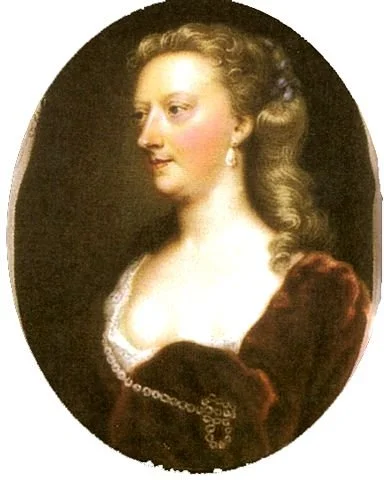
Mary Delany, age 40. artist unknown, c. 18th century
She could decide where to live. She could visit friends and relatives. She could maintain her own correspondence. She could decide how to spend at least some of her money and, perhaps most importantly, no husband stood between Mary and the choices she made about what happened next.
She did not remarry quickly. And that interests me.
For a young widow of good family, another marriage would hardly have been surprising. Instead, Mary spent nearly eighteen years as a widow before marrying again.
She moved among family households and spent considerable time in London, where the world that had disappeared from her childhood opened to her again in another form. She visited, read, listened to music, made things, observed people and wrote an extraordinary number of letters.
An independent woman in the 1720s
It did not necessarily look like our version of independence.
Mary still lived within family networks. Reputation mattered. Money imposed limits. A respectable woman of her position did not simply rent an apartment, announce that she belonged to nobody, and disappear into London.
But within those boundaries, Mary began making choices.
And she had nearly eighteen years to find out what she wanted to do with that freedom.
She returned to London's social world and became part of a remarkable network of friends, relatives, writers, musicians, and women with interests much like her own. Her surviving correspondence becomes richer during these years, and suddenly we can see much more than the outline of her life.
We can see what occupied her days.
Mary read. She drew. She embroidered. She worked with shells and other decorative materials. She played music and went to hear it performed. She visited gardens and country houses. She noticed clothes, rooms, furniture and flowers. She went to dinners, stayed with friends and wrote letters about what she had seen.
These things can look small beside wars, kings and political crises.
For a microhistorian, they are anything but small.
A woman's needlework tells us something about education and labor. A visit to a garden can lead us into the eighteenth-century fascination with botany and the movement of unfamiliar plants into Britain. A letter between two women can expose a private network of information and friendship that never appears in parliamentary records.
Mary was living inside all of it.
One friendship became especially important. Mary Hamilton, later Mrs. Hamilton, became one of Mary's closest companions and correspondents. Through friendships such as this one, we begin to see that Mary's independence wasn't solitary. It depended upon a web of women who wrote to one another, stayed in one another's houses, exchanged news and objects, and offered the companionship that marriage had certainly not given Mary.
And then there were the men who entered this world.
One of them was a friend, Jonathan Swift.
Mary met Swift during her 1731–33 stay in Ireland. Through that circle, she also knew Patrick Delany, whom she would later marry.
That sounds impressive now because Gulliver's Travels has made Swift the famous person in the room.
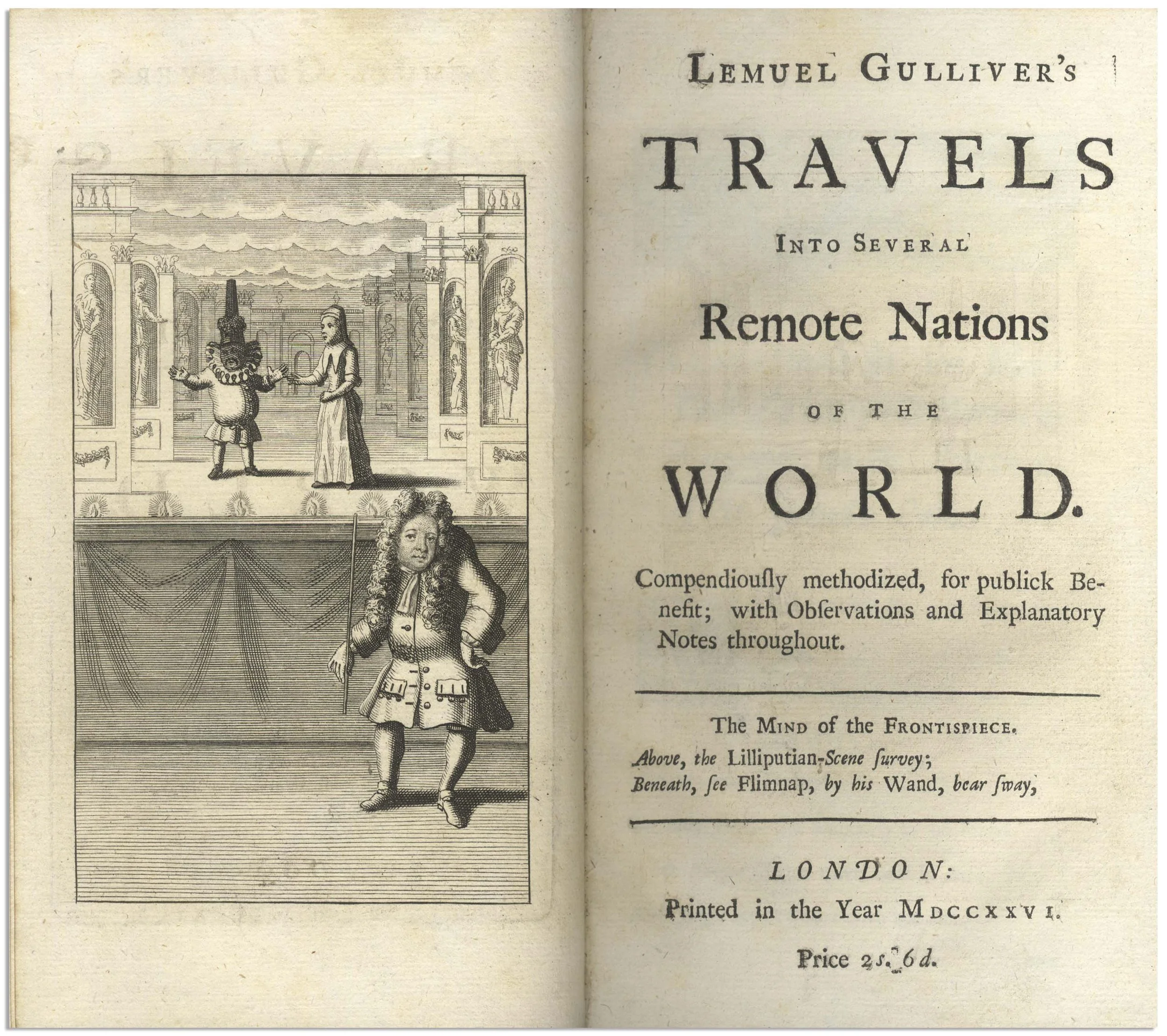
Gulliver’s Travels written by her friend Jonathan Swift
What sort of woman could move comfortably enough through this intellectual and social world to become Swift's friend? What were they talking about? They were ‘creatives’.
Mary kept making things.
Not professionally. Not for exhibition. Not because anyone had decided to call her an artist yet.
She made things because accomplished women made things, because friends exchanged handmade objects, because decorating a room or designing embroidery had social value, and perhaps simply because Mary enjoyed it.
That distinction between an “accomplished woman” and an “artist” will become important.
Who decided where one ended and the other began?
Mary wasn't waiting to become talented.
She already was.
Yet, the world simply had another name for what women like Mary were doing.
For a genteel eighteenth-century woman, activities such as drawing, painting, embroidery, music, decorative needlework, botanical study and other forms of skilled making were commonly understood as feminine accomplishments rather than as the basis of a professional artistic identity.
humph!
After eighteen years of independence and one disastrous marriage, she chose marriage again.
Mary Meets Dr. Delany
Among the people Mary came to know during these years was Dr. Patrick Delany, an Irish clergyman, scholar and writer.
This time, Mary was not seventeen.
She was a woman in her thirties who had already experienced what could happen when somebody else chose a husband for her.
Patrick belonged to the intellectual world surrounding Jonathan Swift in Dublin. He was a fellow of Trinity College and moved among writers, clergy and educated society. Mary encountered him through the friendships that increasingly connected her life in England with Ireland.
There was one rather large complication.
Patrick Delany was married. doh.
His first wife was Margaret Tenison, whom he had married in 1731. Mary and Patrick therefore did not begin as two unattached people moving neatly toward marriage. They knew one another socially while Margaret was alive.
Their familiarity developed over time. Then his wife, Margaret, died in 1741.
Patrick was now a widower.
Mary had been one for sixteen years. But that did not mean she immediately wanted to become Mrs. Delany. Why would she? Mary had spent most of her adult life answering to herself. Marriage meant giving up some of that independence. The law of coverture that had governed her first marriage had not disappeared simply because this time she cared for the man. And there was another problem.
Patrick lived in Ireland.
Choosing him meant choosing Ireland too.
Mary hesitated. She had family in England, friendships built over years and a life she had made for herself after Pendarves. Patrick was not simply asking her to marry him. He was asking her to alter the geography of her life. Eventually, she decided he was worth it.
In 1743, ‘Mary Pendarves’ married Patrick Delany. She was forty-three years old.
I keep coming back to the difference between her two marriages.
At seventeen, Mary said she had been “commanded.” At forty-three, Mary chose.
The institution of marriage had not suddenly become more generous to women between 1718 and 1743. Mary had changed. Her circumstances had changed. She had money of her own, experience, friendships and nearly two decades of adult life behind her.
And this husband appears to have brought something very different into her life.
Patrick respected her mind.
Their household became a place of books, conversation, visitors and making things. Mary did not have to abandon the interests she had developed during her long widowhood. If anything, they seemed to have had more room to grow.
Then there was Delville, their home near Dublin. And the garden.
Mary's 1745 drawings are the gold for us. The National Gallery of Ireland holds A View of ye Beggars Hut in Delville Garden—pen, gray ink and wash over graphite—and Swift and Swans Island in the Garden of Delville, dated 30 December 1745.
These aren't somebody imagining Mary's garden later. Mary stood there and drew it.
She's 45 years old, standing in the landscape she shares with Patrick, looking carefully enough at her surroundings to draw them. These survive in a national art collection today…
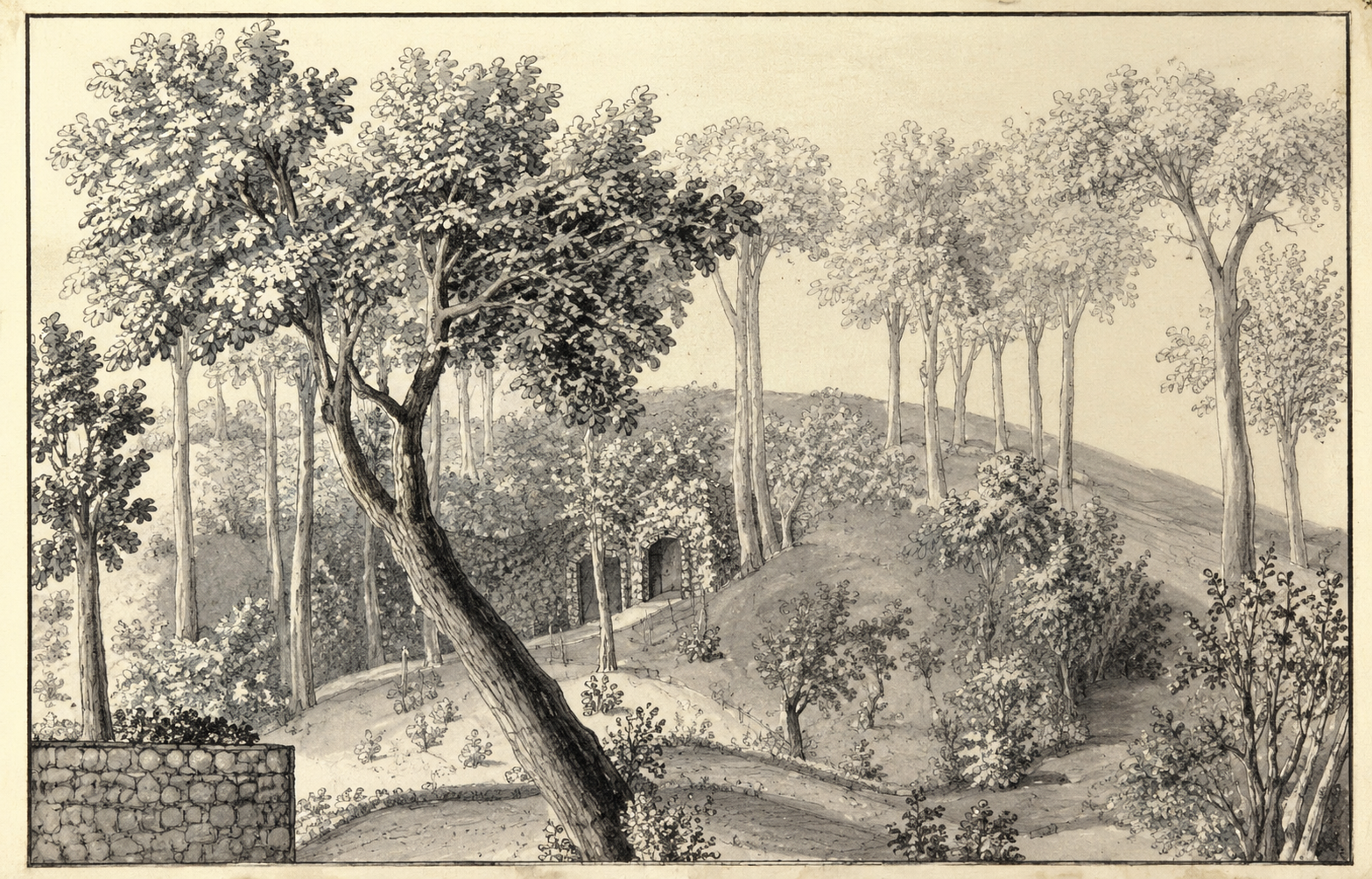
A View of ye Beggars Hut in Delville Garden 1745 · by Mary Delany
For someone trying to understand how Mary eventually came to make those extraordinary flowers, look very closely. Mary herself was already looking closely.
At plants. At shape. At color. At how things grew.
Long before she ever cut a flower from paper, Mary Delany was learning to see one.
An Artist’s Married Life
Mary and Patrick spent years developing the house and its gardens, where plants were grown, acquired, exchanged and discussed. Mary continued drawing and designing, along with embroidery, shellwork and other decorative work. Her education had never really stopped; it had simply moved outside the classroom.
By now she was learning through books, gardens, objects, conversations and observation. She was also living during an extraordinary period of botanical interest, when plants and seeds from increasingly distant parts of the world were finding their way into British and Irish gardens.
The natural world was being collected, classified, drawn and argued over.
Mary was learning through her hands too. Decades of stitching, drawing, cutting, arranging colors and handling delicate materials had given her a considerable store of practical knowledge. Nobody had designed any of this as training for Flora Delanica. It was simply the accumulation of a lifetime.
Mary and Patrick had been together for about twenty-five years before Patrick Delany died in May 1768. Mary was sixty-eight and once again a widow, although this widowhood was very different from the first. At twenty-four she had been released from a marriage she never wanted.
At sixty-eight she had lost a man she had chosen and the life they had made together.
Patrick Delany had no known children, either with Mary or with his first wife, Margaret Tenison.
So when Mary married Patrick in 1743, she wasn't entering a household with children from his first marriage, and Mary herself never became a mother or stepmother. Both of her marriages were childless.
After Patrick's death, another friendship became particularly important. Margaret Bentinck, Duchess of Portland, was one of the great collectors of natural history in eighteenth-century Britain. At the Duchess's estate at Bulstrode, Mary found herself among gardens, botanical specimens, shells, insects, birds and other objects from the natural world.
Naturalists, botanists, collectors and other knowledgeable visitors moved through the Duchess's circle.
Mary was not studying botany at a university or training formally as a botanical artist. She learned the way she had learned so much else: by looking, talking, reading, and doing.
Then, in 1772, at seventy-two, Mary found the material that would make her famous.
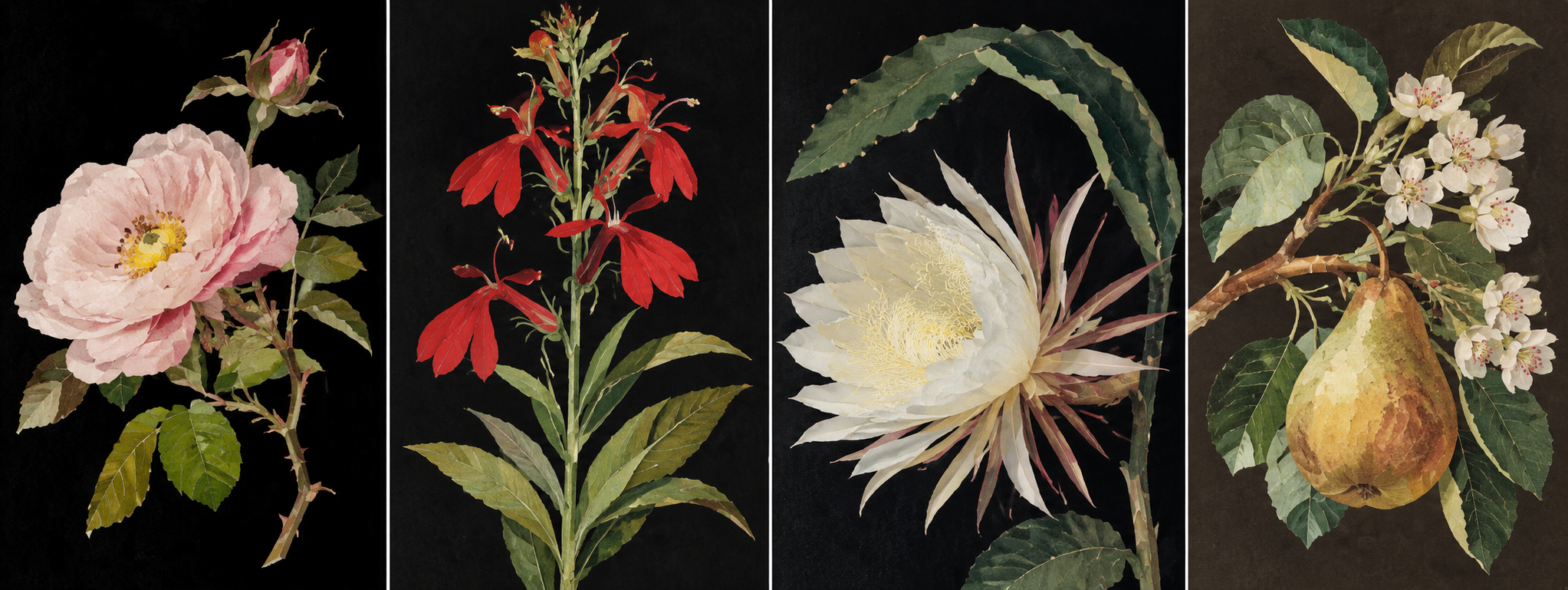
According to the story Mary later told, she noticed a piece of colored paper that closely matched a geranium petal. She cut the paper and began assembling the flower against a black background. One piece became a petal, another a leaf, another part of the stem. She eventually called these works her “paper mosaicks.” We know the collection as Flora Delanica.
Over roughly the next decade, she made nearly one thousand botanical compositions, generally working from actual plant specimens. She cut hundreds of tiny pieces of colored paper and sometimes added watercolor and other details. Look closely, and the flowers are not simply decorative. Leaves show different shades of green, petals curl and overlap, veins run through the foliage, and the plant's reproductive structures are carefully placed.
The woman who made them had spent a long time learning to look.
Her mosaics attracted considerable attention during her own lifetime. King George III and Queen Charlotte knew Mary and admired her work. After the Duchess of Portland died in 1785, the king and queen provided Mary with a house at Windsor and an annual pension!
By then, she was certainly no longer an anonymous elderly woman quietly cutting flowers at a table; her work was being seen and admired in some of Britain’s most influential circles.
Mary’s failing eyesight eventually brought the project to an end.
She stopped making the flower mosaics in 1783, when she was about eighty-three. She died five years later, on 15 April 1788, aged eighty-seven. The surviving Flora Delanica volumes eventually entered the British Museum, where her remarkable paper flowers remain together today.
Perhaps 1772 wasn't really the year Mary Delany became an artist.
It was the year she found the medium history would ultimately remember her for.
What a life! And today, collage is king.
Thank You Mary.
For Your Reference;
Mary Delany, The Autobiography and Correspondence of Mary Granville, Mrs. Delany, edited by Lady Llanover, 6 vols. (1861–1862). This is especially important for us because it preserves Delany’s own letters and recollections. Cambridge University Press
British Museum — Mary Delany — biography, Flora Delanica, her artistic practice, and the museum's collection of her surviving paper mosaics.
Dictionary of Irish Biography — Mary Delany — particularly useful for Mary and Patrick Delany's Irish years and her later relationship with George III and Queen Charlotte.
Barbara Brandon Schnorrenberg, “Delany [née Granville; other married name Pendarves], Mary (1700–1788),” Oxford Dictionary of National Biography. DOI
Clarissa Campbell Orr, Mrs Delany: A Life (Yale University Press, 2019) — a major modern biography of Delany; it is also recommended by the British Museum. British Museum
Molly Peacock, The Paper Garden: Mrs Delany Begins Her Life’s Work at 72 (2011) — particularly useful for understanding the development of the flower mosaics and Delany's later creative life. British Museum
Later Bloomer — “Mary Granville Delany: She Invented the Art of Mixed Media Collage at Age 71” — used as an additional biographical and research reference.
“She Has an Activity of Mind that Never Lets Her be Idle”: Mary Delany, the Enlightenment, and the Creative Arts. It specifically studies Mary's creative development during her 1744–1767 Irish/Delville years, which is unusually relevant to the angle we took—Mary the artist before the famous paper flowers.
Researched & Written by author Krysta Abesamis