Gideon Shaw · Edinburgh Bookseller
Gideon Schaw and the Blue Bible Bookshop 1670-1687
An Edinburgh Bookseller at the Heart of the Seventeenth-Century Book Trade.
Long before my uncle Andrew Chalmers established himself among Edinburgh's stationers and booksellers, another man was already doing business in the crowded commercial heart of the Scottish capital. His name was Gideon Schaw/ Shaw, sometimes recorded as Gideon Shaw, and his shop stood in one of the most important locations in seventeenth-century Edinburgh: Parliament Close, at the sign of the Blue Bible.
Gideon has particular importance to the Chalmers story because in 1683 a young Andrew Chalmers entered his shop as an apprentice. Yet Gideon's own career had begun more than twenty years earlier, and the surviving records reveal a surprisingly substantial bookseller whose commercial relationships stretched beyond Edinburgh and whose family and business connections would continue to matter after his death.
From Selkirk Minister's Son to Edinburgh Bookseller
Gideon was a son of Rev. John Schaw, minister of Selkirk. Rather than following his father into the ministry, Gideon entered Edinburgh's expanding book trade.
On 5 September 1660, he was apprenticed to David Trinsh, bookseller in Edinburgh. Apprenticeship was the normal route into the tightly regulated urban trades of seventeenth-century Scotland. Gideon would have learned not simply how to sell books, but how the entire business operated—stock, accounts, paper, binding, customers, suppliers and the network of printers and booksellers upon whom an Edinburgh stationer depended.
By 20 November 1667, Gideon had become a burgess of Edinburgh on the strength of his apprenticeship to Trinsh.
More revealing still, Gideon was already taking apprentices of his own. On 27 November 1667, Walter Cunningham, son of Alexander Cunningham, minister at Ettrick, was apprenticed to Gideon, who was described as a stationer.
That date matters.
Gideon's association with the Cunningham name began years before his marriage into the Cunningham family.
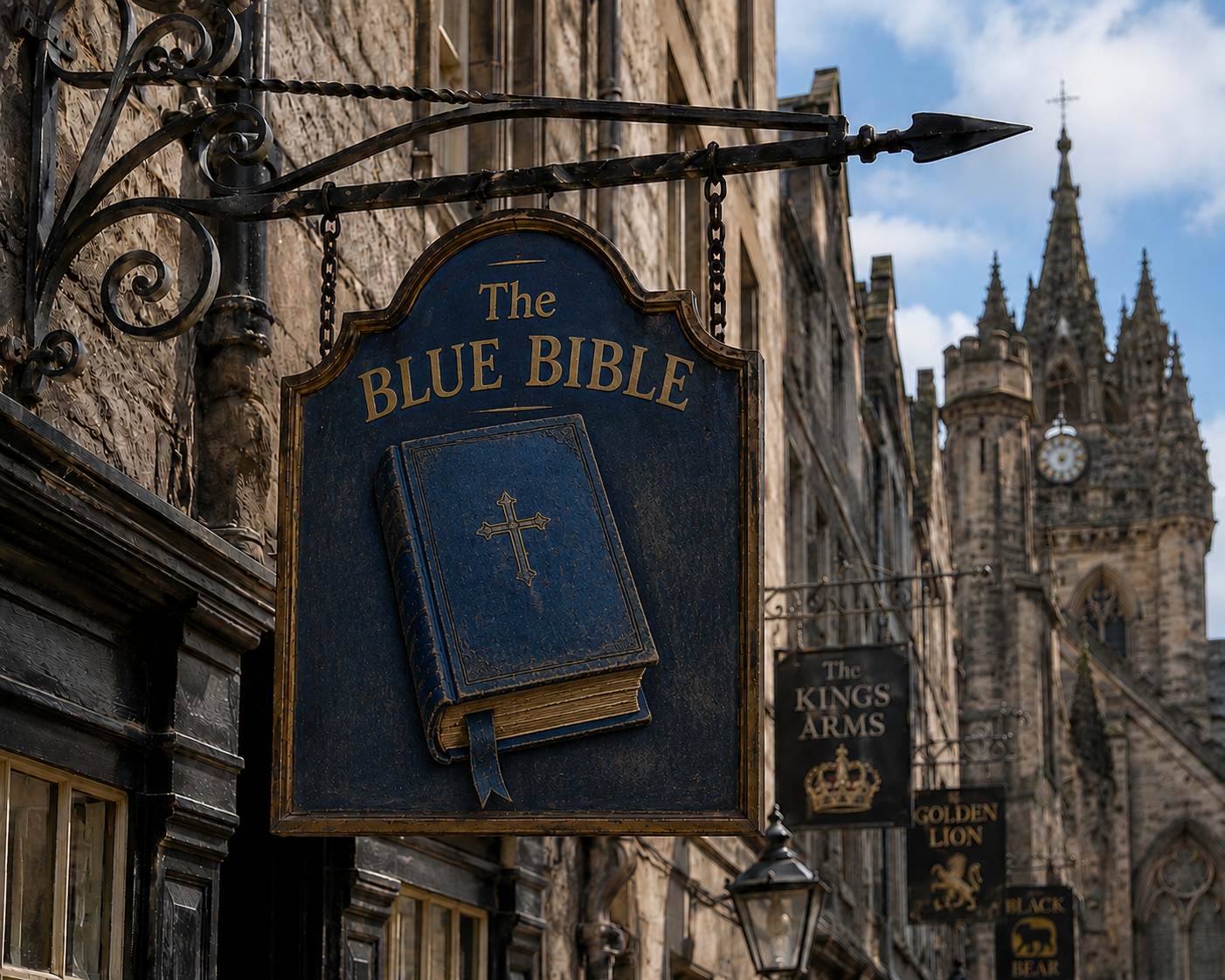
Gideon Shaw was the owner of a bookshop on Parliament Close called ‘The Blue Bible’ 1670-1687
The Blue Bible in Parliament Close
By about 1670, Gideon was conducting business in Parliament Close at the sign of the Blue Bible.
There was no modern numbered street address. Edinburgh businesses were commonly identified by signs, landmarks and closes, and Gideon's surviving book imprints locate him at the Bible—or Blue Bible—in Parliament Close.
This placed his shop in an extraordinary position.
Parliament Close lay immediately beside St Giles' Cathedral and Parliament House, in the dense political, legal, religious and commercial center of Edinburgh. Clergymen, lawyers, merchants, government officials, university men and members of Scotland's political establishment moved through the surrounding streets and closes.
Gideon was therefore not operating an obscure neighborhood shop. The Blue Bible stood within one of the most intellectually and commercially active parts of the city.
The exact shopfront has not yet been identified, and there is no responsible way to assign Gideon's business a modern street number. The old Parliament Close subsequently suffered destructive fires and extensive rebuilding, including a serious fire in 1700, followed by further transformation of the area. The seventeenth-century building containing Gideon's Blue Bible cannot presently be identified with confidence among the surviving structures around modern Parliament Square.
What can be established is the location that mattered to Gideon's contemporaries:
Parliament Close, Edinburgh — at the sign of the Blue Bible.
The Fight Against the Printing Monopoly
In 1671, Gideon Schaw stepped beyond the daily business of selling books and joined other Edinburgh booksellers in a dispute that struck at the future of their trade. Printer Andrew Anderson had secured an extensive royal privilege that gave him extraordinary control over printing in Scotland, alarming booksellers whose livelihoods depended upon access to books and a competitive printing market. Gideon was among six Edinburgh booksellers who formally challenged Anderson's monopoly, placing his name alongside fellow members of the trade willing to oppose a powerful royal patent when it threatened their commercial interests. The protest shows that by 1671—before his marriage to Elizabeth Cunningham—Gideon was already sufficiently established to participate in the larger professional battles of Edinburgh's book trade. The man behind the Blue Bible was not simply tending a shop in Parliament Close; he was taking part in the struggle over who could print, supply, and ultimately control the circulation of books in seventeenth-century Scotland.
Already Established Before Elizabeth Cunningham
Gideon's career chronology corrects an easy misconception about his marriage.
He did not become a bookseller because he married into the Cunningham family.
By the time Gideon married Elizabeth Cunningham on 15 November 1672, he had already spent twelve years in the Edinburgh book trade. He had completed his own apprenticeship, become a burgess, taken an apprentice himself and established his business at the Blue Bible.
In 1671, Gideon was also among a group of Edinburgh booksellers involved in opposition to printer Andrew Anderson's controversial monopoly. This places him squarely within the professional affairs of the Scottish book trade before his marriage.
Elizabeth nevertheless brought an important connection of her own. She was a daughter of William Cunningham, merchant, and on 11 February 1674, Gideon became an Edinburgh Guild Brother through his wife.
The distinction is important.
Elizabeth did not create Gideon's career. Gideon was already a working Edinburgh stationer. His marriage connected that established business to an influential merchant family and strengthened his position within Edinburgh's civic and commercial community.
Gideon and Elizabeth's Son
The surviving Edinburgh parish record provides an especially useful correction to some later secondary accounts of Gideon's family.
On 24 August 1675, William Shaw was baptized in Edinburgh. The ScotlandsPeople Old Parish Register index identifies his parents explicitly: Gideon Shaw and Elizabeth Cuninghame.
This is important because some later material has associated William with Gideon's second wife. The original parish index establishes otherwise: William was the son of Gideon and Elizabeth Cunningham.
William would eventually become extremely important in the settlement of his father's estate.
Another child belonging to Gideon's household was buried at Greyfriars on 1 March 1676. The burial therefore indicates that Gideon and Elizabeth had at least one other child, although that child's identity has not yet been established.
At some point before February 1683, Elizabeth Cunningham died. Her precise death date remains uncertain.
A Second Marriage—and a New Apprentice
On 1 February 1683, Gideon married Marion Marshell.
Only a few months later, another young man entered the Blue Bible.
On 20 June 1683, Andrew Chalmers was apprenticed to Gideon Schaw.
Andrew was approximately fifteen years old.
He therefore entered an established business with more than a decade of history behind it. Gideon had been trading at the Blue Bible since around 1670 and had already spent more than twenty years learning and practicing the Edinburgh book trade.
For Andrew, this was his professional education.
He would have encountered books arriving from printers and suppliers, paper and binding materials, customer accounts, debts and credit, correspondence, and the daily commercial life of Parliament Close. He was learning from a bookseller whose professional connections extended considerably farther than Edinburgh itself.
Inside the Blue Bible
Gideon's surviving testament provides an extraordinary glimpse into the shop.
His Testament Dative and Inventory, dated 27 March 1688, describes what remained in the business following his death.
Among Gideon's possessions were: “the heall books, paper, and uther materiellis in his choap”
In modern language: all the books, paper and other materials in his shop.
Rather than itemizing every volume, the inventory valued the shop contents collectively. This small phrase is important. It establishes directly that when Gideon died, his shop still contained the stock and materials of an operating stationer's business. The Blue Bible had not quietly disappeared before his death.
Andrew Chalmers had been apprenticed within precisely this working environment.
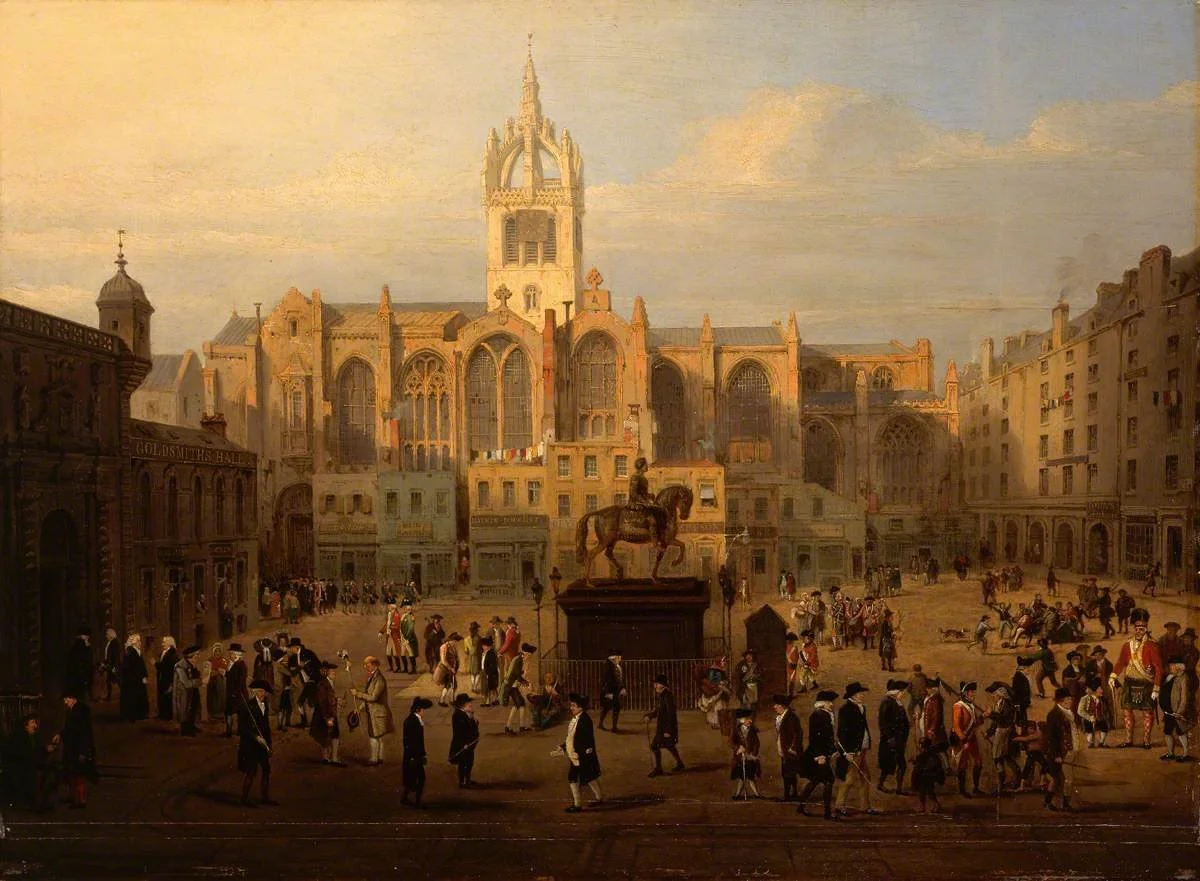
Parliament Square 1685 (*credit: Museums & Galleries Edinburgh – City of Edinburgh Council)
Lawyers hurried to court carrying bundles of legal papers. Messengers crossed the Close delivering documents. Ministers debated theology. Merchants negotiated business. Printers delivered freshly bound books to waiting customers. Every day, Parliament Close buzzed with conversation.
The equestrian statue of King Charles II in Parliament Square, Edinburgh was erected in 1685.
Both Gideon Shaw & Andrew Chalmers would have known the statue in their time.
A Business Connected Beyond Edinburgh
Gideon's testament also reveals the financial network surrounding the Blue Bible.
Money was owed to Gideon by men including James Brand of Baberton, Alexander Sympson, minister at Navar, John Somerville, minister at Cramond, and William Annand, Dean of Edinburgh.
These were not simply anonymous retail customers. Gideon's financial relationships reached into Scotland's clerical, professional and educated communities.
His debts reveal an even wider network.
Among the men to whom Gideon owed money were the London booksellers Richard Royston and Richard Chiswell.
The debt to Chiswell was particularly substantial: £40 sterling.
Chiswell was an important London bookseller and publisher, and his appearance in Gideon's estate demonstrates that the Blue Bible participated in a book market extending well beyond Edinburgh.
The young Andrew Chalmers was therefore learning his profession in a shop connected not merely with local Edinburgh customers but with the wider British book trade.
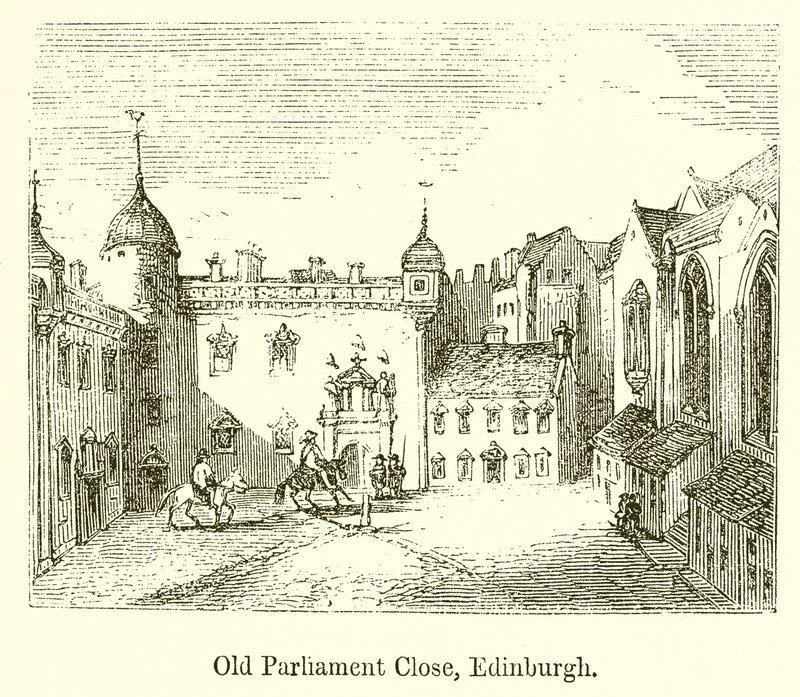
Parliament Close circa 1600s
Gideon's Death
Gideon died in early 1687 and was buried at Greyfriars on 9 March 1687.
A curious event preceded his burial. On 10 February 1687, only twenty-seven days earlier, someone described in the Greyfriars burial record as Gideon's “halflin” was buried. The precise identity of this person remains uncertain, and the surviving record does not establish a cause of death. The proximity of the two burials raises the possibility of illness within the household, but without additional evidence that must remain only a possibility.
Gideon's death left a complicated estate.
His surviving son William (from his first wife Elizabeth) was only about eleven years old.
The testament identifies him as Gideon's: “son lawfull, and only executore dative”
Because William was still a minor, adults had to act on his behalf.
And this is where the Cunningham family reappears.
The Cunningham Return
Gideon had appointed several people as testamentary tutors to act for William.
They included:
James Cunyngham, merchant in Edinburgh
Alexander Cunyngham, Professor of Humanity at the College of Edinburgh
James Muirhead, apothecary in Edinburgh
John Rutherford of Ridhugh
John Rutherford, schoolmaster at Selkirk
and Gideon's widow, William’s step mother - Marion Marshell.
The Cunningham presence is particularly striking now that William's mother has been positively identified as Elizabeth Cunningham.
James and Alexander Cunningham were therefore helping administer the affairs of a boy whose mother belonged to the Cunningham family.
Their exact relationship to Elizabeth has not yet been proven, so it would be premature to call either man William's uncle. Nevertheless, their involvement was not incidental: Gideon himself had selected them as testamentary tutors.
Alexander Cunningham also appears among Gideon's creditors. Gideon owed him £6.
The relationship was therefore simultaneously personal, fiduciary and financial.
Even more intriguing is the fact that Gideon's association with the Cunningham name preceded his marriage to Elizabeth. Walter Cunningham had entered Gideon's service as an apprentice in 1667, five years before Gideon married Elizabeth.
The surviving evidence therefore suggests a Cunningham–Schaw connection extending across decades rather than a relationship created solely by one marriage.
An Estate in Trouble
Gideon's inventory contains another important revelation.
After the goods, money owed to him, and debts owed by him were calculated, the estate record concluded:
“Swa the debtis exceidis the goods”
The debts exceeded the goods.
Gideon's estate was therefore insolvent on paper.
Among the obligations were money owed to Edinburgh authorities, the London booksellers, Alexander Cunningham, and Gideon's widow Marion Marshell, who was entitled to five years of annual rent arising from the 1,000-merks provision made to her under their marriage contract.
When the estate was confirmed, William Aitkin, bookbinder in Edinburgh, became cautioner, providing the required legal security.
Again, the book trade appears at the center of Gideon's affairs even after his death.
What happened physically to the Blue Bible's books, paper and other shop materials remains uncertain. They may have been sold to satisfy creditors, transferred through the trade, or disposed of through some arrangement not recorded in the surviving testament.
For Your Reference;
The Bannatyne Miscellany, Vol. II (Bannatyne Club, Edinburgh, 1836), “Testament Dative and Inventar of Gideon Shaw,” pp. 292–294.
National Records of Scotland / ScotlandsPeople, Old Parish Registers, Edinburgh, William Shaw, 24 August 1675, son of Gideon Shaw and Elizabeth Cuninghame, parish 685/1, ref. 80/13.
Scottish Book Trade Index and the published Edinburgh apprentice/burgess registers, entries for Gideon Schaw/Shaw and Andrew Chalmers.