Lairds of Drumlanrig
James Douglas was born around 1498, the eldest surviving son of Sir William Douglas, 6th of Drumlanrig, and Lady Elizabeth Gordon of Lochinvar. His mother's family came from the Gordons of Lochinvar, another important family in southwest Scotland. On his father's side, James belonged to a Douglas line that had already held Drumlanrig for generations.
He grew up in the gorgeous valley of the River Nith, with the hills rising around him and miles of Douglas country beyond the house. It is easy to picture Drumlanrig today and imagine James inside the castle we see now, with its grand staircases, towers and enormous windows. None of that was there yet.
His home would have been a working tower stronghold.
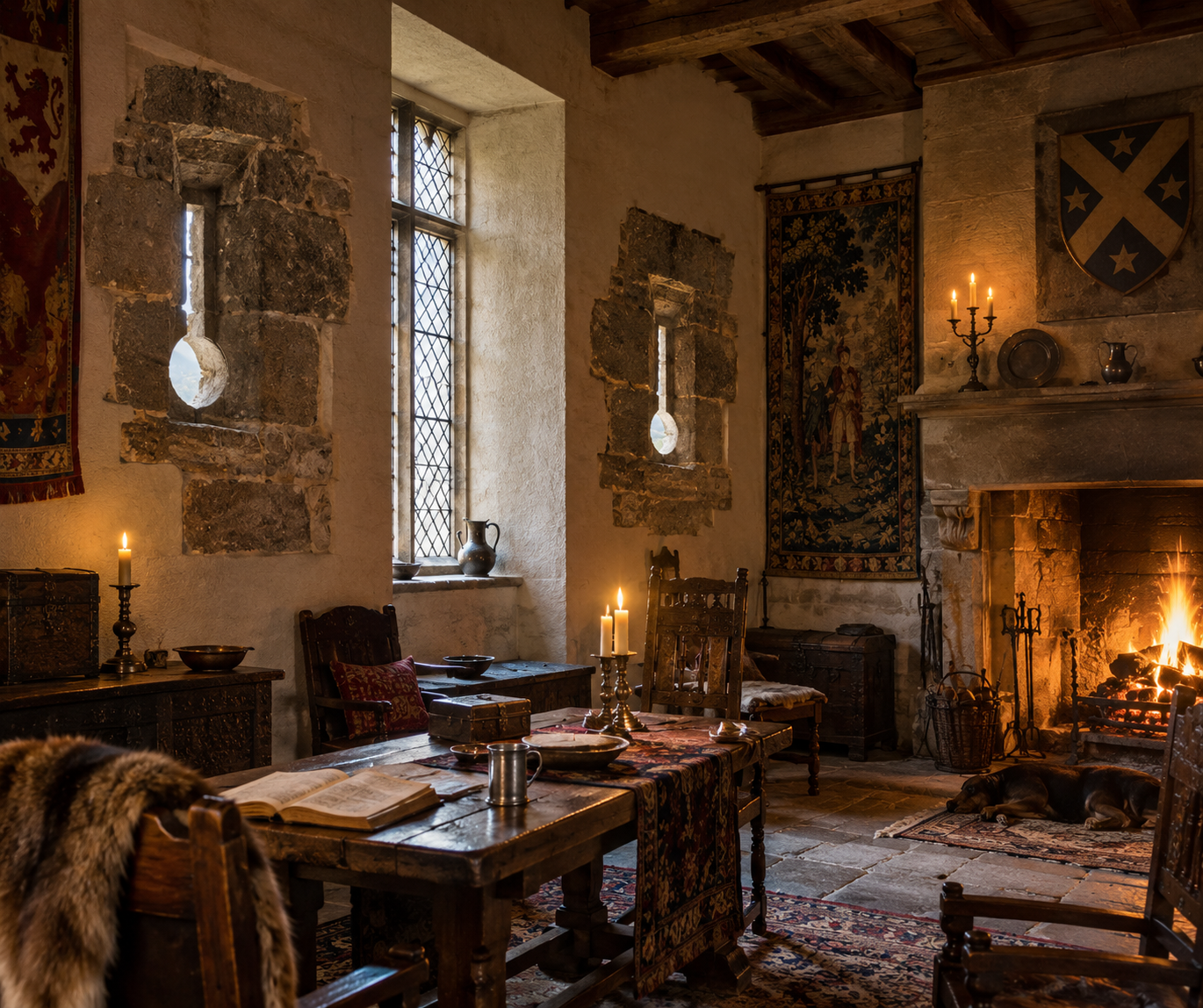
A vision of Drumlanrig in 1500
Long before the great pink castle stood at Drumlanrig, there was another Drumlanrig there.
It was smaller, older, and far more suited to the world James Douglas was born into. We do not know exactly what every part of that house looked like — we do know there was a castle at Drumlanrig by 1492, when James's father, Sir William Douglas (1470-1513), received a charter for it. Parts of an earlier building still survive within the later castle, described as including fragments of old gun loops buried in its walls. Sixteenth-century gun loops could be round, keyhole-shaped, inverted-keyhole, or horizontal openings, depending on date and the firearm they were designed for.
There would have been horses coming and going, servants carrying food and firewood, dogs underfoot, meat turning over a fire, wet cloaks drying, weapons close at hand, and messengers arriving with news from places that could take days to reach. Outside the immediate household were the farms and people whose rents and labor supported the estate. Drumlanrig was a home, but it was also the center of a landed family and everything that came with it.
His father was steadily adding to the family's position. William held Drumlanrig and received charters connected with Dalgarnock, Tibbers and, shortly before his death, Hawick. These were not simply names on a family tree. They represented land, income, influence and responsibility spread across a part of Scotland where power often had to be exercised in person.
For James, though, this was simply the world in which he grew up.
His mother Elizabeth was there, along with his brother Robert and sisters Janet and Agnes. Other children would have been around the household too, along with servants, retainers, and visiting relatives. His education would have been preparing him for the life expected of a Douglas heir: managing land and men, understanding family alliances, riding, hunting, and knowing how to defend both his name and his property.
Then, in 1513, that childhood ended.
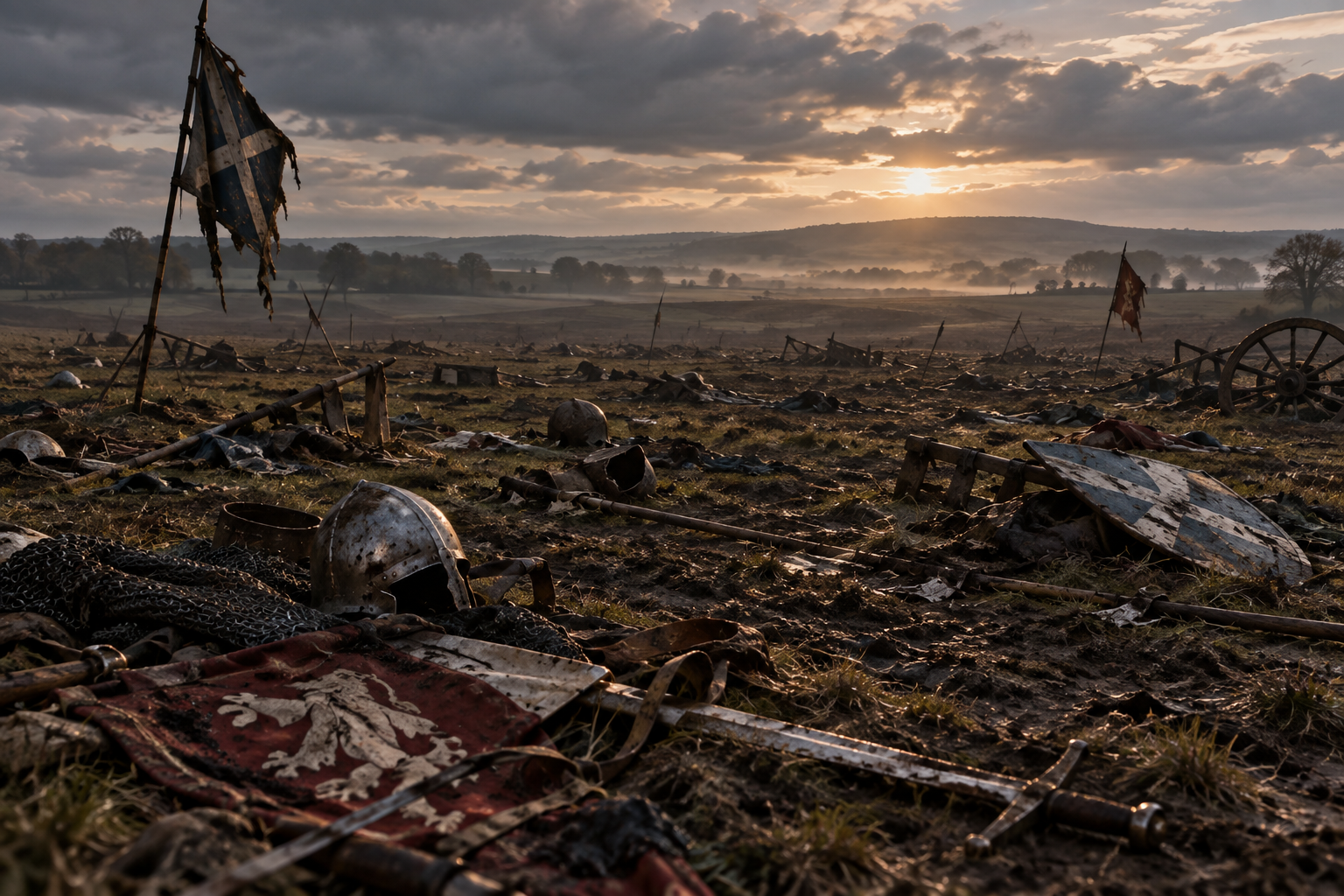
Battle of Flodden · September 9th 1513
King James IV gathered one of the largest Scottish armies of the age and crossed into England. Among the men who went with him was James's father. When the Scots met the English at Flodden. The battle was a disaster. James IV was killed. So were many of the great men of Scotland. Fathers, brothers and sons disappeared from households across the country in a single afternoon.
Sir William Douglas of Drumlanrig was among the dead. Back at Drumlanrig, the news meant something much more personal.
James had lost his father. Still a young man of barely 15, he became James Douglas, 7th of Drumlanrig.
The house he had grown up in was now his. So were the lands attached to it, the people who depended upon them, the family interests his father had spent years building, and the obligations that came with carrying the Douglas name.
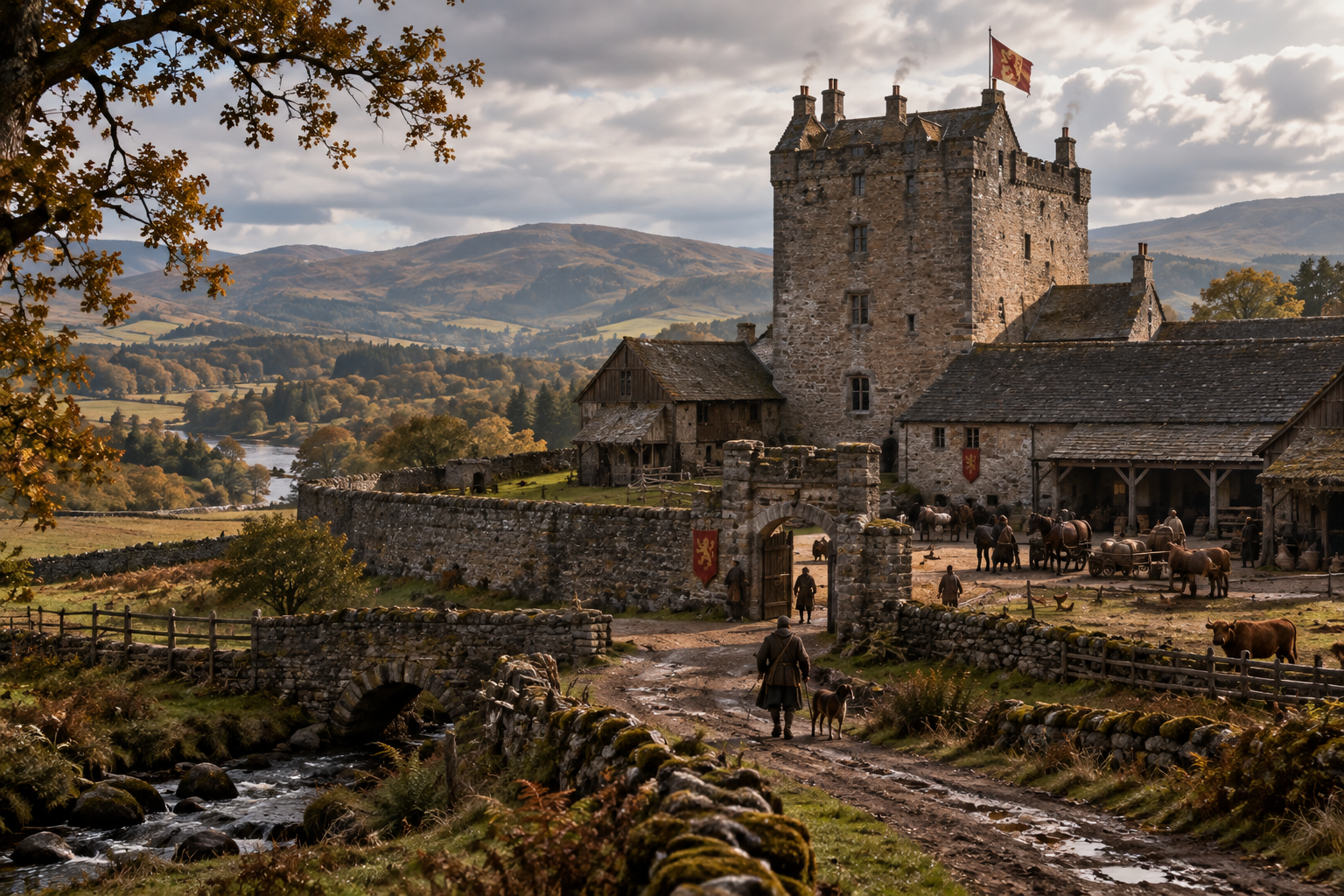
A vision of the original border tower house.
Another complication waited for him.
In that same year, James married Margaret Douglas, daughter of George Douglas, Master of Angus. Margaret belonged to the powerful Angus branch of the Douglas family. Her brother was Archibald Douglas, Earl of Angus, a man who would soon become one of the most powerful and troublesome figures in Scotland.
At first, that marriage probably looked like exactly what marriages between great families were supposed to be: an alliance.
It would not stay that simple.
James had inherited Drumlanrig at a terrible moment. Scotland had lost its king at Flodden, the new king was an infant, and powerful families were already circling the royal child.
Before long, James would find himself caught in the middle of it.
And some of the men standing on the other side would be his own Douglas kin.
The boy at the center of all this was James V, barely a year old when his father was killed at Flodden. For much of his childhood, other people governed in his name, and whoever controlled access to the young king held enormous power.
By 1526, Margaret’s brother, Archibald Douglas, Earl of Angus, had the upper hand. Angus had gained custody of the fourteen-year-old king and surrounded him with his own supporters. James V may have worn the crown, but he had very little control over his own life.
That summer, Walter Scott of Buccleuch decided to act. He gathered a force and attempted to take the king out of Angus’s hands.
James of Drumlanrig joined him.
It put James in a remarkable position. His wife was Angus’s sister, yet here he was riding against her brother and other members of his own Douglas family.
The confrontation came near Melrose in July 1526. Buccleuch’s men were defeated, and Angus kept control of the king.
The Attempt to Rescue the King, 1526
In 1526, Sir James became involved in the dangerous struggle surrounding the young King James V of Scotland. Although James was technically king, he was still a teenager and had fallen under the control of Archibald Douglas, 6th Earl of Angus, who dominated the royal government and kept close control over the king himself.
Not everyone accepted it.
That year, a group of Scottish nobles attempted to free James V from Douglas's control. Sir James was among the barons who took part in this effort to rescue the young king. The struggle erupted into open violence as rival factions fought over possession of the king and, with him, control of Scotland.
The attempts of 1526 failed. Angus retained his hold over James for another two years. But the young king did not forget his captivity. In 1528, at sixteen, James finally escaped Douglas control, assumed personal rule, and turned fiercely against the Douglas family.
Sir James had chosen his side before the king was free.
Two years later, James V escaped. Once free, he turned hard against the Douglases who had controlled him.
Angus fled to England, his lands were forfeited, and the king’s anger spread well beyond the men who had actually held him.
James of Drumlanrig had fought against Angus at Melrose. It did not save him.
In 1529, they imprisoned James, the 7th of Drumlanrig, in Edinburgh.
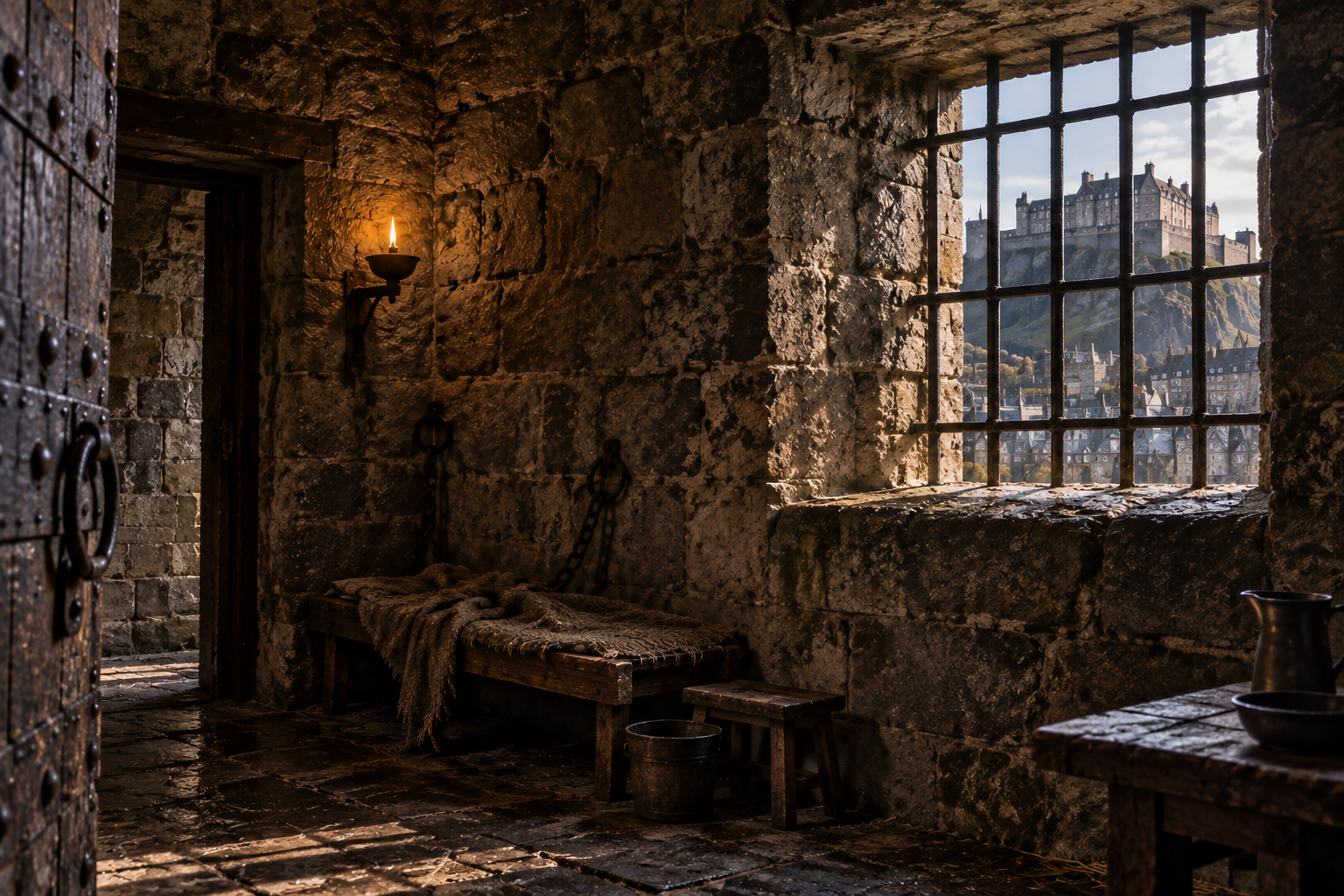
A vision of an Edinburgh prison cell.
He was eventually released and returned to Drumlanrig, where life was considerably less glamorous than the politics of the royal court. There were lands to manage, rents to collect, disputes to settle, horses to feed, and a growing household to support.
James and Margaret now had growing children…
In 1530, their daughter (my ancestor), Nichola Douglas, was born. She would later marry Sir John Johnstone of Johnstone.
The household itself would have included far more people than the immediate Douglas family: servants, retainers, estate officers, visiting relatives, messengers, and the men who came and went on James’s business.
Beyond the house were the people who kept Drumlanrig alive.
They had to grow and harvest grain. Livestock had to survive the winter. Ale was brewed, bread baked, meat butchered and preserved. Fires needed a constant supply of fuel. Horses required fodder, shoes, and shelter. Roofs leaked, walls needed repair, tools broke, and clothes wore out.
When winter settled over the Nith valley, the days were short, and the roads could become miserable. Spring brought planting and young livestock. Summer made travel easier. Autumn meant harvest and putting away enough food to carry people and animals through another winter. And beyond all of that lay the Border.
This was a place where a missing cow could turn into something much larger. Livestock crossed the frontier in raids. Families carried old grudges. Men retaliated against one another. Houses were burned, property taken, and sometimes people killed. The line between Scotland and England existed, but the families living around it did not necessarily behave as though a neat border separated their worlds.
James spent more and more of his life dealing with these problems.
By the early 1550s, he was involved in negotiations concerning the Anglo-Scottish frontier. Then, in 1553, he was appointed Warden of the West March. It gave him real authority.
He was expected to deal with raids, fugitives, stolen property and disputes that crossed the frontier. Scots and English met on appointed days to bring complaints against one another and try to recover what had been taken. Some cases involved violence and murder. Others really did come down to horses, cattle or sheep.
For the people living there, those smaller cases mattered just as much as whatever was happening at court.
By then James had been laird of Drumlanrig for forty years.
He had inherited it as a boy after Flodden. Now he was one of the men expected to keep order across a large piece of southwestern Scotland. And in 1548, another responsibility had already landed in his hands.
Sir Simon Carruthers of Mouswald died without a surviving son. He left two daughters, Janet and Marion Carruthers, and valuable lands that would pass through them. James Douglas became the girls' guardian. They were young heiresses with something powerful families wanted. Land.
Land could make two young girls very important. James had considerable influence over both their property and their marriages. He wanted the Carruthers lands brought into the Douglas orbit.
The story becomes especially troubling with Marion. She resisted an arranged marriage to a Douglas and instead became involved with John Maxwell, a younger son of Lord Maxwell. While staying with her aunt, Marion Carruthers died on 25 September 1570 after falling from the battlements of Comlongon Castle.
Later stories accused the Douglases of pursuing her inheritance and even suggested Marion was driven to her death. Those claims go beyond what we can prove. We do know her inheritance was disputed and that Carruthers’ property eventually passed to the Douglases.
By then, James had become a powerful man in southwestern Scotland. But Scotland itself was changing.
James had been born into a Catholic country, where Mass, saints’ days, confession, and the old Church were simply part of life. By the 1550s, that world was coming apart. James sided with the Protestants. When the Scottish Reformation erupted in 1559–60, he supported the Lords of the Congregation against Mary of Guise. The Reformation Parliament of 1560 rejected papal authority and the Mass, and churches across Scotland began changing as a result.
James took part in what followed. In 1561, he was among those appointed to help establish the new Protestant order set out in the First Book of Discipline, which called for ministers, schools, and support for the poor. He also knew John Knox personally and visited the aging reformer shortly before Knox’s death in 1572.
He had now lived through imprisonment, Douglas feuds, Border violence, and a religious revolution.
Then Scotland’s queen came home. Mary, Queen of Scots, returned from France in August 1561.
She was eighteen, Catholic, and widowed. James Douglas was in his sixties. Their paths were about to cross.
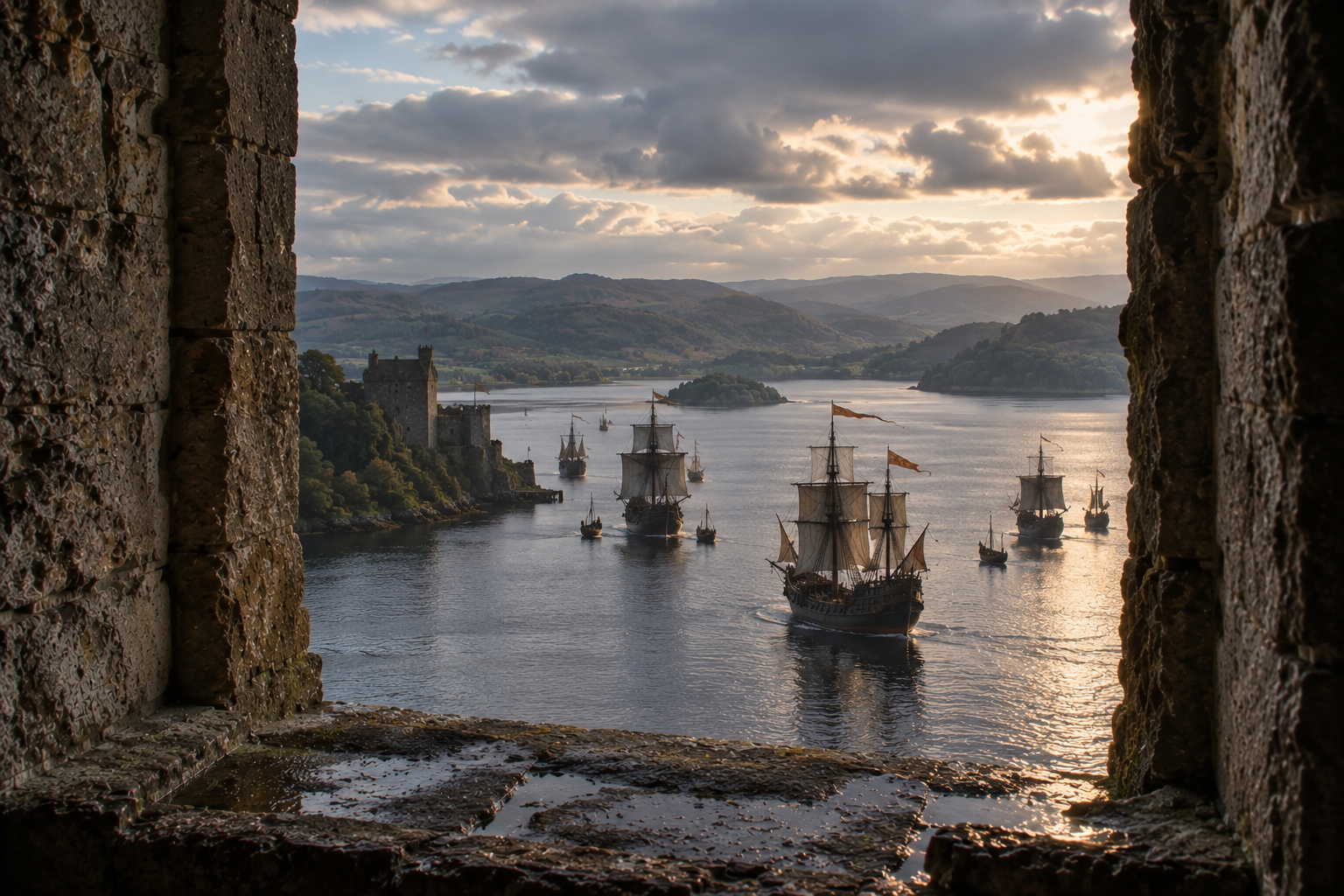
Queen Mary arrives in Scotland
Mary’s return put James in an awkward position. He was a committed Protestant; she remained Catholic. For a few years, the two managed to exist within the same uneasy Scotland. By 1565, James had joined the Protestant nobles opposing Mary during the rebellion known as the Chaseabout Raid. The rebellion failed, and James retreated back toward his own country.
But Mary’s reign was already beginning to unravel.
By that time James had been its laird for more than six decades. His son & heir Sir William Douglas of Hawick predeceased him in September 1572. He watched Scotland abandon the old Church, served along a violent Border, survived imprisonment and rebellion, and lived through the reigns of James IV, James V, Mary Queen of Scots and the childhood of James VI.
By the summer of 1578, James knew he was dying.
In an addition to his will written at Drumlanrig that August, the old laird spoke plainly of his age and the growing weakness of his body. His thoughts were on the house he had spent his life building and the family who would remain there after him. He urged them to put aside quarrels and remember the good of Drumlanrig. James died later that year, having held the estate for more than sixty years. His son William was already gone, so Drumlanrig passed to his grandson and namesake, James Douglas.
The family continued to rise, and generations later their descendants built the enormous Drumlanrig Castle we recognize today.
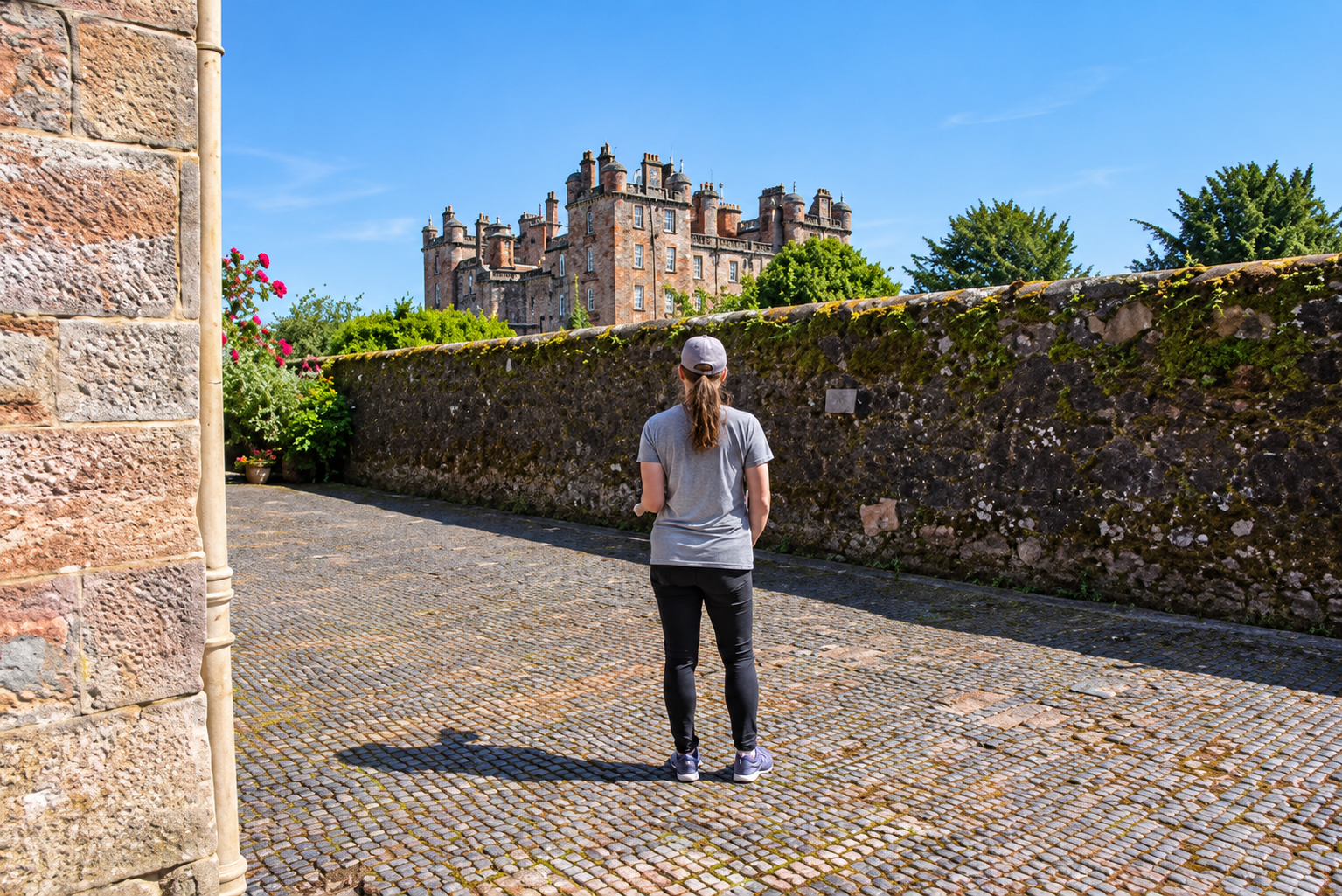
A beautiful day at Drumlanrig Castle
For Your Reference;
Sir James Balfour Paul, ed., The Scots Peerage, Vol. VII (1910), “Queensberry.” — The core genealogical source for James Douglas, 7th of Drumlanrig, his marriages, children, and succession. It supports, among other things, his first marriage to Margaret Douglas, their eventual divorce, his second marriage to Christian Montgomerie, and William as his son and heir.
Royal Commission on the Ancient and Historical Monuments of Scotland, “Drumlanrig Castle,” Canmore. — The best source for the physical Drumlanrig in your story: the castle is recorded by 1492, the present building replaced an earlier structure, and fragments of probable sixteenth-century gunloops survive within its east wall.
Drumlanrig Castle — CanmoreSir Herbert Maxwell, A History of the House of Douglas from the Earliest Times Down to the Legislative Union of England and Scotland, Vol. II (1902). — Useful narrative history for James's political career, the Douglas conflicts, James V, the Reformation period, and the Drumlanrig branch.
Sir William Fraser, The Douglas Book, Vols. I–IV (1885). — A major documentary and genealogical collection for the Douglas family, valuable for charters, family relationships and the larger Douglas world in which Drumlanrig operated.
15th-great-grandfather of author Krysta Abesamis