3rd of Holmains
John Carruthers, the 3rd Laird of Holmains, lived during a period when Scotland was changing around the landed families of Annandale. His lifetime crossed the troubled reigns of James II and James III, while south of the Border England was being torn apart by the Wars of the Roses. Yet John's surviving story is not one of royal courts or famous battles. Like so many of the early Carruthers men, we find him most clearly through land.
By 1471, John had succeeded to the Holmains inheritance. His father, John Carruthers, 2nd of Holmains, was dead by that year, and the younger John appears as heir to the family's property. The surviving evidence is fragmentary enough that Carruthers & Reid were cautious about the exact chronology, but the succession itself is clear: another John now stood at the head of the family Roger de Carruthers had established at Holmains nearly a century earlier. Unlike his father, however, John 3rd barely appears in the surviving record. Records of the Carruthers Family states that he can be identified with certainty only once. That single appearance occurred in 1476, and fortunately for us, the transaction contains enough information to reconstruct one of the most important moments in his life.
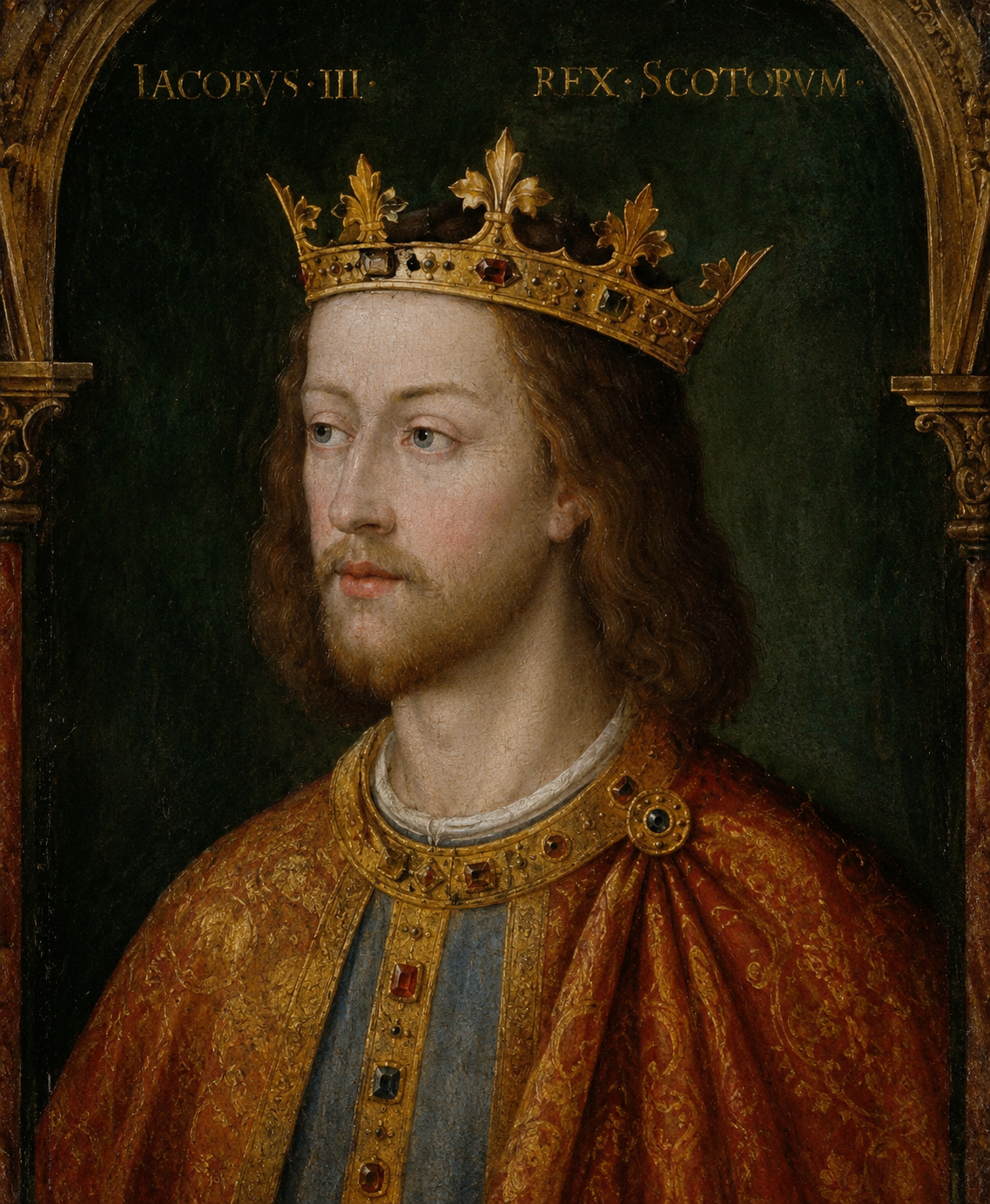
John lived under King James III, who had inherited the Scottish crown as a child in 1460. By the early 1470s, James was attempting to exercise personal rule while pursuing ambitious continental schemes and a new relationship with England. Parliament met repeatedly during these years, including major sessions in 1471 and 1476, while tensions gradually developed between the king and powerful members of the Scottish nobility.
King James III
Across the Border, England was experiencing the Wars of the Roses. Edward IV had recovered the English throne in 1471, and the Lancastrian challenge had temporarily collapsed. For families living in Dumfriesshire, events in England were never entirely distant. Annandale occupied one of Scotland's great southern approaches, and political instability on either side of the frontier could affect trade, military obligations, cattle, property and personal security.
Yet there was also an extraordinary attempt at peace during John's years as laird. In 1474, James III and Edward IV concluded a truce intended to last forty-five years, accompanied by plans to marry James's infant heir to Edward's daughter Cecily of York. The grand marriage scheme ultimately failed, but for a landed family in Annandale, even the possibility of a prolonged Anglo-Scottish peace would have mattered enormously. John therefore lived in a world where decisions made by kings in Edinburgh and London could eventually reach the fields surrounding Holmains. His surviving record, however, shows him concentrating on something much more immediate: the future of his estate and family.
Holmains Settlement 1476
In 1476, John Carruthers resigned his lands into the hands of Alexander Stewart, Duke of Albany and Lord of Annandale. The lands specifically included Holmains, Little Dalton and Fourteenacres—properties that carry us directly back toward Roger's original Holmains holdings. John then arranged for those lands to be placed in favor of his son, another John Carruthers, who would become the 4th Laird of Holmains. This was not John simply abandoning his property. It was an orderly medieval mechanism for arranging succession. John reserved his own liferent, meaning that although his son was placed in possession of the fee of the estate, the 3rd Laird retained the right to use and benefit from the property for the remainder of his life. The arrangement allowed the next generation's title to be established without removing the older laird from his home, income or position.
The transaction therefore gives us a remarkably intimate glimpse into how the Carruthers family was protecting the continuity of Holmains. Nearly one hundred years after Roger received his foundational grant, the estate was no longer simply being allowed to pass unpredictably at death. Its succession was being deliberately arranged while the existing laird was still alive.
The Wife
The same 1476 transaction gives us something equally important. John's wife was alive. Her name, however, was not recorded in the surviving evidence used by Carruthers & Reid. When John transferred the fee of Holmains to his son, he reserved not only his own liferent but also terce for his widow. Under Scots property law, terce protected a widow's interest in a portion of her husband's heritable estate. It was therefore important enough to be preserved explicitly when John arranged the succession. Carruthers & Reid state plainly that John's wife was then living but “is not named.”
This is an important correction to some modern family trees, which have attempted to identify the 3rd Lady of Holmains as a Stewart. For the historical record, therefore, John's wife should remain unknown. But unlike Roger's wife or the wife of John 2nd, she is not completely invisible. We know something definite about her: she was alive in 1476, married to John 3rd Holmains, and her future financial protection was written into the Holmains succession settlement. That small provision may be the closest we presently come to seeing her.
Little Dalton
The Next John Carruthers
The principal child documented by the 1476 transaction was John's son and heir, inevitably another John Carruthers.
He became fiar of Holmains through the arrangement. In Scottish landholding terminology, the distinction matters. His father retained the liferent, while the younger John held the fee—the underlying hereditary right to the estate. This younger John became the 4th Laird of Holmains, and his documentary life would be considerably more eventful than his father's. He acquired additional lands in Dryfesdale, became involved with the powerful Crichton network, appeared in litigation, and lived long enough for another generation of Carruthers heirs to emerge beneath him.
The 1476 transaction therefore catches the family at an unusually useful moment: three parts of the household can be seen at once. There was John 3rd, still alive and retaining his liferent; his unnamed wife, alive and protected by terce; and their son John, receiving the hereditary estate that would make him 4th of Holmains.
Did John Have Another Son?
Carruthers & Reid raise the possibility that the 3rd Laird also had a son named Thomas Carruthers. This Thomas had apparently distinguished himself at the Battle of Arkinholm in 1455 and was rewarded with lands at Corry that had been forfeited by George Corry because of his involvement in the Albany-Douglas invasion. Arkinholm was not an insignificant local skirmish. The battle formed part of the destruction of the great Black Douglas power in southern Scotland during the reign of James II. If Thomas truly was a younger son of John 3rd, then one member of this Holmains household participated directly in one of the major political upheavals of fifteenth-century Scotland.
Carruthers & Reid themselves use cautious language, saying that John “may have had another son, Thomas Carruthers.” That is exactly how we should preserve him: not erased from the story, but clearly identified as a possible son whose placement remains unproven.
Powerful Neighbors
The 1470s also reveal how deeply Holmains was becoming embedded within the network of neighboring Border families.
The Carruthers interacted with the Crichtons, who were feudal superiors in Dryfesdale and Carruthers. John's son received Blawat in 1471 from William, Lord Crichton, and a daughter of the family married one of Crichton's feudal vassals. The relationship became important enough that Carruthers & Reid later wondered whether an otherwise undocumented marriage into the Crichton family might explain some of the favors shown to the next Laird of Holmains.
This is precisely why the unnamed wives of these early Carruthers men remain worth investigating.
Medieval marriage among landed families was rarely merely personal. It could alter property, alliances, obligations and access to powerful patrons. When a family suddenly acquires land or enjoys unusual favor from a neighboring lord, marriage is one of several possibilities historians have to consider.
The documentary discipline that has helped reconstruct the first generations of Holmains remains important here: follow the land, follow the relationships, and do not give an unnamed woman a name merely because a later pedigree supplies one.
John's Death
We do not know when John Carruthers, 3rd of Holmains, died.
The 1476 settlement proves that he was alive in that year, and it also demonstrates that he had already made arrangements for his son to possess the hereditary fee of Holmains. Carruthers & Reid could find no surviving record establishing John's subsequent death date. By 1485, references to John Carruthers of Holmains can safely be attributed to his son, the 4th Laird, according to Carruthers & Reid. The older John's death must therefore have occurred sometime after the 1476 transaction, but attempting to assign him a convenient year would create a precision the evidence simply does not contain. His burial place is likewise unknown.
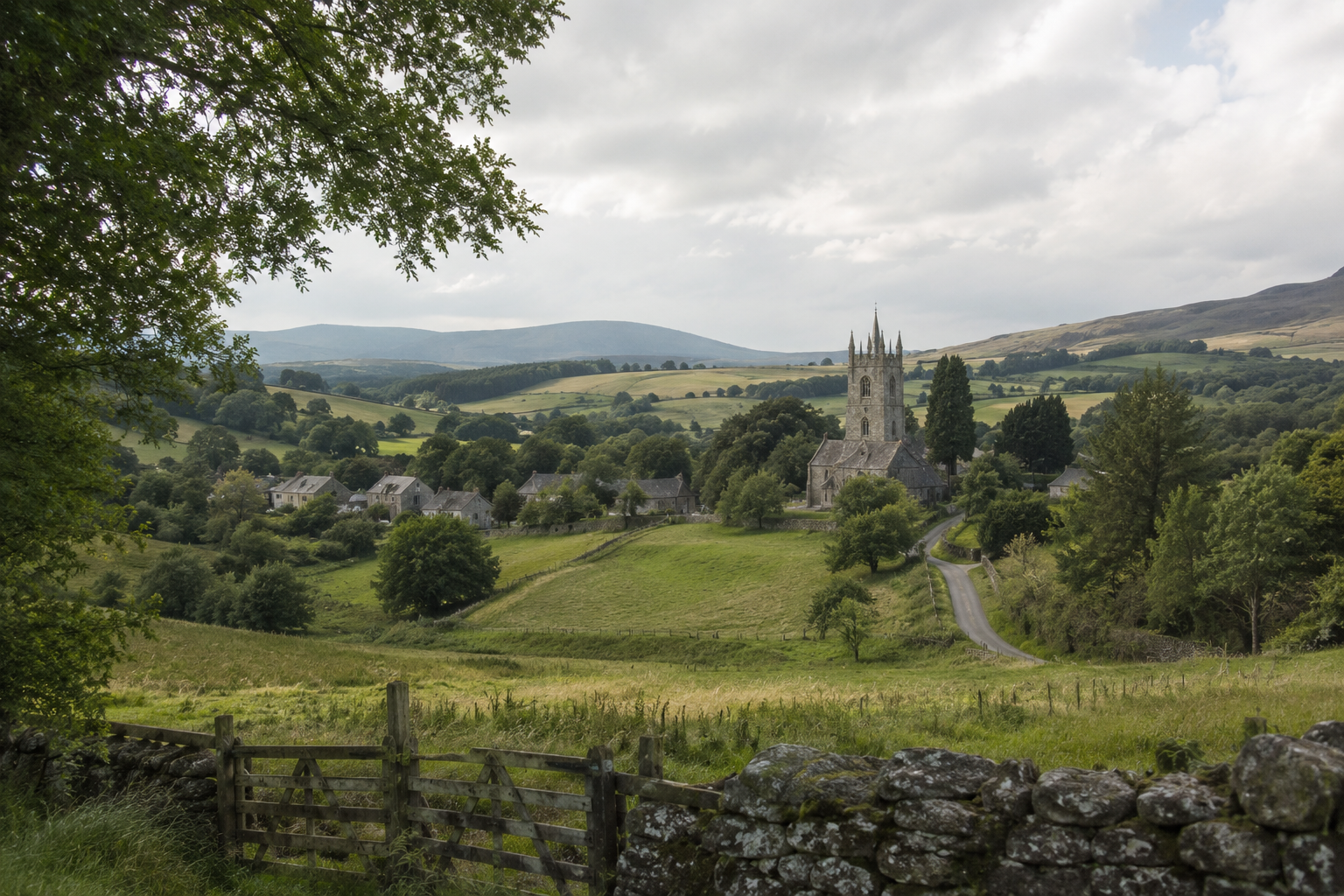
It is tempting to imagine the family using a church associated with their lands, particularly given the Carruthers patronage of Little Dalton inherited from Roger's original holdings. But until burial evidence appears, that remains historical context rather than biography. John 3rd left remarkably little behind on paper. His father can be seen administering an expanded estate and sitting on a retour jury. His son appears repeatedly in the surviving records and would add still more land to Holmains. John himself stands between them, visible with certainty principally through a single transaction in 1476.
Yet that transaction may tell us more about the continuity of the family than a dozen minor references could have done. By 1476, the Carruthers had held Holmains for approximately a century. John had a living wife whose rights required protection, an adult son ready to inherit, and an estate important enough to warrant a carefully structured transfer between generations. Roger had established the house. John 2nd had watched its property expand. Under John 3rd, we can see the family doing something equally important: making certain Holmains survived them. The parchment may have preserved only a few lines about the man himself, but behind those lines was an established household, a wife whose name has been lost, a son preparing to become laird, and a landed inheritance that had already endured through three generations.
That is John Carruthers, 3rd of Holmains—not simply another John in a long pedigree, but the man who deliberately placed the family's inheritance into the hands of the next generation.
For Your Reference;
Born: Unknown · probably Annandale, Dumfriesshire, Scotland
Probable Father: John Carruthers, 2nd of Holmains
Mother: Unknown
Wife:Unknown; documented alive in 1476
Children: John Carruthers, 4th of Holmains; possibly Thomas Carruthers, association not conclusively established
Occupation / Position: 3rd Laird of Holmains; landed gentleman and estate holder in Annandale
Documented:1471–1476
Death: After 1476 · probably Dumfriesshire, Scotland
Burial: Unknown
Key Succession Evidence — 1471: John appears as heir following the death of John Carruthers, 2nd of Holmains. The early chronology contains ambiguities acknowledged by Carruthers & Reid, but the documented Holmains succession places him between the 2nd and 4th Lairds.
Key Primary Evidence — 1476 Holmains Settlement: John resigned Holmains, Little Dalton and Fourteenacres into the hands of Alexander Stewart, Duke of Albany and Lord of Annandale, in favor of his son John. He reserved liferent for himself and terce for his wife, proving that his wife was living when the transaction occurred even though the surviving account does not give her name.
Possible Son — Thomas Carruthers: Carruthers & Reid suggest that Thomas Carruthers, rewarded with the lands of Corry for service at the Battle of Arkinholm in 1455, may have been another son of the 3rd Laird. The relationship should presently be treated as possible rather than documented.
Arthur Stanley Carruthers & R. C. Reid, Records of the Carruthers Family (1934), Chapter V, “Holmains.”Read the original volume at Internet Archive
Holmains Inventory, cited by Carruthers & Reid for the early Holmains succession and 1476 estate transaction.
Historical Manuscripts Commission materials and the Register of the Great Seal of Scotland, used by Carruthers & Reid in reconstructing the fifteenth-century Holmains family.
17th Great Grandfather of author Krysta Abesamis