4th of Holmains
John Carruthers, the 4th Laird of Holmains, inherited a family estate that had been taking shape for more than a century, but his life was markedly different from those of the first three lairds. Roger had established the landed house in 1375, while the next generations consolidated and protected it. With John 4th, the surviving records become much richer. We can follow him acquiring land, witnessing legal instruments, dealing with neighboring families, becoming entangled in a substantial financial dispute, being ordered into royal custody, and finally riding with hundreds of armed Border horsemen into England. By the time his long life was ending, Holmains was no longer simply a local estate. Its laird had become a recognizable participant in the turbulent political and military society of the Scottish West March.
John was the son and heir of John Carruthers, 3rd of Holmains, whose 1476 settlement gives us the first secure glimpse of him. In that year the elder John resigned Holmains, Little Dalton and Fourteenacres into the hands of Alexander Stewart, Duke of Albany and Lord of Annandale, in favor of his son. The father retained his own liferent and protected the terce rights of his unnamed wife, while the younger John became fiar of Holmains. In other words, the hereditary future of the estate had already been placed in John 4th's hands while his father was still alive.
The precise year of John 4th's birth is unknown. The often-repeated date of approximately 1460 is a genealogical estimate rather than a documented birth date. What we can say securely is that he was old enough to receive the fee of Holmains in 1476 and that by 1485, according to Carruthers & Reid, surviving references to John Carruthers of Holmains can safely be attributed to this fourth laird.
A Laird Under Three Scottish Kings
John's lifetime carried the Carruthers family across an extraordinary period of Scottish history. When he became fiar of Holmains, James III occupied the throne. The king's increasingly troubled relationship with his nobility eventually ended violently at the Battle of Sauchieburn in 1488, where James III was defeated and killed. His teenage son succeeded him as James IV, beginning one of the most culturally remarkable reigns of medieval Scotland.
Under James IV, Scotland's royal court embraced Renaissance culture, diplomacy, medicine, music, architecture and new technology. Scotland's first printing press was established in Edinburgh in 1507, only a generation after John became fiar of Holmains. The king strengthened royal government and maintained an active European diplomatic presence while also personally traveling through his kingdom. Yet the world experienced at Holmains would have been very different from the Renaissance brilliance of the royal court. Annandale remained a frontier society in which landholding, kinship, livestock, armed service and the ability to defend one's property remained essential parts of everyday life.
John's generation therefore stood with one foot in two worlds. Renaissance Scotland was emerging to the north while, along the Border, an older system of fortified houses, mounted raiding, feuds and kinship alliances remained very much alive. John's surviving biography shows both sides of that Scotland remarkably well.
Building the Holmains Estate
John did not simply preserve what his father gave him. He expanded it. One of the most important additions occurred in 1492, when he acquired further lands within the Barony of Dryfesdale. These consisted of Daltonheuk, Blaeberrieward and the Isle in the Water of Annan, together with associated rights. The history of these properties reached back through the Crichton family. Sir John Crichton had granted Daltonheuk and the Isle in the Annan, called Blaeberrieward, to his brother Thomas Crichton of Brunston in 1410. Decades later, after political forfeiture changed the superiority of Dryfesdale, the lands passed into John Carruthers's hands.
The relationship between Holmains and the Crichtons is one of the intriguing unanswered questions in these early generations. Blawat had earlier been granted to a Carruthers by William, Lord Crichton, and a Carruthers daughter had married one of Crichton's feudal vassals. Carruthers & Reid were sufficiently struck by these repeated favors that they wondered whether an unrecorded marriage with a daughter of the House of Crichton might explain them. They could not prove such a marriage, however, and neither can we. It remains an interesting possibility rather than a genealogical fact.
On 30 January 1492, John received his charter for Daltonheuk, Blaeberrieward and the Isle from the new superior, Patrick Hepburn, Earl of Bothwell. Seven years later, John was still actively protecting the economic value of those lands, taking legal instruments concerning his rights to the fishings in the River Annan. The detail is wonderful because it reminds us that medieval estates were not simply names on parchment. A river meant food, income and valuable legal rights. John's concern over the Annan fishings was therefore part of the practical business of being Laird of Holmains.
the Business of Being a LairD
The surviving records begin to make John feel considerably more human than his predecessors. In 1493, for example, some of his oxen were stolen by Gilbert Wilson in Glenken. The incident survives because medieval livestock represented serious wealth. Oxen were working animals essential to agriculture, and stealing them from a landed estate was not a trivial nuisance.
Other records place John repeatedly inside the legal world of southern Scotland. Some earlier references to “John Carruthers of Holmains” cannot confidently be divided between the 3rd and 4th lairds, which Carruthers & Reid openly acknowledge. By 1485, however, John 4th was witnessing documents in his own right, and his later appearances leave little doubt that he was actively managing the family's expanding interests.
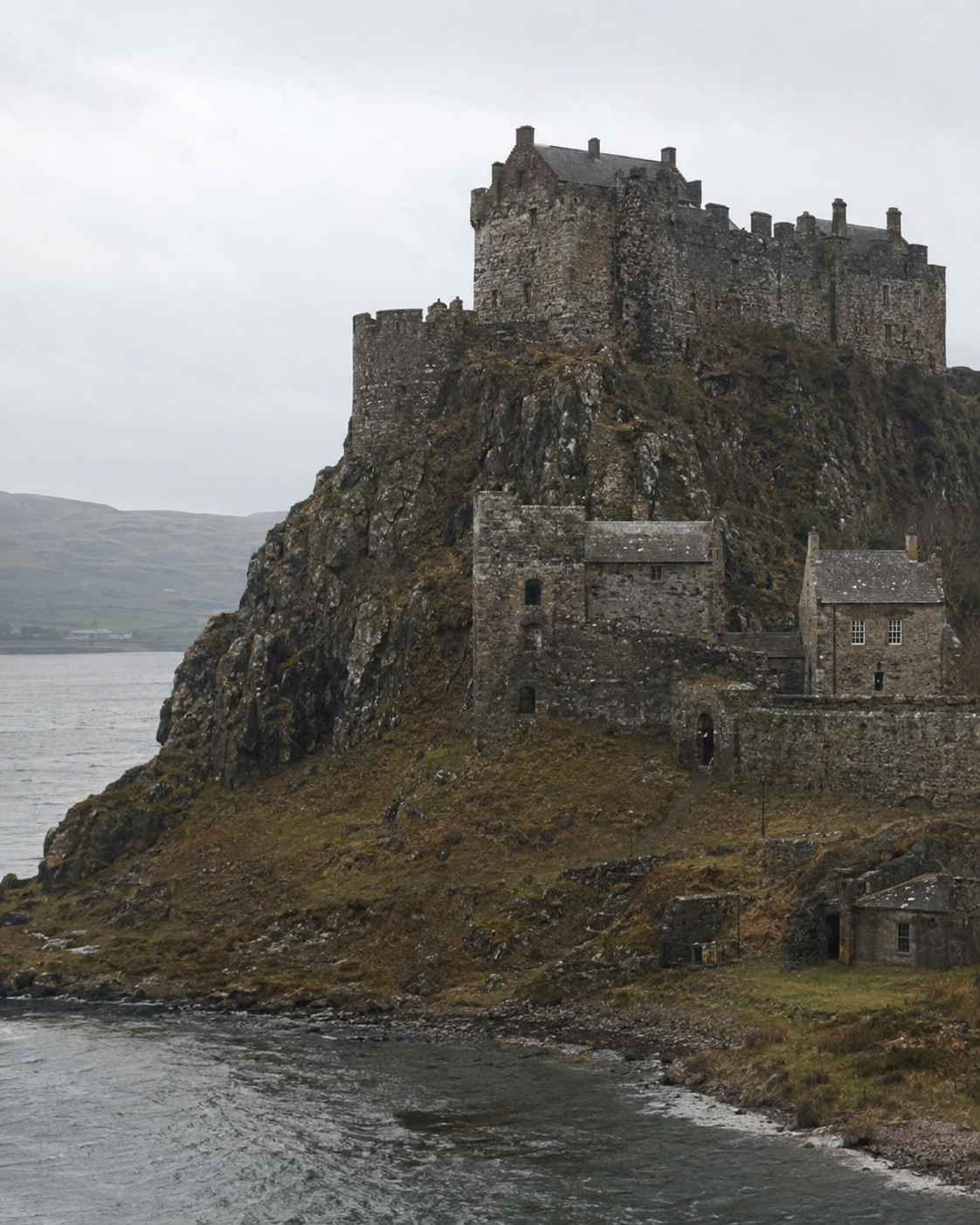
Then, in 1500, something considerably more dramatic happened. John was ordered to enter ward in Dumbarton Castle within eight days, together with the Lairds of Dunwiddie and Cockpool. Other Dumfriesshire lairds were simultaneously ordered into Kildrummie, Blackness and Edinburgh castles. Unfortunately, the surviving record does not tell us what John had done to provoke the order. Carruthers & Reid therefore wisely leave the matter unexplained rather than inventing an offense.
Dumbarton Castle 1500
The incident nevertheless tells us something important about his position. John was operating among the network of substantial Dumfriesshire lairds whose conduct mattered enough to attract governmental attention. Whatever lay behind the order, the Laird of Holmains was no longer an obscure landholder tucked away in Annandale.
The 550-Merk Disaster
Two years later, John became involved in a financial affair that would continue troubling his descendants long after his death.
In 1502, the Court of the Steward of Annandale fined him the enormous sum of 550 merks. The full explanation survives through later documentation. John had acted as surety for a group of men—including Roger Carruthers of Wormanbie, William Graham, Thomas Bell of Kirkconnel, Richard Latimer in Ecclefechan and others—who were required to appear at the Justice Ayre of Dumfries. They failed to appear, leaving John financially responsible for their default. This is another revealing piece of his social world. Being a laird meant more than owning land. Men stood surety for relatives, neighbors, dependents and political associates, effectively placing their own wealth behind another man's promise to obey the law. When those relationships failed, the consequences could be severe.
John attempted to recover his losses by apprising lands belonging to the men whose failure had caused the fine. Some of those properties were then assigned to the Crown toward satisfaction of what he owed. The legal details became complicated because John was not properly infeft in all of the apprised lands, leaving unfinished business that resurfaced during the lifetime of his grandson. He eventually made payment to the royal Treasurer, and in February 1507 he received a Crown precept allowing re-entry into his lands. Formal sasine followed in October 1510. What might appear in a family tree as an uneventful stretch of thirty years was therefore anything but uneventful. Holmains had been expanded, livestock stolen, its laird ordered into ward, an enormous fine incurred, lands seized and reassigned, and John's title to his own property formally restored.
His Wife —
Carruthers & Reid specifically state that both the date of John's death and his wife's name are unknown. That should settle the matter for our working reconstruction unless a new contemporary source is found. As with the previous Holmains generations, later genealogies have attempted to fill this empty space with women from neighboring families. The repeated Carruthers connections with the Crichtons even caused Carruthers & Reid themselves to wonder whether an undocumented Crichton marriage might explain the relationship between the houses. But they presented it as speculation, not evidence. John's wife therefore remains: Wife: Unknown.
She nevertheless existed at the center of a household whose fortunes were steadily increasing. She was the mother of at least two sons we can identify, lived through a period when her husband's lands and legal responsibilities stretched across Annandale, and watched the next generation of the Holmains family reach adulthood. Her name disappearing from the surviving papers is not evidence that she was unimportant. It is evidence of how unevenly medieval records preserved women's lives.
His Son John Never Became Laird
The succession of Holmains now takes an unexpected turn.
John 4th's eldest son was, inevitably, another John Carruthers. He appears beside his father in the surviving records and was explicitly described as his apparent heir. On 12 and 13 October 1512, both John Carruthers of Holmains and “John Carruthers, his son and apparent heir” witnessed the sasine of lands belonging to the Mouswald branch of the family. The younger John was therefore alive, adult, recognized publicly as his father's successor and participating alongside him in the legal affairs of the local landed community.
Even better, Carruthers & Reid's footnote corrects the impression that 1512 is his last appearance: the heir apparent was still alive in February 1516, when he appears in the Castlemaddy Charters. But he never became Laird of Holmains. Sometime after February 1516 and before May 1523, the younger John died before his father. He left a son of his own—yet another John Carruthers—who would eventually bypass the dead generation and succeed his grandfather directly as the 5th Laird of Holmains. This is the reason the Holmains pedigree contains the easily overlooked John Carruthers, Heir Apparent between the 4th and 5th lairds. He was a real generation of the family, but because he died before inheriting Holmains, he never received a lairdship number.
James Carruthers — The Son Who Entered the Church
John 4th had another documented son, James Carruthers, whose life took a very different path.
James entered the Church and had become Rector of Wamphray by 1515. He also appears repeatedly in contemporary documents as a cleric and notary, giving us another glimpse of the opportunities available to younger sons of landed families. The principal estate normally passed through the heir, while brothers could establish careers in the Church, law, administration or military service. In May 1518, his father infeft James in liferent in the five-merk land of Auldtoun, together with land in Moffat and its mote. This transaction is especially valuable because it establishes James directly within John 4th's family rather than relying upon a much later pedigree. James would survive his father and live into the extraordinary religious upheavals of the Scottish Reformation, remaining attached to the old Catholic faith. The two sons therefore represent two very different paths available within a late-medieval landed household: John was raised to inherit Holmains; James was placed within the Church.
Then Scotland Fell Apart at Flodden
The year 1513 changed Scotland.
James IV crossed into England with a great Scottish army and on 9 September 1513 met the English at the Battle of Flodden. The result was catastrophic. James IV was killed together with a devastating number of Scottish noblemen, knights and fighting men, leaving the crown to his infant son James V. For a family living in Dumfriesshire, the consequences were not remote. The loss of a mature king destabilized government just as relations along the Anglo-Scottish frontier became increasingly dangerous. The Borders entered another period of raids, reprisals and political maneuvering. We do not presently have evidence placing John Carruthers personally on the battlefield at Flodden, and we should not put him there merely because he was a Border laird of military age.
What we can document is what happened next. Within two years, John was riding into England with the Scottish Border host.
The Raid on Arthuret — 1515
The Raid on Arthuret
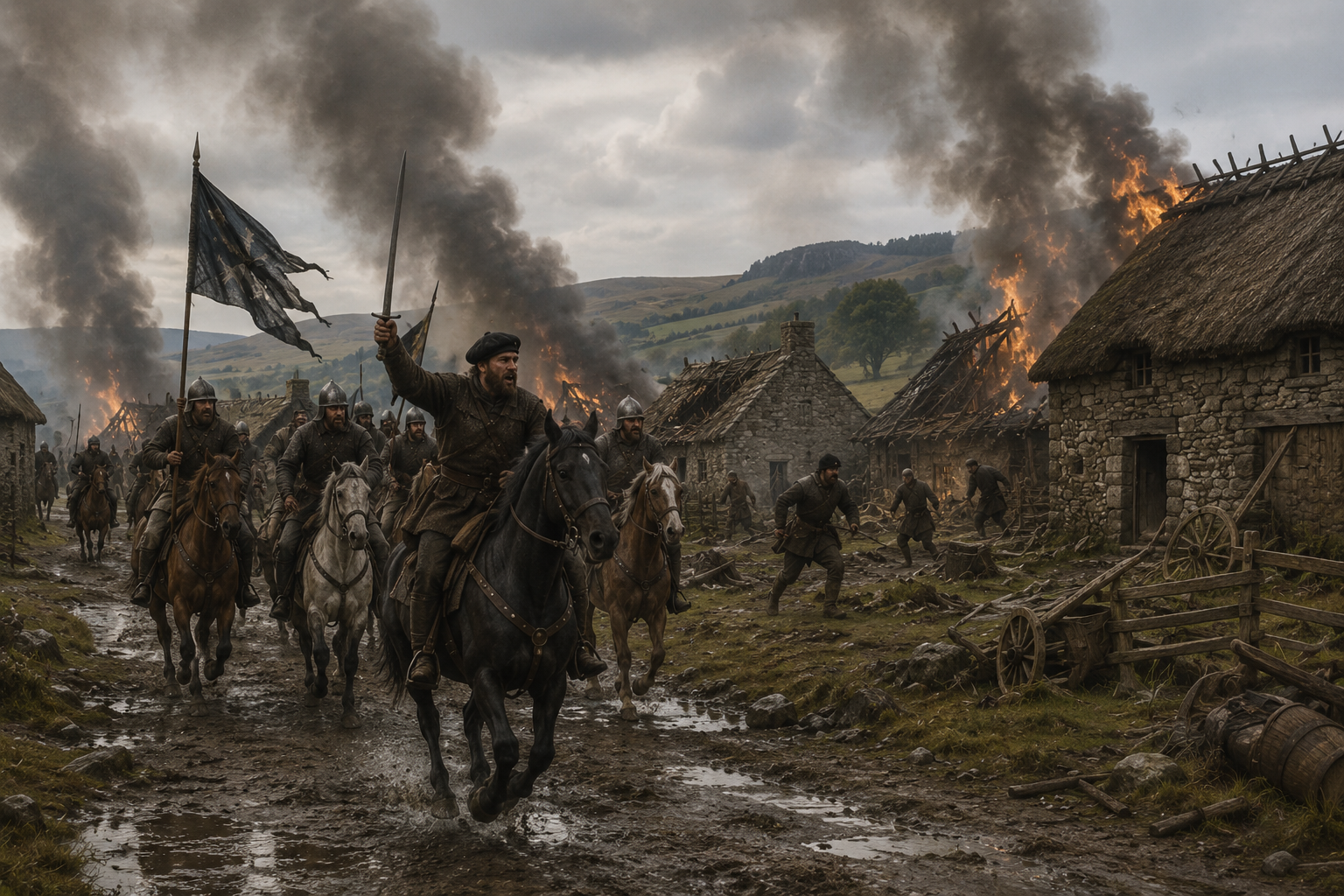
In November 1515, Lord Dacre, the English Warden, reported a substantial Scottish incursion across the Border. The party included the Scottish Warden together with Lord Carlyle, Sir John Murray of Cockpool, the Laird of Johnstone, Simon Carruthers of Mouswald, Sir Alexander Jardine, Carruthers of Holmains, Charteris of Amisfield and other Border lairds. From this force, approximately 400 horsemen were sent toward Arthuret, near modern Longtown. They burned a grange and sixteen houses.
This is the first point in our sequence of Holmains biographies where we can place the laird himself inside the brutal machinery of Border warfare. John was not merely living in a militarized society or theoretically obligated to provide armed service. He was participating in an actual cross-border operation with hundreds of mounted Scots.
Carruthers & Reid explicitly describe his later years as occupied by a resurgence of Border warfare “in which he took an active part.”
The event also places John alongside families whose names recur throughout the history of Dumfriesshire: Murray, Johnstone, Jardine, Carlyle, Charteris and the Mouswald Carruthers. These were not isolated clans living independently of one another. They formed an interconnected Border society that could feud one year, stand surety for one another the next, marry across family lines and ride together when political circumstances demanded it.
Seven Hundred Cattle
Two years later, in 1517, John appears in another episode that could hardly be more characteristic of the Anglo-Scottish frontier.
He participated in a raid into the Debatable Lands in which the Scots carried away approximately 700 English cattle. The affair was substantial enough that Carruthers & Reid note that it occupied the diplomatic machinery of the Scottish and English governments for years afterward. To modern eyes, cattle theft may sound almost mundane beside castles and battles. On the sixteenth-century Border it was anything but. Livestock represented portable wealth. A large-scale cattle raid could damage an enemy economically, reward followers and trigger retaliatory violence across the frontier. Seven hundred cattle represented a considerable haul. By this stage of his life, John 4th had moved a long way from the quiet image of a country landowner. He had managed an expanding estate, dealt with royal and feudal superiors, endured serious legal and financial difficulties and participated personally in armed Border expeditions.
The Grandson Waiting in the Wings
By the late 1510s, however, the succession had changed. John's eldest son and intended heir died sometime after February 1516. The next male heir was therefore the younger man's son—John 4th's grandson. That grandson would become John Carruthers, 5th of Holmains. This is a crucial point in the family tree because it explains what otherwise looks like an inexplicable jump between generations. The 4th Laird did not pass Holmains to a son bearing the title of 5th Laird. His son John died during his lifetime, and the estate therefore descended to the dead heir's son. The documentary proof appears in May 1523. On 21 May 1523, John Carruthers—the grandson—was infeft as heir to his grandfather in Holmains and the associated lands. The following day he received sasine in a 2½-merk land at Ruthwell. John 4th was dead by that date.
John's Death
We do not know the precise day or year in which John Carruthers, 4th of Holmains, died. Carruthers & Reid could establish only that his death occurred before May 1523, when his grandson succeeded him. His burial place is also unknown. His documented life nevertheless stretches across nearly half a century. He became fiar of Holmains in 1476, can safely be identified as the acting Laird in records by 1485, enlarged the estate in the 1490s, navigated serious legal and financial problems around the turn of the century, witnessed his eldest son become heir apparent, survived the national catastrophe surrounding Flodden, rode in the Border warfare of 1515 and 1517, and lived long enough to see the succession move down another generation.
That makes John 4th one of the first Holmains lairds for whom we can begin to reconstruct something approaching an actual life rather than merely a sequence of property transactions.
From Landholder to Border Laird
There is a noticeable evolution when we place the first four Holmains biographies beside one another. Roger's surviving identity is inseparable from the 1375 land grant that established Holmains. John 2nd inherited an estate that had expanded substantially and appears performing the legal responsibilities expected of a landed gentleman. John 3rd carefully arranged the transfer of the estate to the next generation in 1476. With John 4th, the doors suddenly open wider. We find him beside the River Annan, defending fishing rights. We see his oxen stolen. We find him in courts, in financial trouble, standing surety for other Border men and recovering lands when they fail him. We find him ordered into ward at Dumbarton Castle. We see him arranging property for a son who entered the Church, while another son was being prepared to inherit Holmains. And finally, after the death of James IV had plunged Scotland into another dangerous minority, we find the aging Laird of Holmains exactly where the geography of his family had always threatened to place him, on horseback, crossing the English Border.
The estate Roger received in 1375 had survived another generation. More importantly, it had become the seat of a family capable of playing an increasingly visible role in the affairs of Annandale. John's son would never inherit it. His grandson would. And under that grandson, the transformation that had been underway for nearly 170 years would finally become official.
Next, Holmains would become a barony.
For Your Reference;
Born: Unknown · probably mid-15th century · Annandale, Dumfriesshire, Scotland
Father: John Carruthers, 3rd of Holmains
Mother: Unknown; documented alive in 1476 but unnamed
Wife:Unknown
Children:John Carruthers, heir apparent, who died before succeeding his father; James Carruthers, Rector of Wamphray and cleric/notary
Grandson and Successor:John Carruthers, 5th of Holmains, later 1st Baron of Holmains
Occupation / Position: 4th Laird of Holmains; landed gentleman, estate holder and active participant in Border warfare
Fiar of Holmains:1476
Securely identifiable as Laird: by 1485
Death: before 21 May 1523 · probably Dumfriesshire, Scotland
Burial: Unknown
Wife's identity: Unknown; Carruthers & Reid speculated that an undocumented Crichton marriage might explain the family's unusually close Crichton connections, but no marriage is established.
Estate Record — 1476: John became fiar of Holmains through his father's resignation of Holmains, Little Dalton and Fourteenacres in his favor, while his father retained liferent and his mother's terce was protected.
Land Acquisition — 30 January 1492: John obtained a charter from Patrick Hepburn, Earl of Bothwell, for Daltonheuk, Blaeberrieward and the Isle in the Water of Annan, adding another important portion of Dryfesdale to the Holmains estate.
Legal Record — 1500: John was ordered to enter ward in Dumbarton Castle with other Dumfriesshire lairds. The surviving record does not state the offense.
Financial Record — 1502–1510: After standing surety for men who failed to appear at the Justice Ayre of Dumfries, John became liable for a 550-merk fine. Lands were apprised as he attempted to recover the debt; he subsequently received a Crown precept of re-entry in 1507, with sasine following in 1510.
Family Record — 1512/1516: John's eldest son John Carruthers appears as his son and apparent heir in 1512 and was still alive in February 1516. He subsequently predeceased his father, causing the succession eventually to pass to his own son.
Military Record — 1515: Carruthers of Holmains was among the Scottish Border force involved in the raid upon Arthuret, during which approximately 400 mounted men entered the district and burned a grange and sixteen houses.
Military Record — 1517: John participated in the raid into the Debatable Lands that carried away approximately 700 English cattle, creating a dispute between the Scottish and English governments that persisted afterward.
Family/Estate Record — May 1518: John provided his younger son James Carruthers, Rector of Wamphray, with liferent interests in Auldtoun and property associated with Moffat. James also appears in contemporary records as a cleric and notary.
Succession Record — 21–22 May 1523: John's grandson, John Carruthers, was infeft as his heir in Holmains and associated properties and then in land at Ruthwell, proving that the 4th Laird had died by this date and that his eldest son had predeceased him.
Arthur Stanley Carruthers & R. C. Reid, Records of the Carruthers Family (1934), Chapter V, “Holmains,” pp. 81–85. Read the original volume at Internet Archive
Calendar of Holmains Writs — particularly the early writs concerning Daltonheuk, Blaeberrieward, the 1502 surety affair, and the 1523 succession.
Historical Manuscripts Commission, Sixth Report and Fifteenth Report — documentary evidence for the Holmains succession and the John Carruthers heir-apparent generation.
Accounts of the Lord High Treasurer of Scotland, Vol. III — evidence concerning John's payments and restoration to his lands.
16th Great Grandfather of author Krysta Abesamis