7th of Holmains
John Carruthers — Seventh Laird of Holmains, Third Baron
John Carruthers entered the documentary record long before he became 7th Laird of Holmains. He was the eldest known son of George Carruthers, 6th of Holmains, although Records of the Carruthers Family cautiously notes that he may have belonged to George's unidentified first marriage rather than to his later marriage with Margaret Irving. By 1563, John was already independently established as John Carruthers of Harthwat, having been infeft in the ten-merk lands of Rammerscales and Harthwat after William Ramsay of Sipland resigned the superiority. Ten years later, in 1573, John's grandfather, the long-lived John Carruthers, 5th of Holmains, granted him the six-merk lands of Little Dalton and the £4 lands of Ecclefechan called Castlebank. John was therefore being deliberately established as a landed man while both his father and grandfather were still alive.
His lifetime would carry the family across one of the great dividing lines in British history. John was born into the Scotland of Mary Queen of Scots, matured under James VI, and died after that same James had inherited the English throne and begun the political transformation of the Borders. During John's lifetime Mary was forced from the Scottish throne, executed in England in 1587, the Spanish Armada sailed in 1588, and in 1603 the crowns of Scotland and England were united in the person of James VI and I. For a Border laird, that last event was particularly important. The Anglo-Scottish frontier that had shaped Carruthers life for centuries was about to cease functioning as an international border.
John of Harthwat
John's years as John Carruthers of Harthwat are unusually important because he did not simply wait for Holmains to fall into his hands. His grandfather appears to have taken a particular interest in his future. In 1575, John married Nicolas Jardine, sister of Alexander Jardine of Applegarth. The marriage contract was dated at Spedlings on 16 April 1575, and under its terms John's grandfather infeft him in lands amounting to approximately 28 merks and 40 shillings in the parishes of Little Dalton, Meikle Dalton and Dryfesdale. In 1579, this arrangement was extended dramatically: a new Crown charter was obtained covering the whole Barony of Holmains in John's favor. Carruthers & Reid themselves remark upon the unusual nature of the transaction because John's grandfather was effectively benefiting the grandson while John's father George—the actual next Laird—was still alive.
The marriage to Nicolas is particularly valuable because, unlike several of the uncertain wives attached to the earlier Holmains generations, she is documented. Her name was Nicolas—not the modernized “Nicole” sometimes found in online pedigrees—and the 1575 marriage contract provides the strongest foundation for identifying her. She belonged to the Jardines of Applegarth, another major Annandale family whose lands, political relationships and feuds repeatedly intersected with those of the Carruthers.
John continued expanding his own position while his father held Holmains. During George's lairdship he obtained through apprising the lands of Holmheid and others, amounting to sixteen and a half merks and known as the third of Castlemilk. He was also involved in absorbing the Almagill and Hallidayhill properties formerly belonging to the McBrair family. When Robert McBrair, a minor heir, was ordered in 1590 to answer for disorder committed by inhabitants of Almagill, the Privy Council determined that responsibility rested instead with John Carruthers, younger of Holmains. The episode shows John already exercising the practical authority of the future head of the house.
The Fight for Holmains
George Carruthers appears to have died by 22 May 1592, but John's transition into possession was not straightforward. By April 1597, he is securely described as John Carruthers of Holmains, and on 5 April he brought an extraordinary complaint before the Privy Council. John explained that his grandfather had already infeft him heritably in the Barony of Holmains without reserving a liferent either to himself or to George. John had nevertheless allowed his father to occupy the house during his lifetime. After George's death, however, George's widow and her four sons refused to surrender Holmains to him.
The dispute provides a rare glimpse inside the family itself. John's stepmother appeared before the Council and was ordered to deliver the house of Holmains to him. In return she was to receive Kirkwood for life, provided that her sons did not intrude themselves into Holmains and that their differences with John were submitted to arbitration. The following month John received Crown infeftment in Murthwate and Hennelland as heir to his grandfather. His succession therefore involved much more than simply inheriting when his father died; it required John to assert rights that his grandfather had given him decades earlier.
The Head of a Border House
Once established at Holmains, John immediately appears performing the political functions expected of the head of a substantial Border family. He acted as surety in the complicated bonds of mutual caution that attempted to keep order among the West March families, including for Sir John Gordon of Lochinvar and the Laird of Applegarth. When John's own brothers Simon and Thomas refused to obey an order removing them from Almagill and Hallidayhill, John was required to produce them before the authorities. In 1602, he received responsibility for the good behavior of his clan and tenants and was appointed to a committee of Border lairds advising the Warden on maintaining peace.
Maintaining that peace was another matter. In the same year, members of the Carruthers of Dormont branch became embroiled in a dispute over the teind sheaves of Meikle Dalton. Armed with jacks, steel bonnets, swords and lances, they descended upon several settlements, broke into barns and carried away corn. The Privy Council eventually denounced the offenders as rebels. John therefore occupied a difficult position familiar to Border lairds: he was simultaneously head of a powerful kin group, participant in its interests and one of the men whom the Crown expected to control it.
1603 — The Border Changes Forever
In March 1603, Queen Elizabeth I died and James VI of Scotland became James I of England. For most of the Carruthers family's recorded history, Holmains had stood within a militarized frontier zone facing another kingdom. Suddenly the same monarch ruled both sides of that frontier. James began an aggressive campaign to suppress the raiding culture of what he increasingly called the Middle Shires, describing the Borders as the heart of his new British realm. Commissioners were appointed, troublesome lairds were detained away from their home districts, and the Crown attempted to replace the older system of feud, private vengeance and regional allegiance with direct royal law.
John became directly involved in that transformation. In March 1605, he was joined with the Lairds of Drumlanrig, Amisfield, Lag and Applegarth and ordered to deal with a violent seizure of Newbie Tower. A Maxwell party had taken the stronghold from the Johnstones, ejecting its occupants and seriously wounding Edward Johnstone. The Privy Council ordered John and the other lairds to assist the royal lieutenant in retaking the tower and preventing both Maxwells and Johnstones from reigniting the conflict. This is especially striking given the older Holmains association with the Maxwell interest. Under the new political order, John was increasingly acting as an officer of royal authority rather than simply as a partisan Border ally.
The same period brought an important expansion of the Holmains estate. The Carruthers had long claimed rights in Meikle Dalton, where they described themselves as “kindly tenants.” In 1605, the Lindsay proprietors agreed to sell their interest to Holmains for 2,400 merks, bringing a substantial portion of the old parish of Meikle Dalton into the estate. The transfer itself was not finally completed until 1616, but the agreement represented another significant stage in the territorial growth that had begun with Roger's original Holmains grant in 1375.
Steward Depute of Annandale
John's importance in local government increased substantially during these years. With Lord Maxwell in hiding following the killing of Sir James Johnstone of Dunskellie in 1608, John acted as Steward Depute of Annandale and was required to reconstruct the district's missing taxation roll. He convened a court at Lochmaben to prepare a new roll for preservation among the Crown's tax records. He is documented as Steward Depute in 1610 and 1613 and was also among the early Justices of the Peace for Dumfriesshire.
His relationship with royal authority was nevertheless complicated. James's pacification policy did not spare respected Border lairds merely because they were useful. On 26 November 1607, John was ordered into ward at St Andrews, with James Douglas of Torthorwald providing surety of 1,000 merks for his obedience. By the following March he was required to remain within Edinburgh, and later in 1608 he and Sir Alexander Jardine were warded in Fife. Yet while John was confined to Edinburgh, he was still considered sufficiently trustworthy to serve on an assize and acted as Chancellor of the court in a capital case involving the killing of a member of the King's Guard. By September he was again free and functioning as Steward Depute.
This apparent contradiction actually tells us a great deal about the period. John was not being treated simply as a criminal. The Crown was deliberately removing influential Border lairds from their local power bases while simultaneously using their experience and status to administer justice. The old Border elite was being disciplined and incorporated into the new royal system at the same time.
The Prison Beneath Holmains
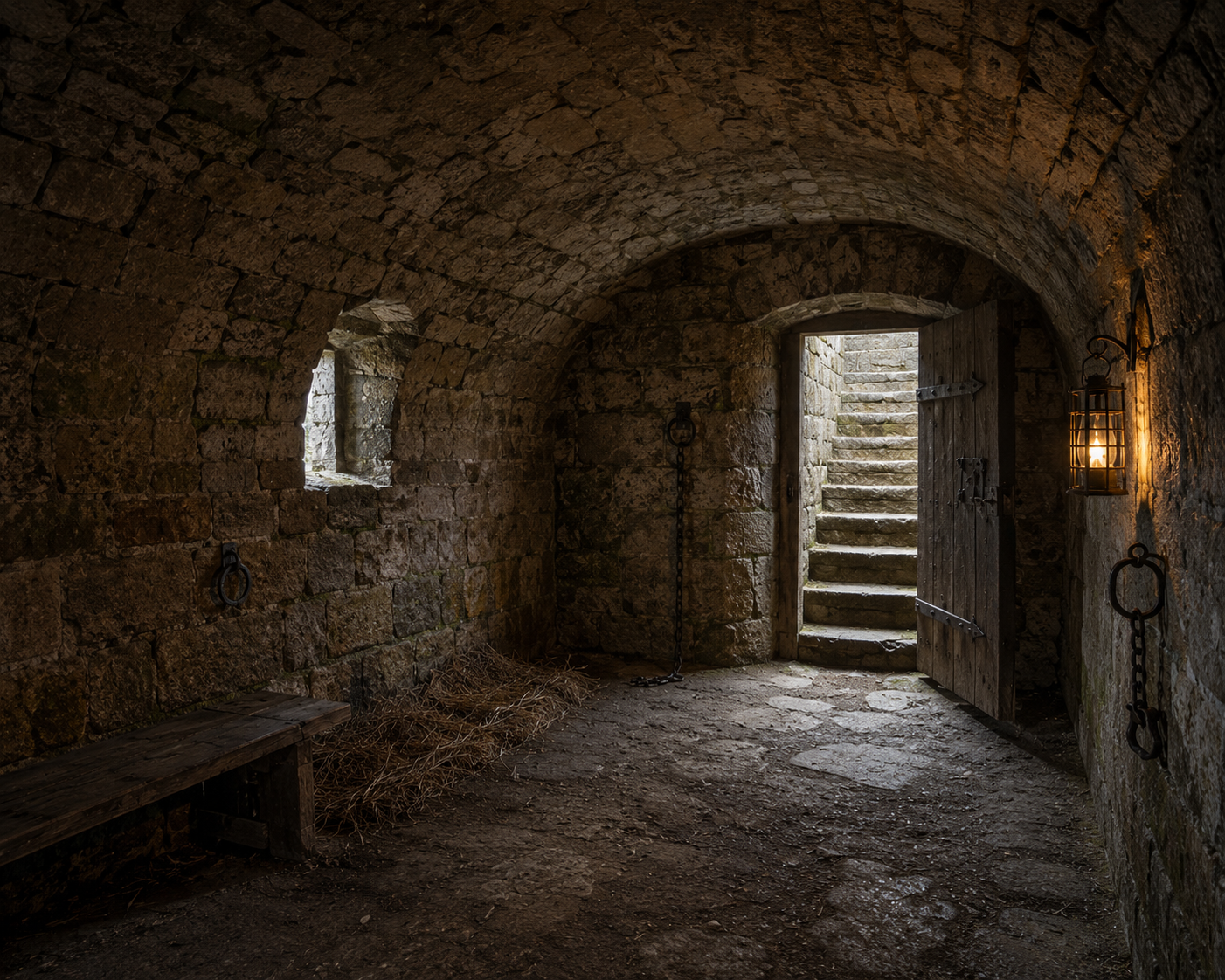
Records of the Carruthers Family states the vaulted basement of Holmains Tower was at times used as a prison.
John's position as Steward Depute gives us one of the most extraordinary surviving details about Holmains Tower itself. With the principal gaol at Dumfries and prisoners sometimes needing to be held locally, Records of the Carruthers Family states that the vaulted basement of Holmains Tower was at times used as a prison. One surviving complaint concerns James Wichtman of Over Dormont, whom John apprehended and confined in what the record calls the “pitt” within the place of Holmains. Wichtman complained to the Privy Council that he had been held in severe conditions without lawful sentence and successfully forced John to provide security of 500 merks that he would not harm him.
This is particularly valuable because it gives us evidence about the physical use of the building rather than simply its existence. Holmains was not merely a family residence surrounded by farmland. During John's tenure its fortified lower level could function as a place of detention connected with his authority in Annandale.
John and Nicola Jardine
‘Nicolas’ or ‘Nichola’ Jardine remained beside John throughout this period and survived him. Their marriage produced at least five documented sons: John, George, William, Thomas and Charles Carruthers. Their eldest surviving son, another John, married Agnes Douglas, daughter of George Douglas of Parkhead and Marion Douglas, in 1600. In 1604, the younger John was infeft in the Barony of Holmains while his father retained liferent and Nicolas retained her customary terce. George became associated with Over Denbie, while William became William Carruthers of Knox and married Mariot Porteous. Thomas and Charles also appear as witnesses to family transactions.
The surviving records do not present Nicolas as a passive figure. After John's death she vigorously defended her own property and liferent interests, sometimes with methods every bit as forceful as those of the men around her. Her later disputes with her eldest son and tenants belong primarily to the story of the 8th Laird, but they demonstrate that the Jardine woman who married John at Spedlings in 1575 remained an active participant in the affairs of Holmains for decades. She was certainly alive in 1631 and may have died around that time.
The Final Years
John's later years were not financially easy. He became involved in substantial debts and surety obligations, including liabilities arising from members of his own family. He was sued in 1611 for an annual obligation of 1,000 merks connected with a debt contracted by his son William, and in 1612 another action sought £1,000 from him, with his eldest son John and Robert Johnstone of Raecleuch also involved. His public responsibilities were troublesome as well. In 1611 he was temporarily replaced as Steward Depute after being accused of negligence in collecting overdue taxation, although the surviving evidence shows him again holding the office afterward.
John died early in 1616. His burial place has not yet been securely identified in the material we have examined. He was succeeded by his eldest surviving son John Carruthers, 8th of Holmains and 4th Baron, while Nicolas Jardine remained alive and retained her rights in the estate. The transition was anything but peaceful: within a year Nicolas was before the Privy Council complaining about her son's conduct at Holmains, opening another turbulent chapter in the family's history.
The Laird Who Saw the Border Disappear
John Carruthers's life occupies an unusually important place in the Holmains story because he stood on both sides of a historical divide. He began as John of Harthwat, a young landed gentleman in a frontier society governed by kinship, armed followings and the constant possibility of Anglo-Scottish conflict. He married into the Jardines, accumulated property, inherited a family still deeply connected with the traditional Border power structure and became head of a house whose members could still settle disputes with steel bonnets and swords.
By the end of his life, the political world that had created that society was disappearing. James VI had become king of England, the international frontier had effectively vanished, and the Crown was deliberately dismantling the old Border order. John experienced that transformation personally: he was ordered away from Annandale during the pacification, yet was simultaneously employed as a judge, commissioner, Justice of the Peace and Steward Depute of Annandale. The same man who could be warded by the Crown could shortly afterward be entrusted with administering its justice.
Roger de Carruthers had founded Holmains in a fourteenth-century Scotland still shaped by the aftermath of the Wars of Independence. More than two centuries later, John Carruthers died in 1616 as a local officer of a monarch who ruled both Scotland and England. Few Holmains generations witnessed a greater transformation.
The Border remained violent, family rivalries remained dangerous and Holmains Tower itself still contained a prison pit, but the political frontier that had defined Carruthers life for generations was gone.
For Your Reference;
Born: date unknown · probably Dumfriesshire, Scotland
Father: George Carruthers, 6th of Holmains and 2nd Baron
Mother: uncertain; John may have been a son of George's unidentified first wife
Known before succession as:John Carruthers of Harthwat
Wife: Nicolas Jardine, sister of Alexander Jardine of Applegarth
Marriage: 16 April 1575 · marriage contract dated at Spedlings
Known Children: John, George, William, Thomas and Charles Carruthers
Position: 7th Laird of Holmains and 3rd Baron; Steward Depute of Annandale; Justice of the Peace for Dumfriesshire; Border commissioner and landed gentleman
Early landholding: infeft in Rammerscales and Harthwat in 1563; Little Dalton and Castlebank in 1573
Holmains: heritably infeft in the barony during his grandfather's lifetime; securely styled of Holmains by April 1597
Death: early 1616
Burial: presently unknown
Successor: John Carruthers, 8th of Holmains and 4th Baron
Arthur Stanley Carruthers & R. C. Reid, Records of the Carruthers Family (1934), Chapter V, “Holmains,” pp. 92–99, drawing extensively upon the Calendar of Holmains Writs, Register of the Privy Council of Scotland, Exchequer Rolls and other contemporary records. Original volume at Internet Archive
Calendar of Holmains Writs — particularly the records concerning Harthwat, the 1575 Jardine marriage contract, the 1579 Holmains charter, Meikle Dalton and the succession arrangements for John's son.
Register of the Privy Council of Scotland — John's 1597 Holmains dispute, Border sureties, 1602 responsibilities, 1605 Newbie intervention, 1607–08 warding, Steward-Depute activity and later legal disputes.
12th Great Grandfather of author Krysta Abesamis
*Note on Historical Images
Some images used in this article are AI-assisted historical reconstructions, created to help visualize people, places, buildings, and events for which no surviving photograph or contemporary image exists. These images are interpretive illustrations, not historical photographs or authenticated portraits. Where possible, reconstructions are informed by surviving records, period architecture, clothing, landscapes, heraldry, and other historical references. They are included for visual context and storytelling and should not be considered documentary evidence.