Women Floral Artists Under The Scope
In the 18th century, London’s vineyards and nurseries supplied lush gardens for rich aristocrats and prosperous merchants. Botanical publications introduced readers to new plants they might never see growing in England. And floral collectors paid considerable sums for these rare specimens, while artists worked to capture their colors and structures before the flowers faded.
For a young woman who could draw, this flourishing trade offered possibilities beyond the usual Georgian lady life.
If the hospital identification proves correct, she was born May 21st, 1781; it offers an intriguing starting point.
The British Lying-In Hospital was a charitable maternity institution. As for her mother, Mary, and her father, William Lawrance’s occupation as a tailor places the family within London’s working trades rather than its wealthy botanical collecting circles.
Sadly, I have found very little evidence of her childhood. No hidden detail tells me how Mary learned to paint. I want to know who first placed a pencil in her hand. Did she learn through formal lessons or someone's encouragement? We may never know.
By 1795, Mary Lawrance was painting and exhibiting a floral piece at the Royal Academy.
The Academy’s annual exhibition was one of London’s most important artistic events.
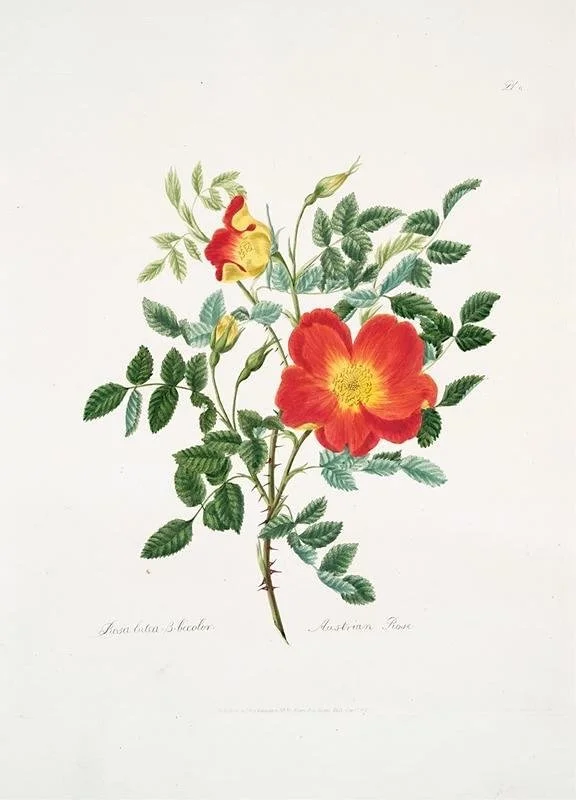
Rosa lutea - bicolor
Imagine, at her young age, seeing her paintings exhibited at the Royal Academy, surrounded by works from some of Britain's most accomplished artists!
In 1795, the Academy recorded a Miss M. Lawrence in London's Marylebone district.
Queen Anne Street East was part of a neighborhood where artists, musicians, craftsmen, and prosperous households lived within reach of London's cultural institutions. Today, its former route is associated with Foley Street and Foley Place, but Mary's original doorways have not been precisely identified. She was a young woman working in a London neighborhood close enough to participate in the capital's expanding artistic and botanical trade.
And then came the roses.
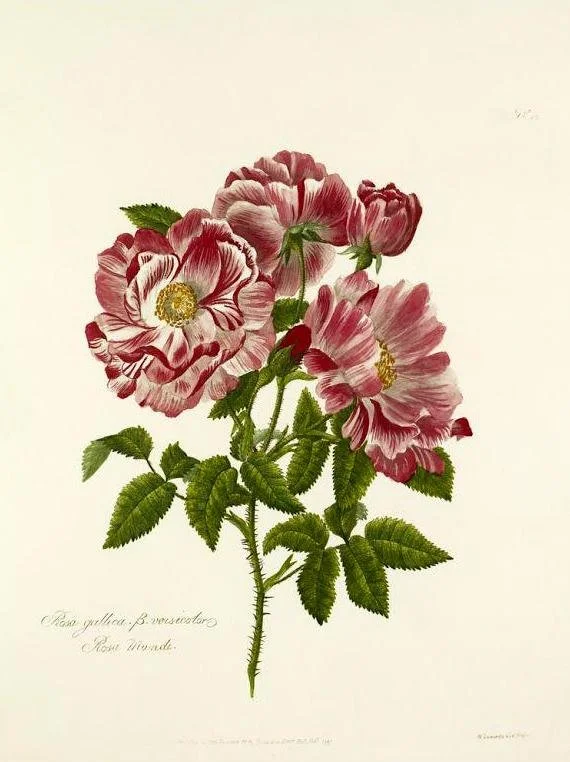
In 1796, Mary began publishing A Collection of Roses from Nature, an extraordinary undertaking that would eventually contain ninety hand-colored plates, issued in thirty installments through 1799. Every rose needed to be observed and drawn. The illustrations had to be transferred into printable form, impressions produced, and their delicate colors applied by hand. Subscribers had to be found, payments collected, and installments delivered.
Mary was producing a substantial botanical publication under her own name.
Rather than relying entirely on established publishers, she sold subscriptions to her own botanical collections, releasing hand-coloured illustrations in installments!
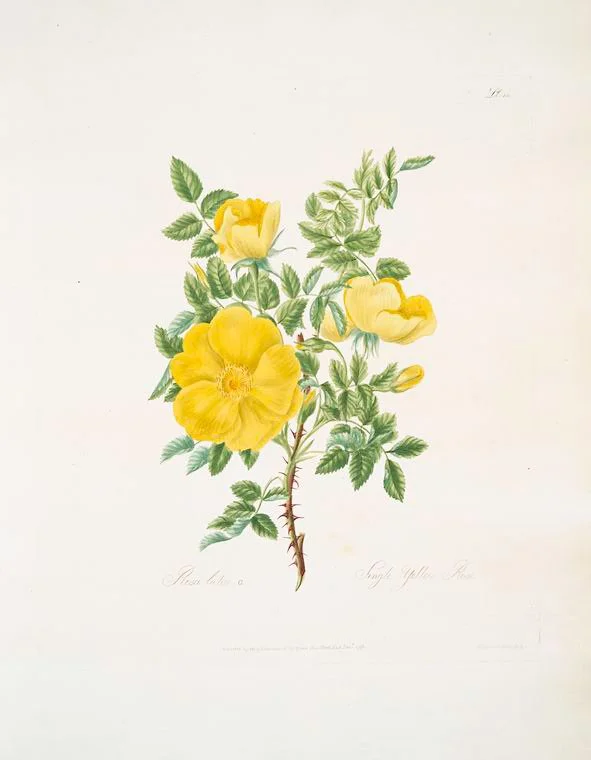
Rosa lutea
Publishing by subscription helped make such an expensive enterprise possible. Rather than waiting until an entire book was finished, an artist or publisher could secure customers in advance and release the work in parts. Brilliant!
It was an established business method, but one that required considerable organization and confidence.
And roses were hardly an easy subject. Their layered petals, subtle color changes, prickled stems, and distinctive leaves demanded close observation. A botanical illustration needed to be beautiful, certainly, but it also had to convey the plant's characteristics. She must have worked day & night!
Some present individual roses with their stems, buds, and foliage. Others demonstrate her gift for arranging flowers into compositions that could appeal to collectors as works of art. The surviving prints identify Mary not only as the artist but also as the engraver and publisher. She was participating in several stages of the process that brought her work into people's homes.
I am very curious how much hand-coloring she actually did herself and how much she may have had assistants complete. Because producing ninety plates for subscribers was a substantial operation!
But by the end of the 1790s, Mary had accomplished something that her earliest Academy entries scarcely hinted at. She had turned her ability to paint flowers into a publishing enterprise.
Ninety roses were apparently not enough for Mary.
Around 1799, she turned her attention to — Passionflowers.
Their elaborate crowns, curling tendrils, and extraordinary colors presented a new artistic challenge. Mary's A Collection of Passion Flowers, Coloured from Nature was intended to contain thirty plates, although only eighteen are known to have appeared. Why the publication remained unfinished is uncertain.
Among the nurseries supplying Mary with botanical specimens was the celebrated Vineyard Nursery in Hammersmith, established by James Lee and Lewis Kennedy around 1745.
Here we find a fascinating connection. James Lee was the father of botanical artist Ann Lee, whose work also appears in this book. Ann died in 1790, before Mary's career was established, but the nursery continued under the next generation.
The two women were connected through the same botanical establishment; sadly, there is no evidence they ever met.
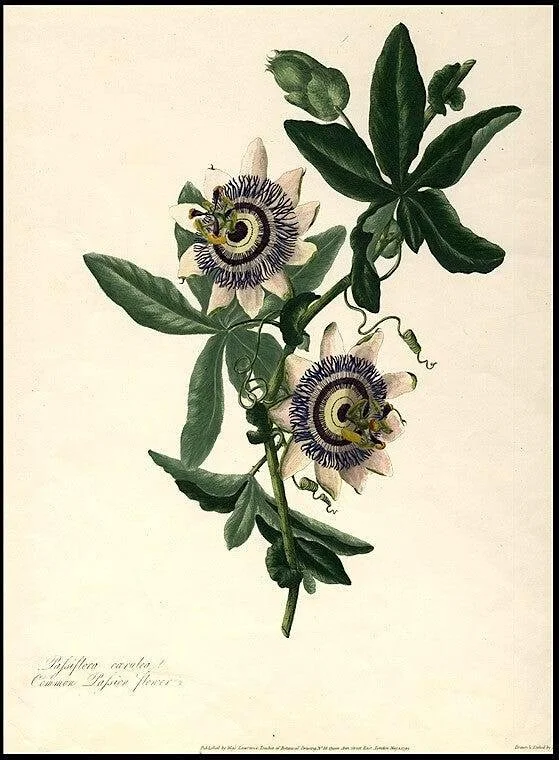
Passiflora caerulea (1802)
The strongest evidence comes from a contemporary publication, not a later biography. A bibliographical record for Mary's Groups of Flowers reproduces its publication imprint:
“published by Mary Lawrance, Teacher of Botanical Drawing, No 86 Queen Ann Street, East London, Nov 1 1800.”
Mary publicly advertised herself as a teacher of botanical drawing. However, the address could have been her residence, studio, teaching premises, or publishing address. The imprint alone tells us that by November 1800, Mary was working at 86 Queen Anne Street East, only a few doors from her recorded 1795 address. She also taught botanical drawing, reportedly charging half a guinea per lesson.
Publishing and teaching had become central to her professional life. Her paintings appeared at the Royal Academy, her publications circulated among collectors, and her drawing lessons brought her into contact with London's fashionable households.
Yet her personal life remains surprisingly difficult to trace.
One valuable glimpse comes from the diary of Joseph Farington, a Royal Academician who recorded conversations, appointments, and encounters within London's artistic community.
In 1804, Farington mentioned Mary in connection with Charles Greville, a prominent collector and naturalist. The reference places her within the professional networks around the Royal Academy, where introductions and recommendations could help an artist secure commissions or recognition. Greville was particularly interested in natural history, making his connection to a botanical artist especially relevant.
Mary's work wasn't confined to the drawing table; she navigated a world of patrons, collectors, publishers, and influential acquaintances. At some point, she married Thomas Kearse and became known as Mary Kearse. I think Thomas was an artist, too. I find that name in exhibition records surrounding Mary.
An artist named ‘T. Kearse’ exhibited Insects, from Nature at the Royal Academy in 1800. It’s fair to identify him as Mary's husband, particularly given their shared interest in natural history, but this connection has not yet been proven.
We can see the professional reputation Mary built before her marriage around 1813. She had exhibited publicly, published two ambitious botanical collections, and taught her skills to others. Her flowers were beautiful, but the career behind them was a considerable accomplishment for a woman working independently in Georgian London.
Once she became Mrs. Kearse, her name changed in the historical record, making it harder to follow her artistic activities through exhibition catalogs, advertisements, and publications.
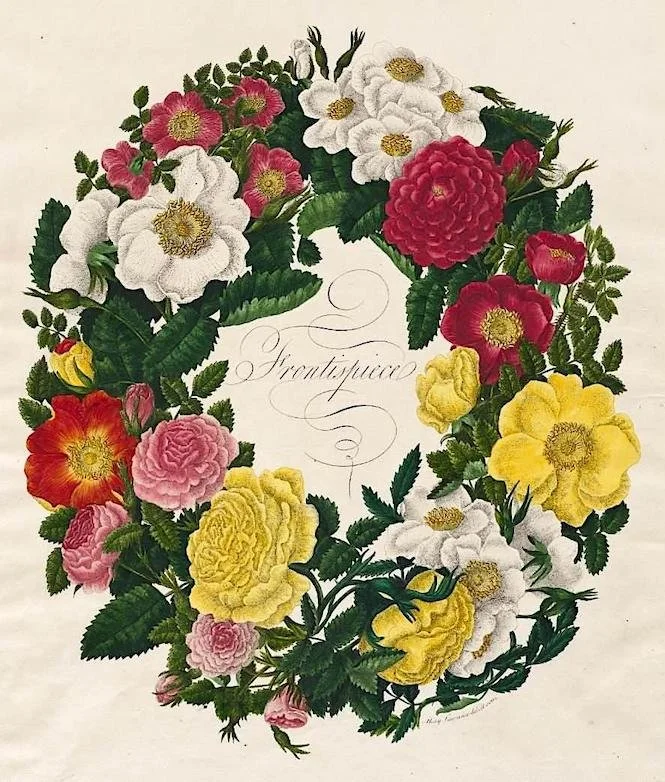
A Wreath of Roses (1799)
Yet, my research suggests that Mary continued exhibiting at the Royal Academy as Mrs. Kearse until 1830.
By then, she had spent more than three decades establishing herself as a botanical artist, engraver, publisher, and teacher. Her name appears again in the 1841 census, reportedly with her occupation recorded simply as artist. It is a small but meaningful detail. Long after the publication of her celebrated roses, she was still identified by the profession she had made her own.
Mary died on 27 March 1845 at 48 Foley Street, Marylebone, and was buried at St Mary's Church, Paddington Green.
Foley Street still exists, and the address survives in modern records, though I do not see the original house standing. I would love to know more about her final years, her marriage, and the household behind that London address. Those details remain frustratingly elusive. But the flowers have survived.
Her roses and passionflowers remain in museum and library collections more than two centuries after she drew them. They preserve the work of a woman who turned a fashionable Georgian accomplishment into a substantial professional career.
Mary Lawrance was an artist who made her living through the beauty and careful observation of plants and left behind an extraordinary record of both. I adore Mary’s work; it has a sweetness that I feel, more than two centuries later, still lingers today.
For Your ReferenceBiographical and historical sourcesAnnette Peach, “Lawrance, Mary (c. 1776/7–1845),” Oxford Dictionary of National Biography, Oxford University Press. Read biography.Blanche Henrey, British Botanical and Horticultural Literature before 1800, 3 vols. (Oxford University Press, 1975). See the discussion of Mary Lawrance and her botanical publications.Joseph Farington, The Diary of Joseph Farington, edited by Kenneth Garlick and Angus Macintyre (Yale University Press, 1978–1984). Contemporary references to Mary's artistic connections, including Charles Greville.
Original publications and surviving artworkMary Lawrance, A Collection of Roses from Nature (London, 1796–1799). Auckland Libraries Heritage Collections — digitized original.Mary Lawrance, A Collection of Roses from Nature (1799). New York Public Library Digital Collections.Mary Lawrance, A Collection of Passion Flowers, Coloured from Nature (London, 1799–1802). Christie's — historical copy and bibliographical description.The Morgan Library & Museum, A Collection of Roses from Nature, accession PML 55622. Collection record.
Royal Academy and archival recordsRoyal Academy of Arts, Exhibition Catalogs, 1794, 1795, 1800, 1816, and 1817. Contemporary records of Mary's exhibitions, addresses, and married name. 1816 original catalog.McGill University, Rare Books and Special Collections, M. Kearse Manuscript, CA RBD MSG 359. Archival catalog.Morning Herald (London), 1 April 1845, p. 7. Reported reference for Mary's death; original notice requires verification.Census of England and Wales, 1841, Marylebone, Middlesex. Reported record for Mary Kearse; original household entry requires verification.Researched & Written by author Krysta Abesamis