Women Floral Artists Under The Scope
In 1803, Britain was preparing for war. For the people of Norfolk, along the coastline, the threat felt close to home. Napoleon Bonaparte’s armies threatened Europe, and fears of a French invasion spread across the English coast.
Sarah Anne Drake was born on July 24th 1803, in Skeyton, a small parish in northeastern Norfolk. Her father was John Drake, a farmer, and her mother was Sarah Forman. Norfolk was an important agricultural county shaped by village life, from planting and harvesting to selling produce at local markets.
Sarah Drake grew up surrounded by the fields, flower gardens, and seasonal changes. Although I have no evidence of where she learned to draw & paint.
An important childhood relationship was Sarah’s friend, Anne. She was John Lindley’s sister — John was a young Norfolk-born botanist who would eventually become one of Britain’s biggest figures in horticultural science. What a great connection!
Sarah was eleven when Napoleon was finally defeated at Waterloo. The country around young Sarah was changing. King George III died in 1820, and his son George IV inherited the throne. Industrial towns were overflowing, and developments in printing and lithography were attracting new artists and audiences.
Botany and flower drawing were now considered suitable accomplishments for educated women.
Yet men largely controlled the institutions that advanced scientific knowledge. Women could study plants, paint them, and sometimes earn a living illustrating them, but they still faced considerable barriers to recognition as scientific authorities. Ugh.
Sarah’s education still remains vague. A loose biographical account places her in Paris as a young woman, possibly studying art, although the dates, institution, and precise nature of her training remain unclear.
Whoever taught her, she eventually developed remarkable accuracy and artistic skill in botanical illustration.
Meanwhile, her childhood friend’s brother was building a career in London.
In 1829, John Lindley was appointed Professor of Botany at the newly founded University of London.
Around 1830, Sarah joined the household of John Lindley and his wife, Sarah Freestone, at Acton Green in Middlesex. She was twenty-seven years old. Some biographical accounts suggest she initially served as governess to the Lindley children. Within the family, she became affectionately known as Ducky.
Their household wasn’t anything like the farm. John Lindley’s professional life involved scientific publications and botanical specimens arriving from collectors and nurseries. How exciting!
And what she didn't know yet was how her own drawings would contribute to this scientific work…
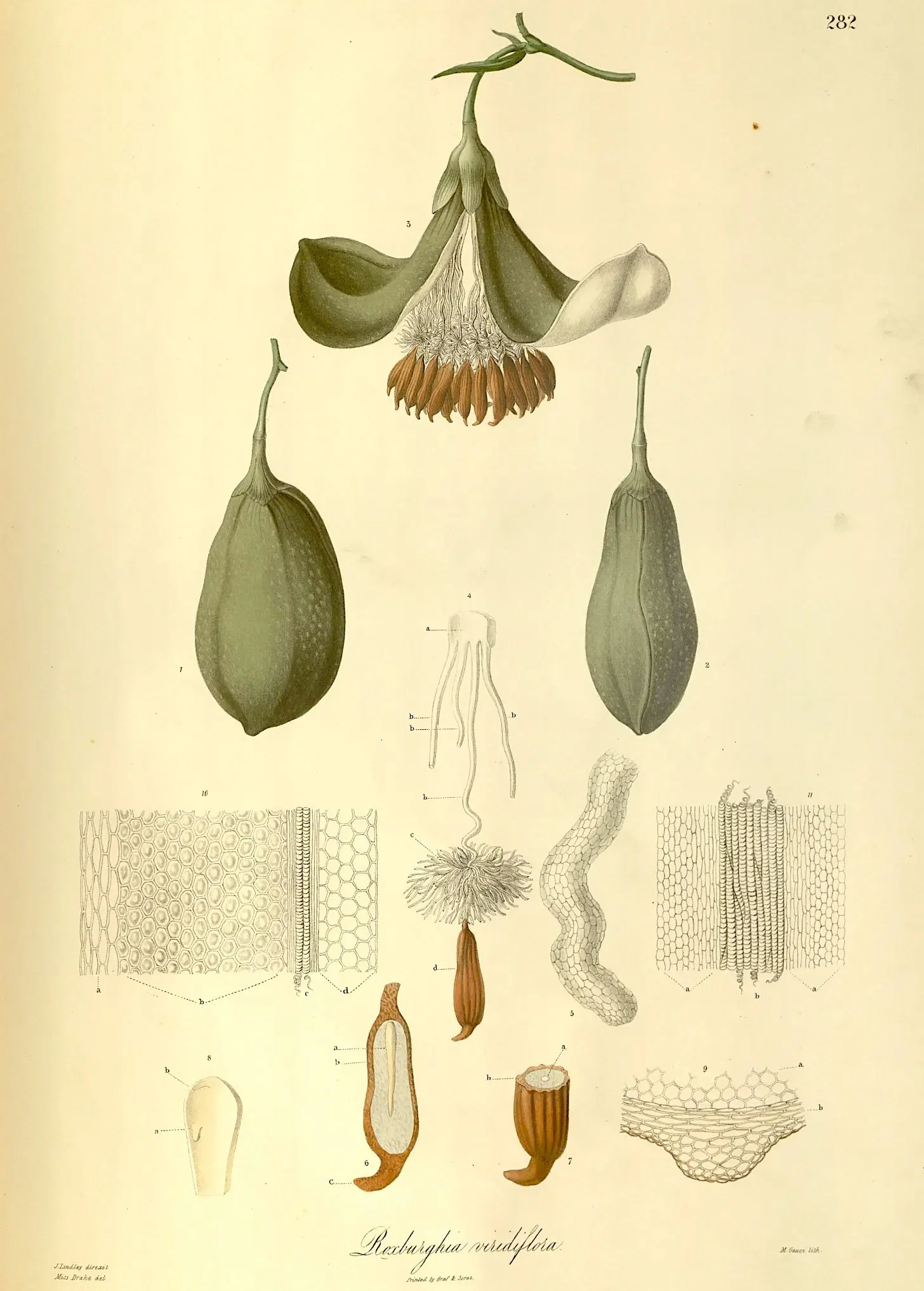
Roxburghia viridiflora (1832). Missouri Botanical Garden Library collection.
By the early 1830s, London was becoming obsessed with exotic plants.
Wealthy collectors were filling their greenhouses with species arriving from Asia, South America, and other distant parts of the world. Orchids were particularly desirable, with their extraordinary shapes, brilliant colors, and often astonishing prices.
Plant hunters traveled overseas in search of botanical treasures. Some returned with living specimens, others with dried plants and drawings. Nurseries competed to introduce unusual species, while scientific publications helped collectors identify what they were buying.
Much of this activity was tied to Britain's expanding imperial trade and colonial networks. Plants collected abroad could become fashionable possessions in English gardens, often with little recognition of the local people whose knowledge had helped collectors find them.
And Sarah Drake was about to become very busy!
John Lindley was already a respected botanist, author, and editor of Edwards's Botanical Register, a beautifully illustrated periodical devoted to plants of interest to British gardeners.
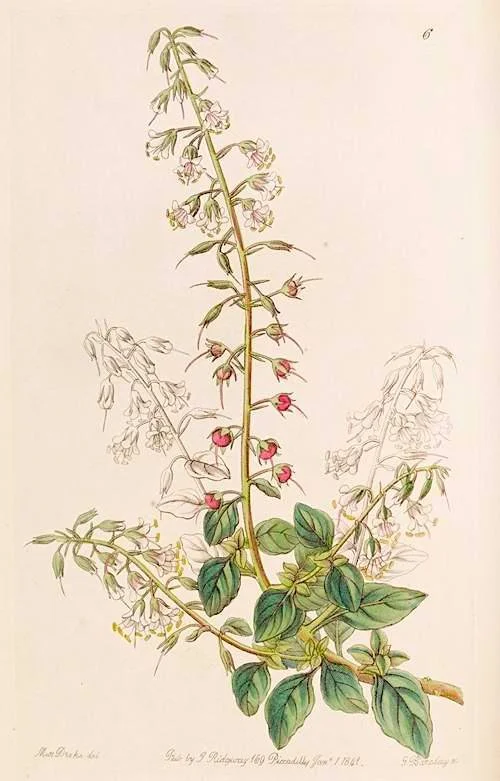
Hibiscus radiatus (1831) in Edwards's Botanical Register, Vol. 17, Plate 1395.
He had plenty of scientific work to occupy him, and Sarah's talent for drawing offered an opportunity. Under his guidance, she began developing her skills as a botanical illustrator, working from living specimens and drawings supplied by collectors.
Her illustrations appeared in Nathaniel Wallich's Plantae Asiaticae Rariores, published between 1830 and 1832, one of the earliest major publications associated with her professional career.
By 1832, Sarah was contributing regularly to Edwards's Botanical Register.
Botanical illustration required considerably more than making a flower look pretty. Every petal, leaf, stem, and reproductive structure had to be represented accurately enough for readers to recognize the species. Sometimes an artist needed to show a plant at different stages of development or include enlarged details of its smallest parts.
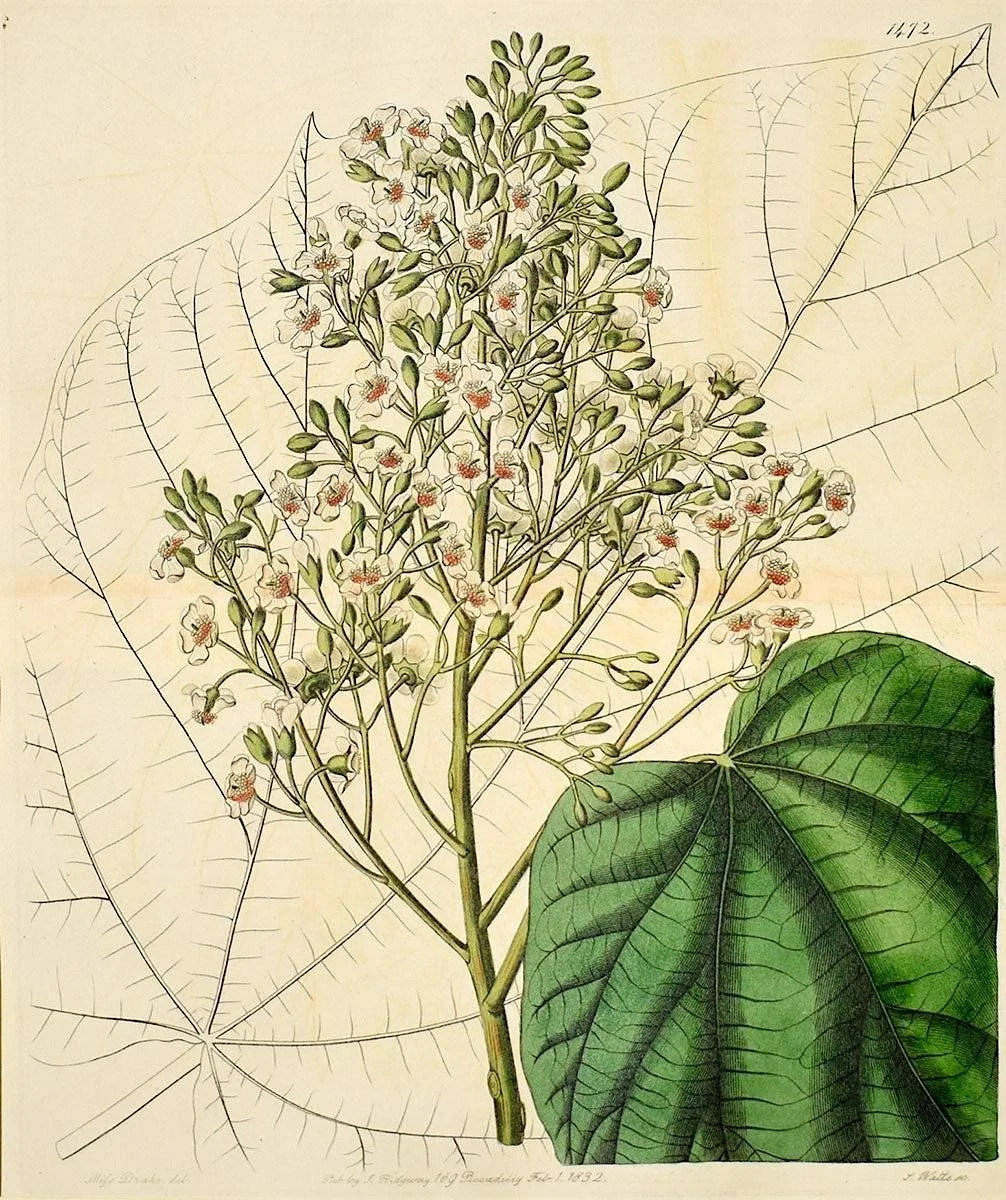
Costus pictus (1833)
Sarah worked with specimens from the Lindley household, the Royal Botanic Gardens at Kew, and the nursery of George Loddiges, whose Hackney establishment was famous for its collection of exotic plants.
Imagine the variety of flowers she encountered, some of which had only recently reached Britain!
In 1834, Sarah's illustrations appeared in Lindley's Ladies' Botany, a publication intended to make botanical knowledge accessible to women. It was an interesting arrangement. Lindley was helping women learn about plants while maintaining a distinction between botanical study as a feminine accomplishment and botany as a serious scientific profession.
(In his inaugural university lecture of 1829, he had complained that botany was too often regarded as an amusement for ladies rather than a subject deserving the serious attention of men. Yet here was a woman helping make his scientific publications possible. O Ding Dongs.)
Sarah's work soon became extraordinary in both quantity and quality.
Between 1832 and 1847, she produced approximately 1,148 plates for Edwards's Botanical Register, including 333 illustrations of orchids.
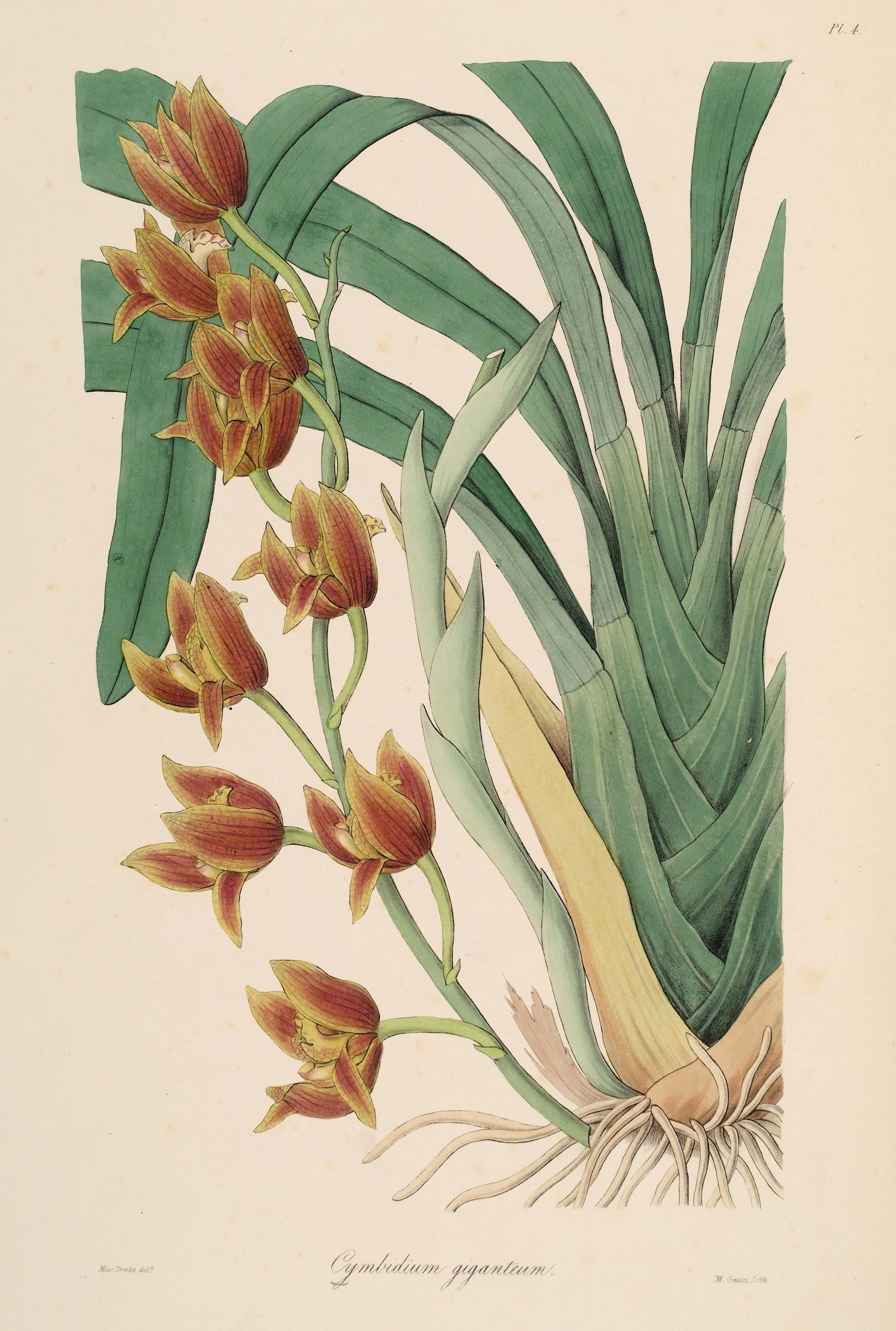
Cymbidium giganteum (1838)
That's an astonishing number of botanical drawings, especially given the precision each one required.
And orchids were becoming an obsession.
In 1837, the year eighteen-year-old Queen Victoria inherited the throne, Lindley's lavish publication Sertum Orchidaceum began appearing in parts. Its title meant A Wreath of the Most Beautiful Orchidaceous Flowers, and Sarah provided many of the original drawings from which its spectacular coloured lithographs were produced.
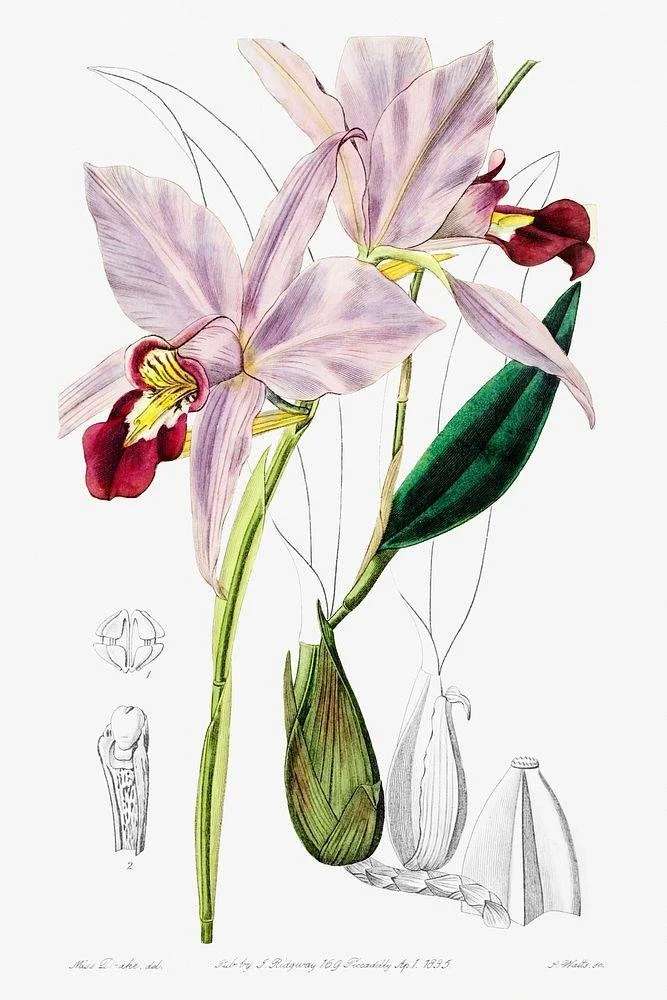
Cattleya perrini (1838)
The large illustrations presented orchids as both scientific specimens and works of art. Their unusual forms filled the pages, with carefully rendered petals, leaves, and roots.
Sarah's name appeared on many of her published works as Miss Drake, sometimes accompanied by the Latin abbreviation del., meaning she drew the original illustration.
But another artist helped turn some of these drawings into finished prints. Lithographer Maxim Gauci transferred Sarah's designs into the lithographic medium, allowing the images to be reproduced and coloured for publication.
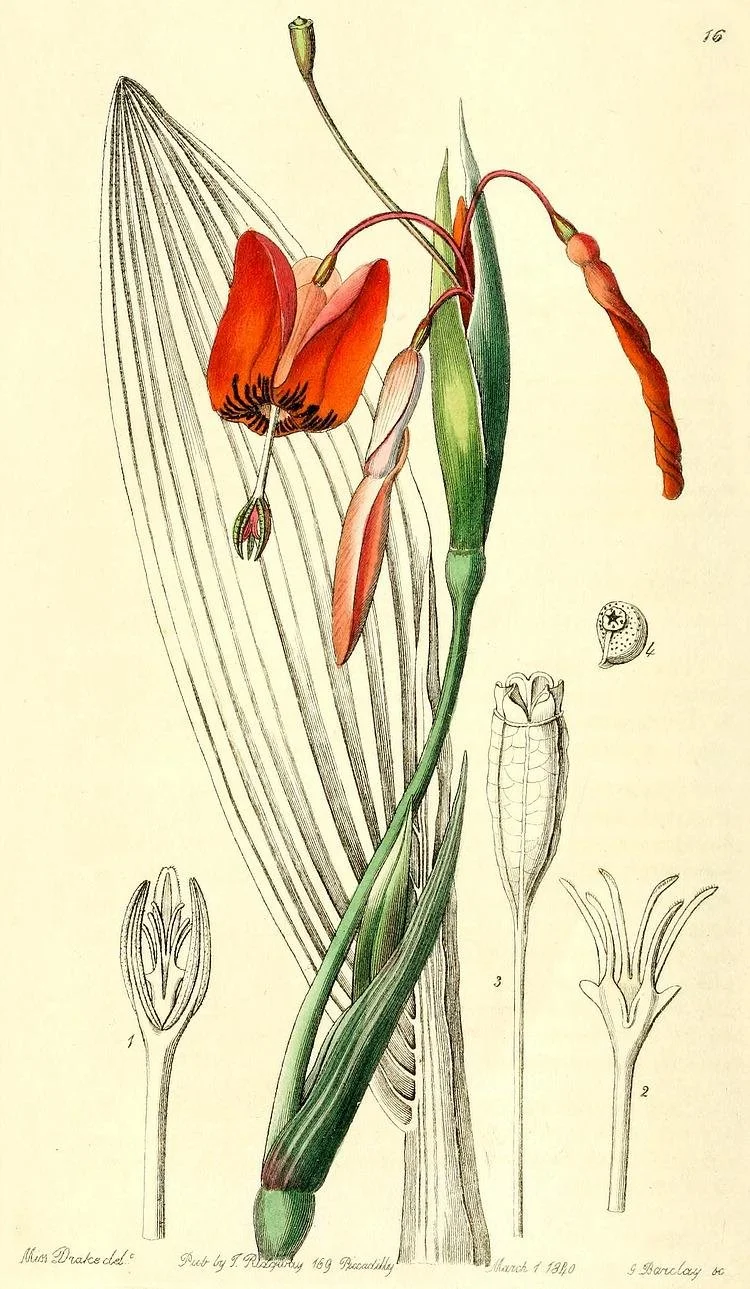
Rigidella flammea (1840)
The distinction matters. Sarah created the botanical drawings, while additional specialists produced the finished printed plates.
By then, her talent was attracting attention beyond Lindley's publications.
James Bateman, a wealthy orchid enthusiast, commissioned an enormous illustrated work, The Orchidaceae of Mexico and Guatemala, published between 1837 and 1843.
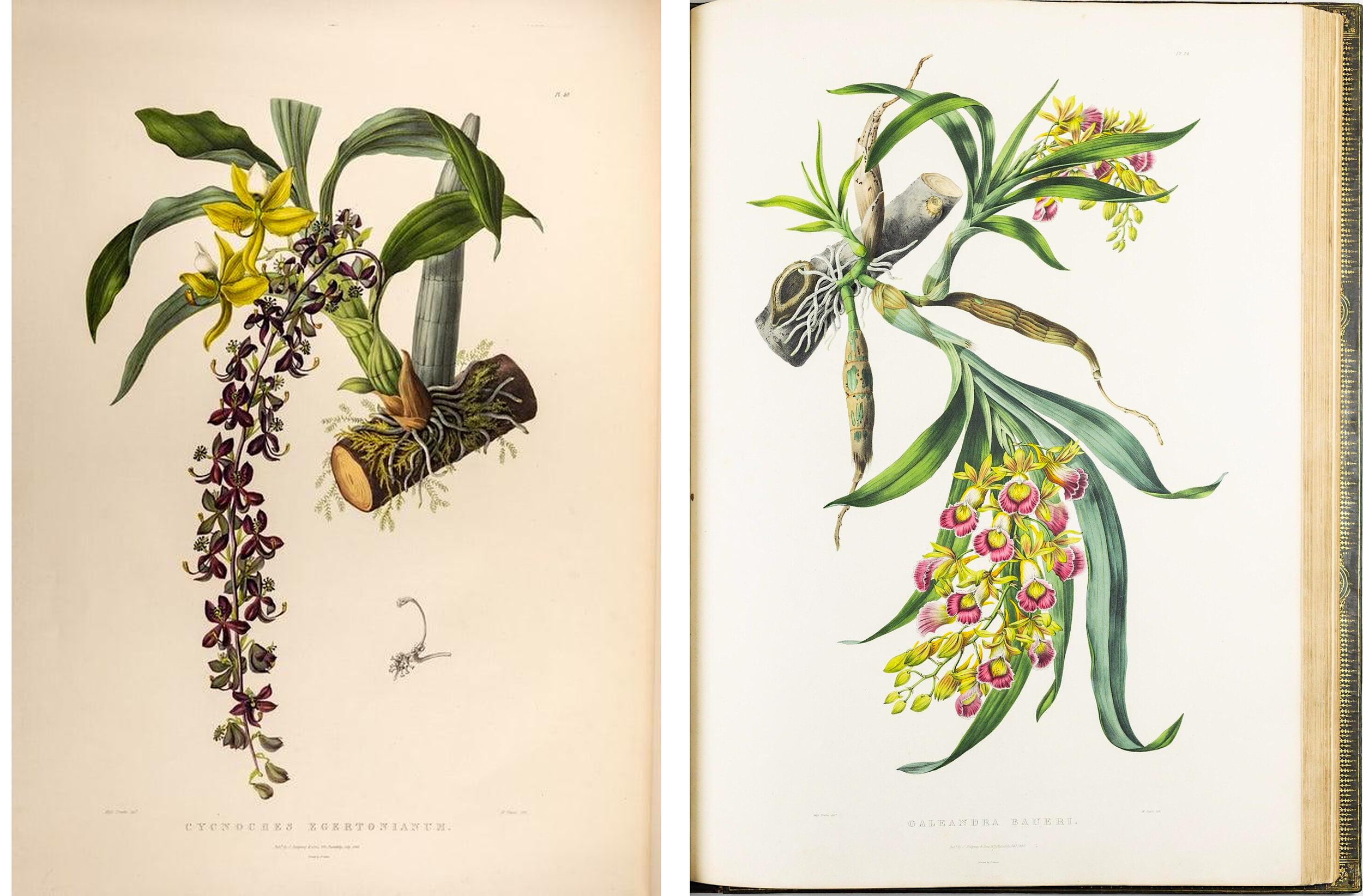
Cycnoches egertonianum (1842), left, and Galeandra baueri (c. 1843), right. The Orchidaceae of Mexico and Guatemala (1837–1843). Courtesy of the Biodiversity Heritage Library / Missouri Botanical Garden Library.
Sarah contributed sixteen of its forty botanical drawings, working alongside another accomplished English floral artist, Augusta Innes Withers, who held the title of Flower Painter in Ordinary to Queen Adelaide.
Two women artists contributed to one of the nineteenth century's most extravagant orchid publications!
Bateman's book was enormous, expensive to produce, and intended for an audience wealthy enough to appreciate such a luxurious botanical publication. Its illustrations helped transform rare orchids into objects of scientific interest and fashionable desire.
For Sarah, the commission showed that others recognized her abilities beyond the Lindley household.
And in 1840, John Lindley honored her in a particularly lasting way.
He named a newly described Australian orchid genus Drakaea after her. These unusual flowers, now commonly called hammer orchids, had been collected in Western Australia, thousands of miles from the English household where Sarah worked. Her name had become part of botanical classification.
(I still haven't found proof that Sarah Anne Drake illustrated an actual — Drakaea orchid.)
Meanwhile, Britain was changing around her. Queen Victoria had married Prince Albert in 1840, railways were connecting towns and cities, and the expanding printing industry was bringing illustrated publications to a growing readership.
Botanical art remained a specialized occupation, but women like Sarah helped shape what readers could see and understand about plants from across the world.
By the time the national census was taken on 6 June 1841, Sarah was still living in the Lindley household at Acton Green.
And the census recorded something wonderful.
Her occupation was listed as Artist.
There it was, written into an official record, while she was producing some of the most beautiful botanical illustrations of her generation.
As for financial arrangements behind Sarah's work, the surviving biographical accounts do not yet give us a satisfactory answer.
Sarah Anne Drake had become a professional artist.
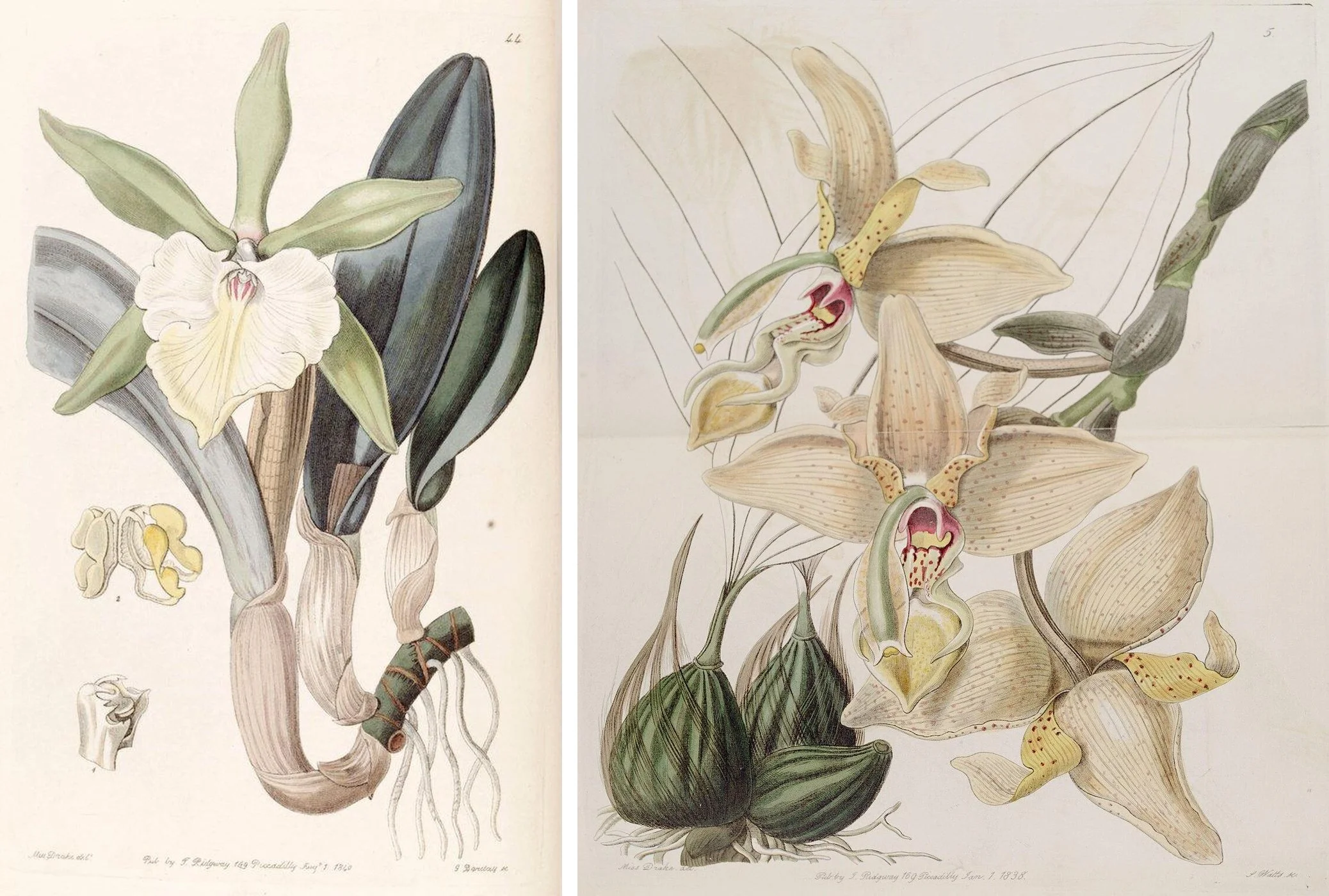
Cattleya orchid (1840), left, and Stanhopea × quadricornis (1838), right. Edwards’s Botanical Register, edited by John Lindley. Courtesy of the Biodiversity Heritage Library.
You might have thought she still had several productive years ahead of her.
In 1847, Edwards’s Botanical Register ceased publication, ending one of the most important chapters of Sarah’s artistic career.
For approximately fifteen years, her illustrations had appeared regularly in its pages. She had drawn everything from delicate garden flowers to extraordinary orchids arriving in Britain from distant parts of the world.
Now, at forty-four, her circumstances were changing. She was a spinster. Sarah spent much of her unmarried adult life working as a professional botanical artist, rather than following the more conventional path of early marriage and motherhood.
The closure of the Botanical Register meant losing a major outlet for her work, although we cannot say with certainty that it was why she left the Lindley household.
Sarah Lindley-Crease, John Lindley's young daughter, studied botanical illustration under Sarah Anne Drake and later remembered her with considerable admiration, describing her as an exceptionally talented botanical draughts-woman.
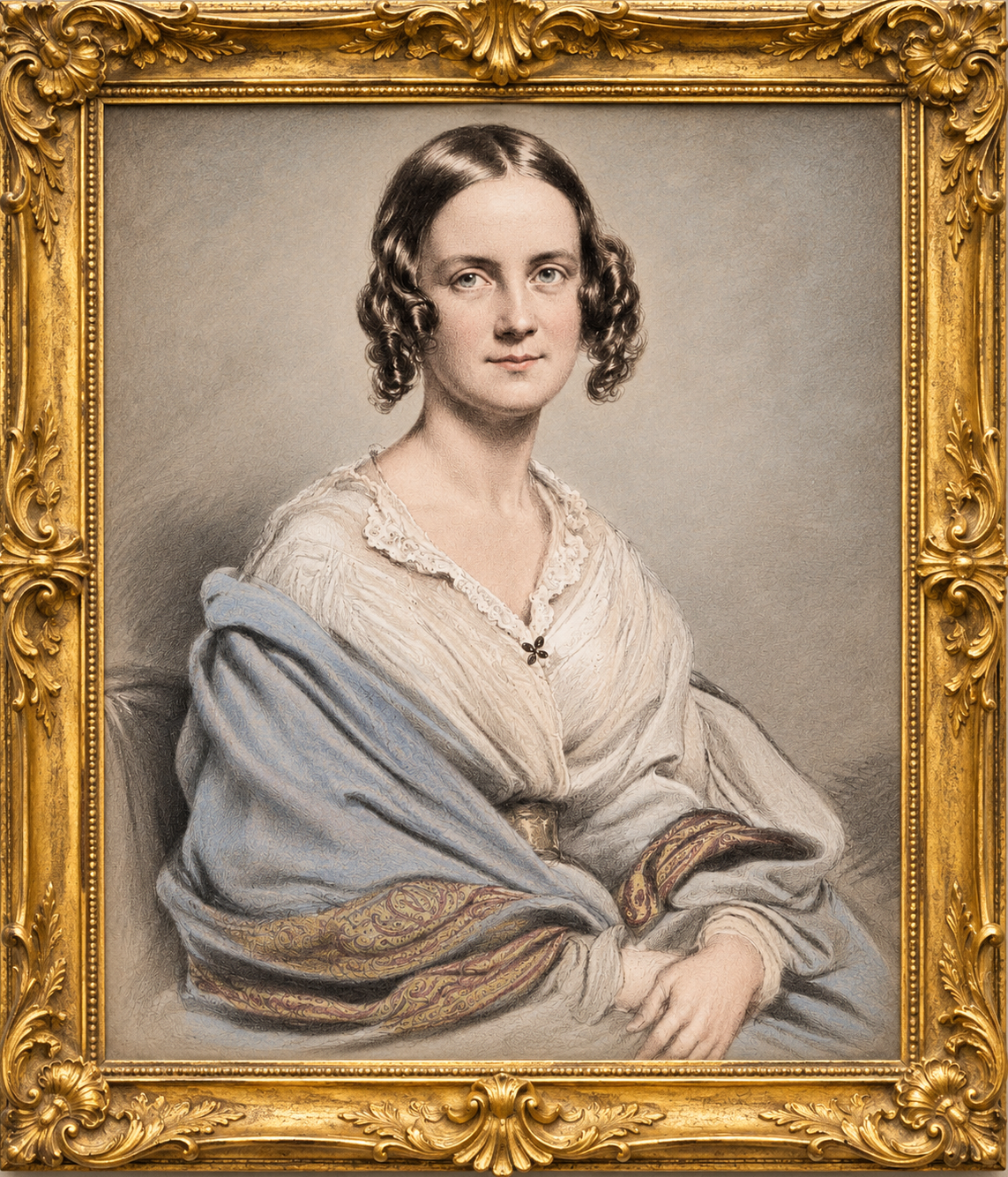
A colorized version of an original sketch of Sarah Anne Drake (c. 1835)
By 1851, Sarah had returned to Norfolk.
The census placed her in Fritton, living with her uncle, Daniel Drake. Interestingly, her occupation was no longer recorded as Artist.
Instead, it described her as a farmer’s daughter.
What a difference ten years had made.
In 1841, Sarah had been a working artist in a household connected to some of Britain's most influential botanical publications. By 1851, the official record identified her through her family and agricultural background.
Had she stopped drawing altogether? We don't know.
There is no reason to assume she lost her artistic abilities or interest in plants. But without surviving correspondence, sketchbooks, or financial records from these later years, we cannot reconstruct her private life.
Meanwhile, Britain itself had changed considerably.
The Great Exhibition opened in London's Hyde Park in 1851, celebrating British manufacturing, technology, design, and products gathered from across the world. Botanical collecting and horticulture were part of this expanding Victorian culture of scientific curiosity and imperial commerce.
Sarah spent much of her professional life illustrating plants from this increasingly international world.
Yet she was no longer at its center of publishing.
On November 23, 1852, Sarah married John Sutton Hastings, a widowed Norfolk farmer associated with Longham Hall. She was forty-nine years old.
John was born in 1790 and was approximately thirteen years older than Sarah. He reportedly had six children with his first wife.
The transcribed 1851 census identifies him as a widower living at Longham Hall. His household included two servants and his nephew, John Henry Hastings, who was described as a house servant and assistant.
A 750-acre agricultural operation was substantial by Norfolk standards. John managed a sizeable workforce, and his livelihood extended well beyond a modest family farm.
The marriage brought a name change. The woman whose illustrations had appeared under Miss Drake was now Sarah Anne Hastings. Unknown.
Unfortunately, the surviving accounts tell us little about their marriage or the household she joined. We do not know whether Sarah continued to paint, maintained her friendships with the Lindley family, or kept copies of her published illustrations.
Her final years remain remarkably quiet in the historical record.
On July 9, 1857, Sarah died at Longham Hall, Norfolk, just fifteen days before her fifty-fourth birthday.
Longham Hall is a historic farmhouse in the village of Longham, Norfolk, England, and remarkably, the building still stands!
Norfolk's official Historic Environment Record identifies Longham Hall as a substantial brick farmhouse built around 1840, with two stories, sash windows, a three-bay frontage, and a columned entrance porch. That means the building dates from Sarah's own lifetime, rather than being a later replacement.
Longham is a small Norfolk village northwest of Dereham, with a history stretching back to the Domesday Book of 1086.
It is located in Longham, near East Dereham, Norfolk, NR19, England. Coordinates: 52.7096° N, 0.8591° E
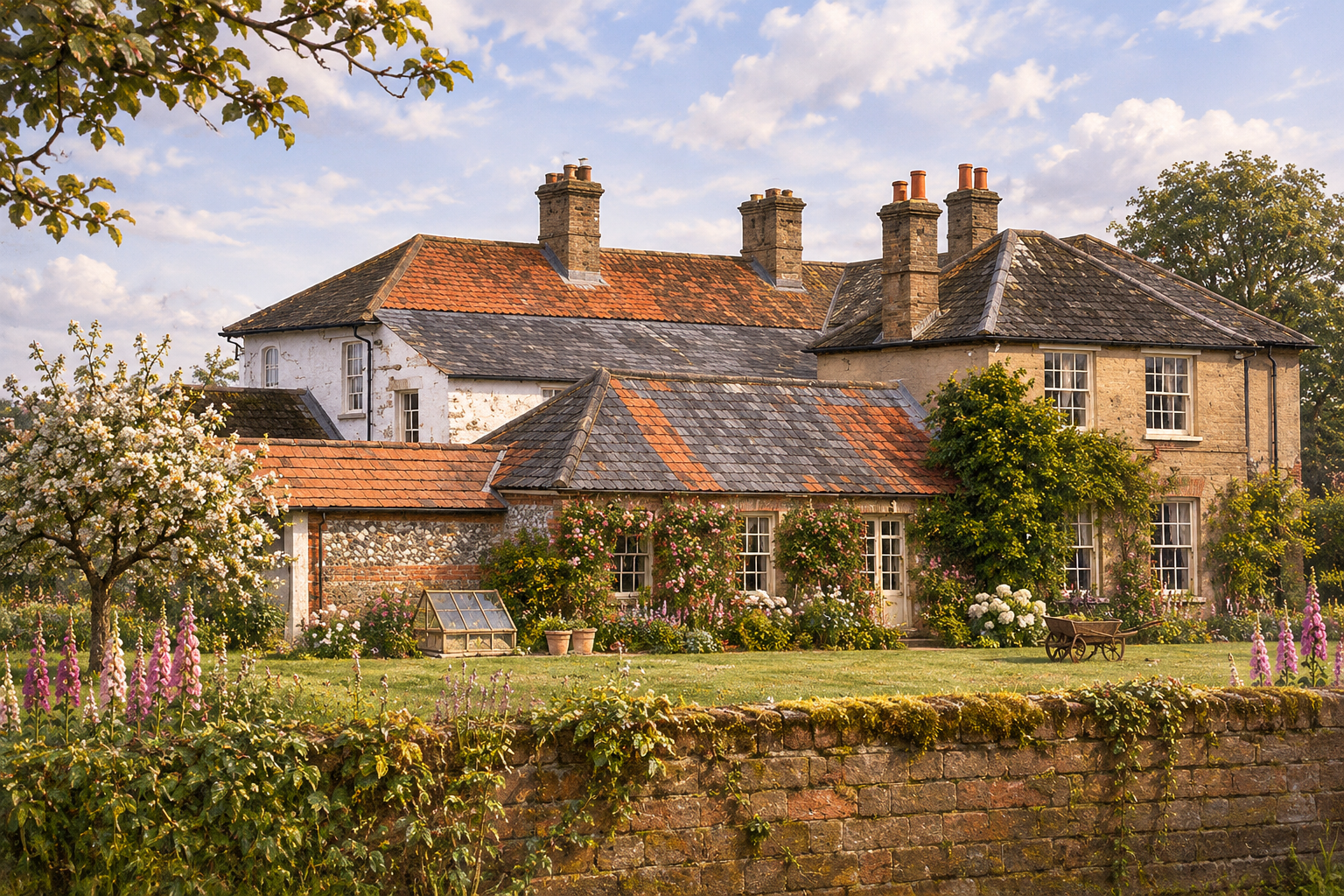
Longham Hall - 52.7096° N, 0.8591° E
Longham Hall is particularly relevant because she lived there after marrying John Hastings. Sadly, they were married for only four years and eight months. And interestingly, he remained close to the Lindley family.
(In a strange twist, a year later, in 1858, John married Sarah's reported childhood friend—Anne Lindley, the sister of botanist John Lindley. He was even at their wedding. Is all that wierd or a good thing? They were already in their 50s.)
A ‘diabetes’ diagnosis is listed on Sarah Anne Drake's reported death certificate.
In 1857, British doctors could recognize diabetes, although they had no insulin treatment.
She was buried at Longham, where her association with the parish remains part of her history. The Australian orchid genus Drakaea was named in her honor. These extraordinary plants, commonly known as hammer orchids, would continue to carry her name through generations of botanical research.
It is rather wonderful to think that a woman born in a small Norfolk parish, whose professional life was recorded so simply as Artist in the 1841 census, would leave her name attached to an entire genus of orchids.
Sarah Anne Drake never became a household name like some of the botanists whose books she illustrated.
Yet her work helped make serious botanical publications possible.
In the year 2000, admirers of Sarah's botanical work erected a memorial inside the Longham parish church recognizing her contribution to John Lindley's publications and the orchid genus Drakaea named in her honor.
Nearly two centuries later, we are still admiring her work.
For Your ReferenceOxford Dictionary of National Biography — Sarah Anne DrakeLinda Hall Library — Sarah Anne DrakeLinda Hall Library — Scientist of the Day (2020)Australian National Botanic Gardens — Sarah Ann DrakeRoyal Botanic Gardens, Kew — Miss Drake (2017)Linnean Society — Before Fellowship (2022)Biodiversity Heritage Library — Women Botanical Artists (2019)Wallich — Plantae Asiaticae Rariores (1830–1832)Lindley — Edwards's Botanical Register (1831–1847)Bateman — The Orchidaceae of Mexico and Guatemala (1837–1843)Hopper & Brown — Australia's Hammer Orchids (2007)Beal Family History — Sarah Anne DrakeBeal Family History — John Sutton HastingsHistoric England — Longham HallResearched & Written by author Krysta Abesamis