Scotland’s sheep
A bustling economic enterprise
The cold wind sweeping down from the Devil’s Beef Tub in the distance whipped through the stone courtyards of an estate that was the hard-won pride of the Carruthers family. By the turn of the eighteenth century, Breconside was a bustling economic sheep enterprise held together by a powerful alliance of regional bloodlines, spearheaded by William Carruthers (1671-1720) and his wife, Margaret Chalmers (1676-1749).
Researchers believe William was a direct descendant of the legendary Carruthers chiefs—his father John, the 9th Lord of Holmains and mother Lady Helen Grierson. The title to Breconside itself came through a fierce matriarchal line, the estate had originally belonged to Margaret’s mother, Janet Johnstone, a daughter of one of the most powerful and notoriously fiercely loyal riding clans of the western marches. When Janet passed the lands down early to newlywed daughter Margaret, it solidified a vital economic anchor for this branch of the Carruthers line.
For William and Margaret, managing Breconside was a ceaseless test of endurance. In a region where a family's status was measured in acres and hooves, they built a busy, self-sustaining agricultural household. Together, they oversaw an army of farm servants, working sheepdogs, and horses, managing everything from the kitchen gardens and smokehouses to the vast pasturelands partitioned by dry-stone walls.
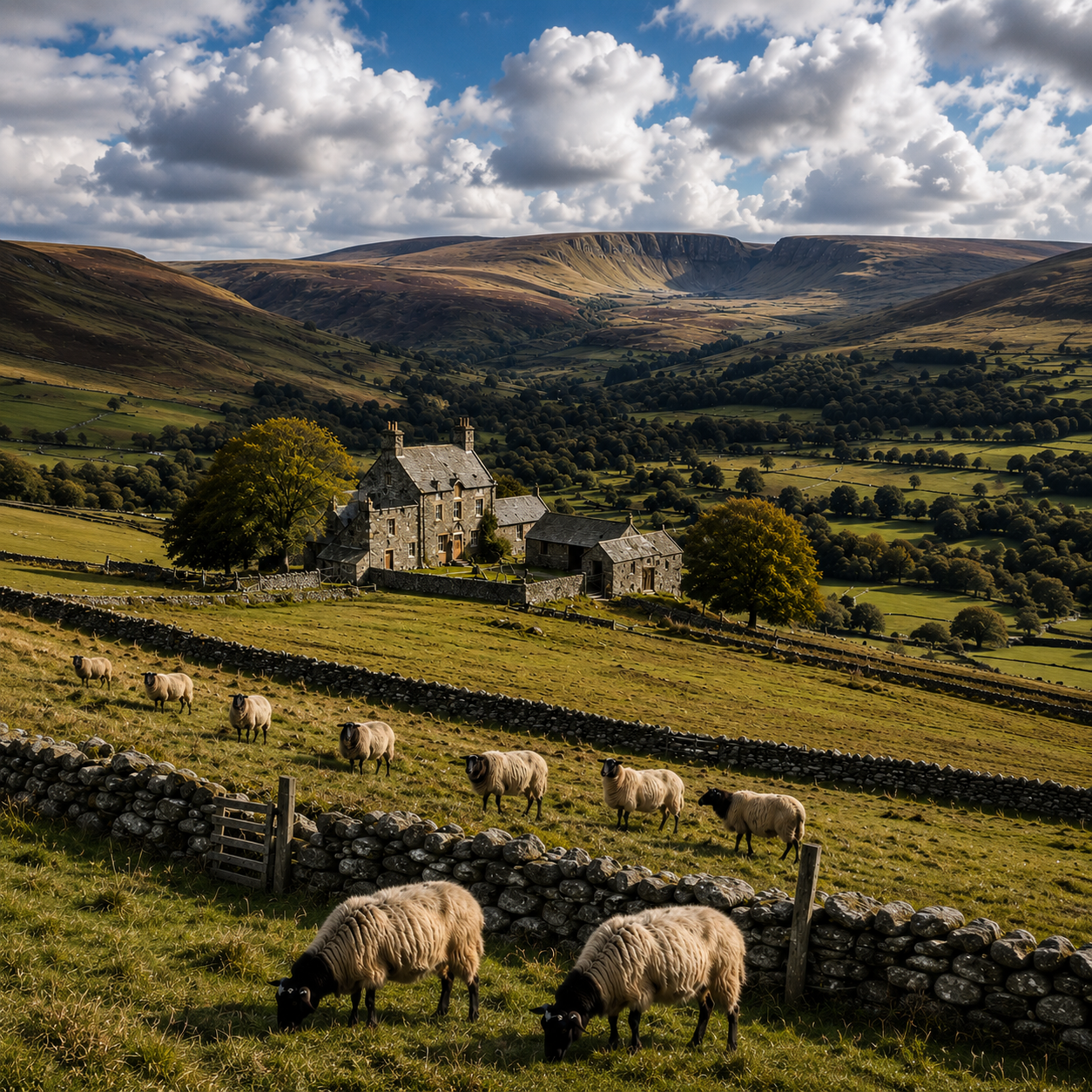
Their partnership was forged in fire. During the catastrophic "Seven Ill Years" of the late 1690s, when repeated crop failures and bitter glacial winters pushed rural Scotland to the brink of starvation, it was William’s management of the hardy Cheviot and Border sheep and Margaret’s shrewd administration of the estate's resources that ensured the family’s survival.
Through the legacy of Janet Johnstone’s land, William and Margaret did not just maintain a roof over their children’s heads; they preserved a bastion of old Border nobility. They raised their family to be deeply conscious of their lineage, ensuring that even as the old frontier world began to fade into history, the Carruthers name remained etched into the very soil of Annandale.
The story of the sheep that roamed Breconside under the stewardship of William Carruthers and Margaret Chalmers is intimately tethered to the monastic history of Scotland. To fully understand the legendary stock that defined this Scotland manor home, we have to look back to the great spiritual and economic empires of the medieval Scottish Borders: the Cistercian Monks.
Where Did the Monks Get Them?
The short answer is that the monks didn't import a brand-new breed from afar; instead, they took the rugged, semi-wild landrace sheep already scraping a living on the British hills and systematically perfected them. When King David I introduced Continental monastic orders to the Scottish Borders in the 12th century—founding the massive abbeys of Melrose, Kelso, Jedburgh, and Dryburgh—he granted the monks vast tracts of wild, upland territory. The Cistercian monks, in particular, were the premier agriculturalists of medieval Europe. They realized that the damp, windswept hills of Dumfriesshire and Roxburghshire were unsuitable for traditional crop farming, but absolutely perfect for sheep.
The monks took the small, local hill sheep—likely descendants of stock managed since Roman times, mixed with hardy Scandinavian breeds brought over by Viking settlers—and applied rigorous, large-scale selective breeding. They selected for two traits: absolute resilience to wet weather and fineness of wool. Over four centuries of careful isolation on abbey granges, these semi-wild hill sheep transformed into the distinct, legendary breeds that would eventually populate Breconside.
The Four-Legged Masters of the Border Hills
Before the riding clans built their fortified tower houses or rode out on midnight raids across the western marches, the ancient Cheviot sheep had already claimed these hills. They were a legendary, near-mythic stock, native to the rugged borderlands for over four centuries.
The old monks had mapped the mountains by their grazing paths, turning the trackless wilderness into a highly organized wool production network. They carefully collected, graded, and packed the fleeces, trading this prized, water-resistant wool to wealthy merchants across Flanders, Italy, and France, effectively bankrolling the Scottish crown.
The Cheviots themselves were small, alert, and fiercely independent creatures with clean, white faces. To survive the elements, they developed an uncanny, inherited instinct called hefting (or "bonding"). Because the vast upland estates were entirely unfenced, survival depended on the sheep knowing their place. A lamb learned the precise, invisible boundaries of its mountain territory directly from its mother. This deeply ingrained geographical memory ensured that the flock never strayed into a rival laird’s valley—and more importantly, they knew exactly which hollows offered shelter from the deadly, trackless whiteouts of a winter blizzard.
Further down the slopes, where the hills smoothed out into the richer valleys and rushing burns of the Breconside estate, lived the native Border sheep. Stouter and heavier than their mountain-climbing cousins, they were less suited for scaling the dizzying crags near the Devil’s Beef Tub, but they were perfectly adapted to the lush valley pastures. While the Cheviots provided the highly lucrative export wool, these native Border valley sheep were the true engine of daily life at Breconside. They provided the household with nutrient-rich milk, tallow for candles, hides for insulation, and meat that sustained William and Margaret’s large family and farm servants through the devastating famine years of the 1690s.
Written about in the new book ‘The Carruthers Men’, when the Atlantic migration swept the family away from Annandale in the 18th century, they left behind a landscape completely engineered by the monks and the resilient, white-faced flocks that still rule the Border hills to this day.