Women Floral Artists Under the Scope
Kind of chic to be Elizabeth Blackwell, or was it?
Oh, Elizabeth’s story is considerably less chic than her beautiful botanical illustrations suggest! Elizabeth was a talented Englishwoman who married a man whose disastrous decisions repeatedly turned her life upside down.
Born Elizabeth Simpson in London on 23 April 1699, she was the daughter of decorative painter Leonard Simpson and his wife, Alice. Her father’s career as an artist gives us a clearer picture of where her artistic interests may have begun. As a young girl, I imagine Elizabeth loved drawing and painting plants, an interest she would carry into adulthood, although the extent of her formal training remains unclear.
Then she married
Alexander Blackwell was her second cousin, and historical accounts describe their marriage as clandestine. He came from an educated family and had considerable intellectual ability, but his professional ventures were troublesome. It is written that questions about his medical qualifications contributed to the couple’s move to London. doh!
There, he established a printing business without the apprenticeship the trade required. He faced legal action, the business collapsed, and by 1734 he was imprisoned for debt.
Sounds like a beautiful loser…
When Alexander was imprisoned for debt, a historical account says Elizabeth's friends encouraged her to earn money by drawing. She was talented with ink, copperplate engravings, and hand-applied color.
Apparently, selling drawings to her friends alone wouldn't solve her financial problems…
The Linnean Society explicitly states that Elizabeth was left with their first child when Alexander went to debtors' prison. The Biodiversity Heritage Library also describes her as supporting a child while working on A Curious Herbal.
The Royal College of Physicians of Edinburgh says Alexander served approximately two years in prison, beginning in 1734.
She was a single mom with a broke husband in jail
While Alexander was in jail, I traced Elizabeth to Chelsea, a village on London’s western edge.
A historical lease places Elizabeth at 4 Swan Walk, Chelsea, between 1736 and 1739.
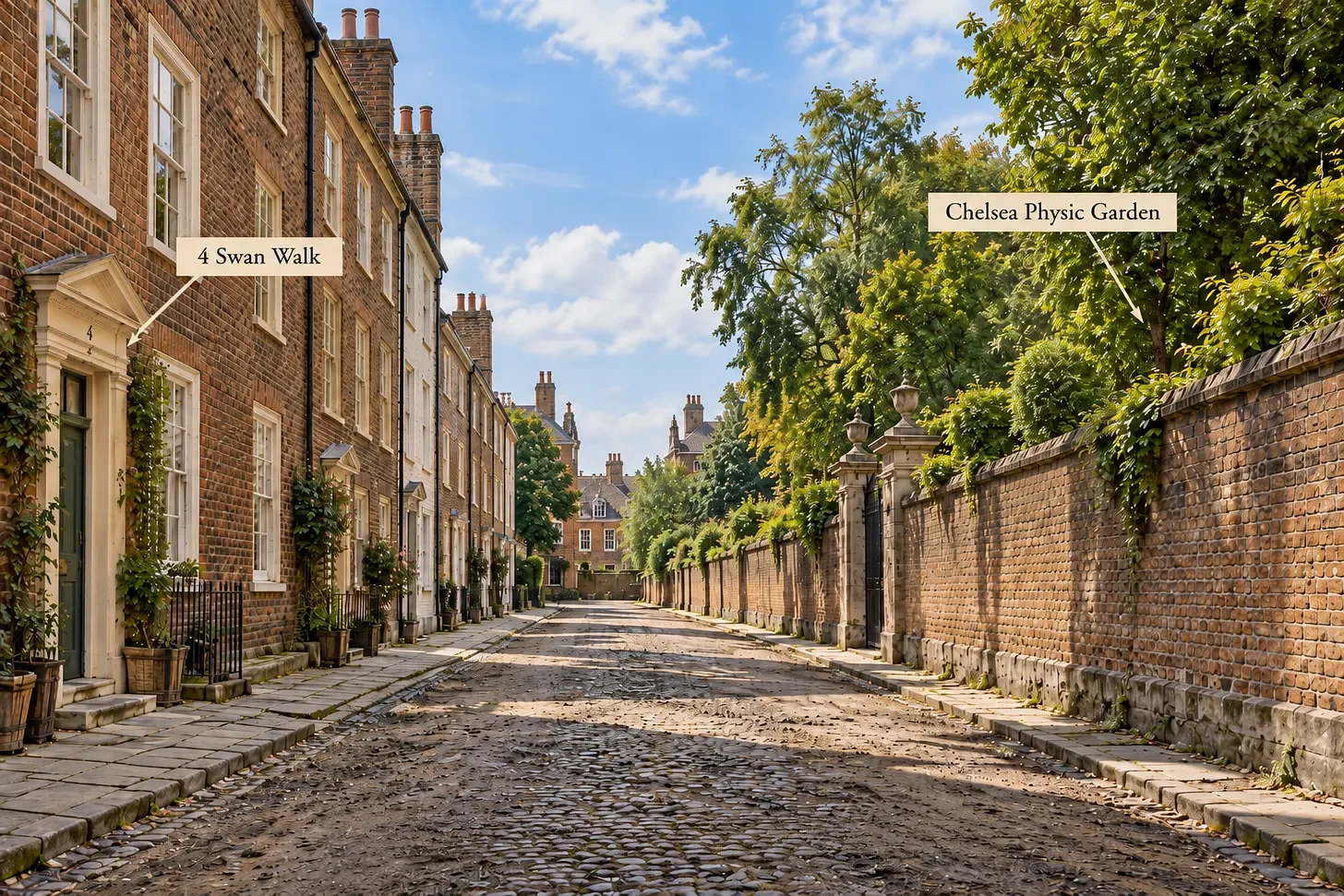
The best location ever!
Because the Chelsea Physic Garden was over the neighboring wall. The very years Elizabeth was preparing and publishing. Her early eighteenth-century house was on one side of the street and the Physic Garden wall on the other.
As an artist, I must shout — ‘OH, how lovely that must have been!’
She lived in a giant art studio day & night.
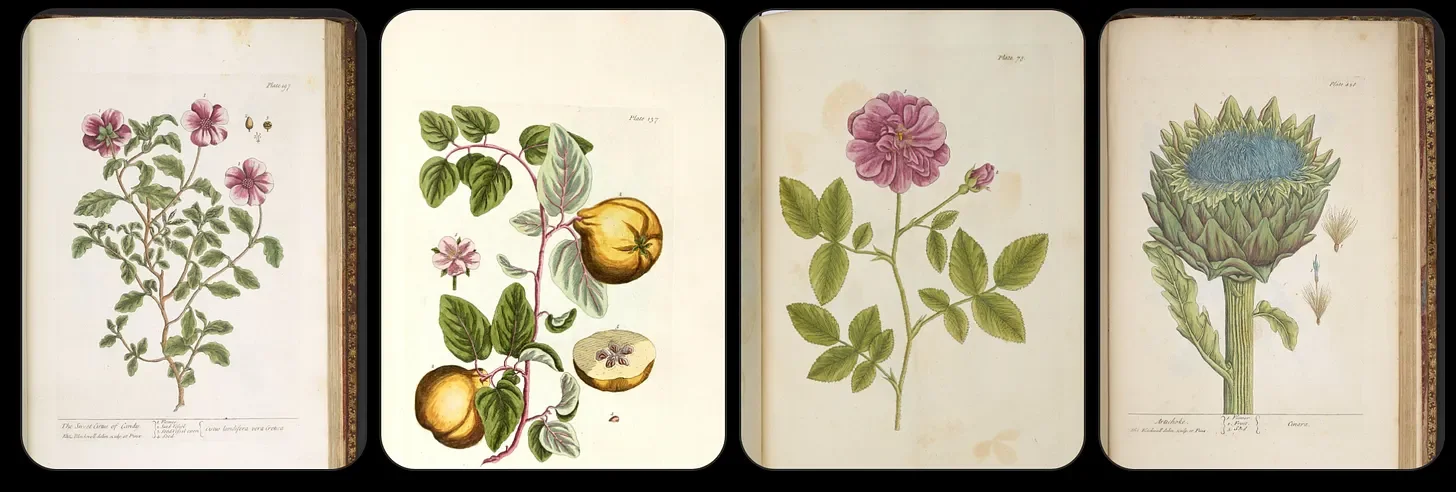
Botanical illustrations, left to right: Mallow (Malva sp.); Quince (Cydonia oblonga); Pink Rose (Rosa sp.); and Artichoke (Cynara cardunculus).
She studied living plants at the Chelsea Physic Garden under the guidance of its botanical experts. She worked with living specimens, examining their shapes and botanical features to illustrate them accurately. And Isaac Rand, who supervised the garden, provided botanical instruction.
In 1735, she showed Sloane and Dr. Richard Mead some preliminary drawings before undertaking the full publication. They were impressed and encouraged her to continue.
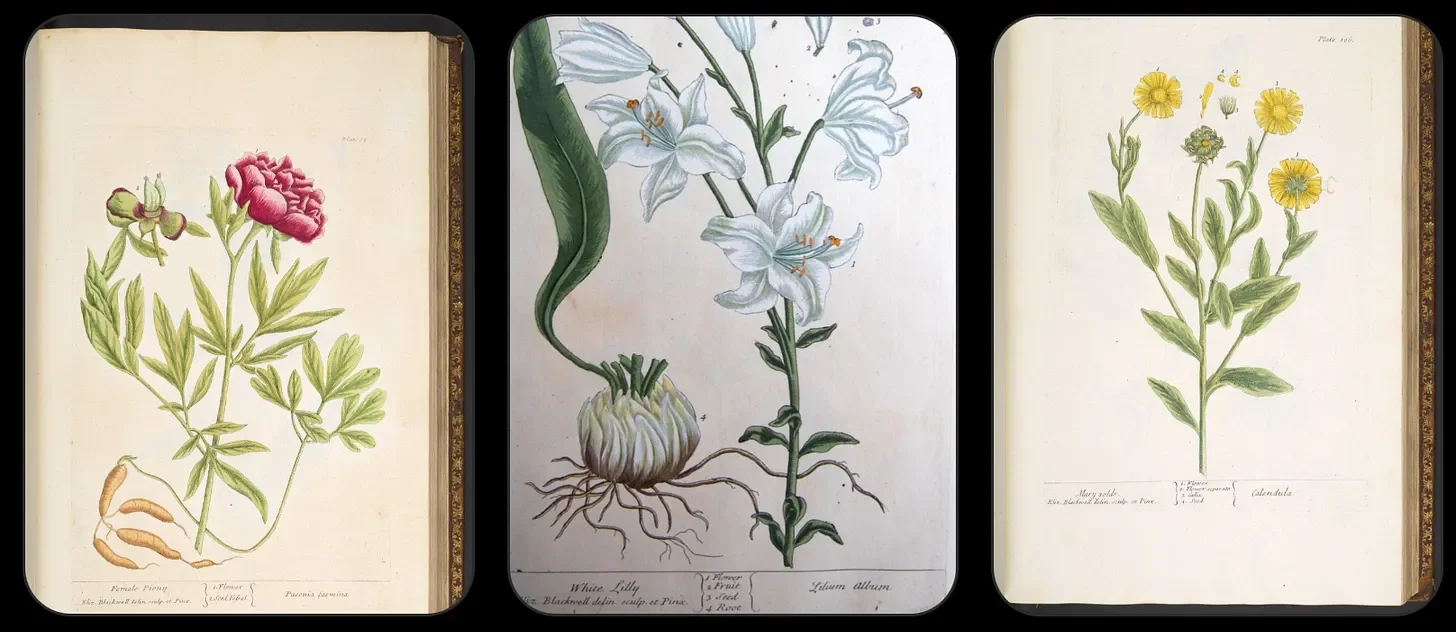
Botanical illustrations, left to right: Female Peony (Paeonia feminea); White Lily (Lilium album); and Marigold (Calendula).
The Royal Horticultural Society's catalog specifically credits Sir Hans Sloane with instigating A Curious Herbal.
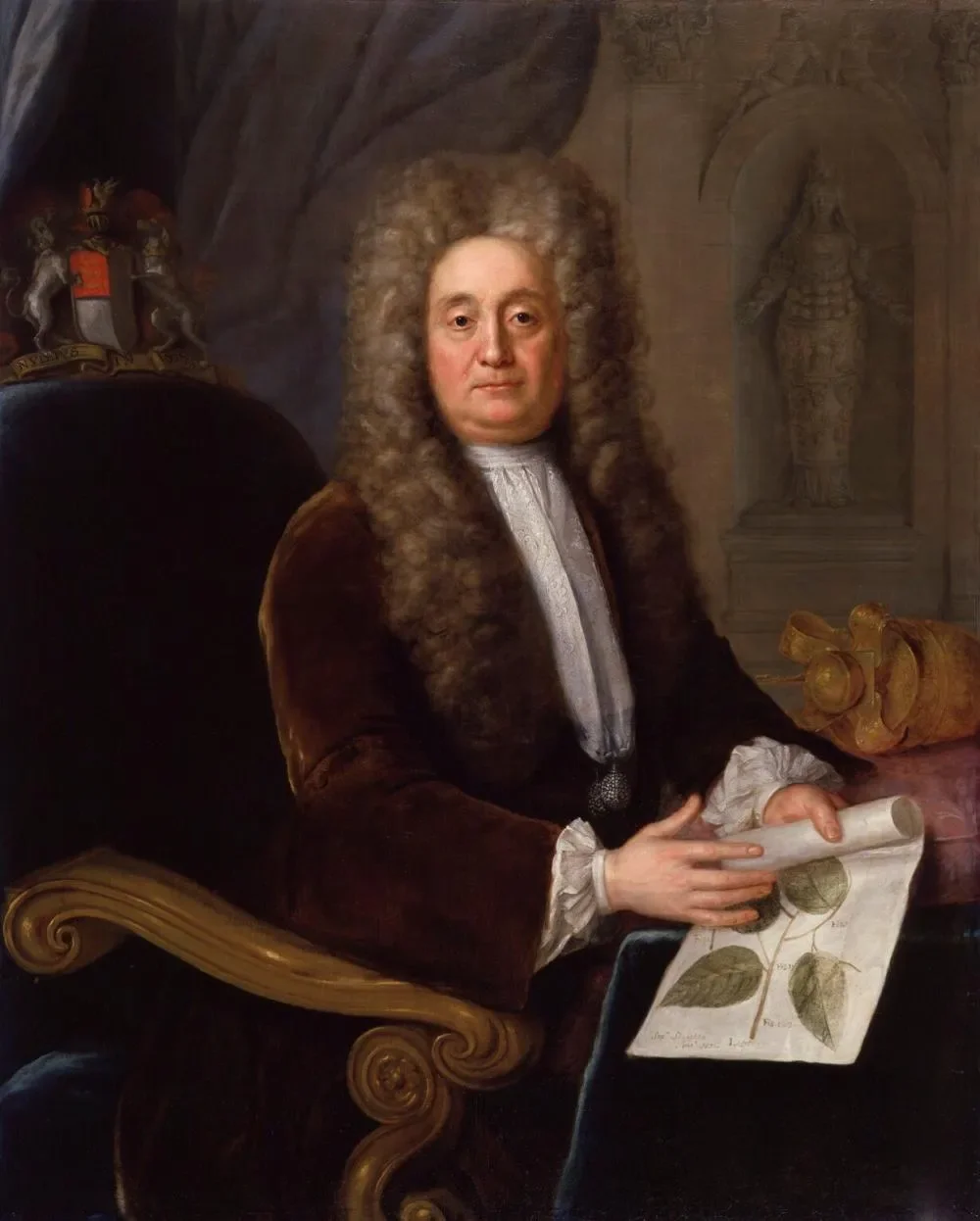
Elizabeth’s friend — Sir Hans Sloane by Charmaine Watkiss
Sir Hans Sloane helped turn Elizabeth’s drawings into something far more ambitious: an illustrated guide of 500 medicinal plants.
Rather than starve waiting for her husband to be released, she began producing an illustrated reference book of medicinal plants.
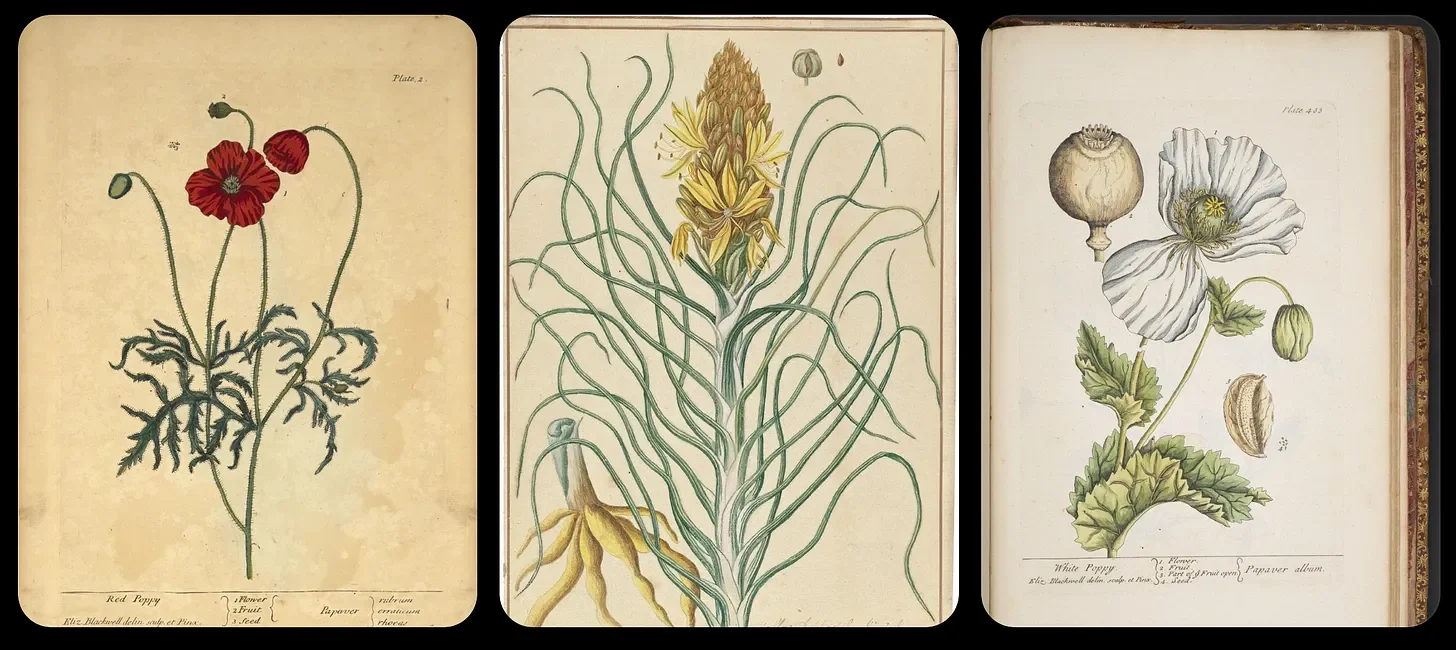
Botanical illustrations, left to right: Red Poppy (Papaver erraticum); Yellow Asphodel (Asphodelus sp.); and White Poppy (Papaver album)
I imagine her walking between Swan Walk and the garden, carrying sketches and studying plants most Londoners would never have recognized.
The address gives us a wonderfully specific setting for her work
She lived right where they cultivated and studied medicinal plants. Elizabeth could examine living specimens, learn from Isaac Rand, who oversaw the garden, and translate her observations into drawings for her book…
Five hundred plants later…
Elizabeth had a lot of work ahead of her. She drew the plants, engraved the copper plates and hand-coloured the illustrations herself. A Curious Herbal began appearing in weekly installments in 1737 and eventually filled two volumes. The illustrations included descriptions of the plants and their medicinal uses.
And it worked! The publication earned enough money to help secure Alexander’s release from prison.
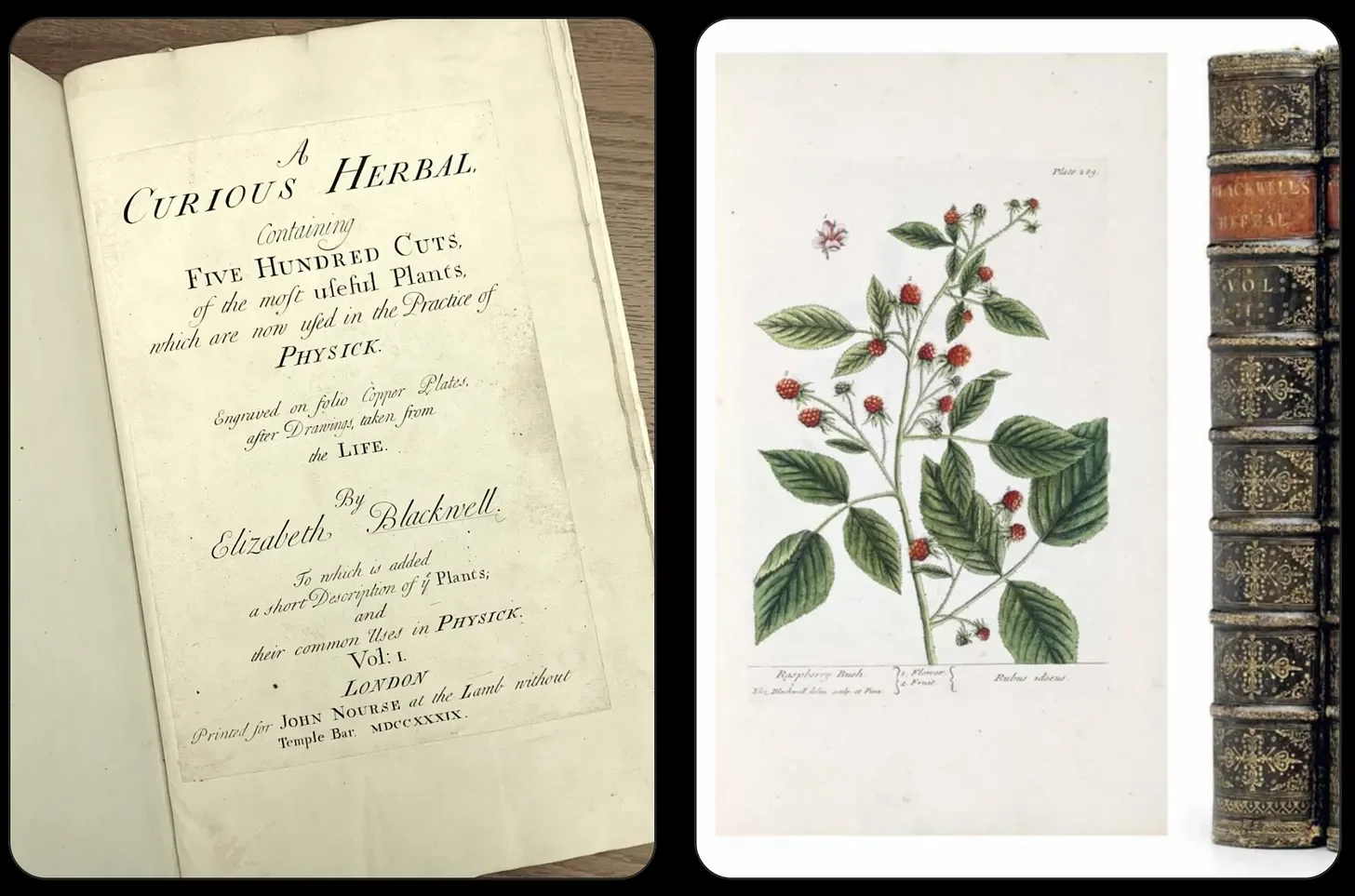
Things were good for a while; they had a family. Then Alexander traveled to Sweden on business, where he became involved in agricultural experiments and caught the royal court’s attention. For a while, his fortunes improved considerably. Then came another disastrous decision.
You'd think he’d learned his lesson. Apparently not.
He became entangled in political intrigue over the Swedish succession, was arrested, and was executed in Stockholm in 1747.
Good grief, Alexander!
According to the Royal College of Physicians of Edinburgh, Elizabeth was still in England, apparently preparing to join Alexander in Sweden; then he was executed on 29 July 1747.
The Linnean Society reports that Elizabeth never saw Alexander again after he left Britain, even though she continued supporting him financially. Ugh.
What began as a desperate attempt to support herself and rescue her husband became a respected botanical publication, admired by physicians, botanists and collectors.
Elizabeth had accomplished something quite extraordinary.
Sadly, there is little evidence of the eleven years between Alexander's execution in 1747 and Elizabeth's death in 1758. She never remarried, and some suggest she may have worked as a midwife, though that remains unconfirmed.
Her only known published work was A Curious Herbal.
She died in London and was buried at Chelsea Old Church, not far from the garden she documented & illustrated so lovingly.
And nearly three centuries later, we can still open her book and admire the flowers she studied just across the street from her little Chelsea home.
So, was it chic to be Elizabeth Simpson-Blackwell?
Well, perhaps not being married to Alexander.
But being Elizabeth herself?
Oh, absolutely.
For Your Reference;Documentary evidence that Elizabeth Blackwell was English, born in London, not Scotland. The source comes from Elizabeth's own writing and contemporary parish records.Bruce Madge, “Elizabeth Blackwell—the forgotten herbalist?” — biography, Chelsea residence Royal Horticultural Society, A Curious Herbal, Volume II — publication and Swan Walk history.Chelsea Old Church, Monuments — Elizabeth’s historical commemoration.Researched & Written by author Krysta Abesamis