Seven Ill Years
The Seven Ill Years: Famine, Fear, and Survival Along the Scottish Borders
In the final years of the seventeenth century, Scotland entered one of the darkest periods in its recorded history. Between roughly 1695 and 1702, a chain of failed harvests, brutal winters, famine, disease, and economic collapse devastated much of the kingdom. The period became remembered in Scottish memory as The Seven Ill Years — a name spoken with the weight of hunger and grief for generations afterward.
For families living in the southwest Border country — particularly in Dumfriesshire and the old Marches — the suffering carried a different texture than it did in the crowded burghs of Edinburgh or Aberdeen. Here, survival depended almost entirely on the land itself. Crops failed. Livestock weakened. Trade slowed. Entire communities found themselves trapped between old feudal obligations, political uncertainty, and the harsh realities of subsistence living.
For Border families such as the Carruthers of Holmains and their surrounding kin networks, the crisis arrived during a time when the region was already carrying centuries of instability behind it.
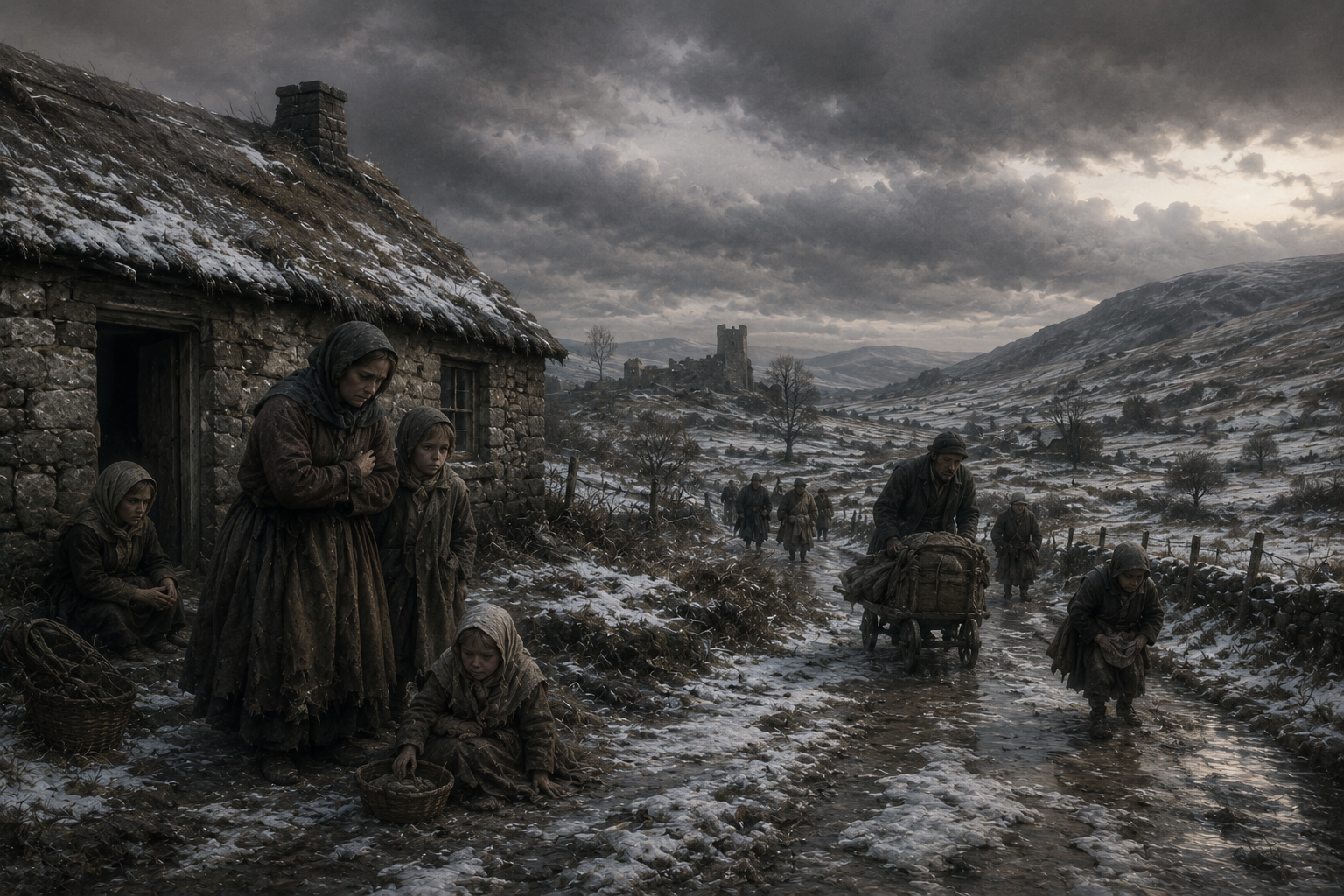
The 1690s brought catastrophic weather across northern Europe, part of what historians now associate with the coldest phase of the Little Ice Age. Summers became wet and short. Winters stretched long and bitter. Grain rotted in the fields before harvest. Frost returned early. Oats and bere barley — the backbone of survival in Scotland — repeatedly failed.
Across the country, famine spread quickly.
Modern estimates suggest that between five and fifteen percent of Scotland’s population may have died during these years from starvation, malnutrition, or disease associated with the famine. Entire parishes recorded rising burials. Desperate families wandered roads seeking food. Begging increased dramatically. Some communities survived only through church relief or local lairds distributing limited stores of grain.
In the Borders, where communities were often more isolated and dependent upon mixed farming, the effects could become deeply personal. A failed harvest did not merely mean inconvenience — it threatened the complete collapse of a household economy. The southwest Border region surrounding Dumfries had long been shaped by centuries of instability. Even though the great age of Border reiving had officially ended by the late 1600s, memories of violence, raids, clan feuds, and shifting loyalties still lingered throughout the countryside.
The old March families — including branches connected to the Carruthers, Johnstones, Maxwells, Irvings, Bells, and Grahams — remained deeply tied to the land and to Crown service traditions that stretched back generations.
Families like the Clan Carruthers Society line of Holmains were not simply isolated farmers. Many Border gentry families historically operated within systems tied to royal administration, military service, local governance, land management, or regional defense. Their fortunes rose and fell alongside the Crown itself.
But the Seven Ill Years cared little for lineage.
Even established households struggled to maintain tenants, preserve livestock, and stabilize rents. Tenants unable to pay could abandon holdings altogether. Grain shortages drove prices upward. Rural laborers faced starvation first, but the strain rippled upward into nearly every social layer of Scottish life.
The Borders also sat dangerously exposed to economic disruption. Cattle movement, regional trade, and local markets slowed under famine pressure. Small landholders became vulnerable to debt. Kinship networks — long essential to survival in the Marches — became lifelines once again. The crisis unfolded during a politically fragile moment for Scotland.
The kingdom had endured decades of religious conflict, civil war memory, Jacobite tensions, and economic strain following the Restoration period. The disastrous Darien Scheme — Scotland’s failed colonial attempt in Panama beginning in 1698 — would soon bankrupt many Scottish investors and deepen national instability even further.
For Border families loyal to Crown service or tied to old royal systems, uncertainty surrounded nearly every level of society.
Men connected to regional administration or hereditary responsibilities often found themselves balancing loyalty, survival, taxation pressures, and local unrest all at once. In rural communities, the Crown could feel both distant and immediate — distant in relief, immediate in taxation and obligation.
The irony was cruel: families who had spent generations serving the stability of the realm were now struggling simply to feed their households. To imagine daily life in Dumfriesshire during the famine years is to picture a countryside under constant strain. Smoke rising weakly from damp hearths. Frozen fields hardened beneath sleet. Thin cattle struggling through winter mud. Grain stores shrinking month by month. Parish relief stretched beyond capacity. Families grinding whatever could be made edible into coarse meal.
In small tower houses and rural farmsteads alike, anxiety would have settled into ordinary conversation:
Would the crop survive?
Would another winter come early?
Would enough seed remain for spring planting?
Could rents still be paid?
Would children survive the season?
The suffering was not always dramatic in the way battles are dramatic. Much of it unfolded quietly — through exhaustion, hunger, sickness, mounting debt, and the slow erosion of stability.
And yet families endured. The people of the western Marches had survived hardship before.
For centuries, the Borderlands had been shaped by warfare, raiding, political instability, harsh terrain, and shifting allegiances between Scotland and England. Survival itself had become part of the regional identity.
The Seven Ill Years tested that endurance once again.
Families adapted however they could: relying on kinship, redistributing labor, consolidating holdings, delaying marriages, seeking opportunities elsewhere, or eventually migrating outward in the decades that followed. For some Border descendants, the hardships of the late 1690s became one of many pressures that contributed to later Scots migration into Ulster and eventually onward to the American colonies.
The memory of hunger often traveled with them. Today, the Seven Ill Years remain strangely absent from much popular discussion of Scottish history, overshadowed by Jacobite rebellions, clan warfare, and romantic Highland imagery. Yet for ordinary Scottish families, the famine years may have shaped daily life more directly than any battle ever could.
In places like Dumfries and the Border Marches, the crisis left scars that echoed across generations.
For families such as the Carruthers line connected to the old Border world, these years were not abstract historical events — they were lived reality. The survival of estates, kin networks, and future generations depended upon enduring one failed season after another in a kingdom pushed dangerously close to collapse.